
AC vs DC Clamp Meter: Which Do You Need?
Choosing the right electrical testing tool can save time, improve safety, and prevent measurement errors. Many electricians and technicians compare an AC vs DC Clamp Meter when selecting equipment for troubleshooting, maintenance, and installation work. Both clamp meters look similar, but their measurement capabilities are different.
An AC clamp meter is mainly designed for measuring alternating current in residential, commercial, and industrial systems. A DC clamp meter is required when working with batteries, solar systems, electric vehicles, and DC-powered equipment.
Understanding the difference between these tools helps you choose the right meter for your application instead of paying for features you may not use.
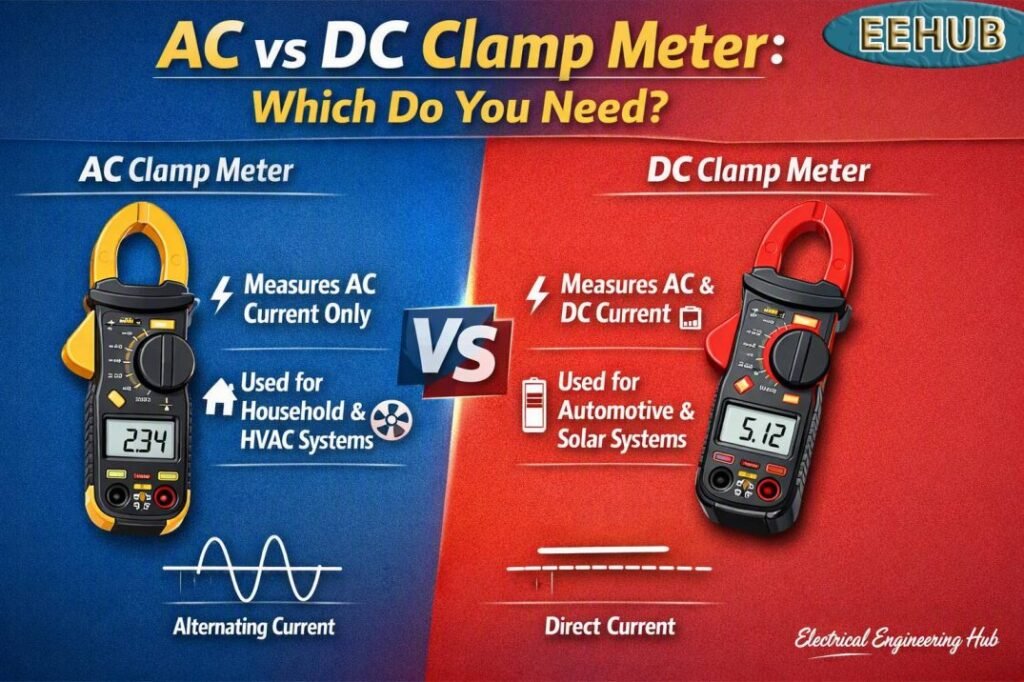
Table of Contents
Table of Contents
Quick Comparison: AC vs DC Clamp Meter
| Feature | AC Clamp Meter | DC Clamp Meter |
|---|---|---|
| Current Measurement | AC current only | AC and DC current |
| Best For | Home wiring, motors, panels | Solar, batteries, automotive, industrial DC |
| Measurement Technology | Current transformer | Hall Effect sensor |
| Accuracy on DC Loads | Not suitable | High accuracy |
| Typical Users | Electricians and maintenance technicians | Engineers, electricians, renewable energy professionals |
| Price Range | Lower cost | Usually higher cost |
| Recommended Model | Basic AC clamp meters | Fluke 325 clamp meter |
What Is an AC Clamp Meter?
An AC clamp meter is an electrical testing device used to measure alternating current without disconnecting the circuit. It uses a clamp jaw that surrounds a conductor and measures the magnetic field produced by current flow.
These meters are commonly used for:
- Checking motor current draw
- Measuring HVAC equipment loads
- Testing electrical panels
- Troubleshooting circuit overloads
- Performing preventive maintenance
For standard electrical systems where current flows as AC, an AC clamp meter provides a fast and convenient solution.
However, an AC-only meter cannot accurately measure direct current because DC does not create the changing magnetic field required by traditional current transformer technology.
What Is a DC Clamp Meter?
A DC clamp meter is designed to measure direct current in addition to AC current. It uses Hall Effect sensor technology to detect magnetic fields created by DC current flow.
DC clamp meters are widely used in applications such as:
- Solar photovoltaic systems
- Battery banks
- Electric vehicles
- UPS systems
- Control panels
- Industrial automation equipment
Modern electrical systems increasingly use DC power sources, making a DC-capable clamp meter a valuable investment for many professionals.
When comparing an AC vs DC Clamp Meter, the ability to measure DC current is often the biggest factor that separates basic models from professional testing tools.
AC vs DC Clamp Meter: Key Differences Explained
The main difference between these meters is how they measure current and where they are used.
Current Measurement Capability
An AC clamp meter measures only alternating current. It works well for electrical distribution systems where current changes direction continuously.
A DC clamp meter can measure both alternating and direct current. This makes it more versatile for modern applications.
For example, an electrician working only on household circuits may need an AC meter, while a technician servicing solar batteries will require DC measurement capability.
Sensor Technology
AC clamp meters normally use current transformer technology. This method is reliable and accurate for AC signals.
DC clamp meters require Hall Effect sensors because DC current creates a steady magnetic field. These sensors allow the meter to detect current direction and magnitude.
This technology difference affects the price and accuracy of the instrument.
Application Areas
| Application | Required Meter |
|---|---|
| Residential electrical wiring | AC Clamp Meter |
| Industrial motors | AC Clamp Meter |
| Solar PV troubleshooting | DC Clamp Meter |
| Battery testing | DC Clamp Meter |
| EV charging systems | DC Clamp Meter |
| Variable frequency drives | AC/DC Clamp Meter |
Which Clamp Meter Should Electricians Buy?
For electricians who mainly work on buildings, distribution boards, lighting circuits, and HVAC systems, an AC clamp meter may be enough.
However, many professionals now handle equipment that includes DC components. Solar installations, battery storage systems, and EV chargers are becoming common in electrical work.
A versatile AC/DC clamp meter provides more flexibility and reduces the need to carry multiple testing tools.
If you work across residential, commercial, and industrial environments, investing in a professional AC/DC clamp meter is usually the better long-term choice.
You can also explore our detailed guide on best clamp meter for electricians to compare professional models suitable for field troubleshooting and electrical maintenance.
Fluke 325 Clamp Meter: Recommended Professional Choice
The Fluke 325 Clamp Meter is a popular choice among electricians, technicians, and engineers who need reliable AC and DC current measurements.
It is designed for demanding electrical environments and offers the accuracy expected from the Fluke brand.
Fluke 325 Key Features
| Feature | Specification |
|---|---|
| AC Current Measurement | Up to 400 A |
| DC Current Measurement | Up to 400 A |
| Voltage Measurement | AC/DC voltage |
| Temperature Measurement | Yes |
| Resistance Measurement | Yes |
| Frequency Measurement | Yes |
| Display | Digital backlit display |
The Fluke 325 combines essential troubleshooting functions in one compact instrument. It is suitable for motor testing, panel measurements, HVAC applications, and industrial maintenance. Read the complete comparison between two popular models fluke 323 vs 325 here.
For professionals who need a dependable meter for daily electrical work, check the latest pricing and availability of the Fluke 325 Clamp Meter before choosing a lower-cost alternative.
AC vs DC Clamp Meter: Accuracy and Practical Use
Accuracy depends on the quality of the sensor, calibration, and measurement conditions. Professional clamp meters provide better accuracy, especially when measuring low current values or complex electrical loads.
A few important factors to consider include:
- Measurement range
- True RMS capability
- Jaw size
- Safety rating
- Display quality
- Brand reliability
True RMS technology is important when measuring non-linear loads such as variable frequency drives, computers, and modern electronic equipment.
A good testing tool should also have proper CAT safety ratings to protect users during high-voltage measurements.
How to Choose the Right Clamp Meter?
Before buying, consider your daily electrical tasks.
| Your Work | Recommended Choice |
|---|---|
| Home electrical repairs | Basic AC clamp meter |
| Industrial maintenance | AC/DC clamp meter |
| Solar installation | DC clamp meter |
| EV charging systems | AC/DC clamp meter |
| Motor troubleshooting | True RMS AC/DC clamp meter |
If your work involves multiple electrical systems, choosing a meter with both AC and DC capability provides better value.
For more options and expert recommendations, visit our guide on best clamp meter for electricians to find models suitable for different professional requirements.
Common Mistakes When Buying a Clamp Meter
Many buyers focus only on current range and ignore other important features.
Common mistakes include:
- Buying an AC-only meter for DC applications
- Ignoring safety ratings
- Choosing poor accuracy for professional work
- Avoiding True RMS models for modern loads
- Selecting a small jaw size for large cables
A reliable meter should match your working environment, not just your budget.
Related Guides
- Best Clamp Meter for Electricians
- Best Clamp Meter Under $100
- Fluke 323 vs Fluke 325 Review
- Best Clamp Meter for HVAC
- Best Clamp Meter for Solar
Frequently Asked Questions
1. Can an AC clamp meter measure DC current?
No. A standard AC clamp meter cannot accurately measure DC current because it uses current transformer technology designed for changing magnetic fields.
2. Is a DC clamp meter better than an AC clamp meter?
A DC clamp meter is more versatile because it can measure both AC and DC current. However, an AC-only meter may be sufficient for users who work only with standard AC electrical systems.
3. Do electricians need an AC/DC clamp meter?
Many modern electricians benefit from an AC/DC clamp meter because electrical systems increasingly include solar panels, batteries, and electronic equipment.
4. Is the Fluke 325 Clamp Meter good for professional use?
Yes. The Fluke 325 is designed for professional troubleshooting and offers AC/DC current measurement, voltage testing, resistance measurement, and temperature functions.
5. What is the main difference between AC and DC clamp meters?
The main difference is current measurement capability. AC clamp meters measure alternating current, while DC clamp meters can measure direct current using Hall Effect sensor technology.
Final Thoughts
Selecting between an AC vs DC Clamp Meter depends on your electrical applications and future needs. AC-only meters work well for traditional electrical systems, while DC-capable models provide greater flexibility for modern technologies.
For electricians, technicians, and engineers who work with different electrical systems, an AC/DC clamp meter is usually the smarter investment.
The Fluke 325 provides professional-grade performance and combines essential measurement functions in one reliable tool. Choosing the right clamp meter today can improve troubleshooting speed, safety, and accuracy for years.
Get new guides in your feed. Follow Electrical Insights on LinkedIn for new electrical standards guides, calculators and design tips from Azad Circuit Hub.
#ACvsDCClampMeter, #ClampMeterGuide, #ClampMeterComparison, #ElectricalTestingTools, #ElectricianTools, #DigitalClampMeter, #ACDCMeasurement, #ElectricalTroubleshooting, #MultimeterTools, #ElectricalEngineering
