True RMS Clamp Meter: Why It Matters
| Feature | True RMS Clamp Meter | Standard Average-Responding Meter |
|---|---|---|
| AC voltage measurement | More accurate on distorted waveforms | Best on clean sine waves |
| AC current measurement | Reliable with non-linear loads | Can show noticeable errors |
| VFD and inverter testing | Better suited | May be inaccurate |
| LED and electronic loads | Better performance | Accuracy can vary |
| Motor troubleshooting | Excellent for modern systems | Suitable for basic loads |
| Electrical maintenance | Recommended | Mainly for simple circuits |
| Typical users | Electricians, engineers, technicians | General electrical testing |
A clamp meter is one of the most useful instruments in an electrical toolbox because it allows current measurements without disconnecting the conductor. But not every clamp meter measures AC current in the same way. This is where a True RMS Clamp Meter becomes important.
As an electrical engineer working with electrical systems, troubleshooting, industrial equipment, motors, control panels, and power systems, I have found that the waveform behind an electrical reading matters just as much as the number shown on the display. Modern loads are rarely limited to simple resistive equipment. Variable frequency drives, LED drivers, UPS systems, switching power supplies, solar inverters, and electronic controls can all produce distorted waveforms.
For these applications, True RMS measurement can provide a much more useful representation of the actual AC value.
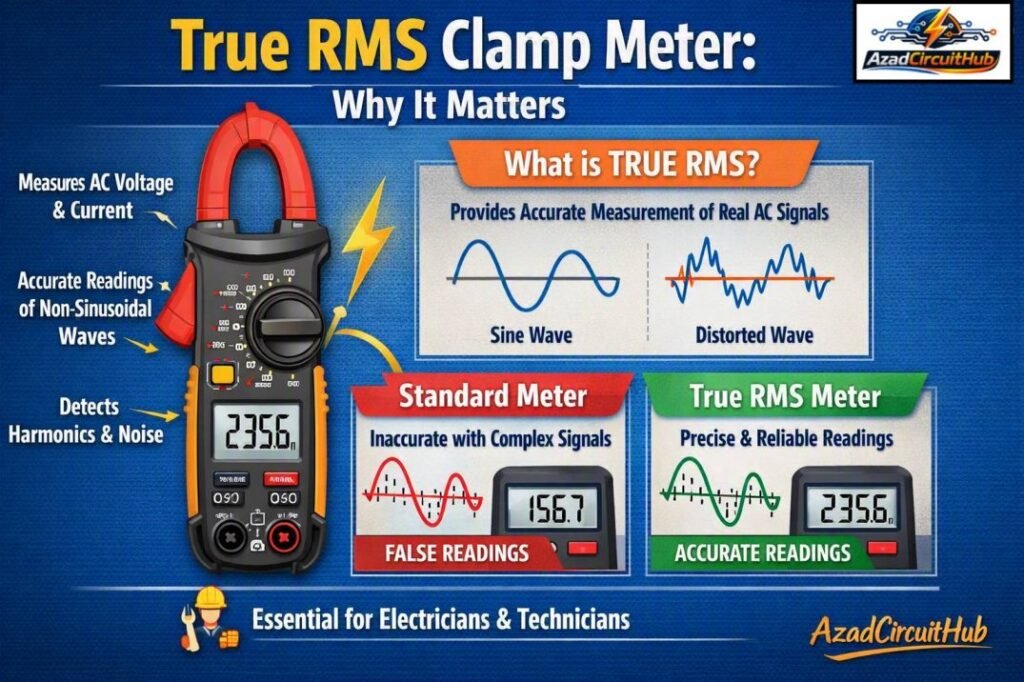
Table of Contents
Table of Contents
What Is a True RMS Clamp Meter?
A True RMS Clamp Meter calculates the root mean square value of an AC waveform rather than assuming that the waveform is a perfect sine wave. RMS is important because it represents the effective heating or power-producing value of an AC signal.
For a pure sine wave, many conventional meters can provide a reasonably accurate reading using an average-responding method. The problem starts when the waveform becomes distorted.
For example, a motor supplied through a variable frequency drive does not always present the same waveform as a simple utility-fed motor. Similarly, electronic power supplies can draw current in short pulses instead of a smooth sinusoidal pattern.
A True RMS Clamp Meter is designed to handle these non-sinusoidal waveforms more accurately.
Why True RMS Matters in Electrical Testing
The biggest advantage becomes clear when measuring modern electrical equipment.
A standard meter may display a current value that looks reasonable but does not accurately represent the actual RMS current when the waveform is distorted. This can lead to incorrect conclusions during troubleshooting.
A True RMS Clamp Meter is particularly useful for:
- Variable frequency drives
- UPS systems
- Solar inverters
- Switching power supplies
- LED lighting
- Computer power supplies
- Industrial control equipment
- Electronic motor controllers
- HVAC equipment
- Non-linear electrical loads
This does not mean every measurement requires True RMS. On a simple heater or a clean utility sine wave, the difference may be small. The benefit becomes more significant as waveform distortion increases.
True RMS vs Standard Clamp Meter
The main difference is the way AC measurements are processed.
| Application | Standard Meter | True RMS Meter |
|---|---|---|
| Resistive heater | Good | Excellent |
| Incandescent lighting | Good | Excellent |
| Basic AC motor | Usually good | Excellent |
| VFD output/input | May be inaccurate | Better suited |
| LED driver | May vary | Better suited |
| UPS output | May vary | Recommended |
| Switching power supply | May vary | Recommended |
| Solar inverter | May vary | Better suited |
| Distorted AC waveform | Limited | Much better |
A useful rule is simple: if the electrical system contains power electronics, a True RMS instrument is generally the safer choice for measurement accuracy.
How a True RMS Clamp Meter Helps Troubleshooting
Consider an industrial panel with a three-phase motor, VFD, contactors, overload protection, and control electronics. If the motor is showing an abnormal temperature or the drive reports an overcurrent condition, measuring phase current is an obvious troubleshooting step.
However, the current waveform may not be perfectly sinusoidal. A conventional average-responding instrument can produce a reading that does not accurately represent the effective current.
A True RMS Clamp Meter can give the technician a more dependable measurement.
It is also useful when comparing phase currents. If two phases appear balanced but the equipment is still behaving abnormally, a more accurate RMS measurement can help determine whether the problem is electrical, mechanical, or related to the power electronics.
For electricians working around modern electrical equipment, this capability can save time and prevent unnecessary component replacement.
KAIWEETS Digital Clamp Meter
The KAIWEETS Digital Clamp Meter is an attractive option for users looking for an affordable electrical testing instrument with clamp-meter functionality. It is suitable for general electrical troubleshooting, maintenance work, automotive applications, and household testing, depending on the specific model and configuration being purchased.
Before ordering, check the Amazon listing for the exact model because KAIWEETS sells several multimeter and clamp-meter versions with different specifications.
Why Consider KAIWEETS?
The main attraction is value. KAIWEETS instruments are aimed at users who want several common electrical measurement functions without moving directly into premium professional pricing.
For a technician who regularly checks voltage, continuity, resistance, and AC current, a KAIWEETS clamp meter can be a practical addition to a tool bag.
Check the latest KAIWEETS Digital Clamp Meter price on Amazon
When selecting any clamp meter, pay particular attention to the stated AC/DC current range, CAT safety rating, jaw capacity, display, frequency capability, and whether the exact model provides True RMS measurement.
If you are comparing several models for field work, our guide to best clamp meter for electrician can help narrow the choice based on practical electrical applications.
Fluke 302+ Digital Clamp Meter
The Fluke 302+ Digital Clamp Meter is aimed at professionals who want a compact clamp meter from one of the most recognized names in electrical test equipment.
Fluke instruments are widely used in electrical maintenance and troubleshooting because durability, measurement performance, and safety are important considerations in professional environments.
The Fluke 302+ is particularly interesting for users who need a straightforward clamp meter for routine electrical measurements. However, buyers should verify the exact specifications of the current product listing, especially when True RMS capability is a deciding factor.
This distinction is important because not every Fluke clamp meter is a True RMS instrument. If True RMS is essential for your application, do not assume it solely from the Fluke brand.
Check the Fluke 302+ Digital Clamp Meter on Amazon
For a broader comparison of professional instruments, see our guide to best clamp meter for electricians, technicians, and electrical maintenance work.
What Should You Look for Before Buying?
Choosing a clamp meter based only on the maximum current range is a common mistake. The measurement environment should determine the features you need.
1. True RMS capability
If you regularly work with VFDs, UPS systems, inverters, LED drivers, or electronic loads, True RMS should be high on your list.
2. CAT safety rating
Electrical safety is more important than extra measurement functions. Choose an instrument with a suitable CAT rating for the installation where it will be used.
3. Current range
Make sure the clamp can measure the expected load current. Industrial applications may require considerably more current capacity than residential troubleshooting.
4. Jaw opening
A larger jaw can make it easier to clamp around thick conductors, but a compact jaw may be preferable inside crowded control panels.
5. AC and DC current
If you work with batteries, solar PV systems, automotive circuits, or DC distribution, DC current measurement can be extremely useful.
6. Frequency measurement
Frequency can help when troubleshooting generators, drives, inverters, and other equipment where the electrical frequency is relevant.
7. Display and usability
A clear display, backlight, data hold, and easy-to-use rotary selector can make a significant difference when working inside panels.
For a more complete buying guide covering professional and budget options, explore our best clamp multimeter guide.
Is a True RMS Clamp Meter Worth the Extra Cost?
For basic electrical work, the answer depends on the application.
If you mainly measure conventional AC circuits supplied by a clean utility waveform, a standard clamp meter may provide acceptable results. However, the price difference between basic and True RMS instruments has become less significant than it once was.
For professional electrical troubleshooting, the additional capability is often worthwhile.
A True RMS Clamp Meter provides greater confidence when measurements are taken on equipment that creates waveform distortion. That can be especially valuable for electricians, industrial technicians, maintenance engineers, and solar professionals.
When You Should Not Rely Only on RMS Current
Even an accurate RMS measurement does not tell the entire story.
When troubleshooting an electrical system, consider voltage, current, power factor, frequency, harmonics, load balance, temperature, and equipment operating conditions. A clamp meter is an excellent diagnostic tool, but it is only one part of a complete electrical assessment.
For example, high RMS current could result from overload, low voltage, poor power factor, mechanical loading, harmonics, or equipment failure. The correct diagnosis requires looking at the complete system.
If you specifically want a professional Fluke comparison, our best fluke clamp meter for electrician guide covers the features that matter when choosing between different Fluke models.
True RMS for Solar, Inverters and VFD Applications
Modern power systems make accurate AC measurement increasingly important.
Solar installations can include inverters, battery systems, MPPT equipment, AC distribution panels, and other power electronic devices. Likewise, industrial facilities increasingly use VFDs to control motor speed and improve energy efficiency.
These devices can create waveforms that are significantly different from an ideal sine wave.
That is one reason a True RMS Clamp Meter can be a useful instrument for renewable energy technicians and industrial electrical engineers. It can provide more meaningful AC measurements when the waveform is not purely sinusoidal.
However, measurements at inverter outputs or other high-energy circuits must always follow the instrument manufacturer’s safety category and operating instructions.
Fluke 323 vs 325: Which One Should You Consider?
The Fluke 323 and 325 are popular clamp-meter choices, but they are designed for somewhat different measurement requirements. The 325 generally offers broader measurement capabilities, making it more attractive when additional functions are needed for troubleshooting.
The right choice depends on the current range, measurement functions, application, and budget rather than simply choosing the more expensive model.
For a detailed model-by-model comparison, see fluke 324 vs 325 before purchasing.
Final Buying Advice
A clamp meter should be selected according to the electrical systems you actually work on. For simple residential loads, a basic instrument can be sufficient. For industrial maintenance, VFD troubleshooting, UPS systems, solar inverters, and electronic loads, True RMS capability becomes much more valuable.
The KAIWEETS Digital Clamp Meter is worth considering when affordability and multiple basic testing functions are priorities. The Fluke 302+ is a compact professional option from a well-established test-equipment manufacturer.
Before clicking the buy button, verify the exact model specifications, safety rating, measurement ranges, and True RMS capability on the current Amazon product page. Product specifications can change between model variants.
Compare current KAIWEETS and Fluke clamp meter prices on Amazon
Frequently Asked Questions
Is a True RMS clamp meter better than a regular clamp meter?
For distorted AC waveforms, yes. True RMS measurement generally provides more accurate readings on non-linear loads such as VFDs, UPS systems, LED drivers, and switching power supplies. For simple sine-wave loads, the difference may be small.
Do I need True RMS for household electrical work?
Not always. A standard meter can work well for many conventional household loads. However, True RMS is useful if you also troubleshoot electronic equipment, LED lighting, inverter-based appliances, HVAC equipment, or other non-linear loads.
Can a True RMS clamp meter measure DC current?
True RMS describes how AC measurements are calculated and does not automatically mean that a meter can measure DC current. Check the specifications of the specific clamp meter to confirm whether DC current measurement is supported.
Is Fluke better than KAIWEETS?
Fluke has a strong reputation for professional electrical test equipment, while KAIWEETS generally competes more strongly on affordability and features per dollar. The better choice depends on the application, required accuracy, safety category, durability, and budget.
Can I use a clamp meter for measuring current in a VFD system?
A suitable clamp meter can be used for many VFD-related measurements, but the instrument must be rated and designed for the application. A True RMS instrument is generally preferable for distorted waveforms. Always follow the meter and VFD manufacturer’s safety instructions.
Get new guides in your feed. Follow Electrical Insights on LinkedIn for new electrical standards guides, calculators and design tips from Azad Circuit Hub.
#TrueRMSClampMeter, #ClampMeter, #ElectricalTesting, #ElectricianTools, #DigitalClampMeter, #TrueRMS, #ElectricalMeasurement, #Multimeter, #ElectricalSafety, #TestEquipment