NEC Article for Motors: Article 430 Guide, FLA Table (2026)
The NEC article for motors is Article 430, titled Motors, Motor Circuits, and Controllers. It tells you how to size motor conductors, overload protection, short-circuit and ground-fault protection, controllers and disconnects, and which table gives the full-load current. Whether you are an electrician, an engineer or a student, this NEC article for motors is the one you will open most often for a pump, fan, compressor or conveyor job.
Article 430 is long. It has 14 parts, and a single motor circuit pulls numbers from several of them. This guide to the NEC article for motors gives you the parts map, the full-load current tables, a worked 10 HP example, the disconnect rules, the 2026 changes and short answers on the other NEC articles people search next. Where a calculator can do the arithmetic, we link to it.
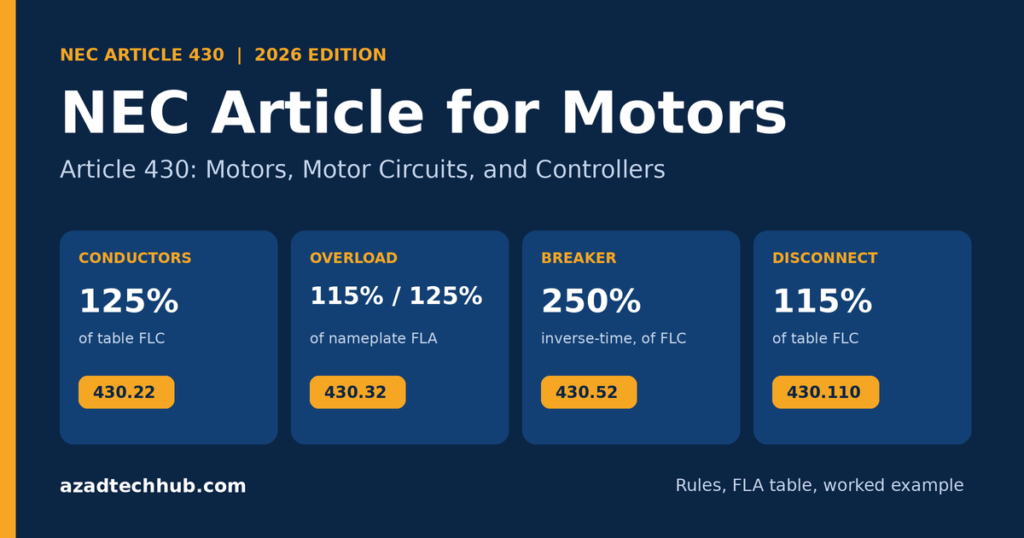
Quick answer: The NEC article for motors is Article 430. Size conductors at 125% of the table full-load current (430.22), the overload device at 115% or 125% of nameplate current (430.32), the branch-circuit breaker from Table 430.52, and the disconnect at 115% of full-load current (430.110).
What Is the NEC Article for Motors?
Article 430 sits in Chapter 4, Equipment for General Use, of the National Electrical Code (NFPA 70). Its scope covers motors, motor branch-circuit and feeder conductors and their protection, overload protection, motor control circuits, controllers and motor control centers. That is why the NEC article for motors is the starting point for every motor load, from a 1/2 HP fan to a large process pump.
Two neighbors matter. Article 440 amends Article 430 for hermetic refrigerant motor-compressors, which is why an AC disconnect height question lands in 440.14. Article 430 also sends you to other articles: Article 240 overcurrent protection and Article 250 grounding and bonding both apply to motor circuits. To see where Article 430 fits among the nine chapters, open our NEC articles list.
NEC Article 430 Parts at a Glance
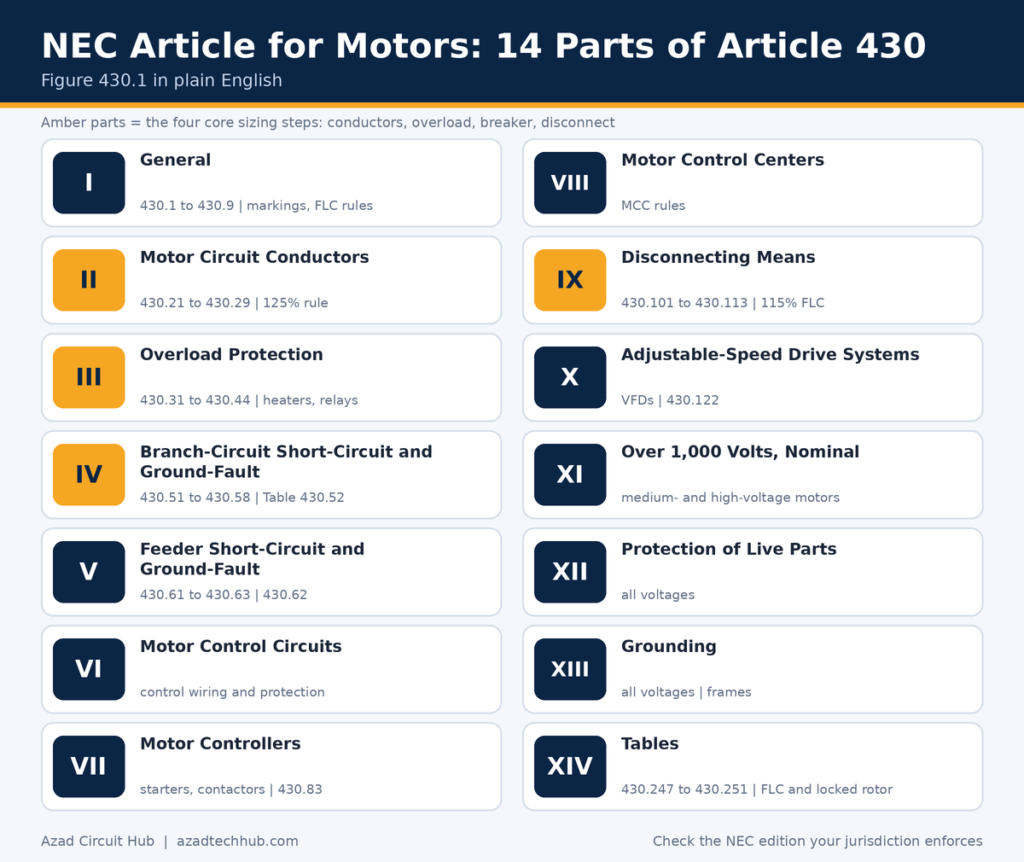
Figure 430.1 in the code works as the table of contents for Article 430. Here are the 14 parts of the NEC article for motors in plain English:
- Part I, General: definitions, motor markings (430.7) and the full-load current rules (430.6).
- Part II, Conductors (430.21 to 430.29): ampacity for branch circuits and feeders.
- Part III, Overload protection (430.31 to 430.44): the heaters or relays.
- Part IV, Branch-circuit short-circuit and ground-fault protection (430.51 to 430.58).
- Part V, Feeder short-circuit and ground-fault protection (430.61 to 430.63).
- Part VI, Control circuits.
- Part VII, Controllers: starters and contactors.
- Part VIII, Motor control centers.
- Part IX, Disconnecting means (430.101 to 430.113).
- Part X, Adjustable-speed drive systems.
- Part XI, Over 1,000 volts, nominal.
- Part XII, Protection of live parts.
- Part XIII, Grounding.
- Part XIV, Tables: the full-load current tables.
If you work on motor control centers, Part VIII of the NEC article for motors applies. See our motor control center design standards and how to size a motor control center.
NEC Motor FLA Table: Tables 430.248 and 430.250
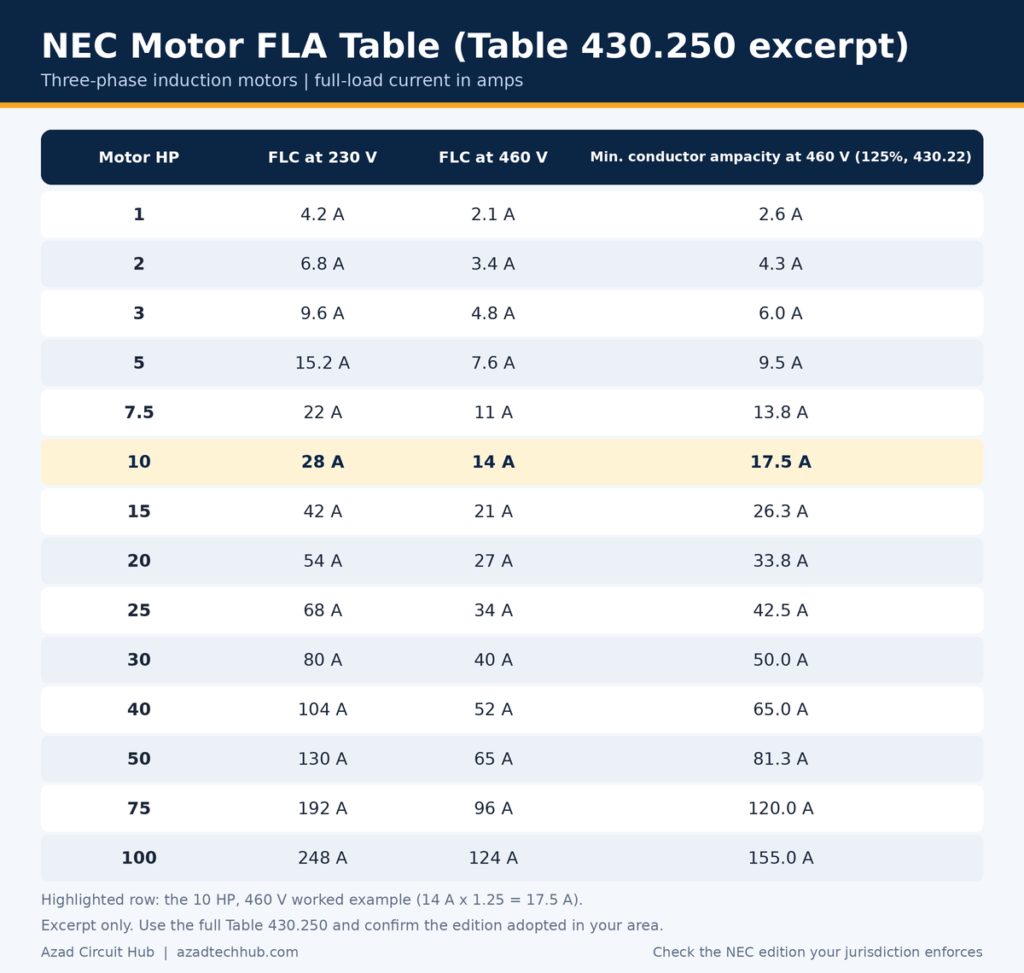
The NEC article for motors does not let you size conductors from the nameplate. For conductors, disconnects and short-circuit protection, Article 430 uses the tabulated full-load current (FLC) from Table 430.247 (dc), 430.248 (single-phase) or 430.250 (three-phase). The nameplate full-load amps (FLA) are used for overload protection, with a few exceptions such as multispeed motors (430.6). Here is an excerpt of the NEC motor FLA table for three-phase induction motors:
| Motor HP | FLC at 230 V | FLC at 460 V | Min. conductor ampacity at 460 V (125%) |
|---|---|---|---|
| 1 | 4.2 A | 2.1 A | 2.6 A |
| 2 | 6.8 A | 3.4 A | 4.3 A |
| 3 | 9.6 A | 4.8 A | 6.0 A |
| 5 | 15.2 A | 7.6 A | 9.5 A |
| 7.5 | 22 A | 11 A | 13.8 A |
| 10 | 28 A | 14 A | 17.5 A |
| 15 | 42 A | 21 A | 26.3 A |
| 20 | 54 A | 27 A | 33.8 A |
| 25 | 68 A | 34 A | 42.5 A |
| 30 | 80 A | 40 A | 50.0 A |
| 40 | 104 A | 52 A | 65.0 A |
| 50 | 130 A | 65 A | 81.3 A |
| 75 | 192 A | 96 A | 120.0 A |
| 100 | 248 A | 124 A | 155.0 A |
Excerpt only. Read the full table in NFPA’s free online access to the code, and confirm the edition your jurisdiction enforces. For relay settings built on the same FLA values, use our motor overload setting table (PDF and Excel).
NEC 430 Motor Requirements Step by Step
This is how the NEC article for motors works on a real job. Take the steps in order:
- Find the FLC. Use Table 430.248 or 430.250 for the motor’s horsepower and voltage.
- Size the conductors (430.22). Ampacity must be at least 125% of FLC for a single continuous-duty motor. Then check Table 310.16 and the terminal temperature rating in 110.14(C).
- Size the overload device (430.32). Use 125% of nameplate FLA for motors with a service factor of 1.15 or more, or a temperature rise of 40°C or less. Use 115% for all other motors. Our overload relay setting calculator and step-by-step overload sizing guide do this for you.
- Size short-circuit and ground-fault protection (430.52). Table 430.52 sets the maximum rating as a percentage of FLC: 300% for non-time-delay fuses, 175% for dual-element fuses, 250% for inverse-time breakers and 800% for instantaneous-trip breakers. If the result is not a standard size, the next higher standard size is permitted.
- Select the controller (430.83). Its horsepower rating must not be lower than the motor’s.
- Select the disconnect (430.110). It must be rated at least 115% of FLC and, in most cases, be horsepower rated.
For several motors on one feeder, add 125% of the largest motor FLC to the FLC of the others (430.24). Feeder protection follows 430.62.
Worked Example: 10 HP, 460 V, Three-Phase Motor
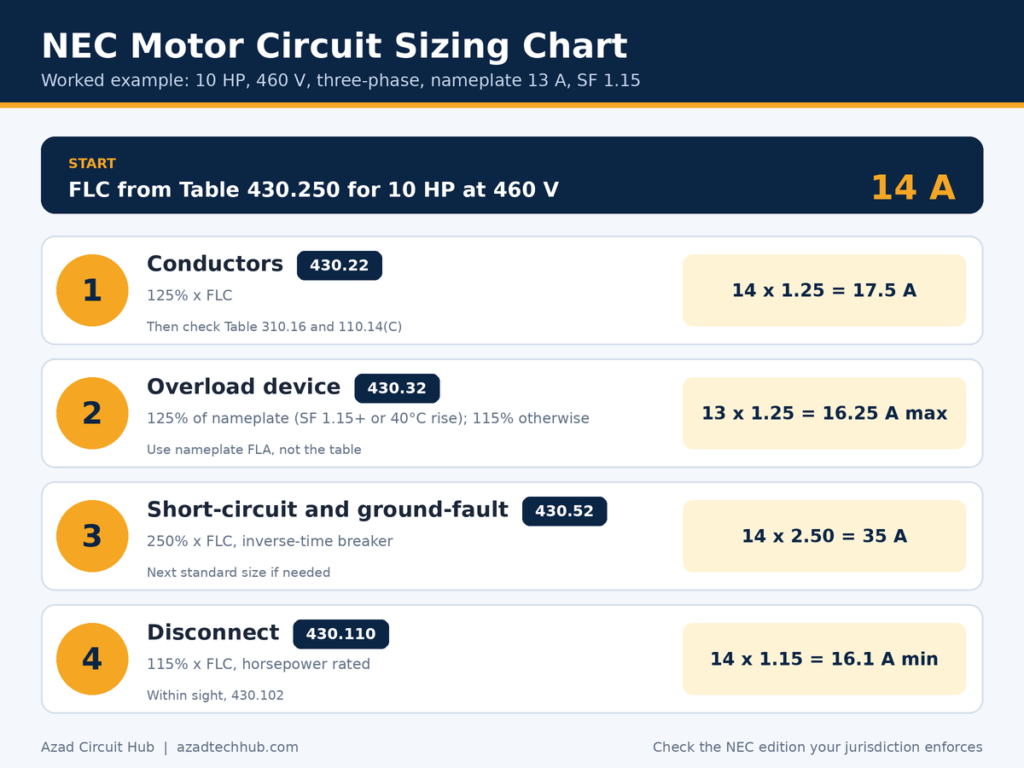
- FLC from Table 430.250: 14 A.
- Minimum conductor ampacity: 14 A × 1.25 = 17.5 A, so 12 AWG copper is a common choice.
- Overload (nameplate 13 A, service factor 1.15): 13 A × 1.25 = 16.25 A maximum.
- Inverse-time breaker: 14 A × 250% = 35 A, which is a standard size.
- Disconnect: 14 A × 115% = 16.1 A minimum, horsepower rated.
A 35 A breaker on 12 AWG looks wrong until you remember that 240.4(G) lets the NEC article for motors govern motor circuits, and the overload device protects the conductor. For cable length and voltage drop, run the numbers in our motor cable size calculator and read wire sizing for motors. Check real running current against the nameplate with a clamp meter.
NEC 430 Ampacity and Motor Sizes
Searches for “NEC 430 ampacity” and “NEC 70 motor sizes” ask the same question: what current do I design for? NEC 70 is just the code’s document number, NFPA 70. Motor sizes in the code are the horsepower ratings in the tables. In the NEC article for motors, ampacity comes from two places: the 125% rule in 430.22 sets the minimum, and Table 310.16 gives the conductor’s rating.
What people call NEC motor specifications are the nameplate markings required by 430.7: manufacturer, voltage, FLA, horsepower, speed, service factor or temperature rise, and design letter. Read them off the nameplate before you start.
Motor Disconnects, Controllers and Grounding
Part IX of the NEC article for motors requires a disconnect within sight of the controller (430.102(A)), and a separate one within sight of the motor and driven machinery unless an exception applies (430.102(B)). In the code, “in sight” means visible and not more than 50 ft away. A motor disconnect is typically horsepower rated (430.109) and sized at 115% of FLC (430.110).
Keep the working space in front of it clear using our guide to 110.26 working space and clearance in front of panels. Motor frames must be grounded under Part XIII and Article 250. To check windings, see winding resistance vs insulation resistance and our megger buyer’s guide.
What Changed in the 2026 NEC for Motors
The 2026 edition of the NEC article for motors added two energy-efficient motor types, Design BE (brushless excitation) and Design CE (capacitor excitation), across Article 430. New 430.22(H) sizes conductors for a single BE or CE motor in continuous duty at 125% of FLC.
New Table 430.251(C) lists their maximum locked-rotor currents. Table 430.52(C)(1) now groups them with Design B energy-efficient motors, which allows up to 1,100% for an instantaneous-trip breaker used with a listed combination motor controller. Section 430.132 now addresses GFCI and SPGFCI protection between a motor and power conversion equipment. Confirm which edition your state has adopted before you apply any of this.
Motors rarely work alone, so the sections below answer the NEC article questions people search next.
NEC Code for Variable Frequency Drives
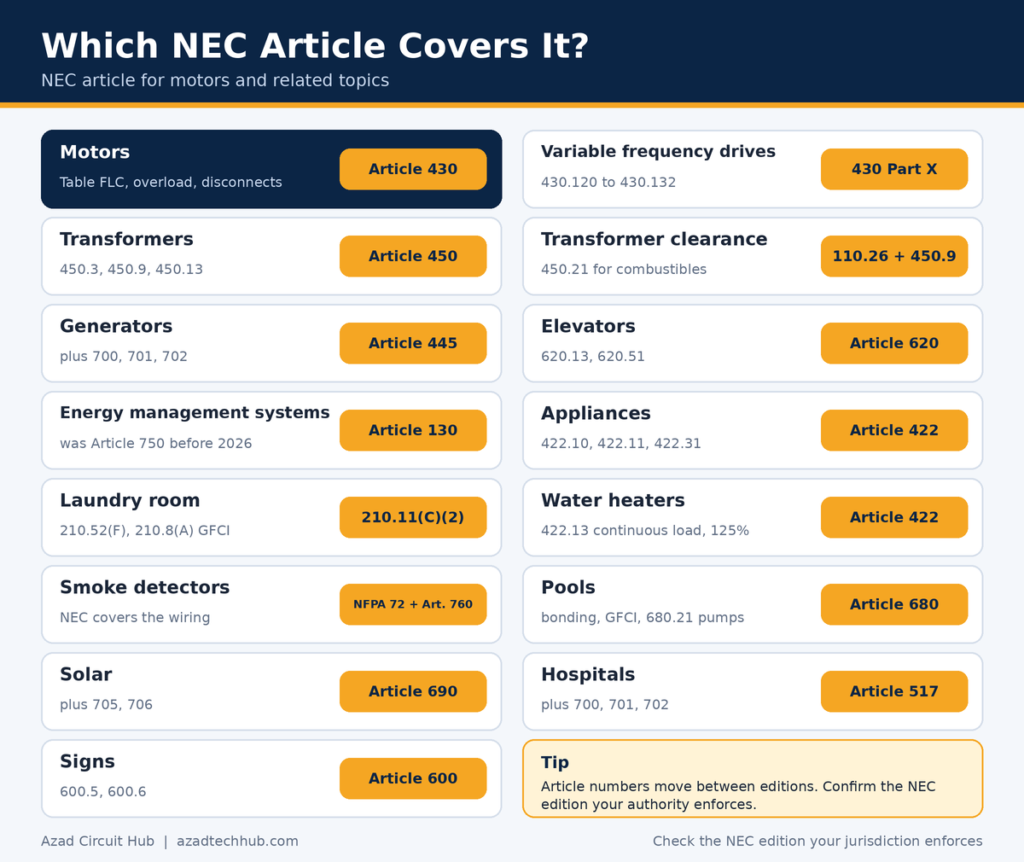
Variable frequency drives fall under Part X of Article 430, Adjustable-Speed Drive Systems. Conductors that feed the drive are sized at 125% of the drive’s rated input current (430.122), overload and short-circuit protection follow the Part X rules, and 430.131 covers bypass arrangements. This part of the NEC article for motors also pairs with the 2026 GFCI language in 430.132. For wiring and earthing, see our guide to VFD connections and earthing.
NEC Article for Transformers
The NEC article for transformers is Article 450, Transformers and Transformer Vaults. It covers overcurrent protection (450.3), ventilation (450.9), accessibility (450.13) and location rules for dry-type and liquid-filled units. Size primary and secondary protection with our transformer OCPD sizing chart, and browse the transformer hub for testing and neutral sizing.
NEC Code for Transformer Clearance
Transformer clearance comes from three places. Section 110.26 sets the working space in front of equipment, at least 36 in. deep, 30 in. wide and 6.5 ft high for most installations. Section 450.9 requires ventilation, so follow the manufacturer’s side and rear clearances. Section 450.21 limits how close dry-type units sit to combustible material, for example 12 in. for units of 112.5 kVA or less without a fire-resistant barrier. See NEC code for clearance in front of panels for the full 110.26 table.
NEC Article for Generators
The NEC article for generators is Article 445, which covers generator marking, overcurrent protection and disconnects. Articles 700, 701 and 702 add rules for emergency, legally required standby and optional standby systems. Our full guide, NEC article for generators, explains each one. Motors draw about six times their running current at startup, so size the set with the generator sizing calculator.
NEC Article for Elevators
The NEC article for elevators is Article 620, covering elevators, dumbwaiters, escalators, moving walks and platform lifts. Motor feeders and branch circuits for elevator machines follow 620.13, which adapts the NEC article for motors to elevator duty cycles. Each car needs a lockable disconnect in the machine room (620.51), and the machine room working space must stay clear under 110.26.
The NEC Article for Energy Management Systems Is Article 130
The NEC article for energy management systems is Article 130 in the 2026 NEC. The content sat in Article 750 in the 2023 edition and earlier, so older lists and exam notes point to the wrong number. Article 130 covers the controls that manage loads and power sources to stay within the capacity of a service or feeder. The NEC articles list shows the other 2026 renumbering.
What NEC Article Covers the Rules Necessary for the Installation of Appliances?
Article 422, Appliances. It sets the branch-circuit rating (422.10), overcurrent protection (422.11), flexible cord use (422.16) and disconnecting means (422.31). Appliances with motors also pull in the NEC article for motors, and air conditioners pull in Article 440. Start branch-circuit sizing with our NEC article for branch circuits guide.
NEC Code for Laundry Room
A laundry room needs at least one 20 A branch circuit for the laundry receptacle outlets (210.11(C)(2)) and at least one receptacle outlet in the laundry area (210.52(F)). GFCI protection applies to receptacles in laundry areas (210.8(A)); see NEC Article 210.8 A. An electric dryer is an Article 422 appliance and needs its own branch circuit.
NEC Article for Water Heaters
There is no separate article for water heaters. Storage-type units fall under Article 422, and 422.13 treats a storage water heater of 120 gallons or less as a continuous load, so the branch circuit is sized at 125% of the nameplate rating. A 4,500 W, 240 V heater draws 18.75 A, and 18.75 A × 1.25 = 23.4 A. A 25 A breaker is the minimum standard size, and most installers use a 30 A breaker with 10 AWG copper. See the 125% continuous load rule.
NEC Article for Smoke Detectors
The NEC does not say where smoke alarms go. Placement and interconnection come from NFPA 72 and your local building or residential code. The NEC covers the wiring: Article 760 for fire alarm systems, and Article 210 for the branch circuit that powers dwelling smoke alarms. Our guide to arc fault breakers explains the AFCI rules that can apply to those circuits.
NEC Article for Pools
The NEC article for pools is Article 680, Swimming Pools, Fountains, and Similar Installations. It covers equipotential bonding, GFCI protection, receptacle distances, underwater luminaires and pump motors. A pool pump is still a motor, so Article 680 (see 680.21) applies on top of the NEC article for motors. Hot tubs have their own rules; see hot tub disconnect requirements.
NEC Article for Solar
The NEC article for solar is Article 690, Solar Photovoltaic (PV) Systems, with Article 705 for interconnected power sources and Article 706 for energy storage. Rapid shutdown, conductor sizing and disconnects are the most common questions. Read our full guide, NEC code for solar installation, and size the system with the solar inverter sizing calculator.
What NEC Article Governs a Hospital?
Article 517, Health Care Facilities. It covers wiring in patient care spaces, grounding (517.13), essential electrical systems and isolated power systems. Hospital pumps and fans still follow the NEC article for motors, and emergency and standby power also involve Articles 700, 701 and 702. Grounding in patient care spaces builds on Article 250.
What Article in the NEC Has Requirements for Signs?
Article 600, Electric Signs and Outline Lighting. It requires a 20 A branch circuit for the sign outlet at each tenant entrance (600.5), a disconnect within sight of the sign (600.6), and marking and grounding of the sign. People who search NEC article 600 are looking for these sign rules.
NEC Article 430 PDF and Free Download
People search for the NEC article for motors PDF, an NEC article 430 PDF and a free download. The honest answer is that NFPA copyrights the NEC, so there is no legal free PDF of Article 430. NFPA gives free read-only online access to NFPA 70 at nfpa.org after you register, and it sells print and PDF copies.
Unofficial PDFs are often out of date or incomplete and can show the wrong table. Save the charts on this page for quick reference, then read the exact wording in the official free copy. Our NEC articles list and NEC code for commercial buildings guides explain free access in more detail.
NEC Article for Motors FAQs
What is the NEC article for motors?
Article 430, Motors, Motor Circuits, and Controllers. Article 440 adds rules for air-conditioning and refrigeration motor-compressors.
What size breaker does a motor need?
Take the FLC from Table 430.248 or 430.250, then multiply by the Table 430.52 percentage. An inverse-time breaker is limited to 250% of FLC.
Do I use nameplate amps or the FLA table?
Use the tables for conductors, disconnects and short-circuit protection. Use the nameplate for overload protection.
How many parts does the NEC article for motors have?
Fourteen, from Part I (General) to Part XIV (Tables).
Does the NEC article for motors apply to air conditioners?
Partly. Article 440 amends the NEC article for motors for hermetic motor-compressors, and you apply both articles.
Where is the NEC motor FLA table?
In Part XIV: Tables 430.247 to 430.250, plus Table 430.251 for locked-rotor current.
Related NEC Article Questions
What Is Article 90 of the NEC?
Article 90 is the introduction. It states the purpose and scope of the code, how it is arranged, and how to read mandatory and permissive rules. See the NEC articles list.
What Is Article 240 in the NEC?
Article 240 covers overcurrent protection: breakers, fuses and conductor protection. Motor circuits get special treatment under 240.4(G) and the NEC article for motors. Read our NEC article for overcurrent protection.
What Is Section 300.5 of the NEC?
Section 300.5 covers underground installations. Table 300.5 gives minimum cover, for example 24 in. for direct-buried cable, 18 in. for PVC conduit and 6 in. for rigid metal conduit. See underground conduit depth and buried electrical wires.
What Is Article 725 of the NEC?
Article 725 covers Class 1, Class 2 and Class 3 remote-control, signaling and power-limited circuits. The 2026 NEC added Article 206 for non-power-limited remote-control and signaling circuits. Our NEC article for branch circuits guide explains where Article 725 fits.
NEC Article for Motors: Key Takeaways
The NEC article for motors is Article 430. Use table FLC for conductors, disconnects and short-circuit protection, and the nameplate for overload protection. Remember the four numbers: 125% for conductors, 115% or 125% for overload, 250% for an inverse-time breaker and 115% for the disconnect. Bookmark this NEC article for motors guide, confirm the edition your authority enforces, and use our calculators to check the arithmetic.
Get new guides in your feed. Follow Electrical Insights on LinkedIn for new electrical standards guides, calculators and design tips from Azad Circuit Hub.
More NEC Guides and Calculators on Azad Circuit Hub
- Pumps and motors hub: testing, sizing and MCC guides.
- Motor overload setting table PDF and Excel and 3 phase motor winding resistance chart.
- NEC article for branch circuits and NEC article 210.20 A.
- Conduit fill calculator and electrical calculators.