
Motor Control Center Design Standards: Complete Industrial Compliance Guide for Reliable MCC Systems
Motor Control Center Design Standards play a critical role in ensuring the safety, reliability, efficiency, and maintainability of industrial electrical systems. A properly designed Motor Control Center (MCC) serves as the backbone of motor-driven operations in manufacturing plants, water treatment facilities, oil and gas installations, power generation stations, and commercial industries.
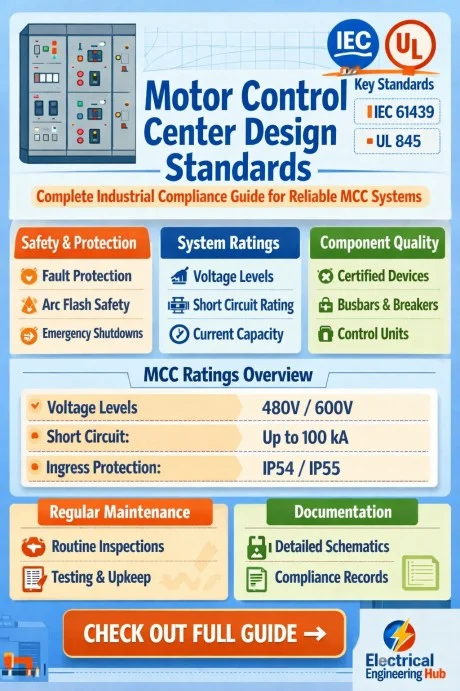
Table of Contents
As industries continue to adopt automation and intelligent motor control solutions, compliance with recognized design standards becomes even more important. Proper adherence to industry regulations helps reduce downtime, improve personnel safety, simplify maintenance activities, and ensure long-term operational performance.
This guide explains the most important Motor Control Center Design Standards, key design considerations, compliance requirements, and best practices for developing reliable MCC systems.
Know more about mcc panel design software
What Is a Motor Control Center (MCC)?
A Motor Control Center is a centralized assembly of motor starters, variable frequency drives (VFDs), protection devices, power distribution equipment, and control components housed within enclosed sections.
The primary purpose of an MCC is to provide a safe and organized method for controlling multiple electric motors from a single location.
Modern MCC systems typically include:
- Motor starters
- Circuit breakers
- Contactors
- Overload relays
- Variable frequency drives
- Soft starters
- PLC interfaces
- Power monitoring devices
- Communication modules
These components work together to provide motor control, protection, monitoring, and operational flexibility.
Why Motor Control Center Design Standards Are Important
Following Motor Control Center Design Standards ensures consistency and reliability throughout the lifecycle of an MCC installation.
Key benefits include:
| Benefit | Description |
|---|---|
| Safety | Protects personnel from electrical hazards |
| Reliability | Reduces equipment failures and downtime |
| Compliance | Meets legal and regulatory requirements |
| Maintainability | Simplifies troubleshooting and repairs |
| Scalability | Allows future expansion of motor systems |
| Performance | Improves overall system efficiency |
Industrial facilities that neglect proper standards often experience increased maintenance costs, unexpected outages, and safety risks.
Download the mcc panel design guide pdf
Major Motor Control Center Design Standards
Several international standards govern MCC design and construction.
IEC 61439
IEC 61439 is one of the most widely recognized standards for low-voltage switchgear and controlgear assemblies.
It specifies requirements for:
- Temperature rise limits
- Dielectric properties
- Short-circuit withstand capability
- Mechanical strength
- Internal separation
- Verification procedures
Facilities operating under IEC-based electrical systems generally require MCCs to comply with IEC 61439 requirements.
UL 845
UL 845 is the primary North American standard for Motor Control Centers.
The standard covers:
- Construction requirements
- Component ratings
- Busbar design
- Grounding systems
- Short-circuit current ratings
- Safety testing
Know more about What is a Motor Control Center (MCC)
UL-listed MCCs are commonly used throughout the United States and many international projects.
NFPA 70 (National Electrical Code)
The National Electrical Code provides installation requirements for electrical equipment.
Important areas affecting MCC design include:
- Grounding and bonding
- Conductor sizing
- Overcurrent protection
- Equipment accessibility
- Arc flash considerations
IEEE Standards
IEEE standards support MCC design through guidelines covering:
- Power system protection
- Equipment coordination
- Reliability studies
- Harmonic mitigation
- Electrical safety practices
Know more about Motor Control Center Bucket Replacement Cost
NEMA Standards
NEMA standards define enclosure classifications and equipment performance criteria.
Common enclosure types include:
| NEMA Type | Application |
|---|---|
| NEMA 1 | Indoor general-purpose installations |
| NEMA 3R | Outdoor weather-resistant areas |
| NEMA 4 | Washdown environments |
| NEMA 4X | Corrosive locations |
| NEMA 12 | Industrial dust environments |
Essential Design Parameters for MCC Systems
Successful compliance with Motor Control Center Design Standards requires careful evaluation of multiple design factors.
Load Assessment
Every MCC design begins with a detailed load analysis.
Engineers should evaluate:
- Connected motor loads
- Starting currents
- Continuous operating currents
- Future expansion requirements
- Duty cycles
Accurate load calculations prevent under-sizing and improve reliability.
Know more about Top 12 Motor Control Center Manufacturers USA
Short-Circuit Rating
One of the most critical aspects of MCC design is determining the available fault current.
The Short Circuit Current Rating (SCCR) must exceed the maximum fault level at the installation point.
Factors influencing SCCR include:
- Utility fault contribution
- Transformer impedance
- Cable lengths
- Generator contribution
Proper SCCR selection protects equipment during fault conditions.
Busbar Design
Busbars distribute electrical power throughout the MCC.
Design considerations include:
- Current carrying capacity
- Temperature rise limits
- Material selection
- Mechanical strength
- Fault withstand capability
Copper busbars are commonly preferred due to superior conductivity and reliability.
Download the excel sheet for MCC panel sizing calculation
Voltage Drop Considerations
Excessive voltage drop can negatively impact motor performance.
Engineers should evaluate:
- Feeder lengths
- Conductor sizes
- Motor starting conditions
- Load distribution
Maintaining acceptable voltage levels improves equipment life and operational efficiency.
Know more about Motor Control Center Upgrade vs Replace
MCC Protection Requirements
Protection systems are fundamental elements of Motor Control Center Design Standards.
Overcurrent Protection
Protection devices include:
- Molded case circuit breakers
- Air circuit breakers
- Motor protection circuit breakers
- Fuses
These devices isolate faults before they damage equipment.
Motor Overload Protection
Overload relays protect motors from:
- Excessive current
- Locked rotor conditions
- Phase imbalance
- Thermal overload
Electronic overload relays provide improved accuracy and diagnostic capabilities.
Ground Fault Protection
Ground fault protection helps prevent:
- Equipment damage
- Fire hazards
- Personnel injury
Many modern MCC systems incorporate advanced ground fault monitoring features.
Find all about Motor Control Center Installation Cost
Arc Flash Safety Requirements
Arc flash incidents represent one of the most serious electrical hazards in industrial environments.
Modern MCC designs should include:
- Arc-resistant construction
- Protective relays
- Remote operation capability
- Safety interlocks
- Arc flash labeling
Compliance with NFPA 70E significantly improves workplace safety.
Arc Flash Risk Reduction Methods
| Method | Benefit |
|---|---|
| Current-limiting devices | Reduces incident energy |
| Arc-resistant enclosures | Directs arc energy away from personnel |
| Protective relays | Faster fault clearing |
| Maintenance switches | Improves worker safety |
| Remote racking systems | Minimizes exposure |
Know more about GIS vs AIS Switchgear
Intelligent MCC Systems and Automation
Industrial facilities increasingly deploy intelligent MCCs that support advanced automation and monitoring.
Features may include:
- PLC integration
- SCADA connectivity
- Energy monitoring
- Predictive maintenance
- Remote diagnostics
- Digital protection relays
These technologies improve operational visibility and reduce maintenance costs.
For engineers working with electrical documentation, understanding control and power schematics is equally important. A useful resource is this guide on How to read MCC drawings, which helps interpret MCC layouts, wiring diagrams, and motor control circuits effectively.
Environmental and Installation Considerations
Environmental conditions significantly influence MCC design.
Indoor Installations
Indoor MCCs should account for:
- Ventilation
- Ambient temperature
- Dust levels
- Maintenance access
Adequate clearance improves safety and serviceability.
Find all about Top 15 Medium Voltage Switchgear Manufacturers in UAE & Buyers
Outdoor Installations
Outdoor systems require additional protection against:
- Rain
- Moisture
- UV exposure
- Corrosion
- Temperature extremes
Proper enclosure selection ensures long-term reliability.
Hazardous Locations
Certain industries require MCCs for hazardous environments.
Examples include:
- Oil and gas facilities
- Chemical processing plants
- Fuel storage terminals
- Mining operations
Designs must comply with applicable hazardous area classifications.
Know more about Electrical Panel Upgrade 200 Amp
Cable Management and Wiring Standards
Organized cable routing improves system performance and maintenance efficiency.
Best practices include:
- Separate power and control wiring
- Use proper cable trays
- Maintain bending radius requirements
- Label all conductors
- Implement color coding standards
Proper cable management reduces troubleshooting time and enhances safety.
MCC Testing and Verification Requirements
Compliance with Motor Control Center Design Standards involves extensive testing before commissioning.
Routine Tests
Routine testing typically includes:
- Visual inspection
- Mechanical operation checks
- Insulation resistance testing
- Wiring verification
- Functional testing
Use our online tool for free Electrical Panel Upgrade Cost Calculator
Type Tests
Type testing validates design performance under specified conditions.
Common tests include:
| Test Type | Purpose |
|---|---|
| Temperature rise test | Verify thermal performance |
| Dielectric test | Confirm insulation integrity |
| Short-circuit test | Validate fault withstand capability |
| Mechanical endurance test | Assess durability |
| Degree of protection test | Verify enclosure rating |
These tests ensure reliable operation under normal and fault conditions.
Best Practices for Reliable MCC Design
Organizations seeking maximum reliability should follow proven engineering practices.
Recommended approaches include:
- Design for future expansion
- Use standardized components
- Maintain proper ventilation
- Implement intelligent monitoring
- Perform coordination studies
- Conduct arc flash analysis
- Select high-quality protection devices
- Establish preventive maintenance programs
Use our online tool for free Wire Size Calculator for Subpanels and Feeders – NEC Guidelines Included
These practices contribute to longer equipment life and reduced operational risk.
Common Design Mistakes to Avoid
Even experienced engineers can encounter issues during MCC development.
Common mistakes include:
- Underestimating fault current levels
- Insufficient cooling provisions
- Improper enclosure selection
- Inadequate cable space
- Lack of spare feeders
- Poor labeling practices
- Ignoring arc flash requirements
Avoiding these errors improves system reliability and regulatory compliance.
Conclusion
Motor Control Center Design Standards provide the foundation for safe, efficient, and reliable motor control systems across industrial facilities. Compliance with standards such as IEC 61439, UL 845, NFPA 70, IEEE guidelines, and NEMA requirements helps ensure long-term performance while protecting personnel and equipment.
Use our online tool for free Sub Panel Breaker Size Calculator – Find the Right Breaker for Your Electrical Sub Panel
A well-designed MCC incorporates proper load assessment, protection coordination, fault current analysis, busbar sizing, arc flash mitigation, and intelligent monitoring capabilities. As industrial automation continues to advance, adherence to recognized design standards remains essential for achieving operational excellence and minimizing lifecycle costs.
By applying these principles and best practices, engineers can develop MCC systems that deliver dependable performance while meeting modern industrial safety and compliance requirements.
Frequently Asked Questions (FAQs)
What are Motor Control Center Design Standards?
Motor Control Center Design Standards are industry regulations and engineering guidelines that define the design, construction, testing, and installation requirements for MCC systems to ensure safety, reliability, and compliance.
Which standard is commonly used for MCC design?
IEC 61439 and UL 845 are the most widely used standards for MCC design, depending on the project’s geographic region and regulatory requirements.
Why is SCCR important in MCC systems?
The Short Circuit Current Rating ensures that the MCC can safely withstand fault currents without catastrophic equipment failure during electrical faults.
What is the difference between a traditional MCC and an intelligent MCC?
A traditional MCC focuses on motor control and protection, while an intelligent MCC includes communication, diagnostics, monitoring, PLC integration, and remote control capabilities.
How often should an MCC be inspected?
Most industrial facilities perform visual inspections monthly and comprehensive preventive maintenance annually, although inspection frequency depends on operating conditions and manufacturer recommendations.
Follow Us on Social:
Subscribe our Newsletter on Electrical Insights for latest updates from Electrical Engineering Hub
#MotorControlCenter,#MCCDesign,#ElectricalEngineering,#IndustrialAutomation,#PowerDistribution,#MotorControl,#IECStandards,#NEMAStandards,#IndustrialElectrical,#ControlPanelDesign
