
NEMA ICS 18 Motor Control Center Standard: Complete Compliance Guide, Requirements & Best Practices
Motor Control Centers (MCCs) are critical components in industrial power distribution and motor management systems. They provide a centralized location for controlling, protecting, and monitoring electric motors used in manufacturing plants, water treatment facilities, oil and gas operations, commercial buildings, and other industrial environments.
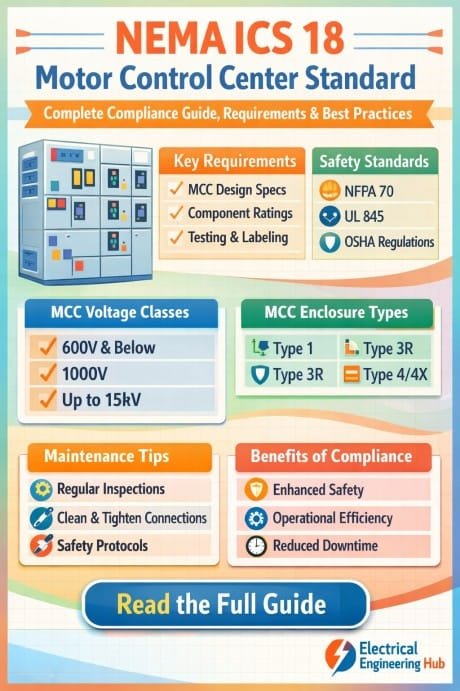
Table of Contents
Among the key standards governing MCC design and construction, the NEMA ICS 18 Motor Control Center Standard plays an important role in establishing performance, safety, testing, and construction requirements. Understanding this standard helps engineers, contractors, plant operators, and maintenance personnel ensure reliable operation while maintaining compliance with industry best practices.
Know more about IEC Standard for Earthing System
This comprehensive guide explains the NEMA ICS 18 Motor Control Center Standard, its requirements, compliance considerations, testing procedures, and implementation best practices.
What Is the NEMA ICS 18 Motor Control Center Standard?
The NEMA ICS 18 Motor Control Center Standard is a National Electrical Manufacturers Association (NEMA) standard that establishes guidelines for the construction, performance, testing, and application of motor control centers.
The standard provides manufacturers and end users with a consistent framework for designing MCC assemblies that meet operational, safety, and reliability requirements. It helps ensure interchangeability, proper coordination of components, and standardized testing procedures across different manufacturers.
Industrial facilities rely on this standard to achieve:
- Improved personnel safety
- Reliable motor operation
- Consistent equipment performance
- Easier maintenance and troubleshooting
- Better system integration
- Enhanced electrical protection
Know more about IEC Standard for Insulation Resistance Test – Procedures, Limits & Best Practices Explained
By following the NEMA ICS 18 Motor Control Center Standard, organizations can reduce operational risks while improving system efficiency and long-term equipment reliability.
Understanding Motor Control Centers
A Motor Control Center is a factory-assembled structure containing motor starters, circuit breakers, disconnect switches, variable frequency drives (VFDs), soft starters, control devices, and communication equipment.
A typical MCC consists of:
| Component | Function |
|---|---|
| Main Busbar | Distributes electrical power throughout the MCC |
| Motor Starters | Start and stop motors |
| Circuit Breakers | Provide overcurrent protection |
| Disconnect Switches | Isolate equipment for maintenance |
| VFDs | Control motor speed and torque |
| Control Relays | Manage control logic |
| Metering Devices | Monitor electrical parameters |
| Communication Modules | Enable remote monitoring and SCADA integration |
The NEMA ICS 18 Motor Control Center Standard defines requirements for these assemblies to ensure safe and dependable operation.
Know more about IEC Standard for MV Cable Testing: Complete Acceptance, Routine & Type Test Guide
Key Objectives of the Standard
The standard was developed to establish consistency in motor control center manufacturing and performance.
The primary objectives include:
- Standardized construction methods
- Enhanced personnel protection
- Reliable electrical performance
- Defined testing procedures
- Improved maintenance accessibility
- Interchangeable unit designs
- Uniform terminology and ratings
These objectives help create a common understanding between equipment manufacturers, consultants, contractors, and facility owners.
Major Requirements of NEMA ICS 18
Several critical requirements must be considered when designing and specifying MCCs.
Structural Construction Requirements
The enclosure structure must provide adequate mechanical strength and support for all installed equipment.
Requirements typically include:
- Rigid frame construction
- Secure mounting arrangements
- Proper compartment separation
- Adequate ventilation
- Accessibility for maintenance
- Protection against accidental contact
The structural design must withstand normal operating conditions without compromising safety or performance.
Know more about Transformer Oil Testing
Bus System Requirements
The bus system serves as the electrical backbone of the MCC.
Key considerations include:
| Bus Feature | Requirement |
|---|---|
| Current Rating | Suitable for connected loads |
| Material | Copper or aluminum |
| Insulation | Proper insulation levels |
| Short-Circuit Strength | Adequate fault withstand capability |
| Connections | Secure and reliable joints |
| Accessibility | Safe maintenance access |
Bus systems must be designed to handle continuous load currents and fault conditions safely.
Unit Construction Standards
Motor control units must be designed for safe operation and easy replacement.
Typical requirements include:
- Plug-in or withdrawable units
- Secure electrical connections
- Mechanical interlocks
- Proper grounding
- Door-mounted operators
- Clear identification labels
These features support maintenance efficiency while minimizing operational risks.
Know all about ieee and iec standards
Safety and Protection Features
Safety is a major focus of the NEMA ICS 18 Motor Control Center Standard.
Required protective features may include:
- Ground fault protection
- Short-circuit protection
- Overload protection
- Arc flash mitigation measures
- Equipment grounding
- Interlocking mechanisms
These protections help safeguard both personnel and equipment.
Testing Requirements Under NEMA ICS 18
Testing verifies that the MCC meets performance and safety expectations before installation.
Mechanical Testing
Mechanical tests evaluate:
- Structural integrity
- Unit insertion and removal
- Door operation
- Interlock functionality
- Mechanical durability
These tests ensure the MCC can withstand routine operation and maintenance activities.
Find all about IEC Standard for Relay Testing: Best Guide
Electrical Testing
Electrical testing confirms:
- Insulation integrity
- Bus continuity
- Dielectric strength
- Control circuit functionality
- Grounding effectiveness
Manufacturers perform these tests to verify proper operation before shipment.
Short-Circuit Performance Verification
One of the most important aspects of MCC design is fault withstand capability.
Testing validates:
- Busbar performance during faults
- Structural stability under fault conditions
- Protection device coordination
- Containment of fault energy
Proper short-circuit ratings are essential for maintaining electrical safety in industrial facilities.
Find all about Capacitor Bank Sizing for Power Factor Correction – Step by Step
Compliance Considerations for Engineers and Facility Owners
Achieving compliance requires attention during design, procurement, installation, and operation.
During System Design
Engineers should:
- Determine load requirements
- Calculate fault current levels
- Select proper bus ratings
- Verify environmental conditions
- Define future expansion needs
Early planning helps prevent costly modifications later.
During Equipment Procurement
When purchasing MCCs, review:
| Evaluation Item | Importance |
|---|---|
| NEMA Compliance | Confirms standard adherence |
| Short-Circuit Rating | Ensures fault protection |
| Bus Rating | Supports connected loads |
| Enclosure Type | Matches environment |
| Documentation | Simplifies maintenance |
| Testing Records | Verifies quality |
Proper specification review helps avoid installation issues.
Know more about IEC Standard for Neutral to Earth Voltage – Limits, Measurement & Safety Guidelines
During Installation
Installation teams should:
- Follow manufacturer instructions
- Verify grounding connections
- Check bus joints
- Confirm torque values
- Inspect protective devices
- Perform acceptance testing
Correct installation plays a major role in long-term reliability.
Best Practices for Maintaining Compliance
Compliance should continue throughout the equipment lifecycle.
Conduct Regular Inspections
Routine inspections should focus on:
- Loose electrical connections
- Signs of overheating
- Corrosion
- Dust accumulation
- Damaged insulation
- Mechanical wear
Preventive maintenance can identify problems before they become major failures.
Find all about IEEE Standard for Short Circuit Calculation
Maintain Accurate Documentation
Documentation should include:
- Single-line diagrams
- MCC layouts
- Protection settings
- Maintenance records
- Inspection reports
- Equipment manuals
For technicians working with MCC installations, understanding drawings is essential. A useful resource is this guide on How to read MCC drawings, which helps interpret motor control center schematics and layouts effectively.
Verify Protection Settings
Protection devices should be periodically reviewed to ensure proper coordination.
This includes:
- Circuit breaker settings
- Overload relay adjustments
- Ground fault protection
- Motor protection parameters
- VFD protection settings
Incorrect settings can compromise safety and equipment protection.
Know more about IEEE Standard for Contact Resistance
Implement Predictive Maintenance
Modern facilities increasingly use:
- Thermal imaging
- Power quality monitoring
- Vibration analysis
- Online condition monitoring
- Digital asset management systems
These technologies improve reliability while supporting compliance objectives.
Common Mistakes to Avoid
Organizations often encounter compliance issues due to preventable mistakes.
Common examples include:
- Selecting inadequate short-circuit ratings
- Ignoring environmental conditions
- Poor cable management
- Improper grounding
- Lack of maintenance records
- Unauthorized equipment modifications
- Inadequate operator training
Avoiding these issues can significantly improve MCC performance and lifespan.
Explore all about IEEE Standard for Cable Insulation Resistance Test
Benefits of Following NEMA ICS 18
Facilities that implement the NEMA ICS 18 Motor Control Center Standard correctly can achieve several operational advantages.
Improved Safety
Properly designed MCCs reduce risks associated with:
- Electrical faults
- Arc flash incidents
- Equipment failures
- Maintenance activities
Increased Reliability
Standardized construction and testing contribute to:
- Reduced downtime
- Consistent performance
- Longer equipment life
- Improved operational continuity
Easier Maintenance
Maintenance personnel benefit from:
- Standardized unit arrangements
- Better accessibility
- Clear labeling
- Simplified replacement procedures
Better System Expansion
Organizations can expand motor control systems more efficiently because standardized designs support future modifications and upgrades.
Know more about IEEE Standard for Instrument Transformers
Future Trends in Motor Control Center Standards
Industrial automation continues to evolve rapidly.
Modern MCC systems increasingly incorporate:
- Smart motor protection
- Industrial Ethernet networks
- Remote diagnostics
- SCADA integration
- Energy monitoring
- Predictive analytics
- Digital twin technology
While the foundational requirements of the NEMA ICS 18 Motor Control Center Standard remain important, manufacturers continue integrating advanced technologies that improve efficiency, reliability, and operational visibility.
Conclusion
The NEMA ICS 18 Motor Control Center Standard provides a comprehensive framework for the design, construction, testing, and application of motor control centers. It helps manufacturers deliver reliable equipment while giving facility owners confidence in safety, performance, and maintainability.
Find all about IEEE Standard for Insulation Resistance Test
Organizations that understand and apply the requirements of the NEMA ICS 18 Motor Control Center Standard can improve operational reliability, reduce safety risks, simplify maintenance activities, and support long-term system performance. Whether designing a new industrial facility or upgrading an existing MCC installation, compliance with recognized industry standards remains an essential part of successful electrical system management.
Frequently Asked Questions (FAQs)
What should be verified when purchasing an MCC?
Key items include NEMA compliance, short-circuit ratings, bus ratings, enclosure type, testing documentation, protection features, and future expansion capability.
How does NEMA ICS 18 improve safety?
The standard includes requirements for protection systems, grounding, testing procedures, interlocks, and construction practices that reduce electrical hazards and equipment failures.
Does NEMA ICS 18 apply to all motor control centers?
The standard primarily applies to motor control center assemblies and related components intended for industrial motor control applications.
Why is the NEMA ICS 18 Motor Control Center Standard important?
It promotes safety, reliability, consistency, and quality in MCC design while helping manufacturers and users meet recognized industry practices.
What is the NEMA ICS 18 Motor Control Center Standard?
The NEMA ICS 18 Motor Control Center Standard is a NEMA guideline that establishes requirements for the construction, performance, testing, and application of motor control centers used in industrial and commercial facilities.
Get new guides in your feed. Follow Electrical Insights on LinkedIn for new electrical standards guides, calculators and design tips from Azad Circuit Hub.
#NEMAICS18,#MotorControlCenter,#MCCStandards,#ElectricalStandards,#IndustrialAutomation,#MotorControl,#NEMACompliance,#ElectricalEngineering,#PowerDistribution,#ControlPanelDesign
