
Best Insulation Resistance Testers (Megger Tester) Guide
Choosing the right insulation tester is important when you work with motors, cables, transformers, switchgear, generators, or building wiring. A good tester helps identify deteriorating insulation before it causes leakage current, equipment failure, or an unexpected shutdown.
As an electrical engineer, I have found that the best instrument is not always the one with the highest test voltage. The right choice depends on the equipment under test, required measurement range, safety category, test voltage options, and how often the instrument will be used.
This guide compares four practical options and explains what to check before buying.
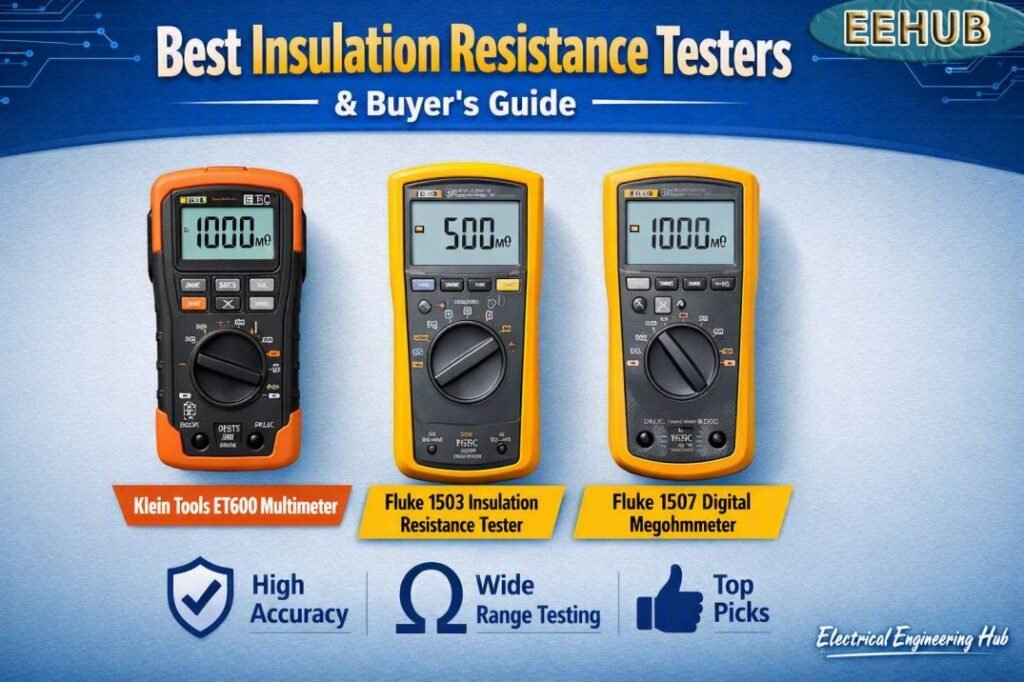
Table of Contents
Table of Contents
Best Insulation Resistance Testers
1. Klein Tools ET600 Multimeter
The Klein Tools ET600 is a practical option for electricians who want insulation testing combined with other electrical measurement functions. Its compact design makes it useful for troubleshooting panels, wiring, and electrical equipment without carrying several separate instruments.
For occasional insulation checks, a multifunction meter can be more convenient than a dedicated megohmmeter. It is particularly useful for technicians who already rely on Klein Tools equipment and want a familiar interface.
The main advantage is versatility. Instead of using a meter only for insulation resistance, you can use a multifunction instrument for routine electrical troubleshooting as well.
Why Consider the Klein ET600?
- Useful for electrical troubleshooting
- Compact field-friendly design
- Suitable for electricians and maintenance personnel
- Combines insulation-related testing with other measurements
- Convenient for service work where portability matters
Ready to add a versatile insulation-testing meter to your electrical toolkit? Check the Klein Tools ET600 Multimeter on Amazon for current availability and pricing.
2. Fluke 1503 Insulation Resistance Tester
The Fluke 1503 is a strong option for electricians and maintenance professionals who need a dedicated insulation resistance tester from an established test-equipment manufacturer.
Its design is aimed at practical field measurements rather than laboratory-only applications. It can be used for checking insulation in electrical installations, motors, cables, and other equipment where insulation condition is important.
One of its biggest benefits is usability. When performing repeated tests, an instrument that is straightforward to operate can reduce mistakes and speed up maintenance work.
Fluke 1503 Highlights
- Dedicated insulation resistance testing
- Multiple test-voltage options
- Designed for field troubleshooting
- Suitable for preventive maintenance
- Fluke reputation for professional test equipment
- Useful for electrical installation verification
For contractors, industrial electricians, and maintenance teams, this model is worth considering when dependable insulation testing is more important than having numerous unrelated functions.
If you need a professional-grade instrument for routine insulation checks, check the Fluke 1503 Insulation Resistance Tester on Amazon and compare today's price before buying.
3. Fluke 1507 Digital Megohmmeter Resistance Tester
The Fluke 1507 is designed for professionals who need more flexibility when performing insulation resistance measurements. It is particularly suitable for technicians who routinely test motors, cables, switchgear, control circuits, and electrical installations.
A professional megohmmeter should do more than produce a resistance number. Test voltage selection, measurement stability, safety functions, and ease of operation all influence how useful the instrument becomes during real maintenance work.
The Fluke 1507 is therefore a good candidate for users who perform insulation testing regularly rather than only once or twice a year. Read Complete guide on Fluke 1507 Insulation Tester Megger here.
Fluke 1507 vs Fluke 1503
| Consideration | Fluke 1503 | Fluke 1507 |
|---|---|---|
| Basic insulation testing | Excellent | Excellent |
| Professional maintenance | Excellent | Excellent |
| Testing flexibility | Good | Very good |
| Field troubleshooting | Very good | Very good |
| Frequent insulation testing | Suitable | Especially suitable |
| Best for | Routine professional work | More demanding applications |
Looking for greater flexibility for regular insulation testing? See the Fluke 1507 Digital Megohmmeter Resistance Tester on Amazon and check the latest customer reviews and pricing.
Fluke 1507 vs 1587 Comparison
The Fluke 1507 vs 1587 comparison mainly comes down to testing needs and additional diagnostic features. Both are professional insulation resistance testers, but the 1587 combines insulation testing with broader multimeter functionality.
| Feature | Fluke 1507 | Fluke 1587 |
|---|---|---|
| Insulation test | 50–1000 V DC | 50–1000 V DC |
| Insulation resistance | Up to 10 GΩ | Up to 10 GΩ |
| Multimeter functions | Limited | Advanced |
| Best suited for | Insulation testing | Testing + troubleshooting |
For a dedicated insulation tester, the 1507 can be practical, while the 1587 offers greater versatility for technicians who need one instrument for multiple electrical tests. See our detailed Fluke 1507 vs 1587 comparison for specifications and buying considerations when choosing among the Best Insulation Resistance Testers.
How to Choose the Right Insulation Tester
The correct instrument depends on the application. Before buying, consider these factors.
Test Voltage
Different electrical systems require different insulation test voltages. Common ranges include 250 V, 500 V, 1,000 V, and higher values on specialized equipment.
Never select a test voltage simply because it is higher. Always follow the equipment manufacturer's instructions and the applicable testing standard.
Resistance Range
Insulation resistance is usually expressed in megohms or gigohms. A tester with a wide measurement range gives you greater flexibility when checking both healthy and deteriorated insulation.
Safety Rating
Electrical testing can expose the technician to dangerous voltage. Look for an appropriate CAT rating, robust test leads, proper input protection, and a reputable manufacturer.
Automatic Discharge
Cables, motors, and other equipment can retain electrical charge after a DC insulation test. An automatic discharge function is an important safety feature because it helps remove stored charge after testing.
Ease of Use
A complicated tester can slow down field work. Look for a clear display, easy test-voltage selection, accessible controls, and a useful test-lock feature.
Difference Between Megger and Insulation Tester
A Megger is a well-known brand name often used for insulation resistance testing, while an insulation tester is the broader term for the instrument itself. Both measure insulation resistance, but modern testers may offer additional functions such as PI, DAR, voltage selection, and continuity testing.
| Feature | Megger | Insulation Tester |
|---|---|---|
| Meaning | Brand and commonly used term | General instrument category |
| Main Test | Insulation resistance | Insulation resistance |
| Test Voltage | Typically 50–5000 V+ | Depends on model |
| Extra Functions | Varies by model | May include PI, DAR, continuity |
Understanding the difference helps when comparing the Best Insulation Resistance Testers for cables, motors, transformers, and electrical installations.
For a detailed comparison, see our guide on the Difference Between Megger and Insulation Tester to choose the right testing instrument.
Where Insulation Resistance Testing Fits Into Maintenance
Insulation testing is commonly included in preventive maintenance programs. It can help detect deterioration before a fault becomes serious.
Typical applications include:
- Motor winding testing
- Power cable insulation checks
- Transformer maintenance
- Switchgear testing
- Generator inspection
- Control circuit verification
- Building wiring checks
- Electrical installation commissioning
Temperature and moisture can influence insulation readings, so test conditions should be recorded when results are being compared over time. Trending readings is often more useful than judging one measurement in isolation.
For the correct test voltage, preparation procedure, and interpretation approach, see our IEC Standard for Insulation Resistance Test guide before performing field measurements.
How to Use Megger Insulation Tester 1000V
Using a 1000V Megger insulation tester correctly helps identify insulation deterioration before it causes faults or equipment damage. First, isolate and de-energize the circuit, then verify that no voltage is present.
| Step | Action |
|---|---|
| 1 | Disconnect and isolate the equipment |
| 2 | Select the 1000V test range |
| 3 | Connect the test leads |
| 4 | Start the insulation resistance test |
| 5 | Record the MΩ reading |
Hold the test until the reading stabilizes, then discharge the circuit safely after testing. Always follow the equipment manufacturer’s limits and applicable safety procedures.
For a detailed procedure, see our guide on How to Use Megger Insulation Tester 1000V. Choosing from the Best Insulation Resistance Testers also makes it easier to match test voltage, measurement range, and safety features to your application.
Best Megger Insulation Testers 1000V
For testing high-voltage insulation in motors, cables, switchgear, and industrial equipment, a 1000V insulation tester provides a useful balance of testing capability and practical field use. The best megger insulation tester 1000v models typically offer selectable test voltages, clear resistance readings, automatic discharge, and rugged construction for electrical maintenance work.
| Feature | What to Look For |
|---|---|
| Test voltage | Up to 1000V DC |
| Insulation range | High MΩ to GΩ range |
| Safety | Automatic discharge and CAT-rated inputs |
| Display | Digital, easy-to-read LCD |
| Applications | Motors, cables, panels, transformers |
| Useful functions | PI/DAR testing and test timer |
When comparing the Best Insulation Resistance Testers, pay attention to measurement range, accuracy, safety features, battery life, and the type of equipment you regularly service. A 1000V model is particularly useful for technicians who need more testing flexibility than basic low-voltage insulation testers provide.
Best Megger Insulation Testers 5000V
For high-voltage cable, transformer, motor, and switchgear testing, a 5000V insulation resistance tester provides the test voltage needed for demanding electrical maintenance work. When comparing the Best Insulation Resistance Testers, look for stable test output, wide resistance measurement range, safety features, and clear digital readings.
| Feature | What to Look For |
|---|---|
| Test Voltage | Up to 5000V DC |
| Main Applications | Cables, motors, transformers, switchgear |
| Resistance Range | High MΩ to GΩ/TΩ |
| Key Features | PI/DAR, auto discharge, data logging |
A quality best megger insulation tester 5000v should also offer reliable insulation diagnostics and safe discharge after testing. For detailed models, specifications, and buying recommendations, see our dedicated guide to the Best Megger Insulation Testers 5000V.
Best Megger Insulation Tester 10kV
For high-voltage cable, transformer, motor, and switchgear testing, a 10 kV insulation tester provides the higher test voltage needed for demanding maintenance work. When comparing the Best Insulation Resistance Testers, look for high measurement ranges, PI/DAR testing, strong safety features, and reliable data recording.
| Feature | What to Look For |
|---|---|
| Test voltage | Up to 10,000 V DC |
| Applications | Cables, motors, transformers, switchgear |
| Key tests | Insulation resistance, PI, DAR |
| Safety | Overvoltage protection and discharge function |
A quality megger 10kv insulation tester should also offer clear readings and stable performance in industrial environments. For detailed models, specifications, and buying recommendations, see our guide to the Best Megger Insulation Tester 10kV options before choosing a tester.
Best Digital Insulation Testers
Digital insulation testers make insulation resistance testing faster and easier to interpret, especially when checking cables, motors, switchgear, and electrical installations. Look for a tester with suitable test voltages, a clear digital display, automatic discharge, and reliable safety features.
| Feature | What to Look For |
|---|---|
| Test voltage | 250V, 500V, 1000V or higher |
| Measurement | High resistance in MΩ/GΩ |
| Display | Clear digital LCD |
| Safety | Auto-discharge and live-circuit detection |
| Best use | Cables, motors, panels, and equipment |
When comparing the Best Digital Insulation Testers, consider the application and required test voltage rather than choosing solely by price.
For detailed model comparisons, specifications, and buying advice, see our guide to Best Digital Insulation Testers. This can help you choose a tester that matches your electrical testing requirements.
Best Industrial Megger Insulation Tester
For industrial maintenance, the best industrial megger insulation tester should provide high test voltages, reliable insulation resistance readings, and strong safety features. Megger offers professional testers suitable for motors, transformers, switchgear, cables, and other high-voltage equipment.
| Feature | Recommended for Industrial Use |
|---|---|
| Test voltage | 500V–10kV+ |
| Resistance range | Up to hundreds of GΩ |
| Key tests | Insulation resistance, PI, DAR |
| Safety | Automatic discharge and CAT rating |
| Best use | Motors, cables, transformers, switchgear |
When comparing the Best Insulation Resistance Testers, consider test voltage, measurement range, data logging, battery life, and portability. For demanding maintenance programs, a 5kV or 10kV Megger can provide more suitable testing capability than basic handheld models. See our detailed guide to the best industrial megger insulation tester for recommended models, features, and selection tips.
Important Testing Safety Tips
Always isolate the equipment before connecting an insulation tester. Verify the circuit is de-energized using an appropriate voltage-testing procedure.
Disconnect sensitive electronic equipment before applying a high DC test voltage. Devices such as variable-frequency drives, electronic controls, surge protection components, and other solid-state equipment may not be designed for megohmmeter testing.
After completing the test, allow the instrument to discharge the circuit and verify that no dangerous voltage remains.
Never rely on an insulation resistance reading as the only indication that equipment is safe to energize.
Which Insulation Tester Should You Buy?
For electricians who want multifunction capability, the Klein Tools ET600 is an attractive choice. It makes sense when general electrical troubleshooting is just as important as insulation measurements.
A basic Megohmmeter Insulation Tester can be appropriate for budget-conscious maintenance users who primarily need high-resistance testing.
The Fluke 1503 is a strong professional choice for routine electrical maintenance, while the Fluke 1507 is better suited to users who need greater flexibility and perform insulation testing frequently.
My recommendation is to select the tester according to your equipment and testing procedure rather than simply choosing the most expensive model.
For a deeper explanation of acceptable procedures and standards, visit our IEC Standard for Insulation Resistance Test resource before starting a formal inspection.
MIT1525 15 kV Review: Is It a Good High-Voltage Tester?
The MIT1525 is a 15 kV insulation resistance tester designed for demanding electrical maintenance and diagnostic work. In this MIT1525 15 kV Review, its high test voltage makes it particularly useful for medium-voltage cables, transformers, switchgear, and other high-voltage assets.
| Feature | MIT1525 |
|---|---|
| Maximum test voltage | 15 kV |
| Primary use | High-voltage insulation testing |
| Suitable for | Cables, transformers, switchgear |
| Best suited for | Professional electrical testing |
For buyers comparing the Best Insulation Resistance Testers, the MIT1525 stands out when a standard 1 kV or 5 kV tester is not enough. Its advanced testing capability makes it a strong choice for engineers and maintenance teams working on critical high-voltage equipment.
For detailed specifications, applications, and testing performance, see our complete MIT1525 15 kV Review.
Final Buying Advice
The best insulation tester is one that matches the voltage level, equipment type, resistance range, and safety requirements of your work. For occasional electrical troubleshooting, a multifunction instrument may provide better value. For regular preventive maintenance, a dedicated professional megohmmeter is usually the better investment.
Before purchasing, compare the available test voltages, measurement range, safety category, automatic discharge, build quality, warranty, and replacement accessories. Also check the manufacturer's instructions for the equipment you intend to test.
Related Guides & Testers
- Insulation Resistance Testing Standards
- Insulation Resistance Testing Procedures
- Fluke 1587 Insulation Multimeter
Frequently Asked Questions
What is an insulation resistance tester used for?
An insulation resistance tester applies a controlled DC voltage to electrical insulation and measures the resulting resistance. It is commonly used on cables, motors, transformers, switchgear, generators, and electrical installations.
What is a good insulation resistance value?
There is no single value that applies to every electrical system. The acceptable result depends on equipment voltage, insulation type, applicable standards, manufacturer requirements, temperature, and testing conditions. Compare results with the relevant specification rather than relying on one universal number.
Can I use a normal multimeter for insulation testing?
A standard multimeter can measure resistance, but its test voltage and resistance range are generally not equivalent to a dedicated insulation tester. Insulation testing requires a controlled higher DC test voltage to assess insulation condition properly.
How often should insulation resistance testing be performed?
The frequency depends on the equipment, operating environment, maintenance program, and applicable requirements. Motors and cables in demanding industrial environments may require more frequent testing than equipment in clean, dry conditions. Follow the manufacturer's maintenance recommendations and your site's testing procedure.
Is a megohmmeter safe to use?
A megohmmeter can be used safely when the manufacturer's instructions and proper electrical safety procedures are followed. The circuit must be isolated, sensitive equipment should be disconnected when required, appropriate PPE should be used, and stored electrical charge must be discharged after testing.
If your testing work involves standards-based acceptance testing, read our IEC Standard for Insulation Resistance Test guide alongside this buyer's guide. It can help you understand the testing requirements before selecting and using an instrument.
Get new guides in your feed. Follow Electrical Insights on LinkedIn for new electrical standards guides, calculators and design tips from Azad Circuit Hub.
#BestInsulationResistanceTesters, #InsulationResistanceTester, #Megohmmeter, #InsulationTesting, #ElectricalTesting, #ElectricalSafety, #MeggerTester, #ElectricalTestEquipment, #InsulationTest, #Electricians
