
Fluke 1507 vs 1587: Which Insulation Tester Should You Buy?
Choosing the right insulation tester depends on whether you need a dedicated megohmmeter or a more complete electrical troubleshooting instrument. In the Fluke 1507 vs 1587 comparison, both meters provide professional insulation resistance testing, but the Fluke 1587 adds significantly more diagnostic functions.
As an electrical engineer, I have found that insulation testing is most useful when it is combined with proper visual inspection, continuity checks, and circuit diagnostics. A good insulation resistance tester should not simply produce a high resistance reading; it should help you understand what is happening in the circuit.
The Fluke 1507 is designed primarily for insulation resistance and basic electrical testing. The Fluke 1587 combines insulation testing with a full digital multimeter, making it more suitable for technicians who regularly troubleshoot electrical equipment.
Fluke 1507 vs 1587: Quick Comparison
| Feature | Fluke 1507 | Fluke 1587 |
|---|---|---|
| Insulation resistance | Yes | Yes |
| Test voltages | 50, 100, 250, 500, 1000 V | 50, 100, 250, 500, 1000 V |
| Insulation range | Up to 10 GΩ | Up to 2 GΩ |
| Digital multimeter | Basic electrical measurements | Full-featured DMM |
| AC/DC voltage | Yes | Yes |
| Resistance | Yes | Yes |
| Continuity | Yes | Yes |
| Capacitance | No | Yes |
| Frequency | No | Yes |
| Diode test | No | Yes |
| Min/Max recording | No | Yes |
| Low-pass filter | No | Yes |
| Temperature measurement | No | Yes, with compatible probe |
| Motor drive diagnostics | Limited | More suitable |
| Best suited for | Insulation testing | Insulation testing + troubleshooting |
The important point in the Fluke 1507 vs 1587 comparison is that the 1507 focuses on insulation resistance testing, while the 1587 is intended to cover a much wider range of electrical maintenance tasks.
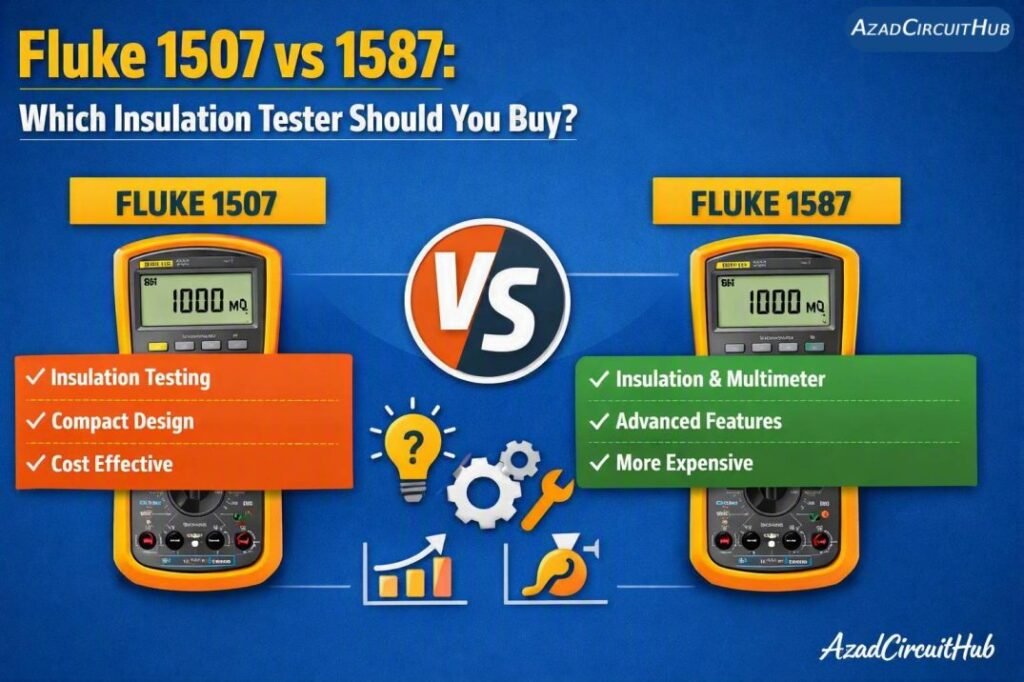
Table of Contents
Table of Contents
Fluke 1507: What Do You Get?
The Fluke 1507 is a compact insulation multimeter aimed at electricians, maintenance technicians, and electrical engineers who primarily need insulation resistance measurements.
It provides selectable test voltages of 50 V, 100 V, 250 V, 500 V, and 1000 V. This makes it practical for testing many low-voltage electrical systems, motors, transformers, cables, and control wiring where the appropriate test voltage has been established.
A major advantage is its straightforward operation. You select the required insulation test voltage, connect the leads, and perform the test. The meter is also relatively compact compared with multifunction insulation diagnostic instruments.
For technicians who already own a good digital multimeter, the 1507 can make sense because it fills the insulation-testing gap without paying for additional troubleshooting functions.
Key Fluke 1507 features
- 50 V to 1000 V insulation test voltages
- Insulation resistance measurement up to 10 GΩ
- Automatic discharge of capacitive voltage
- Continuity testing
- AC/DC voltage measurement
- Resistance measurement
- Compact handheld design
- Professional electrical maintenance applications
If your work mainly involves preventive maintenance, cable testing, motor insulation checks, and electrical installation inspection, the Fluke 1507 can be a practical choice.
Buying the Fluke 1507
If you already have a quality DMM and need a dedicated insulation tester, check the current Fluke 1507 on Amazon for availability, seller information, and current pricing before purchasing.
Fluke 1587: What Makes It Different?
The Fluke 1587 takes a different approach. Instead of functioning mainly as an insulation tester, it combines insulation resistance testing with a more capable digital multimeter.
This distinction matters in troubleshooting situations. An electrician may begin with an insulation resistance test and then need to measure voltage, resistance, current, capacitance, frequency, or temperature. With the 1587, many of these measurements can be performed with the same instrument.
The Fluke 1587 also includes a low-pass filter that can be useful when working around variable-frequency drives and other systems where unwanted high-frequency components can affect measurements.
Its Min/Max recording function is another useful feature for troubleshooting intermittent electrical conditions.
Key Fluke 1587 features
- Five selectable insulation test voltages
- Insulation resistance testing
- True-RMS electrical measurements
- AC/DC voltage measurement
- Resistance and continuity
- Capacitance measurement
- Frequency measurement
- Diode testing
- Temperature measurement with compatible accessories
- Min/Max recording
- Low-pass filtering
- Automatic discharge of capacitive voltage
For industrial maintenance, the additional functions can reduce the need to carry separate instruments.
Fluke 1507 vs 1587 for Motors and Cables
Both instruments can be used for insulation resistance testing, but the appropriate test method depends on the equipment being tested.
For motors, technicians commonly check winding insulation to ground and compare readings between phases where applicable. A single insulation reading should not be treated as a complete motor health assessment. Temperature, motor size, winding condition, contamination, moisture, and test duration can all affect the result.
For cables, the correct test voltage and acceptance criteria should come from the applicable standard, manufacturer documentation, or maintenance procedure. Never apply a megohmmeter to an energized circuit.
| Application | Fluke 1507 | Fluke 1587 |
|---|---|---|
| Motor insulation testing | Excellent | Excellent |
| Cable insulation checks | Excellent | Excellent |
| Control wiring | Excellent | Excellent |
| Panel troubleshooting | Good | Excellent |
| VFD troubleshooting | Limited | Better suited |
| General DMM work | Basic | Excellent |
| Preventive maintenance | Excellent | Excellent |
If insulation testing is only one part of your maintenance routine, the 1587's broader measurement capability becomes more valuable.
Fluke 1577 vs 1587
Another comparison worth understanding is Fluke 1577 vs 1587. Both are insulation multimeters, but the 1587 is positioned as the more feature-rich troubleshooting instrument.
The 1577 combines insulation resistance testing with digital multimeter functions, making it more versatile than a dedicated insulation tester. The 1587 adds further diagnostic capabilities, including functions useful for industrial troubleshooting.
| Category | Fluke 1577 | Fluke 1587 |
|---|---|---|
| Insulation testing | Yes | Yes |
| DMM functionality | Yes | Yes |
| Industrial troubleshooting | Good | More comprehensive |
| Advanced diagnostic functions | Fewer | More |
| VFD-related measurements | More limited | Low-pass filter |
| Typical user | Maintenance electrician | Industrial electrical technician/engineer |
The choice between these two depends on how often you use the additional DMM and diagnostic features.
Fluke 1507 vs 1503
The Fluke 1507 vs 1503 comparison is more straightforward. The 1507 provides a wider range of insulation test voltages and is intended for more demanding professional applications.
The 1503 is a simpler insulation tester designed around essential insulation and electrical measurements. For technicians who only need basic insulation testing, it can be sufficient. For equipment that requires a 1000 V insulation test, the 1507 offers a clear functional advantage.
Which One Should You Buy?
The Fluke 1507 is usually the more logical choice when insulation resistance testing is the primary requirement. It is simpler, focused, and can pair well with an existing professional multimeter.
The Fluke 1587 is more appropriate when you want one instrument to handle insulation testing and a wider range of electrical troubleshooting tasks.
A useful way to decide is to consider your existing toolbox.
Choose the Fluke 1507 if:
- You already own a good digital multimeter.
- Insulation testing is your main requirement.
- You regularly test motors, cables, panels, and wiring.
- You want a dedicated professional insulation tester.
- You prefer a straightforward instrument.
Consider the Fluke 1587 if:
- You want insulation testing and DMM functions in one instrument.
- You work with industrial machinery.
- You troubleshoot VFD-driven equipment.
- You need frequency, capacitance, temperature, and Min/Max functions.
- You want greater versatility from a single meter.
For a broader look at insulation resistance instruments and their applications, see our guide to best insulation resistance tester options before making a final purchase.
Fluke 1507 vs 1587: Price and Value
Price should not be the only consideration. The 1507 can provide better value when you already have a capable DMM because you are not paying for functions you may rarely use.
The 1587 can offer stronger overall value for technicians who would otherwise carry both a megohmmeter and a multifunction digital multimeter.
When comparing Amazon listings, check the exact model number, included test leads, probes, temperature accessories, warranty terms, and seller information. Professional Fluke instruments can be offered in different package configurations.
Check the Fluke 1587 on Amazon
If you need a combined insulation tester and digital multimeter, check the Fluke 1587 on Amazon for the latest price and package contents. Availability and pricing can change, so verify the listing before ordering.
Insulation Testing Safety Tips
Insulation resistance testing involves applying a test voltage to the circuit. The equipment must be properly isolated before testing.
Always follow the manufacturer's instructions and your site's electrical safety procedure. Disconnect sensitive electronic devices before applying a megohmmeter test where required. Variable-frequency drives, PLCs, electronic controls, surge protection devices, and other connected electronics may require isolation.
Before touching conductors after testing, allow the instrument to complete its discharge function and verify the circuit is safe.
For additional models and buying considerations, our guide to best insulation resistance testers covers other options for electrical maintenance and field testing.
Frequently Asked Questions
Is the Fluke 1507 better than the Fluke 1587?
They serve different needs. The 1507 is focused on insulation resistance testing, while the 1587 combines insulation testing with more extensive digital multimeter and troubleshooting functions.
What is the main difference between Fluke 1507 and 1587?
The main difference is functionality. The 1507 is a dedicated insulation multimeter with essential electrical measurements, while the 1587 adds more advanced DMM and diagnostic capabilities.
Can the Fluke 1507 test motor insulation?
Yes. The Fluke 1507 can perform insulation resistance tests on suitable de-energized motors. The correct test voltage and acceptance criteria should be based on the motor manufacturer's instructions and applicable maintenance standards.
Can the Fluke 1587 be used as a regular multimeter?
Yes. The Fluke 1587 includes conventional digital multimeter functions in addition to insulation resistance testing. This makes it useful for technicians who perform both preventive maintenance and electrical troubleshooting.
Is a 1000 V insulation test always required?
No. The appropriate insulation test voltage depends on the equipment, circuit voltage, manufacturer's instructions, and applicable testing procedure. Applying an unnecessarily high test voltage can damage equipment that is not designed for it.
Final Buying Considerations
The Fluke 1507 and 1587 are aimed at slightly different users. The 1507 makes sense when reliable insulation resistance testing is the main objective and a separate DMM is already available. The 1587 makes more sense when you want one professional instrument that can move from insulation testing into general electrical troubleshooting.
Before ordering, compare the current Amazon price, included accessories, warranty, and exact model configuration. Also consider how frequently you will use the additional diagnostic functions. That practical assessment often matters more than simply choosing the model with more features.
Follow Us on Social:
Subscribe our Newsletter on Electrical Insights for latest updates from Azad Circuit Hub
#Fluke1507, #Fluke1587, #InsulationTester, #FlukeMultimeter, #ElectricalTesting, #InsulationResistance, #ElectricalTesters, #ElectricianTools, #Megohmmeter, #FlukeTools
