
EV Charging Levels Explained: Level 1 vs 2 vs 3 (DC Fast) + Connector Types
Choosing the right EV charger becomes much easier when you understand how charging speed, voltage, power output, and connector design work together. The three common charging categories are Level 1, Level 2, and Level 3 DC fast charging. Each serves a different purpose, from overnight home charging to rapid charging on highways.
As an electrical engineer with experience in electrical systems, power equipment, and renewable energy applications, I look at EV charging from both the consumer and electrical-design side. The important question is not simply which charger is fastest. It is whether the charging equipment matches your vehicle, electrical service, daily driving needs, and installation conditions.
This guide explains EV charging levels, charger types, connector standards, charging speeds, and the equipment worth considering for home and travel use.
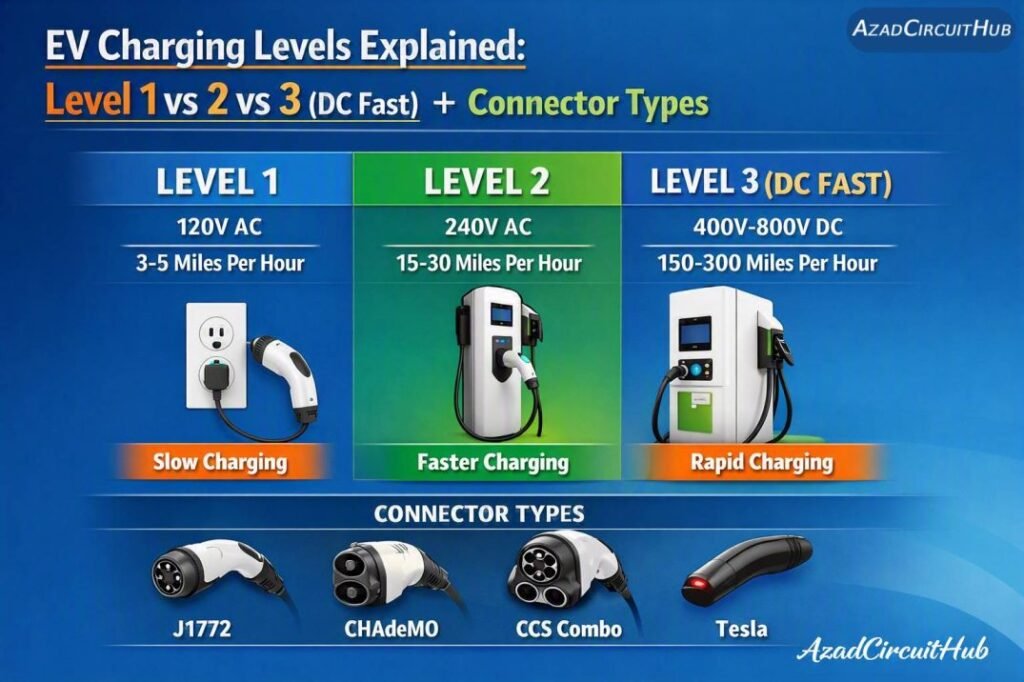
Table of Contents
Table of Contents
EV Charging Levels at a Glance
The main difference between EV charging levels is the electrical supply and charging power available to the vehicle. Level 1 normally uses a standard household outlet, while Level 2 requires a higher-power AC circuit. Level 3 uses DC power and is primarily found at commercial charging stations.
| Charging Type | Typical Supply | Typical Power | Approx. Range Added | Common Location | Charging Speed |
|---|---|---|---|---|---|
| Level 1 | 120V AC | 1.2–1.9 kW | 2–5 miles/hour | Home | Slow |
| Level 2 | 208–240V AC | 3.3–19.2 kW | 12–80 miles/hour | Home, workplace, public | Fast |
| Level 3 DC Fast | High-voltage DC | 50–350+ kW | 100–200+ miles in 20–30 min* | Public stations | Very fast |
*Actual charging speed depends on the EV, battery temperature, state of charge, charger rating, and other factors.
These figures are general ranges rather than guarantees. A vehicle capable of accepting only 7.2 kW, for example, cannot charge at 11.5 kW simply because a higher-rated EVSE is installed.
What Is Level 1 EV Charging?
Level 1 is the simplest form of EV charging. It typically uses a 120V AC household outlet in North America and can be useful for drivers who have a low daily mileage requirement.
A Level 1 EV charger generally delivers around 1.2 to 1.9 kW. Charging can therefore take many hours, particularly for a larger battery.
For example, adding roughly 30 miles of range may require considerably longer on Level 1 than on a properly installed Level 2 system.
When Level 1 Makes Sense
Level 1 can be practical when:
- Daily driving is relatively low
- The vehicle remains parked overnight
- A dedicated 240V circuit is not available
- You are renting and cannot modify the electrical system
- You want a basic backup charging option
The major advantage is simplicity. You usually do not need a dedicated high-power circuit, although the outlet and circuit should still be inspected for proper condition and loading.
What Is Level 2 EV Charging?
Level 2 is the most important category for home EV charging. It normally operates from a 208–240V AC supply and can provide substantially more power than Level 1.
Depending on the EVSE and vehicle, residential Level 2 charging can range from approximately 3.3 kW to 19.2 kW. Many residential installations fall between 7.2 and 11.5 kW.
The actual charging rate is limited by the lowest-rated component in the system. This includes the EV’s onboard AC charger, the EVSE, circuit capacity, and installation configuration.
Why Homeowners Choose Level 2
A Level 2 installation can restore significantly more driving range during an overnight charging period. It is particularly useful for commuters, households with multiple EVs, and drivers who regularly cover longer distances. For detailed comparison in level 1 and level 2 charging, follow our guide here: level 1 vs level 2 charging at home
Before installation, an electrician should check the service capacity, panel condition, breaker rating, conductor sizing, grounding, and local electrical requirements.
Looking for a dedicated home charging solution? Check current Amazon options for a Best Level 2 EV Charger and compare amperage, connector type, cable length, and smart features before purchasing.
What Is Level 3 DC Fast Charging?
Level 3 is commonly called DC fast charging. Unlike Level 1 and Level 2, the charging station supplies DC power directly to the vehicle’s battery system after the charging equipment manages the required conversion and control functions.
DC fast chargers can range from approximately 25 kW to 350 kW or more. However, the vehicle determines how much power it can actually accept.
Charging power also changes during a charging session. An EV may accept high power at a lower state of charge and gradually reduce the rate as the battery approaches a high state of charge.
Where DC Fast Chargers Are Used
Level 3 equipment is commonly installed at:
- Highway rest areas
- Public charging networks
- Shopping centers
- Fleet depots
- Service stations
- Commercial parking facilities
The equipment is much larger and more expensive than typical residential EVSE, making it unsuitable for most home installations. Know more about DC Fast Charging (Level 3) here.
EV Charger Types You Should Know
Understanding different ev charger types helps prevent confusion because “charger” is often used to describe both the charging station and the vehicle’s onboard charging equipment.
| EV Charger Type | Power Delivery | Typical Use |
|---|---|---|
| Portable Level 1 EVSE | AC | Emergency and overnight charging |
| Hardwired Level 2 EVSE | AC | Permanent home installation |
| Plug-in Level 2 EVSE | AC | Flexible residential charging |
| Smart EVSE | AC | Scheduled and connected charging |
| DC Fast Charger | DC | Public rapid charging |
| Portable EV charger | Usually AC | Travel and backup use |
Technically, an EVSE controls and safely delivers electrical power to the vehicle. The vehicle’s onboard charger converts AC electricity into DC for battery storage during AC charging.
EV Charging Levels 1 2 3: How Do They Compare?
When comparing ev charging level 1 2 3, charging speed is only one factor. Installation requirements and vehicle compatibility are equally important.
| Factor | Level 1 | Level 2 | Level 3 DC Fast |
|---|---|---|---|
| Voltage | Usually 120V AC | Usually 208–240V AC | High-voltage DC |
| Home suitability | Excellent | Excellent | Usually impractical |
| Installation | Simple | Dedicated circuit often required | Commercial-grade |
| Typical use | Overnight | Daily home charging | Long-distance travel |
| Equipment cost | Low | Moderate | High |
| Charging speed | Slow | Fast | Very fast |
| Vehicle compatibility | Broad | Broad | Vehicle dependent |
For most EV owners who can install a suitable 240V circuit, Level 2 provides a useful balance between charging speed and residential practicality.
EV Charging Connector Types Explained
Connector selection is critical because an EV charging station is useful only when its connector matches the vehicle or an appropriate approved adapter is available.
The major ev charging connector types used in North America include J1772, NACS, CCS, and CHAdeMO.
| Connector | Charging | Common Application | Notes |
|---|---|---|---|
| J1772 | AC Level 1/2 | Many older/non-Tesla EVs | Established AC connector |
| NACS | AC/DC | Tesla and increasingly other EVs | Also known as SAE J3400 |
| CCS1 | AC/DC | Many North American EVs | Combines J1772 with DC pins |
| CHAdeMO | DC | Older EVs and some legacy networks | Declining use in North America |
| CCS2 | AC/DC | Europe and many other markets | Different from North American CCS1 |
Connector standards vary by market. A cable designed for one region should not automatically be assumed to work with vehicles in another region.
J1772
SAE J1772 has been widely used for AC charging in North America. It supports Level 1 and Level 2 charging and has been fitted to many non-Tesla EVs.
NACS / SAE J3400
The North American Charging Standard, now standardized as SAE J3400, uses a compact connector capable of AC and DC charging. Tesla vehicles have historically used this connector, and adoption by other manufacturers has expanded.
CCS1
CCS1 adds two large DC contacts below the J1772-style upper section. This allows the same vehicle inlet design to support both AC charging and DC fast charging.
CHAdeMO
CHAdeMO was widely used by several earlier EV models and charging networks. It remains relevant for compatible vehicles and existing infrastructure, although newer North American charging deployments have increasingly moved toward other connector standards. Know more about Electric Vehicle Charging Port Types here.
How to Choose a Home EV Charger
The right home EVSE depends on the vehicle and electrical installation rather than the advertised maximum amperage alone.
Check these specifications before buying:
- Vehicle charging capacity: Find the maximum AC charging rate supported by your EV.
- Circuit capacity: Confirm the available electrical service and breaker requirements.
- Plug or hardwire configuration: Choose the installation style appropriate for your location.
- Cable length: A longer cable can make garage or driveway charging more convenient.
- Connector: Confirm the connector matches your vehicle.
- Outdoor rating: Look for suitable weather and enclosure protection if installed outdoors.
- Smart features: Wi-Fi, scheduling, energy monitoring, and load management can be useful.
- Safety certifications: Look for recognized testing and certification appropriate to your market.
For another home-charging option, compare a best ev charger level 2 on Amazon based on connector, current rating, cable length, installation method, and user requirements.
Level 1 vs Level 2 EV Charger
Choosing between Level 1 and Level 2 charging depends mainly on your daily mileage, available electrical capacity, and charging time. Within the broader EV Charging Levels, these two options are designed for home and overnight charging.
| Feature | Level 1 | Level 2 |
|---|---|---|
| Typical voltage | 120V | 208–240V |
| Charging speed | Slow | Faster |
| Installation | Standard outlet | Dedicated circuit usually required |
| Best for | Light daily driving | Regular daily driving |
For a closer look at charging speeds, electrical requirements, and practical home-use differences, see this detailed guide on Level 1 vs Level 2 EV Charger before choosing a setup.
Popular Level 2 EV Chargers to Compare
Several established products are commonly considered by home EV owners, including the ChargePoint Home Flex, Emporia EV Charger, Grizzl-E, and Autel MaxiCharger. Availability, pricing, connector versions, and included accessories can change, so check the current Amazon listing and manufacturer’s specifications before ordering.
| Product | Category | Key Features to Check |
|---|---|---|
| ChargePoint Home Flex | Level 2 | Adjustable charging current, app connectivity |
| Emporia EV Charger | Level 2 | Energy monitoring, smart charging |
| Grizzl-E | Level 2 | Rugged enclosure, residential use |
| Autel MaxiCharger | Level 2 | Smart controls, display/app features |
If you are comparing a famous level 2 ev charger for home use, check the famous level 2 ev charger options on Amazon and verify the exact connector and amperage version before buying.
What Is a Type 2 Electric Car Charger?
A Type 2 electric car charger uses the widely adopted IEC 62196-2 connector for AC charging. Common in Europe and many other markets, it supports single-phase and three-phase charging, typically from around 3.7 kW to 22 kW depending on the vehicle and charging equipment. Unlike the charging level itself, Type 2 describes the connector and interface.
Understanding this distinction helps when comparing EV Charging Levels and connector types. For a deeper explanation, see our guide on what is type 2 EV charger, including its pin configuration, charging speeds, compatibility, and practical applications.
| Feature | Type 2 |
|---|---|
| Standard | IEC 62196-2 |
| Charging | AC |
| Typical power | 3.7–22 kW |
| Common use | Home and public charging |
Does Higher Charging Power Always Mean Faster Charging?
Not necessarily. The EV determines how much power it can accept.
Suppose a home EVSE can provide 11.5 kW, but the vehicle’s onboard AC charger accepts only 7.2 kW. The vehicle will generally charge at its available 7.2 kW limit.
Battery temperature also matters. Cold batteries can restrict charging power, while a high state of charge can cause charging power to taper.
This is particularly important when comparing DC fast charging specifications. A 250 kW charging station does not mean every EV connected to it will receive 250 kW.
EV Charging Safety and Installation
EV charging involves sustained electrical loading, often for several hours. Installation quality therefore matters.
A residential Level 2 circuit should be designed according to the applicable electrical code and equipment instructions. In North America, this commonly involves requirements from the National Electrical Code (NEC), including provisions applicable to continuous loads and EV charging equipment.
Do not rely on an existing receptacle simply because its voltage appears correct. Loose connections, undersized conductors, damaged receptacles, poor terminations, and overloaded circuits can create heat and reliability problems.
For a permanent installation, have the circuit and equipment evaluated by a qualified electrician.
Tethered vs Untethered EV Charger
When comparing home and workplace charging options, the choice between a tethered and untethered unit mainly comes down to cable convenience and flexibility. This is particularly relevant when choosing equipment for different EV Charging Levels.
| Feature | Tethered Charger | Untethered Charger |
|---|---|---|
| Cable | Permanently attached | Removable |
| Convenience | Plug in directly | Connect cable when needed |
| Flexibility | Limited cable options | Works with compatible cables |
| Storage | Cable remains with unit | Cable stored separately |
A tethered unit is convenient for frequent daily charging, while an untethered design provides greater flexibility for drivers who use different cables or vehicles. For a detailed comparison, see our guide to Tethered vs Untethered EV Charger and the key factors to consider before installation.
Frequently Asked Questions
What are the 3 levels of EV charging?
The three common categories are Level 1 AC, Level 2 AC, and Level 3 DC fast charging. Level 1 is the slowest and generally uses a household outlet, Level 2 uses higher-voltage AC for faster home charging, and Level 3 supplies DC power at public fast-charging stations.
Is Level 2 charging better than Level 1?
Level 2 provides substantially faster charging than Level 1, but suitability depends on driving habits and electrical infrastructure. Drivers with low daily mileage may find Level 1 sufficient, while higher-mileage users often benefit from Level 2.
What connector does my EV need?
It depends on the vehicle and market. North American EVs may use J1772, NACS/SAE J3400, CCS1, or other configurations. Check the vehicle manufacturer’s specifications before purchasing an EVSE or adapter.
Can I install a Level 2 charger at home?
Yes, many homes can support Level 2 charging, but the electrical system must have adequate capacity. A qualified electrician should verify the service, circuit, breaker, conductors, grounding, and installation requirements before installation.
Does DC fast charging damage an EV battery?
Modern EVs use battery-management and charging controls to regulate charging power, temperature, and battery conditions. Frequent high-power charging can have different battery-aging effects than slower AC charging, but the impact depends on the vehicle, battery chemistry, temperature, charging pattern, and manufacturer controls.
Final Thoughts
Understanding EV charging levels makes it easier to select charging equipment without paying for specifications your vehicle cannot use. Level 1 is convenient for light-duty overnight charging, Level 2 is designed for faster residential and workplace charging, and Level 3 DC fast charging is intended primarily for rapid public charging.
Connector compatibility is just as important as charging power. Before buying an EVSE, verify your vehicle’s inlet, maximum AC charging rate, electrical supply, installation requirements, and desired cable length.
For most home buyers, the practical comparison is between a portable Level 1 unit and a properly installed Level 2 EVSE. The right choice depends on how much energy you need each day and how quickly you want your vehicle ready for the next trip.
Get new guides in your feed. Follow Electrical Insights on LinkedIn for new electrical standards guides, calculators and design tips from Azad Circuit Hub.
#EVChargingLevels, #EVCharging, #Level1Charging, #Level2Charging, #DCFastCharging, #EVChargers, #ElectricVehicles, #EVChargingGuide, #EVConnectorTypes, #HomeEVCharging
