Electric Vehicle Charging Port Types: Complete Guide to CCS, CHAdeMO, Type 2 & Fast Charging Standards
Electric vehicles are becoming more common on roads worldwide, and understanding Electric Vehicle Charging Port Types is essential for both new EV owners and industry professionals. As charging infrastructure expands, different connectors and standards are used across regions, making it important to know how each system works.
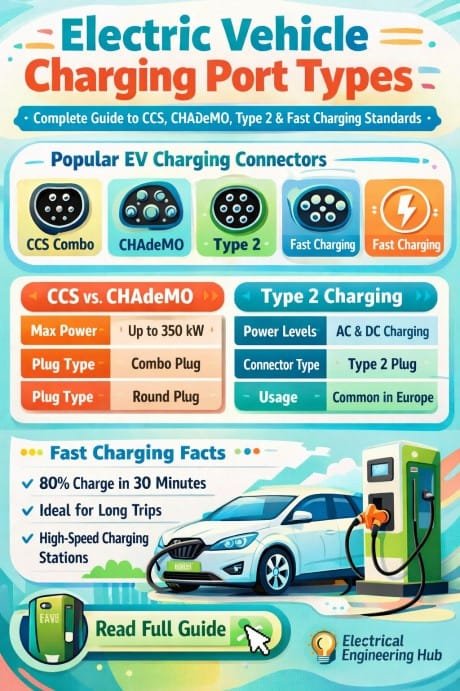
Table of Contents
A clear understanding of Electric Vehicle Charging Port Types helps drivers choose compatible charging stations, avoid charging delays, and make informed decisions when purchasing an electric vehicle. From home charging setups to high-speed highway stations, the connector type plays a major role in charging speed and convenience.
CCS (Combined Charging System) Overview
CCS is one of the most widely adopted standards in Europe, North America, and several emerging markets. It combines AC and DC charging in a single port, making it highly versatile for modern EVs. Many manufacturers prefer CCS because it supports fast charging while maintaining compatibility with regular AC charging stations.
Use our online tool EV Charger Load Calculation Tool
In the broader discussion of Electric Vehicle Charging Port Types, CCS stands out due to its ability to handle high power levels, often up to 350 kW in advanced charging stations. This allows electric vehicles to gain significant range in just minutes during long-distance travel.
| Feature | CCS Charging System |
|---|---|
| Charging Type | AC + DC Combined |
| Maximum Power | Up to 350 kW |
| Common Regions | Europe, North America |
| Key Benefit | Fast and universal compatibility |
CCS is widely considered the future-proof solution due to its integration with modern EV architectures and expanding global support.
CHAdeMO Charging Standard Explained
CHAdeMO is a Japanese fast-charging protocol that was among the earliest DC fast charging systems. It is commonly used by Nissan and Mitsubishi electric vehicles. Although its global adoption has slowed compared to CCS, it still plays a significant role in many regions, especially in Asia.
When analyzing Electric Vehicle Charging Port Types, CHAdeMO is known for its reliable DC fast charging capability and vehicle-to-grid (V2G) support. This allows energy to flow back to the grid in certain applications, making it unique among other standards.
Know more about Electric Vehicle Charging Station Cost
CHAdeMO typically supports charging speeds up to 100 kW, though newer versions aim for higher capacities. However, the industry trend is gradually shifting toward CCS compatibility.
Type 2 AC Charging Port
Type 2 connectors are the standard AC charging solution in Europe and widely used in residential and workplace charging stations. They are designed for slower charging compared to DC fast chargers but are highly efficient for daily use.
In the ecosystem of Electric Vehicle Charging Port Types, Type 2 is considered essential for home charging infrastructure. It supports single-phase and three-phase electricity, allowing flexible charging speeds depending on the power supply.
| Feature | Type 2 Charging Port |
|---|---|
| Charging Type | AC Charging |
| Power Range | Up to 22 kW (home), 43 kW (public) |
| Common Regions | Europe, Asia-Pacific |
| Usage | Home and workplace charging |
Type 2 connectors are often combined with CCS in modern EVs, allowing drivers to use both slow and fast charging networks efficiently.
Know more about ChargePoint Charging Station Cost
Fast Charging Standards and Performance Levels
Fast charging has transformed EV usability by significantly reducing charging time. DC fast charging systems like CCS and CHAdeMO enable rapid energy transfer directly to the battery, bypassing the onboard charger limitations.
Understanding Electric Vehicle Charging Port Types is incomplete without evaluating fast charging performance, as this determines long-distance travel efficiency and charging network usability.
Charging Speed Comparison
| Standard | Charging Type | Typical Speed | 80% Charge Time |
|---|---|---|---|
| CCS | DC Fast Charging | 50–350 kW | 20–40 minutes |
| CHAdeMO | DC Fast Charging | 50–100 kW | 30–60 minutes |
| Type 2 | AC Charging | 7–22 kW | 4–8 hours |
Fast charging stations are typically located on highways, commercial hubs, and urban charging parks to support quick turnaround times.
Regional Adoption and Industry Trends
Different regions have adopted different Electric Vehicle Charging Port Types based on infrastructure and automotive industry influence. Europe strongly favors CCS and Type 2, while Japan continues to support CHAdeMO alongside newer transitions.
Find all about EV Charging Station Code Requirements
China also uses its own GB/T standard, though many international EVs entering the market are now designed with CCS compatibility. This global shift indicates a movement toward standardization, reducing confusion for international EV users.
Manufacturers are increasingly designing vehicles with dual compatibility to ensure access to multiple charging networks. This trend improves convenience and reduces dependency on a single standard.
Compatibility Challenges in EV Charging Networks
One of the main challenges in Electric Vehicle Charging Port Types is compatibility across different charging stations. Not all EVs can use every charger without adapters, and some fast chargers are limited to specific standards.
Drivers often face issues when traveling between regions due to mismatched infrastructure. This is why multi-standard charging stations are becoming more common, offering CCS, CHAdeMO, and Type 2 connectors in a single location. Use our online tool ev battery degradation calculator
Compatibility also affects charging speed, as using adapters or older infrastructure may limit performance even if the vehicle supports faster charging.
Know more about Best 12 Electric Vehicle Charging Stations in New York
Future of Charging Port Technology
The future of Electric Vehicle Charging Port Types is moving toward standardization and higher efficiency. Wireless charging, ultra-fast charging above 500 kW, and universal connectors are being tested to simplify EV usage.
Automakers are also focusing on integrating smart charging systems that communicate with the grid for better energy management. This includes load balancing, renewable energy integration, and vehicle-to-grid technology expansion.
As infrastructure evolves, the number of competing standards is expected to decrease, leading to a more unified global charging ecosystem.
Conclusion
Electric Vehicle Charging Port Types continue to shape the growth of electric mobility worldwide. From CCS and CHAdeMO to Type 2 AC systems, each standard plays a vital role in supporting different charging needs and regional requirements.
Use our online tool for free EV Charger Breaker and Wire Size Calculator
Understanding Electric Vehicle Charging Port Types helps users choose the right vehicle and charging setup while ensuring compatibility with available infrastructure. As technology advances, the industry is steadily moving toward faster, more efficient, and more standardized charging solutions that will define the future of electric transportation.
Follow Us on Social:
Subscribe our Newsletter on Electrical Insights for latest updates from Electrical Engineering Hub
#ElectricVehicleChargingPortTypes,#EVCharging,#EVPorts,#EVChargingStations,#ElectricCars,#EVInfrastructure,#ChargingStandards,#CCS,#CHAdeMO,#Type2Charging
