DC Fast Charging (Level 3) Explained: Cost, Speed & Can You Install One at Home?
DC Fast Charging is the fastest practical way to recharge many electric vehicles without waiting several hours. Unlike AC home charging, it sends direct current to the vehicle’s battery through dedicated charging equipment, bypassing much of the vehicle’s onboard AC charger.
That difference makes a major impact on charging speed. A compatible EV may add hundreds of miles of range during a typical fast-charging session, depending on the vehicle, battery size, charger output, temperature, and state of charge.
As an electrical engineer working with power systems, electrical installations, and renewable energy equipment, I look at EV charging from both the vehicle and electrical-infrastructure side. For homeowners, the important question is not simply how fast a charger can charge. The available electrical service, demand, installation cost, cable size, protection, and utility requirements all matter.
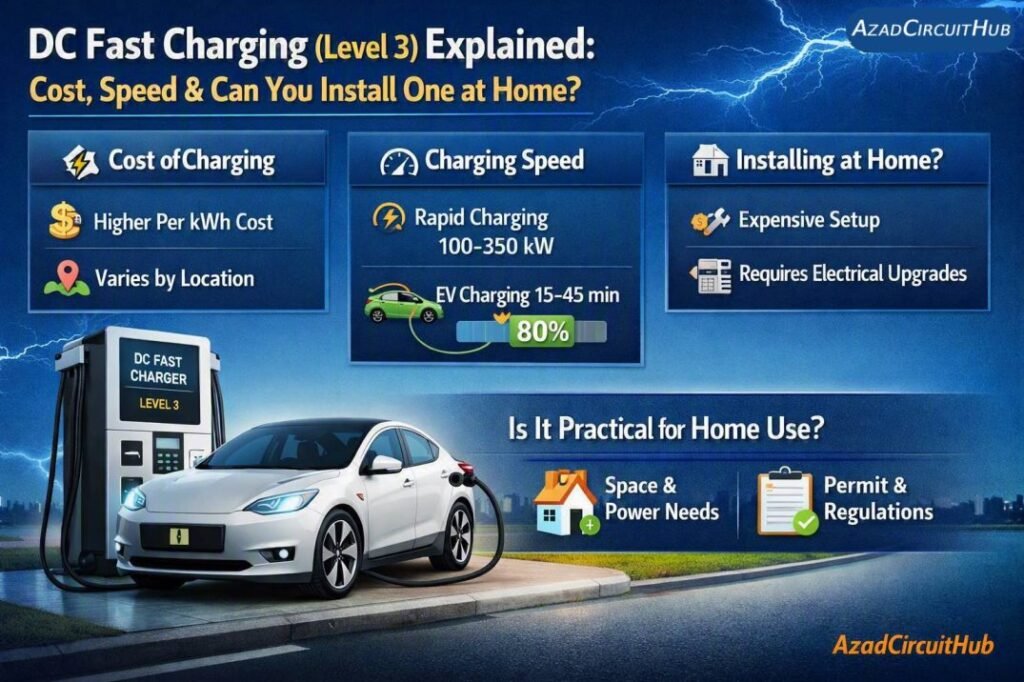
Table of Contents
Table of Contents
DC Fast Charging at a Glance
| Feature | DC Fast Charging / Level 3 | Level 2 AC Charging | Level 1 AC Charging |
|---|---|---|---|
| Typical power | 50–350 kW | 7–19.2 kW | 1.2–1.9 kW |
| Typical voltage | 400–1000 V DC system range | 208–240 V AC | 120 V AC |
| Typical use | Highway, commercial, fleet | Homes, workplaces | Homes, overnight |
| Charging speed | Very fast | Moderate | Slow |
| Installation | Complex | Relatively simple | Usually plug-in |
| Home suitability | Limited | Excellent | Basic |
| Equipment cost | High | Low to moderate | Low |
| Electrical service impact | Very high | Moderate | Low |
The actual charging rate depends on the EV and charger. A 250 kW charging station does not mean every EV will receive 250 kW.
What Is DC Fast Charging?
DC Fast Charging, often called Level 3 charging, supplies DC power directly to the EV battery. In contrast, an AC charger supplies alternating current to the vehicle, where the onboard charger converts it to DC.
A level 3 charger contains substantial power electronics, cooling equipment, control systems, protection devices, and communication hardware. This is why these installations are much larger than residential Level 2 EV chargers.
Charging power can range from roughly 25 kW for smaller systems to 350 kW or more for high-power public charging equipment. Some newer systems are designed for even higher output, although the vehicle must support the corresponding charging rate.
How does a level 3 charger work?
The basic charging process is:
- The EV is connected to the charging connector.
- The charger and vehicle communicate.
- The charger checks battery and charging conditions.
- AC power is converted to controlled DC power inside the station.
- DC power is delivered directly to the battery.
- Charging power changes continuously according to the vehicle’s battery-management system.
This controlled power delivery allows a level 3 EV charger to provide substantially more energy in a short period than conventional residential charging.
How Fast Is Level 3 Charging?
Charging speed varies considerably between vehicles. Battery temperature, state of charge, battery chemistry, charger rating, and vehicle charging limits all affect the actual result.
For example, an EV capable of accepting 150 kW cannot take advantage of a 350 kW station at the full 350 kW rate.
| Charger Rating | Approximate Charging Use | Typical Application |
|---|---|---|
| 25–50 kW | Fast charging | Small commercial sites |
| 60–100 kW | Rapid charging | Public and fleet charging |
| 150 kW | High-speed charging | Highway and commercial sites |
| 250 kW | Ultra-fast charging | Major public charging |
| 350 kW | Very high-power charging | High-end highway networks |
The charging curve is also important. An EV may briefly accept high power when the battery is at a lower state of charge and then reduce power as the battery approaches a higher state of charge.
This means the advertised maximum power should not be treated as the charging speed for the entire session.
Level 3 Charging Station Cost
The level 3 charging station cost can be much higher than the price of a residential Level 2 charger because the equipment requires high-power switching electronics, protection, cooling, communications, and substantial electrical infrastructure.
A small commercial DC charger may cost several thousand dollars, while high-power equipment and complete commercial installations can reach tens of thousands of dollars or more.
| Cost Component | Typical Consideration |
|---|---|
| DC charger | Several thousand dollars to much more |
| Electrical installation | Depends heavily on site |
| Switchgear | May be required |
| Transformer | Possible for high-power installations |
| Trenching | Site dependent |
| Utility upgrade | Potentially significant |
| Permits | Varies by jurisdiction |
| Demand charges | Important for commercial users |
| Maintenance | Higher than residential AC charging |
These figures are planning ranges rather than fixed prices. Local labor, electrical regulations, utility tariffs, equipment brand, power rating, and site conditions can change the final project cost substantially.
Can You Install a DC Fast Charger at Home?
Technically, a DC fast charger at home is possible. Practically, it is not the normal choice for most houses.
A typical residential electrical service may not have enough spare capacity for a 50 kW, 100 kW, or higher charger. For comparison, a 100 kW charger operating at full output draws an enormous amount of power compared with a typical household load.
A proper installation may require:
- A service-capacity assessment
- New distribution equipment
- Larger conductors
- Dedicated overcurrent protection
- Disconnecting equipment
- Grounding and bonding
- Surge protection
- Utility approval
- Permits and inspection
- Potential transformer or service upgrades
For most homeowners, a properly installed Level 2 charger is a much more practical solution.
If your goal is dependable overnight charging, explore our Best Level 2 EV Charger guide to compare residential charging options, installation requirements, and useful features.
Why Level 2 Usually Makes More Sense at Home
A residential Level 2 charger can provide enough energy overnight for many daily driving requirements without requiring the electrical infrastructure associated with a commercial DC station.
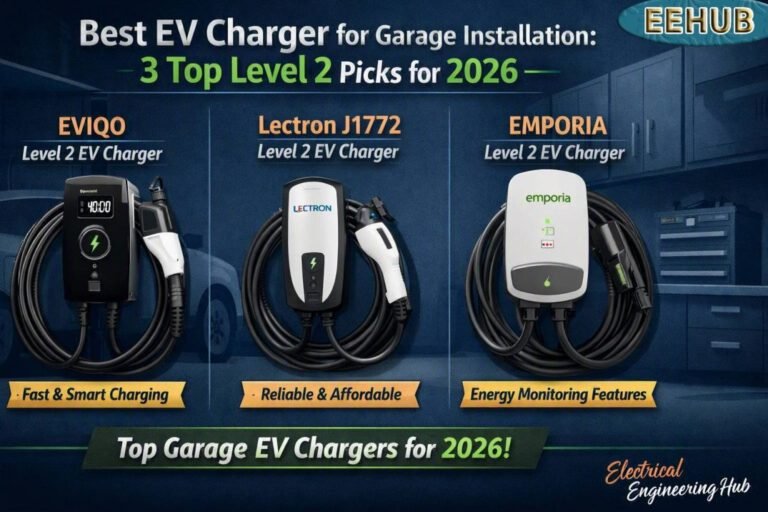
Popular home chargers include models such as the Emporia EV Charger, EVIQO EV Charger, and other 240 V smart EV chargers sold through Amazon and other retailers.
Amazon buying option: If you are shopping for a residential EV charger, the Emporia EV Charger is worth considering for its smart charging controls, energy monitoring features, and home-oriented installation approach. Always confirm the latest model specifications, connector type, amperage, and Amazon availability before purchasing.
For another comparison of residential charging options, see our best ev charger level 2 guide before choosing a unit for your garage.
What Electrical Service Does a Level 3 Charger Need?
The electrical requirement depends on the charger rating.
A small 50 kW charger is already a substantial electrical load. A 150 kW or 350 kW unit can require commercial-scale electrical infrastructure.
For example, at a simplified 400 V DC output, 100 kW corresponds to approximately:
100,000 W ÷ 400 V = 250 A DC
The input side is more complicated because the charger operates through power electronics and may use three-phase AC input. Voltage, efficiency, power factor, and installation design all affect the actual input current.
This is one reason a site assessment is essential before purchasing a high-power charger.
Level 3 Charging Connector Types
Connector compatibility is another important consideration.
| Connector | Common Application |
|---|---|
| CCS | DC fast charging on many EVs |
| NACS | Tesla and increasingly adopted North American standard |
| CHAdeMO | Older EV fast-charging applications |
| GB/T DC | Common in China |
| CCS2 | Widely used in Europe and other markets |
Always check the charging connector supported by your vehicle. An adapter may work in some situations, but compatibility depends on the vehicle, charger, connector standard, and charging network.
Level 3 Charging vs Level 2 Charging
The biggest difference is where the AC-to-DC conversion takes place and how much power the system can deliver.
Level 2 charging sends AC electricity to the vehicle’s onboard charger. The onboard charger converts it into DC for the battery.
A level 3 charger performs the high-power AC-to-DC conversion externally and supplies controlled DC power to the vehicle.
If you are comparing all three charging options, our EV Charging Level 1 vs 2 vs 3 guide explains the differences in charging speed, installation, cost, and practical use.
What Affects DC Fast Charging Speed?
Several factors determine the real charging time:
Battery state of charge
Charging is generally fastest when the battery has a lower state of charge. Power often decreases as the battery approaches a high state of charge.
Battery temperature
A cold or excessively hot battery may limit charging power. Modern EVs use battery thermal management to control temperature.
Vehicle charging limit
The vehicle determines how much power it can accept. A high-rated charging station cannot force an EV to accept more power than its charging system allows.
Charger capacity
The charger itself must have sufficient power available. A shared station may also reduce available output when multiple vehicles are connected.
Battery size
A larger battery generally requires more energy to reach the same state of charge, although charging speed is not determined by battery size alone.
Is a Level 3 EV Charger Worth It for Home Use?
For most homeowners, the economics favor Level 2 charging.
A level 3 EV charger makes more sense where vehicles need rapid turnaround, such as commercial fleets, dealerships, highway charging sites, taxi operations, and high-mileage businesses.
For a homeowner who parks overnight, the additional equipment and electrical infrastructure may provide little practical benefit compared with a well-sized 240 V Level 2 system.
The right approach is to calculate daily energy consumption and determine how much charging time is available. If an EV needs 30 kWh overnight and the home charger can reliably deliver that energy during the available charging window, substantially higher charging power may not provide meaningful everyday value.
Safety and Installation Considerations
High-power EV charging should be treated as a serious electrical installation.
Never size conductors, breakers, disconnects, or other protective equipment solely from the charger’s advertised output. The complete installation must account for continuous load requirements, ambient temperature, conductor installation method, voltage drop, short-circuit conditions, grounding, bonding, and applicable electrical codes.
A qualified electrician should evaluate the service capacity and installation before a high-power charging system is connected.
For residential equipment, choose a charger with appropriate certifications for your market and follow the manufacturer’s installation instructions.
Frequently Asked Questions
Is DC Fast Charging the same as Level 3 charging?
Yes. In common EV terminology, Level 3 refers to high-power DC charging, although the exact power range varies between equipment and standards. Public stations can provide substantially different charging rates.
Can I install a level 3 charger in my garage?
It is technically possible, but the electrical service and installation requirements can make it impractical for many homes. A professional electrical assessment is required before considering a residential high-power installation.
How much does a level 3 charging station cost?
The level 3 charging station cost varies widely with charger power, electrical service, installation, transformer requirements, trenching, permits, and utility upgrades. Commercial installations can cost many thousands of dollars.
Does Level 3 charging damage an EV battery?
Frequent high-power charging can contribute to battery degradation, but modern EVs use battery-management and thermal-control systems to manage charging. The vehicle manufacturer’s recommendations should be followed.
Is Level 2 better than Level 3 for home charging?
They serve different purposes. Level 3 provides much faster charging, while Level 2 generally fits residential overnight charging better because its power requirements and installation costs are substantially lower.
Final Thoughts
DC Fast Charging has transformed EV charging by making long-distance travel and high-mileage operation much more practical. Its high power comes with equally important electrical-infrastructure requirements, however.
For most residential properties, the better planning exercise is to determine daily energy requirements, available charging time, electrical service capacity, and the appropriate Level 2 charger rather than automatically pursuing a commercial-grade DC system.
If you are evaluating chargers for a home installation, compare the electrical rating, connector, cable length, smart controls, safety certifications, warranty, load-management features, and installation requirements before buying. A properly sized residential charger can provide convenient overnight charging without the complexity of a high-power commercial installation.
Get new guides in your feed. Follow Electrical Insights on LinkedIn for new electrical standards guides, calculators and design tips from Azad Circuit Hub.
#DCFastCharging, #Level3Charging, #EVCharging, #ElectricVehicle, #EVCharger, #FastCharging, #EVChargingAtHome, #ElectricCar, #EVInfrastructure, #DCCharger