
Fluke 1587 Insulation Multimeter Review: Worth Buying in 2026?
If you work around motors, control panels, switchgear, generators, or industrial wiring, an insulation tester can save you from problems that a standard multimeter may never detect. The Fluke 1587 FC combines a digital multimeter with insulation resistance testing, making it useful for electricians and maintenance engineers who need more than basic voltage and continuity checks.
As an electrical engineer with hands-on experience around industrial electrical systems, I look at insulation testers from a practical maintenance perspective. The important questions are not only accuracy and specifications, but also whether one instrument can handle routine troubleshooting, preventive maintenance, and insulation testing without becoming inconvenient in the field.
The Fluke 1587 Insulation Multimeter is designed around that idea. It provides conventional multimeter functions while adding insulation resistance measurements up to 2,000 MΩ and test voltages up to 1,000 V DC.
Fluke 1587 Insulation Multimeter Review at a Glance
| Feature | FLUKE-1587 FC |
|---|---|
| Instrument type | 2-in-1 insulation multimeter |
| Insulation test voltage | 50, 100, 250, 500, 1,000 V DC |
| Insulation resistance | Up to 2,000 MΩ |
| AC/DC voltage | Up to 1,000 V |
| Resistance | Yes |
| Continuity | Yes |
| Capacitance | Yes |
| Frequency | Yes |
| Min/Max/Average | Yes |
| Auto discharge | Yes |
| FieldSense/AC current | Not the primary function |
| Wireless connectivity | Fluke Connect |
| Application | Electrical maintenance, motors, cables and equipment |
| Model reviewed | FLUKE-1587 FC |
The combination is the main attraction. Instead of carrying a separate insulation resistance tester and multimeter for every maintenance job, technicians can use one instrument for many common electrical tests.
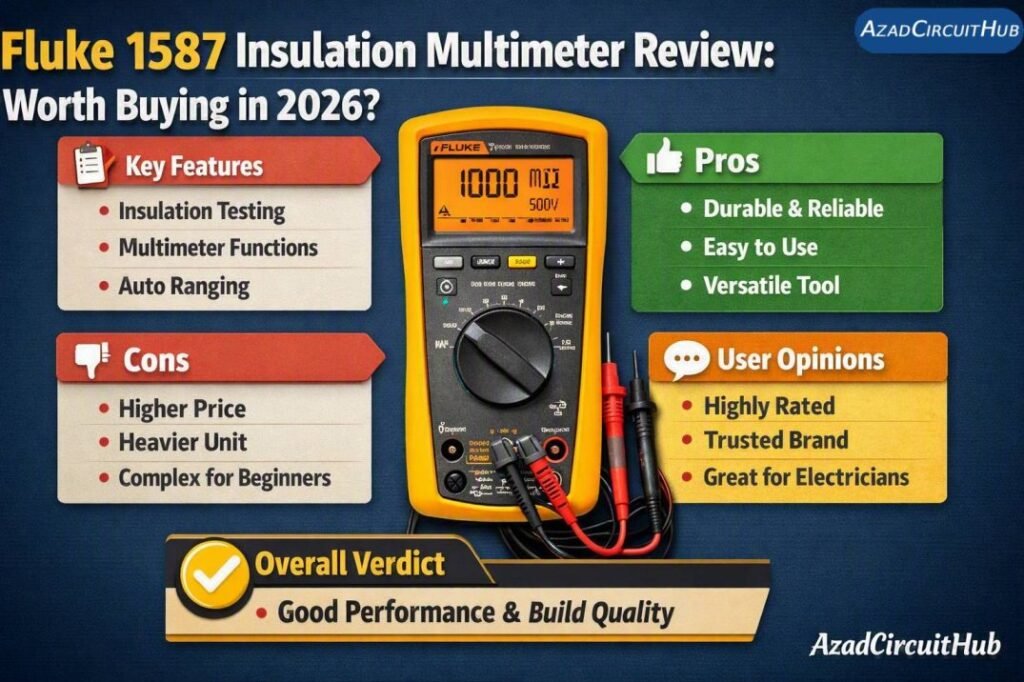
Table of Contents
Table of Contents
What Is the Fluke 1587 FC?
The Fluke 1587 FC is a 2-in-1 insulation multimeter aimed at professional electrical maintenance. It works as a conventional digital multimeter and also performs insulation resistance tests.
Its insulation test range makes it suitable for checking motors, transformers, cables, switchgear, control circuits, and other electrical equipment where insulation condition is important.
The Fluke 1587 FC version also supports Fluke Connect, allowing compatible test information to be transferred to a mobile device. This can be useful when maintenance records, test history, or remote review are part of the workflow.
For technicians who already carry a good Fluke meter, the 1587 FC is less about replacing every instrument and more about combining two important functions into one rugged package.
Insulation Resistance Testing Performance
The key reason to buy this instrument is its insulation testing capability.
A normal multimeter can measure resistance, but ordinary resistance measurements are not the same as a proper insulation resistance test. Insulation testers apply a higher DC test voltage to assess the resistance of insulation systems.
The selectable 50 V, 100 V, 250 V, 500 V, and 1,000 V test levels give the technician flexibility for different applications.
| Test voltage | Typical application |
|---|---|
| 50 V | Sensitive low-voltage electronic/control circuits where appropriate |
| 100 V | Low-voltage circuits and selected equipment |
| 250 V | Control and low-voltage applications |
| 500 V | Common LV motors, cables and installations |
| 1,000 V | Higher-voltage insulation testing where the equipment and procedure permit |
The correct test voltage should always follow the equipment manufacturer's instructions and the applicable electrical testing procedure. Applying an unsuitable insulation test voltage to sensitive electronics can cause damage.
Up to 2,000 MΩ Measurement Range
The instrument can measure insulation resistance up to 2,000 MΩ. That gives it enough range for many industrial maintenance applications where insulation resistance can vary from relatively low values to hundreds or thousands of megohms.
For preventive maintenance, the trend can be just as useful as one isolated reading. A motor that repeatedly shows declining insulation resistance may deserve further investigation before it develops into an operational failure.
Standard Multimeter Functions
Another reason the Fluke 1587 Insulation Multimeter is interesting is that it does not stop at insulation testing.
It provides functions normally expected from a professional digital multimeter, including AC/DC voltage, resistance, continuity, capacitance, frequency, and diode testing. Min/Max/Average functions can also help when investigating changing electrical values.
This makes the meter practical for troubleshooting panels and machinery before or after an insulation test.
For example, a technician may first verify supply voltage, check continuity, measure resistance, and then isolate the equipment and perform an insulation test. Having these functions in one instrument reduces the amount of equipment needed at the job site.
Fluke 1587 FC vs a Dedicated Megohmmeter
People often search for “fluke 1587 fc megger” because the instrument performs the same broad type of insulation resistance testing associated with megohmmeters. Megger, however, is also a well-known test equipment brand, so the terms are not interchangeable as product names.
| Consideration | Fluke 1587 FC | Dedicated insulation tester |
|---|---|---|
| Insulation testing | Yes | Yes |
| General multimeter | Yes | Usually limited |
| Portability | High | Depends on model |
| Motor maintenance | Suitable | Suitable |
| Cable testing | Suitable for many LV applications | Model dependent |
| Advanced cable diagnostics | Limited | Some specialized models offer more |
| One-tool convenience | Excellent | Lower |
| Complex diagnostic testing | May require another tester | Better with specialized equipment |
The 1587 FC makes the most sense when general electrical troubleshooting and insulation testing are both part of your work.
Fluke 1587 FC for Motors and Cables
Motor insulation testing is one of the most practical applications.
Before testing, the motor must be isolated and safely discharged. The technician can then test winding insulation to ground and, where the procedure permits, between appropriate conductors.
For cables, insulation testing can help identify deterioration, contamination, moisture effects, or insulation damage. However, cable testing requirements vary significantly with voltage class, cable construction, length, and applicable standards.
For medium- and high-voltage cable maintenance, specialized equipment may be required for tests such as VLF, tan delta, or partial discharge diagnostics.
If your work is mainly focused on cable maintenance, see our guide to the best insulation testers for high-voltage cable maintenance for equipment suited to more specialized applications.
Fluke 1587 Price and Value in 2026
The Fluke 1587 price varies by seller, package contents, region, and promotions. Amazon pricing can change frequently, so checking the current listing before purchasing is important.
The instrument is positioned above basic multimeters because it combines insulation testing with professional multimeter functions and Fluke's industrial-oriented design.
If you only need voltage, resistance, and continuity measurements, a conventional multimeter will cost considerably less. If you regularly perform insulation tests, however, buying one combination instrument can make more sense than carrying separate meters.
Check the Current Amazon Price
If you want the exact FLUKE-1587 FC configuration covered in this review, check the current Amazon listing for today's price, availability, included accessories, and seller information.
Always verify that the listing is for the FLUKE-1587 FC model rather than a different Fluke insulation tester.
Not sure whether the 1587 is the right choice for your work? Our Fluke 1507 vs 1587 guide compares features and testing capabilities to help you evaluate both insulation testers.
Fluke 1587 Manual and Test Procedures
Anyone purchasing this meter should read the Fluke 1587 manual before performing insulation resistance tests. The manual covers operating procedures, safety information, test functions, connections, and appropriate precautions.
This is particularly important because insulation testing involves applying potentially hazardous DC test voltages.
Before an insulation test:
- Isolate the circuit or equipment.
- Apply the required lockout/tagout procedure.
- Verify the absence of hazardous voltage.
- Disconnect sensitive electronic equipment where required.
- Select the appropriate insulation test voltage.
- Connect the test leads correctly.
- Perform the test.
- Allow the equipment to discharge before touching conductors.
Never treat an insulation test like an ordinary resistance measurement.
If your priority is finding a general-purpose meter for electrical work, you can also compare it with our guide to the best multimeter for electricians before making a purchase.
Is the Fluke 1587 FC Worth Buying?
The Fluke 1587 Insulation Multimeter is worth considering when your work combines everyday electrical troubleshooting with regular insulation resistance testing.
Its biggest advantage is versatility. A technician can carry one professional instrument for many routine measurements and insulation tests instead of switching between two separate devices.
It is less compelling for users who rarely perform insulation testing or who need advanced diagnostic testing for medium- and high-voltage cable systems. Those applications can justify a dedicated insulation analyzer or specialized cable diagnostic instrument.
For general industrial maintenance, motor testing, electrical troubleshooting, and preventive maintenance, the combination of functions is the main value proposition.
Who Should Buy It?
The instrument is particularly suitable for:
- Industrial electricians
- Electrical maintenance engineers
- Motor repair technicians
- Facility maintenance teams
- Electrical contractors
- Plant maintenance departments
- Technicians performing preventive maintenance
- Professionals who need insulation testing and DMM functions in one tool
For readers comparing dedicated insulation testing equipment, our best insulation resistance tester guide covers other options and different testing requirements.
Pros and Cons
| Pros | Cons |
|---|---|
| Combines DMM and insulation tester | More expensive than a standard DMM |
| Up to 1,000 V insulation test | Not a substitute for advanced HV cable diagnostics |
| Up to 2,000 MΩ insulation resistance | May be excessive for basic electrical work |
| Multiple selectable test voltages | Larger than a basic handheld multimeter |
| Fluke Connect capability | Professional features increase purchase cost |
| Useful for industrial maintenance | Dedicated testers can offer specialized functions |
You can also review our broader best insulation resistance testers guide if you want to compare combination meters with dedicated megohmmeters.
Frequently Asked Questions
Is the Fluke 1587 FC a good insulation tester?
Yes. It combines insulation resistance testing with a full set of general multimeter functions, making it useful for industrial electrical maintenance, motors, cables, and equipment troubleshooting.
What is the maximum insulation resistance of the Fluke 1587 FC?
The meter can measure insulation resistance up to 2,000 MΩ. Its available insulation test voltages include 50 V, 100 V, 250 V, 500 V, and 1,000 V DC.
What is the Fluke 1587 FC used for?
It is used for insulation resistance testing and conventional electrical measurements. Common applications include motor maintenance, cable checks, control circuits, electrical panels, and preventive maintenance.
Is the Fluke 1587 FC the same as a Megger?
It performs insulation resistance testing, which is commonly associated with megohmmeters or “Megger” testing. Megger is also a separate test equipment brand, so the Fluke 1587 FC should not be confused with a Megger-branded instrument.
Where can I buy the Fluke 1587 FC?
The FLUKE-1587 FC is sold through electrical test equipment distributors and online retailers, including Amazon. Check the current Amazon listing for the latest price, availability, accessories, and seller details.
Final Takeaway
The Fluke 1587 Insulation Multimeter is designed for professionals who want insulation resistance testing and everyday multimeter functions in a single instrument. Its selectable test voltages, high insulation resistance range, industrial applications, and Fluke Connect capability make it a versatile option for maintenance work.
The deciding factor is your testing requirement. For routine motor, equipment, LV cable, and electrical maintenance work, the combination can reduce the need to carry multiple instruments. For advanced medium- or high-voltage cable diagnostics, a dedicated specialist tester may still be necessary.
Before purchasing, compare the current FLUKE-1587 FC price, included accessories, warranty, and your actual test requirements rather than choosing solely by brand or maximum specifications.
Follow Us on Social:
Subscribe our Newsletter on Electrical Insights for latest updates from Azad Circuit Hub
#Fluke1587, #InsulationMultimeter, #FlukeMultimeter, #InsulationTester, #ElectricalTesting, #ElectricianTools, #MultimeterReview, #ElectricalTestEquipment, #FlukeTools, #ElectricalSafety
