
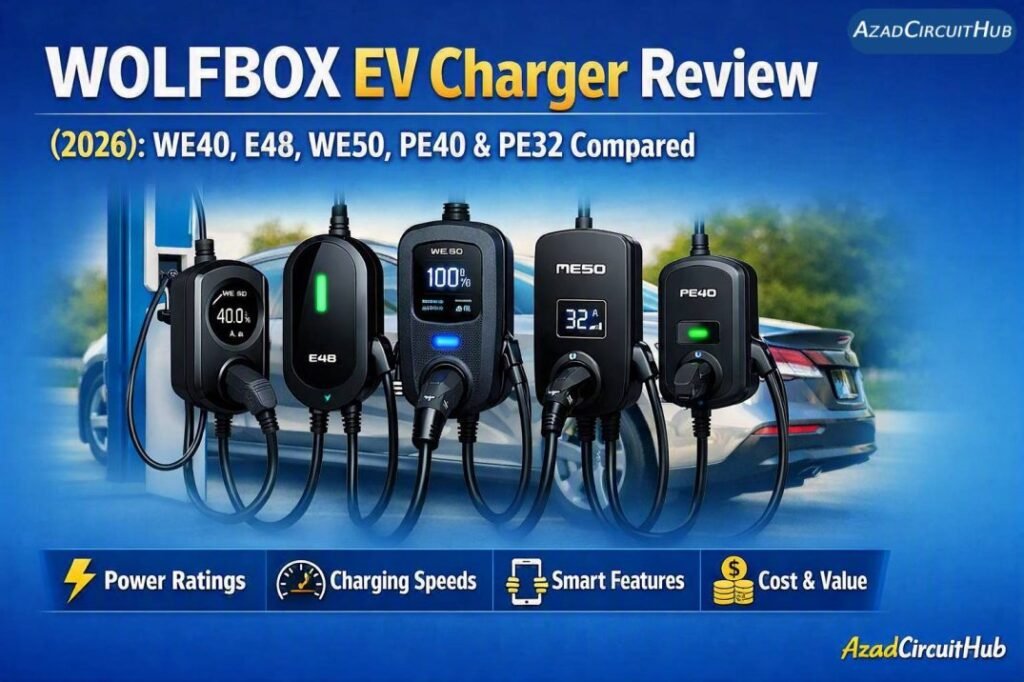
WOLFBOX EV Charger Review (2026): WE40, E48, WE50, PE40 & PE32 Compared
Choosing a home EV charger is not simply about finding the highest amperage on the box. Installation method, circuit capacity, connector type, cable length, charging speed, and daily driving needs all matter. In this WOLFBOX EV Charger Review, I compare five popular models — WE40, E48, WE50, PE40, and PE32 — to make the selection easier.
As an electrical engineer with more than 15 years of experience working with electrical panels, industrial systems, automation, and power equipment, I pay particular attention to the electrical side of EV charging. A charger can advertise 40, 48, or 50 amps, but the home’s branch circuit and installation method ultimately determine what can be used safely.
WOLFBOX EV Charger Comparison
| Model | Max Charging Current | Approx. Power at 240V | Installation | Buy Now |
|---|---|---|---|---|
| WOLFBOX WE40 | 40A | 9.6 kW | Hardwired/installation dependent | Buy Now on Amazon |
| WOLFBOX E48 | 48A | 11.52 kW | Hardwired | Buy Now on Amazon |
| WOLFBOX WE50 | 50A | 12 kW | Installation dependent | Buy Now on Amazon |
| WOLFBOX PE40 | 40A | 9.6 kW | Plug-in/installation dependent | Buy Now on Amazon |
| WOLFBOX PE32 | 32A | 7.68 kW | Plug-in/installation dependent | Buy Now on Amazon |
Actual charging output depends on the vehicle, electrical supply, circuit rating, installation configuration, and charger settings. Always verify the current specifications on the manufacturer’s listing before installation.
Recommended Charger
WOLFBOX WE40 Review
The WOLFBOX WE40 is a practical option for EV owners who want strong Level 2 charging without moving into the highest-current category.
At 40 amps and 240 volts, the theoretical charging power is about 9.6 kW. For many households, that is already enough to replace a large portion of a battery overnight.
The main advantage of a 40-amp charger is the balance between charging speed and electrical infrastructure. A continuous EV load generally requires the branch circuit to be sized according to applicable electrical codes, so the available panel capacity should be checked before installation. Read complete WOLFBOX 40amp Level 2 EV Charger (WE40) Review here.
For buyers who do not need the maximum charging rate, the WE40 can make sense as a daily home charging solution.
Check WOLFBOX WE40 price on Amazon
If you are comparing it with other home charging options, my guide to the best level 2 ev charger also covers charging speed, installation type, cable management, and other important buying factors.
WOLFBOX E48 Review
The WOLFBOX E48 moves up to 48 amps, giving it a theoretical maximum of 11.52 kW at 240 volts.
That extra output can be useful for drivers with larger batteries, higher daily mileage, or shorter charging windows. However, higher current also places greater demands on the electrical installation.
For a 48-amp continuous EV load, the circuit must be appropriately sized under the applicable electrical requirements. This is one reason hardwired installation can be attractive for higher-current EV chargers.
The E48 is therefore more interesting for buyers who have the electrical capacity and genuinely need faster Level 2 charging.
From an electrical engineering perspective, I would not select the E48 simply because 48 amps sounds better. If your vehicle normally sits overnight and your daily mileage is modest, a 32A or 40A charger may already meet your needs. Read complete WOLFBOX 48 Amp Level 2 EV Charger Review here including E48 & WE48 Hardwired (Plus WE50).
WOLFBOX WE50 Review
The WE50 targets buyers looking for even higher charging capability. At 50 amps and 240 volts, its theoretical maximum is approximately 12 kW.
The difference between 48A and 50A is small in practical charging terms. A buyer should therefore look beyond the number printed on the charger.
Panel capacity, branch-circuit requirements, cable installation, breaker size, vehicle acceptance rate, and local electrical rules can all affect the real-world benefit.
The WE50 can be worth considering when the vehicle supports the available charging rate and the installation is designed for it.
Check WOLFBOX WE50 price on Amazon
WOLFBOX PE40 Review
The WOLFBOX PE40 offers a 40-amp charging class, making it another option for drivers who want considerably faster charging than a typical Level 1 portable charger.
Its 9.6 kW theoretical output at 240 volts is suitable for many residential EV charging situations.
The PE40 is particularly worth comparing with the WE40 based on installation style, included accessories, connector arrangement, cable length, and current-adjustment options rather than focusing only on amperage.
Before buying any plug-in EV charger, check that the existing receptacle, circuit, wiring, breaker, and installation method are suitable for continuous EV charging. A receptacle should never be treated as automatically suitable simply because its voltage and amperage appear to match the charger. Read complete WOLFBOX PE40 Portable EV Charger Review here.
WOLFBOX PE32 Review
The WOLFBOX PE32 operates at a lower 32-amp charging level, producing approximately 7.68 kW at 240 volts.
That is still substantially faster than Level 1 charging and can be enough for drivers with predictable daily mileage.
Check WOLFBOX PE32 price on Amazon
A 32-amp charger may also be useful where the home’s electrical capacity makes a higher-current installation less attractive. In EV charging, the fastest charger is not always the most appropriate charger.
Read complete WOLFBOX PE32 Portable EV Charger Review here.
WOLFBOX 40 Amp vs 48 Amp: What Is the Difference?
The difference becomes easier to understand when looking at charging power.
| Charging Current | Voltage | Theoretical Power |
|---|---|---|
| 32A | 240V | 7.68 kW |
| 40A | 240V | 9.60 kW |
| 48A | 240V | 11.52 kW |
| 50A | 240V | 12.00 kW |
A 48A charger can deliver about 20% more theoretical power than a 40A charger at the same voltage. However, actual charging speed also depends on the vehicle’s onboard AC charger.
Know more about Level 1 vs Level 2 charging
For example, if an EV can only accept a lower AC charging rate, installing a higher-output EVSE will not necessarily make that vehicle charge faster.
This is why I recommend checking the vehicle specification before deciding between the WOLFBOX 40-amp and 48-amp models.
Which WOLFBOX EV Charger Should You Buy?
The answer depends mainly on your vehicle, driving pattern, electrical service, and installation.
| Your Situation | Model to Consider |
|---|---|
| Moderate daily driving | PE32 |
| General home charging | WE40 |
| Need a higher charging rate | E48 |
| Want approximately 12 kW capability | WE50 |
| Prefer the PE-series configuration | PE40 |
If you drive 30–50 miles per day and have overnight charging available, even a mid-range Level 2 charger can provide substantial recovery time. Higher output becomes more useful when daily mileage is high or charging windows are short.
For another comparison of residential charging equipment, see my detailed best level 2 ev charger guide before making the final purchase.
What to Check Before Buying a WOLFBOX Level 2 Charger
A good WOLFBOX level 2 charger should be matched to the complete electrical system rather than selected in isolation.
Check these points before ordering:
- Your EV’s maximum AC charging rate
- Available electrical panel capacity
- Required branch-circuit rating
- Hardwired versus plug-in installation
- NEMA receptacle compatibility where applicable
- Cable length and routing
- Indoor or outdoor installation requirements
- Weather protection and operating environment
- Current adjustment options
- Warranty and manufacturer support
- Connector compatibility with your vehicle
EV charging is a continuous load, so installation deserves the same care given to other high-power electrical equipment.
WOLFBOX EV Charger Features That Matter
Features such as Wi-Fi connectivity, display information, scheduling, adjustable current, cable management, and protective functions can improve the ownership experience.
However, smart features should come after electrical compatibility.
A charger that fits your panel and vehicle but has fewer app features can be more useful than a highly connected model that requires an unsuitable installation.
This is particularly important for homeowners upgrading from Level 1 charging. The goal should be dependable overnight energy delivery, not simply the largest possible amperage.
Is a WOLFBOX EV Charger Worth Buying?
WOLFBOX offers several charging levels and installation configurations, which makes the range useful for different residential charging requirements.
The WE40 and PE40 sit around the 40-amp class, while the E48 and WE50 target higher-current charging. The PE32 provides a lower-current alternative for drivers who do not require maximum Level 2 output.
My recommendation as an electrical engineer is to start with your vehicle and electrical service, then select the charger. This avoids paying for charging capacity that the car cannot use or the home’s electrical system cannot comfortably support.
For buyers comparing several brands, I also recommend checking my best level 2 ev charger comparison for alternatives and installation considerations.
Frequently Asked Questions
Is WOLFBOX a good EV charger brand?
WOLFBOX offers a range of residential EV charging equipment across different current levels and configurations. Buyers should compare the exact model’s specifications, warranty, installation requirements, and vehicle compatibility before purchasing.
Is a 40 amp or 48 amp EV charger better?
Neither is automatically better for every installation. A 48A charger can provide more theoretical charging power, but the vehicle must support the additional output and the electrical installation must be appropriately designed.
What is the difference between WOLFBOX WE40 and E48?
The main charging-current difference is 40A versus 48A. At 240V, their theoretical outputs are approximately 9.6 kW and 11.52 kW respectively. Installation and vehicle compatibility should also be considered.
Which WOLFBOX EV charger should I buy?
For moderate daily driving, a 32A or 40A model may be sufficient. Drivers who need faster AC charging and have compatible vehicles and electrical infrastructure can consider the higher-current E48 or WE50.
Can I install a WOLFBOX Level 2 charger myself?
Installation depends on the model and electrical configuration. Hardwired and high-current installations can involve significant electrical work and should comply with applicable local electrical codes and manufacturer instructions. Where required, use a qualified electrician.
Final Verdict
The five models serve different charging requirements rather than representing five versions of exactly the same product. The PE32 is aimed at moderate charging needs, the WE40 and PE40 occupy the 40-amp class, while the E48 and WE50 provide higher theoretical charging capacity.
Before buying, match the WOLFBOX EV charger to your EV’s onboard charger, available electrical capacity, installation method, and daily mileage. That approach will usually produce a more useful result than choosing purely on maximum amperage.
Related Guides
- eviqo level 2 ev charger review
- EVDANCE Level 1&2 EV Charger Review
- NexCyber Level 2 EV Charger Review
- SEGUMA Level 1&2 Tesla Charger Review
- eV charger cable size calculator
Get new guides in your feed. Follow Electrical Insights on LinkedIn for new electrical standards guides, calculators and design tips from Azad Circuit Hub.
#WOLFBOXEVCharger, #EVChargerReview, #WOLFBOX, #Level2EVCharger, #EVCharging, #HomeEVCharger, #ElectricVehicle, #EVChargerComparison, #EVChargingStation, #EVAccessories
