WOLFBOX 48 Amp Level 2 EV Charger Review: E48 & WE48 Hardwired (Plus WE50)
Choosing a hardwired EV charger is different from buying a basic plug-in charging unit. The installation, circuit rating, cable length, weather protection, connectivity, and daily charging load all matter.
As an electrical engineer with more than 15 years of experience working with electrical panels, industrial systems, automation, and power equipment, I pay close attention to the installation side of EV chargers. A charger may advertise a high output, but the home’s electrical system must be able to support that load continuously.
The WOLFBOX 48 Amp Level 2 EV Charger range includes the E48 and WE48, while the higher-output WE50 provides a 50-amp option. All three are designed for hardwired 240V installations, making them suitable for homeowners who want a permanent home EV charging setup.
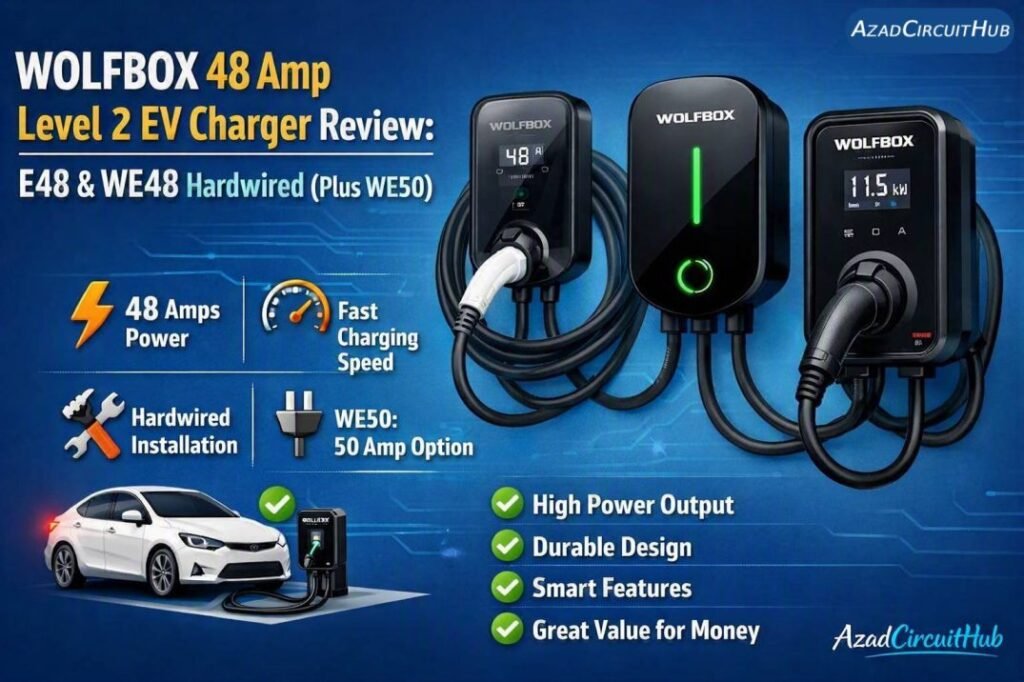
Table of Contents
Table of Contents
WOLFBOX E48 vs WE48 vs WE50: Quick Comparison
| Feature | WOLFBOX E48 | WOLFBOX WE48 | WOLFBOX WE50 |
|---|---|---|---|
| Maximum current | 48A | 48A | 50A |
| Supply | 240V | 240V | 240V |
| Approx. maximum power | 11.5 kW | 11.5 kW | 12 kW |
| Installation | Hardwired | Hardwired | Hardwired |
| Connector | J1772 | J1772 | J1772 |
| Cable | 25 ft | 25 ft | 25 ft |
| Weather rating | IP66 / NEMA 4 | Weather-resistant design | IP66 / NEMA 4 |
| Wi-Fi | Yes | Yes | Yes |
| App control | Yes | Yes | Yes |
| RFID | Yes | Yes | Yes |
| Certification | CSA | — | CSA |
| Best suited for | High-output home charging | Smart home charging | Maximum output in this range |
For most buyers comparing these models, the biggest difference is not charging speed alone. The installation requirements and feature package should also be considered.
My Take on the WOLFBOX 48 Amp Level 2 EV Charger
A 48-amp EV charger is already a substantial residential electrical load. At 240V, 48A represents about 11.5 kW of charging power.
That is why I would not treat this type of charger like a normal household appliance. The branch circuit, overcurrent protection, wiring, disconnect requirements, and panel capacity should be checked before installation.
The E48 is particularly interesting because it combines a hardwired design with a 25-foot cable, Wi-Fi connectivity, app controls, and RFID access. The CSA-certified construction and weather protection also make it suitable for installations where the charger is exposed to outdoor conditions.
The WE48 offers the same basic 48-amp charging class and is another option for homeowners who want a permanent charging station rather than a portable unit.
For readers comparing several home charging products, I have also covered the broader market in my WOLFBOX EV Charger Review, including practical considerations beyond the headline amperage.
WOLFBOX E48: What You Get
The wolfbox e48 is the model I would look at closely when certification, weather protection, and smart features are priorities.
Its 48-amp maximum output can deliver approximately 11.5 kW at a nominal 240V supply. Actual charging speed depends on the vehicle's onboard AC charger and the electrical supply.
Key E48 features
- 48A maximum charging output
- 240V hardwired installation
- J1772 connector
- 25-foot charging cable
- Wi-Fi connectivity
- Smartphone app control
- RFID card access
- IP66 and NEMA 4 weather protection
- CSA certification
- Approximately 11.5 kW maximum output
The 25-foot cable is useful in a residential garage because the vehicle charging port may not always be positioned close to the electrical installation point.
Check the WOLFBOX E48 on Amazon
If you want the 48A model with CSA certification and smart controls, the WOLFBOX Level 2 EV Charger 48A E48 is worth checking on Amazon for the current price and availability.
WOLFBOX WE48: How Does It Compare?
The wolfbox we48 sits in the same 48-amp charging class. That means there is no major theoretical charging-power advantage over the E48 when both are supplied with the same 240V voltage and the vehicle can accept the full current.
The more important question is which feature package and certification information applies to the exact model being purchased.
| Specification | E48 | WE48 |
|---|---|---|
| Maximum current | 48A | 48A |
| Nominal voltage | 240V | 240V |
| Approx. output | 11.5 kW | 11.5 kW |
| Installation | Hardwired | Hardwired |
| Connector | J1772 | J1772 |
| Cable length | 25 ft | 25 ft |
| Smart controls | Yes | Yes |
| Wi-Fi | Yes | Yes |
| RFID | Yes | Yes |
For either model, the vehicle remains an important part of the equation. A charger capable of 48A does not automatically mean every EV will draw 48A.
If your priority is comparing this unit with other high-output home charging stations, see my guide to the best level 2 ev charger options for a wider comparison.
WOLFBOX 50 Amp EV Charger: Why Consider the WE50?
The wolfbox 50 amp ev charger is the WE50. It increases the maximum current from 48A to 50A.
At 240V:
50A × 240V = 12,000W
That works out to approximately 12 kW under nominal conditions.
The difference between 48A and 50A is relatively small. Therefore, I would not choose the WE50 simply because the number is higher. I would choose it when the installation and vehicle can make practical use of the additional capacity.
The WE50 is also a hardwired charger with a J1772 connector. The supplied specification includes a 25-foot cable, Wi-Fi and app control, RFID access, and weather protection.
Why I would consider the WE50
From an electrical installation perspective, the WE50 gives you a little more available charging capacity while remaining in the same general class of residential Level 2 chargers.
For homeowners already planning a dedicated hardwired installation, that extra capacity can make sense if the vehicle supports it and the electrical installation is designed accordingly.
Check the WOLFBOX WE50 price on Amazon
The WOLFBOX 50A Level 2 EV Charger WE50 is my recommended model from these three when its additional output and feature package fit the installation. Check Amazon for the latest price, availability, and current seller information before ordering.
WOLFBOX Hardwired EV Charger Installation Considerations
A wolfbox hardwired ev charger should be installed as a dedicated EV charging circuit rather than sharing the circuit with ordinary household receptacles.
One important point is continuous-load sizing. EV charging is generally treated as a continuous load, so the circuit must be designed with the applicable electrical code requirements rather than simply matching the breaker to the charger's maximum current.
For a 48A continuous charging load, the commonly applied 125% calculation gives:
48A × 125% = 60A
For a 50A continuous charging load:
50A × 125% = 62.5A
The exact installation method, conductor size, breaker, disconnect, and other requirements depend on the applicable electrical code, equipment instructions, wiring method, ambient conditions, and local authority requirements.
I would have a qualified electrician verify the existing service capacity before installation, particularly in older homes.
Charging Speed: 48A vs 50A
The difference between 48A and 50A is only 2A, so charging-time improvement is modest.
| Charger output | Approx. power at 240V | Relative output |
|---|---|---|
| 32A | 7.68 kW | Standard high-speed Level 2 |
| 40A | 9.6 kW | High |
| 48A | 11.52 kW | Very high |
| 50A | 12.0 kW | Slightly higher |
Actual charging time depends on battery capacity, state of charge, vehicle charging limits, temperature, and charging efficiency.
For example, an EV with a 48A onboard AC charging limit may not gain anything from a 50A EVSE. The vehicle determines how much AC power it can accept.
Smart Controls, Wi-Fi and RFID
One useful feature across this WOLFBOX family is the combination of connected controls and RFID access.
Wi-Fi connectivity can make a permanent home charger easier to monitor and manage. RFID access is also useful when you want some control over who can activate the charger.
For a residential installation, these features are more useful when the charger is positioned in a shared garage, driveway, or other location where physical access is not completely controlled.
Still, I would treat connectivity as a secondary feature. The electrical installation, charging compatibility, protection, and physical build should come first.
Is WOLFBOX Good for Outdoor Installation?
The E48 specification includes IP66 and NEMA 4 weather protection, which is useful for outdoor applications.
However, weather resistance does not mean the installation can ignore local electrical requirements. The mounting location, cable routing, connections, drainage, and protection from physical damage still matter.
An outdoor charger should be positioned so that the cable does not create a trip hazard and the connector can be stored securely when not in use.
Which WOLFBOX Charger Should You Buy?
| Your priority | Model to consider |
|---|---|
| 48A maximum charging | E48 |
| 48A smart charging | WE48 |
| Slightly higher 50A capacity | WE50 |
| Outdoor-rated E48 specification | E48 |
| Maximum output of these three | WE50 |
| Permanent installation | All three |
My recommended model is the WE50 when the vehicle supports the additional current and the home's electrical system is designed for the required circuit.
If your vehicle is limited to 48A or less, the E48 or WE48 may provide essentially the same practical charging performance.
For a broader look at home charging equipment and installation factors, see the best level 2 ev charger guide before making a final purchase.
Pros and Cons
Pros
- High 48A to 50A Level 2 output
- Hardwired installation
- 240V residential charging
- Long 25-foot cable
- J1772 compatibility
- Wi-Fi and app connectivity
- RFID access
- Weather-resistant construction
- CSA-certified E48 specification
Cons
- Requires professional electrical installation
- High continuous electrical load
- Hardwired design is less portable
- 50A output may provide little benefit with some EVs
- Actual charging speed depends on the vehicle
Frequently Asked Questions
Is a 48 amp EV charger worth it?
A 48A charger can be useful for EV owners who want faster home AC charging and have sufficient electrical capacity. At 240V, it can provide approximately 11.5 kW under nominal conditions.
What size breaker is needed for a 48 amp EV charger?
Because EV charging is normally treated as a continuous load, a 48A load is commonly calculated at 125%, producing a 60A circuit requirement. The final breaker, conductor, and installation method must follow the applicable electrical code and charger instructions.
Is the WOLFBOX WE50 faster than the E48?
The WE50 can deliver up to 50A compared with 48A for the E48. At 240V, that is approximately 12 kW versus 11.5 kW. The actual difference may be small, particularly if the vehicle cannot accept more than 48A.
Can a WOLFBOX 48A charger be installed outdoors?
The E48 specification includes IP66 and NEMA 4 weather protection. Outdoor installation should still follow the manufacturer's instructions and applicable electrical requirements, including suitable mounting, wiring, protection, and cable management.
Is WOLFBOX E48 compatible with Tesla?
The E48 uses a J1772 connector. Tesla vehicles that support J1772 AC charging generally require the appropriate Tesla-approved or compatible J1772-to-Tesla adapter, depending on the vehicle and charging setup.
Final Buying Considerations
The WOLFBOX 48 Amp Level 2 EV Charger family offers homeowners a high-power alternative to lower-current Level 2 equipment. The E48 and WE48 provide up to approximately 11.5 kW at 240V, while the WE50 increases the nominal maximum to about 12 kW.
For my recommendation, I would choose the WE50 when the EV can use the additional current, the home's service has adequate capacity, and the installation is being designed specifically for a 50A charging load.
If the vehicle is limited to 48A, the practical difference can be minimal, making the E48 or WE48 sensible alternatives.
Before purchasing, verify the exact model, certification, connector, cable length, electrical requirements, and current Amazon listing. Most importantly, have the installation evaluated by a qualified electrician rather than assuming an existing residential circuit can support a high-output EV charger.
Related Guides & Tools
- WOLFBOX EV charger lineup comparison
- 40A plug-in Wolfbox version
- best Level 2 EV chargers
- EV charger cable size calculator
- NexCyber 48A Level 2 charger review
- EVIQO 40/48A charger review
Get new guides in your feed. Follow Electrical Insights on LinkedIn for new electrical standards guides, calculators and design tips from Azad Circuit Hub.
#WOLFBOX, #EVCharger, #Level2EVCharger, #48AmpEVCharger, #WOLFBOXE48, #WOLFBOXWE48, #WOLFBOXWE50, #HomeEVCharging, #EVCharging, #ElectricVehicle