SEGUMA Level 1&2 Tesla Charger Review: 12A/16A Dual-Voltage NACS EVSE
The SEGUMA Level 1&2 Tesla Charger is designed for Tesla owners who want one portable EV charging solution for both standard household outlets and faster 240V charging. It supports 12A charging at 120V through a NEMA 5-15 connection and up to 16A at 240V through a NEMA 6-20 plug.
The package also includes a 25-foot charging cable, NACS connector, and ETL certification. That combination makes it useful for home charging, garages, workshops, rental properties, and travel where outlet types may vary.
As an electrical engineer with experience working around electrical systems, equipment selection, and power distribution, I pay close attention to more than the advertised charging speed. Plug type, circuit rating, voltage, cable length, protection, certification, and installation requirements all matter when choosing an EVSE.
SEGUMA Level 1&2 Tesla Charger Specifications
Here is a quick overview of the main specifications listed for this model.
| Feature | Specification |
|---|---|
| Charger type | Level 1 / Level 2 portable EV charger |
| Vehicle connector | NACS |
| 120V charging | 12A |
| 240V charging | 16A |
| 120V plug | NEMA 5-15 adapter |
| 240V plug | NEMA 6-20 |
| Cable length | 25 ft |
| Certification | ETL Certified |
| Tesla compatibility | Model 3, Model Y, Model S, Model X |
| Maximum 240V output | Approximately 3.84 kW |
| Maximum 120V output | Approximately 1.44 kW |
| Installation | Portable plug-in design |
| Primary use | Home, garage, travel and backup charging |
At 240V and 16A, the theoretical charging power is about 3.84 kW. At 120V and 12A, it is about 1.44 kW. Actual charging speed can be lower because the vehicle, battery temperature, state of charge, supply conditions, and charging settings all affect the result.
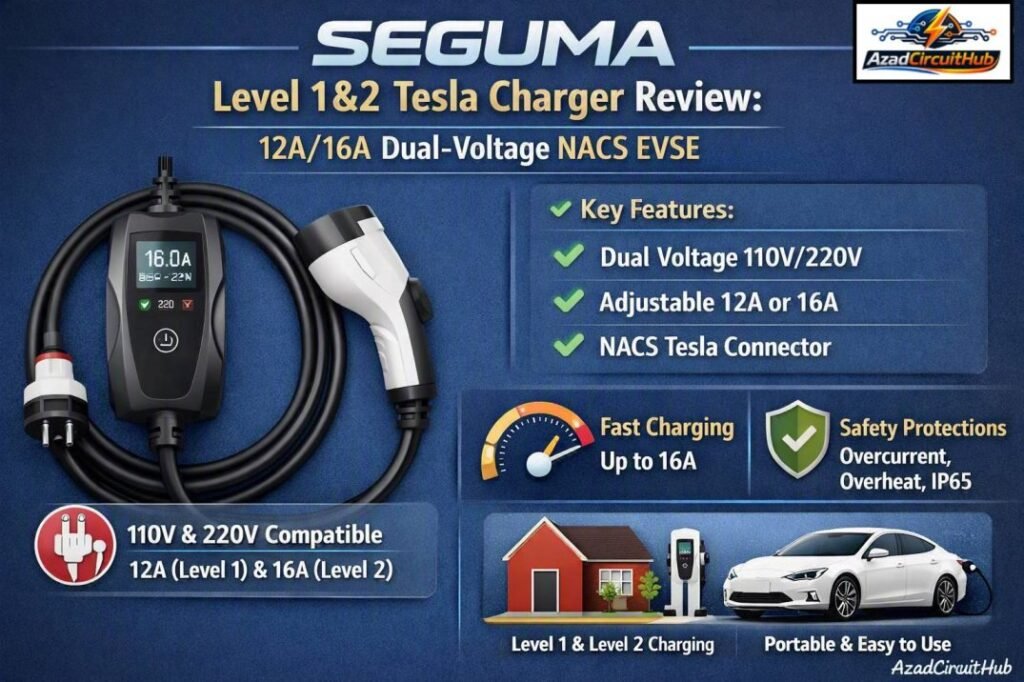
Table of Contents
Table of Contents
What Makes the SEGUMA Level 1&2 Tesla Charger Different?
The biggest advantage is its dual-voltage design. Instead of carrying separate EVSE units for different locations, the same charger can work with a conventional 120V household receptacle or a suitable 240V NEMA 6-20 outlet.
For everyday home charging, 240V operation is considerably more useful. The available power is more than twice the theoretical output of the 120V configuration. This can make overnight charging more practical for drivers with moderate daily mileage.
The 120V option is better viewed as a convenient backup. It can be useful when visiting family, staying at a property without a dedicated EV outlet, or charging at a location where only a standard receptacle is available.
120V Level 1 vs 240V Level 2 Charging
Understanding the difference between the two operating modes is important before buying a portable Tesla EV charger.
| Charging Mode | Voltage | Current | Approx. Power | Typical Use |
|---|---|---|---|---|
| Level 1 | 120V | 12A | 1.44 kW | Backup and low-mileage charging |
| Level 2 | 240V | 16A | 3.84 kW | Regular home charging |
| NEMA 5-15 | 120V | 12A | 1.44 kW | Standard household outlet |
| NEMA 6-20 | 240V | 16A | 3.84 kW | Dedicated 240V circuit |
The 16A 240V configuration is still modest compared with higher-output 32A or 40A home EV chargers. However, it has an advantage for users who do not need maximum charging speed and already have a compatible 240V circuit.
For an existing 6-20 receptacle, this can be a relatively simple portable charging arrangement, provided the circuit and installation meet applicable electrical requirements.
Check the electrical circuit before using 240V charging
A NEMA 6-20 outlet should not simply be assumed to be suitable because it physically accepts the plug. The branch circuit, breaker, conductor size, grounding, receptacle condition, and installation method should all be checked.
Continuous EV charging places a sustained load on an electrical circuit. Under the NEC continuous-load approach, the circuit should be sized appropriately for the EVSE's maximum current. A qualified electrician should verify an existing installation when there is any doubt.
25-Foot Cable: A Practical Advantage
The 25-foot cable is one of the more useful features for home users. A longer EV charging cable can make parking easier when the outlet is not directly beside the vehicle's charge port.
It can also help in garages where the electrical receptacle is positioned on a side wall. However, cable length should not encourage users to route the cable across vehicle traffic areas or locations where it can become a trip or crushing hazard.
When using any portable EVSE outdoors, keep the connections protected from standing water and follow the manufacturer's instructions for weather exposure.
ETL Certification and Electrical Safety
The SEGUMA Level 1&2 Tesla Charger is listed as ETL Certified. ETL is a certification mark associated with Intertek's testing and certification services, and it is commonly seen on electrical products sold in North America.
Certification is a useful purchasing factor, but it does not eliminate the need for proper installation. Users should inspect the plug, receptacle, cable, and connector regularly.
Avoid using damaged extension cords or makeshift adapters. The charger should be connected to an appropriate receptacle with a properly grounded electrical system.
Tesla Compatibility
This model uses an NACS connector and is listed for Tesla Model 3, Model Y, Model S, and Model X vehicles.
| Tesla Vehicle | Listed Compatibility |
|---|---|
| Tesla Model 3 | Yes |
| Tesla Model Y | Yes |
| Tesla Model S | Yes |
| Tesla Model X | Yes |
Tesla vehicle configurations can vary by model year and market, so buyers should confirm connector compatibility and vehicle charging requirements before ordering.
For owners comparing portable and permanently installed solutions, our guide to the best ev charger level 2 can help narrow the options based on charging speed, installation type, and daily driving needs.
Is 16A at 240V Fast Enough?
For many drivers, yes. A 3.84 kW EVSE is not a high-power Level 2 charger, but it can provide useful overnight charging.
For example, eight hours at the theoretical 3.84 kW rate represents roughly 30.7 kWh of supplied energy before charging losses. Real-world energy added to the battery will be lower.
The actual range gained depends heavily on the Tesla model, efficiency, weather, battery condition, and charging losses. Therefore, it is better to judge the charger by your daily energy requirement rather than by a claimed miles-per-hour figure.
Who Should Buy the SEGUMA Level 1&2 Tesla Charger?
This portable Tesla charger makes the most sense for:
- Tesla owners who want both 120V and 240V charging options.
- Drivers with access to a NEMA 6-20 receptacle.
- People who need a portable backup EVSE.
- Apartment or rental-property users who cannot install a permanent wall charger.
- Owners who value a 25-foot cable.
- Drivers who normally have moderate daily charging requirements.
It may not be the best choice for households that require the fastest possible overnight charging. Those users should consider a higher-amperage Level 2 EVSE and a properly sized dedicated circuit.
If you are specifically interested in established EVSE brands and widely used charging equipment, see our guide to the famous level 2 ev charger options before choosing a long-term home charger.
Ready to compare prices?
If the dual-voltage design, NACS connector, 25-foot cable, and 16A 240V capability fit your charging needs, check the current Amazon listing before ordering. Product pricing and availability can change.
Check Price of SEGUMA Level 1&2 Tesla Charger on Amazon
For drivers prioritizing maximum charging output, our comparison of the fastest level 2 charger options is a useful next step.
Pros and Cons
| Pros | Cons |
|---|---|
| 120V and 240V operation | 16A limits Level 2 charging speed |
| NEMA 5-15 and 6-20 connections | Requires a suitable 240V circuit for Level 2 |
| 25-foot cable | Long cable requires careful routing |
| NACS connector | Compatibility should be checked by model/year |
| ETL Certified | Not a substitute for proper electrical installation |
| Portable design | Lower output than many premium Level 2 EVSEs |
Final Verdict
The SEGUMA Level 1&2 Tesla Charger is an interesting option for Tesla owners who want flexibility rather than maximum charging power. Its combination of 120V 12A and 240V 16A operation allows the same EVSE to serve as both a backup charger and a practical home Level 2 solution.
The 25-foot cable is useful for difficult outlet locations, while the NEMA 6-20 connection provides a meaningful upgrade over ordinary 120V charging when a suitable circuit is available.
I would consider this charger particularly attractive for a Tesla owner who already has a correctly installed 240V 20A circuit and does not need the higher output offered by larger Level 2 units. Buyers looking for a more powerful permanent setup should compare other options before making a final decision.
You can also explore our guide to the best level 2 ev charger for a broader comparison of home charging solutions.
Frequently Asked Questions
Is the SEGUMA Level 1&2 Tesla Charger compatible with Tesla Model 3?
Yes. The charger is listed for Tesla Model 3, Model Y, Model S, and Model X vehicles and uses an NACS connector. Always confirm your specific vehicle configuration before purchasing.
How many amps does this Tesla charger use?
It is rated for 12A at 120V using the NEMA 5-15 connection and 16A at 240V using the NEMA 6-20 connection. The 240V configuration provides approximately 3.84 kW of theoretical input power.
Can I plug the 240V version into any outlet?
No. The NEMA 6-20 plug requires a compatible 240V receptacle and properly sized branch circuit. Do not use improvised adapters or modify the plug to fit another receptacle.
Is 16A Level 2 charging good for overnight charging?
For many Tesla owners, 16A at 240V can be adequate for overnight charging, especially with moderate daily driving. The suitability depends on how much energy your vehicle needs each day and the available charging time.
Is the SEGUMA charger worth buying?
It can be a good fit if you want a portable dual-voltage Tesla EVSE with a 25-foot cable and have access to a suitable 240V NEMA 6-20 circuit. Drivers who need faster charging should compare higher-amperage Level 2 chargers.
Related Guides
- Grizzl E Level 2 EV Charger Review
- Generac EV Charger Review
- EVIQO Level 2 EV Charger Review
- Lectron Level 2 EV Charger Review
- Leviton EV Charger review
- EVDANCE Level 1&2 EV Charger Review
Get new guides in your feed. Follow Electrical Insights on LinkedIn for new electrical standards guides, calculators and design tips from Azad Circuit Hub.
#TeslaCharger, #SEGUMACharger, #NACSEVSE, #Level1Charger, #Level2Charger, #PortableEVCharger, #TeslaEVSE, #ElectricVehicle, #EVCharging, #HomeEVCharging