
EVDANCE Level 1&2 EV Charger Review: 16A Portable J1772 EVSE With 25FT Cable
If you need a portable EV charger that can work with both a standard household outlet and a higher-voltage 240V connection, the EVDANCE Level 1&2 EV Charger is worth considering. This model combines Level 1 and Level 2 charging in one portable unit and comes with a long 25-foot cable, making it practical for garages, driveways, and home charging setups.
As an electrical engineer with hands-on experience in electrical systems, power distribution, and equipment installation, I pay close attention to charging current, plug configuration, protection features, cable length, and installation requirements when reviewing EVSE products. The EVDANCE Level 1&2 EV Charger stands out mainly because it offers flexible 120V/240V operation without requiring a permanently mounted wall charger.
EVDANCE Level 1&2 EV Charger Specifications
The following table summarizes the key specifications of the Amazon-listed configuration covered in this review.
| Feature | EVDANCE Charger Specification |
|---|---|
| Charger type | Portable EVSE |
| Charging levels | Level 1 and Level 2 |
| Maximum current | 16A |
| Level 1 input | 120V |
| Level 2 input | 240V |
| Cable length | 25 feet |
| Vehicle connector | SAE J1772 |
| Listed certification | ETL Listed |
| Standard home plug | NEMA 5-15 |
| 240V plug | NEMA 6-20 |
| Compatible vehicles | J1772 EVs and PHEVs |
| Color | Black |
| Installation | Portable / plug-in |
| Best use | Home, garage, driveway and travel charging |
Check the current Amazon price and availability of the EVDANCE charger here: Amazon buying link
The combination of NEMA 5-15 and NEMA 6-20 plugs is one of the main attractions. It allows the same EVSE to be used for slower 120V charging or faster 240V charging when the appropriate receptacle and electrical circuit are available.
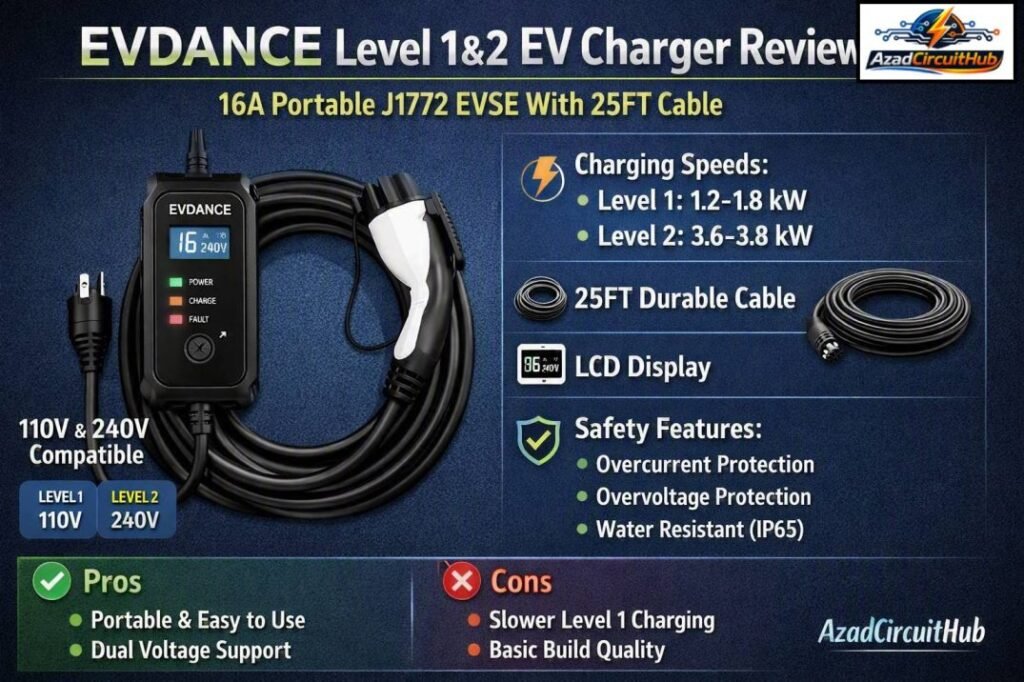
Table of Contents
Table of Contents
What Is the EVDANCE Level 1&2 EV Charger?
The EVDANCE Level 1&2 EV Charger is a portable J1772 EVSE designed for electric vehicles and plug-in hybrid vehicles that use the SAE J1772 charging connector.
Rather than functioning as a simple extension cord, an EVSE manages the connection between the electrical supply and the vehicle. The vehicle determines how much current it can accept, while the EVSE communicates the available charging current and provides the required control and protection functions.
At 120V, the charger can be used with a conventional NEMA 5-15 household outlet. At 240V, the supplied NEMA 6-20 configuration allows higher charging power, up to the charger's 16A maximum rating.
This makes it particularly interesting for EV owners who want an affordable portable charging solution rather than immediately installing a high-powered 32A, 40A, or 48A Level 2 station.
Level 1 vs Level 2 Charging Performance
The biggest practical difference is the supply voltage.
| Configuration | Voltage | Maximum Current | Approx. Input Power* | Typical Use |
|---|---|---|---|---|
| Level 1 | 120V | 12A | 1.44 kW | Overnight or low-mileage charging |
| Level 2 | 240V | 16A | 3.84 kW | Faster home charging |
| NEMA 5-15 | 120V | 12A | 1.44 kW | Standard household receptacle |
| NEMA 6-20 | 240V | 16A | 3.84 kW | Dedicated 240V circuit |
*Approximate maximum input power before considering charging losses.
At 240V and 16A, the theoretical input power is about 3.84 kW. Actual energy delivered to the battery will be lower because of vehicle charging losses and other system losses.
For many drivers, 3.84 kW is enough for overnight charging. However, drivers covering very high daily mileage may prefer a higher-current Level 2 EVSE.
25-Foot Cable: A Major Advantage
Cable length can make a surprisingly large difference in everyday EV charging.
The EVDANCE Level 1&2 EV Charger includes a 25-foot charging cable, giving the user considerably more flexibility when the electrical outlet is not directly beside the vehicle.
This can be useful when:
- The garage outlet is behind the vehicle.
- The car is parked in the driveway.
- Two vehicles share a charging area.
- The electrical receptacle is mounted several feet away.
- You need more positioning flexibility during travel.
A long cable can also reduce the temptation to use an extension cord. For EV charging, avoiding unapproved extension cords is important because charging loads can remain high for several hours.
Want a broader comparison before buying? See our guide to the best ev charger level 2 for other home charging options and higher-current alternatives.
NEMA 5-15 and NEMA 6-20 Compatibility
The dual-plug configuration is one of the most useful features of this EVDANCE model.
The NEMA 5-15 connection is designed for a standard 120V household receptacle. The NEMA 6-20 connection is intended for a suitable 240V receptacle.
However, simply having a 240V outlet does not automatically mean the circuit is suitable. The receptacle, breaker, conductor size, grounding, and installation method should all be checked before using the Level 2 configuration.
At 16A continuous charging, the circuit must be appropriately sized under the electrical code applicable to the installation. In North American installations, EV charging is generally treated as a continuous load, so the circuit must have adequate capacity rather than being selected based only on the charger's nameplate current.
ETL Listed EVSE
The product is advertised as ETL Listed, which is an important consideration when selecting electrical equipment.
Third-party certification can provide additional confidence that a product has been evaluated against applicable safety requirements. Buyers should still verify the certification details on the actual product and current listing, particularly when purchasing electrical equipment through online marketplaces.
For an EV charger, safety considerations go beyond certification. The receptacle should be in good condition, connections should be properly rated, and the circuit should be capable of handling the charging load.
How Fast Does It Charge?
Charging speed depends on the vehicle's onboard charger, battery size, battery state of charge, temperature, and other charging conditions.
The EVDANCE Level 1&2 EV Charger can provide approximately 1.44 kW at 120V and up to approximately 3.84 kW at 240V at its 16A maximum.
For example, a vehicle requiring 30 kWh of usable energy would theoretically need about:
30 ÷ 3.84 = 7.8 hours
Real-world charging will take longer because charging is not perfectly efficient and the vehicle may reduce current during portions of the charging cycle.
At 120V, the same 30 kWh requirement could take considerably longer, making Level 1 more appropriate for vehicles that are parked for long periods.
Who Should Buy This EVDANCE Charger?
The EVDANCE Level 1&2 EV Charger makes the most sense for EV and PHEV owners who value portability and flexibility.
It is particularly suitable for:
- Apartment or rental-property users with approved outlets.
- Homeowners who do not want a permanent wall-mounted charger.
- Drivers with moderate daily mileage.
- People who want both 120V and 240V charging capability.
- EV owners who need a long charging cable.
- Travelers who want a portable J1772 EVSE.
It may not be the best choice for drivers who need maximum charging speed. A 16A Level 2 EVSE is substantially slower than many 32A, 40A, or 48A home charging stations.
If your priority is maximum charging output, compare this model with options in our guide to the fastest level 2 charger before making a purchase.
EVDANCE Level 1&2 EV Charger Pros and Cons
| Pros | Cons |
|---|---|
| Supports 120V and 240V charging | Maximum Level 2 current is 16A |
| Long 25-foot cable | Slower than high-current Level 2 EVSEs |
| J1772 connector | Not suitable for vehicles requiring a different connector without proper equipment |
| NEMA 5-15 and 6-20 options | Requires suitable 240V receptacle for Level 2 operation |
| Portable design | Not a permanently mounted charging station |
| ETL Listed configuration | Actual charging speed depends on the vehicle |
| Suitable for EVs and PHEVs | High-mileage users may need more charging power |
Installation and Electrical Safety Considerations
One of the most important points in this EVDANCE Level 1&2 EV Charger review is that the charger should be connected only to a properly rated electrical circuit.
For 120V charging, avoid using damaged or loose receptacles. A receptacle that becomes unusually hot during charging should not be ignored.
For 240V operation, use a properly installed NEMA 6-20 receptacle on a suitable circuit. The wiring, overcurrent protection, grounding, and receptacle rating should comply with the applicable electrical code.
As an electrical engineer, I would also recommend checking the condition of the existing circuit before using an older garage outlet for continuous EV charging. EV charging can place a steady load on wiring for many hours, which is different from briefly operating a household appliance.
Is the EVDANCE Charger Good for Home Charging?
For moderate charging requirements, yes. The EVDANCE Level 1&2 EV Charger offers a useful balance between portability, cable reach, and charging flexibility.
Its biggest limitation is power output. At 16A on 240V, it delivers about 3.84 kW, so it should not be compared directly with high-output Level 2 EV chargers.
For someone who drives a moderate distance each day and can charge overnight, however, the lower charging rate may be perfectly adequate.
Before purchasing, confirm your vehicle uses a compatible J1772 inlet and check the current Amazon listing for the exact plug configuration and included accessories.
See the current EVDANCE charger price on Amazon: Check Price on Amazon
EVDANCE Level 1&2 EV Charger vs Higher-Power Chargers
| Factor | EVDANCE 16A | Higher-Power Level 2 EVSE |
|---|---|---|
| Maximum current | 16A | Often 32A–48A+ |
| 240V power | About 3.84 kW | Approximately 7.7–11.5 kW+ |
| Portability | Excellent | Varies |
| Installation | Plug-in | Often plug-in or hardwired |
| Cable reach | 25 ft | Varies |
| Daily high-mileage use | Moderate | Better suited |
| Overnight charging | Good | Excellent |
| Electrical requirements | Lower | Higher |
| Best for | Flexible portable charging | Faster home charging |
If you are comparing several products for a permanent home installation, our guide to the best level 2 ev charger can help you evaluate charging speed, electrical requirements, and practical features.
Final Verdict
The EVDANCE Level 1&2 EV Charger is a practical portable EVSE for drivers who want the flexibility of both 120V and 240V charging. Its 25-foot cable, J1772 connector, 16A maximum output, and NEMA 5-15/NEMA 6-20 configuration give it a useful combination of portability and versatility.
Its main trade-off is charging speed. At approximately 3.84 kW on a 240V supply, it is suitable for overnight charging but will not match the charging rate of higher-current Level 2 stations.
For moderate daily driving, rental properties, garages, travel, and users who value a portable setup, it can be a sensible choice. For very high daily mileage or rapid overnight replenishment, a higher-powered EVSE is likely a better investment.
Check the EVDANCE Level 1&2 EV Charger on Amazon for customer reviews: Buy on Amazon
If you are still comparing products, our roundup of the famous level 2 ev charger options provides another way to compare popular charging solutions before choosing one for your home.
Frequently Asked Questions
Is the EVDANCE Level 1&2 EV Charger compatible with all EVs?
It is designed for EVs and PHEVs using the SAE J1772 charging connector. Vehicles with other inlet standards may require an appropriate, approved adapter, and compatibility should be confirmed with the vehicle manufacturer.
Can I use the EVDANCE charger with a normal household outlet?
Yes. The listed configuration includes a NEMA 5-15 connection for 120V Level 1 charging. The actual circuit and receptacle should be in good condition and suitable for the continuous charging load.
How much power does the EVDANCE charger use at 240V?
At its maximum 16A current and 240V supply, the theoretical input power is approximately 3.84 kW. Actual battery charging power can be lower because of vehicle and charging-system losses.
Is a 25-foot EV charging cable useful?
Yes. A 25-foot cable provides greater flexibility when the outlet is not close to the vehicle. It can be especially helpful for driveway and garage charging, although the cable should be routed safely without creating a trip or vehicle-damage hazard.
Is this charger suitable for daily EV charging?
It can be suitable for daily charging when the vehicle's energy needs are moderate and an appropriate electrical circuit is available. Drivers with high daily mileage may benefit from a higher-current Level 2 EVSE that can replenish the battery faster.
Related Guides
- Grizzl E Level 2 EV Charger Review
- Generac EV Charger Review
- EVIQO Level 2 EV Charger Review
- Lectron Level 2 EV Charger Review
- Leviton EV Charger review
Get new guides in your feed. Follow Electrical Insights on LinkedIn for new electrical standards guides, calculators and design tips from Azad Circuit Hub.
#EVDANCEEVCharger, #EVCharger, #Level2EVCharger, #Level1EVCharger, #J1772EVCharger, #PortableEVCharger, #EVSE, #ElectricVehicle, #HomeEVCharging, #EVChargerReview
