Leviton EV Charger review: Level 2 40 Amp 9.6kW with Wi-Fi
If you are looking for a smart home EV charger that combines a solid 40-amp charging rate with Wi-Fi connectivity, the Leviton Level 2 Smart EV Charger deserves a close look. In this Leviton EV Charger review, I am evaluating it from both a homeowner’s and an electrical engineer’s perspective, focusing on charging performance, installation, smart features, cable handling, safety, and overall value.
As an electrical engineer with 15 years of experience working with electrical systems maintenance and power equipment, I pay particular attention to circuit requirements, continuous-load considerations, protection, installation quality, and real-world usability. A charger may have impressive specifications, but the electrical installation behind it is equally important.
The Leviton model covered here delivers up to 40 amps at 240 volts, giving a maximum charging output of 9.6 kW. Its Wi-Fi connectivity also makes it more convenient than a basic plug-and-charge EVSE.
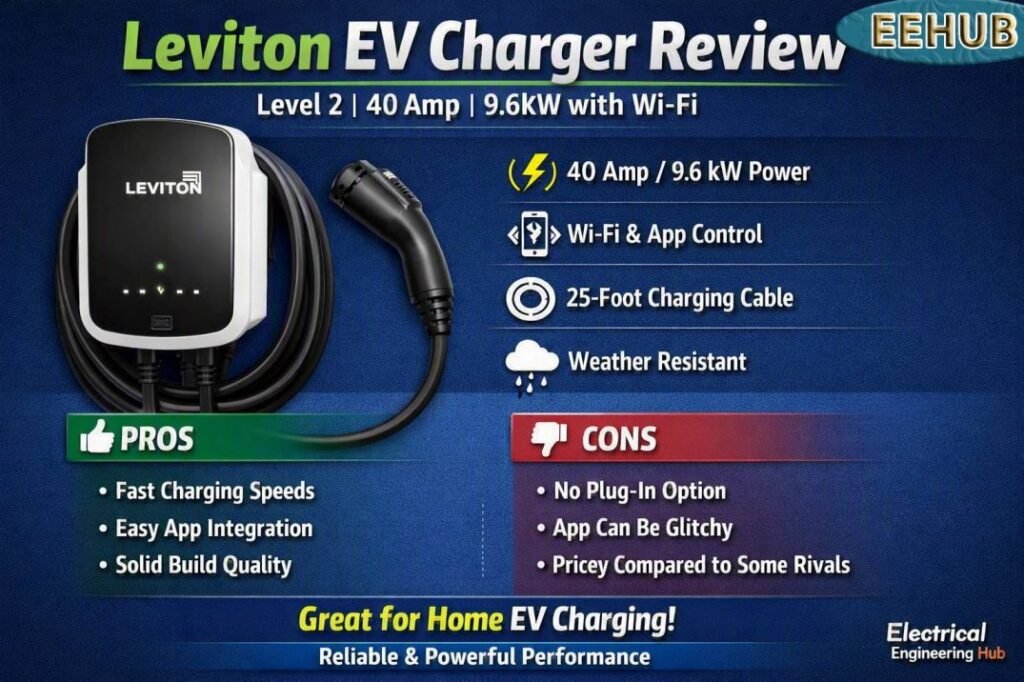
Table of Contents
Table of Contents
Leviton EV Charger review
| Feature | Leviton Level 2 Smart EV Charger |
|---|---|
| Charger type | Level 2 AC EV charger |
| Maximum current | 40 amps |
| Maximum output | 9.6 kW |
| Supply | 240V AC |
| Connectivity | Wi-Fi |
| Charging type | J1772 AC charging |
| Smart control | Yes |
| Indoor/outdoor use | Designed for residential installation |
| Best suited for | Home EV charging |
| Installation | Dedicated circuit recommended/required |
| Main advantage | 40A charging with smart connectivity |
Leviton EV Charger review: What makes it different?
The biggest attraction is the balance between charging speed and smart-home functionality. A 40-amp Level 2 EV charger can provide substantially faster charging than a standard 120V household outlet, making it a practical choice for drivers who want to replenish a vehicle overnight.
At 40 amps and 240 volts, the theoretical charging power is:
40A × 240V = 9,600W = 9.6kW
Actual charging speed can vary because the vehicle's onboard charger, battery state, temperature, charging settings, and electrical supply all affect the final result.
The Wi-Fi connection is another useful feature. Instead of treating the EVSE as a simple electrical appliance, you can use its connected functionality to monitor and manage charging through the manufacturer's ecosystem.
Key features and specifications
For homeowners comparing smart EV charging stations, the following features are particularly important.
40-amp Level 2 charging
The 40A output is a strong middle ground for residential EV charging. It is faster than many 32A units while avoiding the higher circuit demands associated with 48A or 80A charging equipment.
A properly installed 40A EVSE normally requires a circuit sized for the continuous load. For a 40-amp continuous charging load, a 50-amp branch circuit is commonly used under NEC requirements, subject to the specific installation, equipment instructions, wiring method, and local code.
9.6kW charging capacity
At full rated output, the charger can deliver up to 9.6 kW of AC charging power. For many EV owners, this is more than enough for overnight charging.
For example, if an EV could continuously accept the full 9.6 kW output, a 4-hour charging session would theoretically transfer about 38.4 kWh before accounting for charging losses.
Built-in Wi-Fi connectivity
Wi-Fi is useful when you want more control over charging rather than simply plugging in the vehicle.
Depending on the available software and vehicle integration, smart charging features can help with monitoring, scheduling, and controlling charging sessions. This can be particularly useful for households that want to charge during specific hours.
Installation and electrical requirements
Installation is one area where I would not cut corners.
A 40-amp EV charger represents a substantial continuous electrical load. The branch circuit, overcurrent protection, conductor size, disconnecting means where applicable, grounding, enclosure, and installation method should all comply with the manufacturer's instructions and applicable electrical codes.
Before purchasing, check your electrical panel for available capacity and space. A panel with an open breaker position does not automatically mean it has enough load capacity for an EV charger.
Your electrician should also consider:
- Available service capacity
- Existing household loads
- Panel rating
- Breaker compatibility
- Conductor ampacity
- Voltage drop for long cable runs
- Grounding and bonding
- Outdoor installation requirements
- Local permitting requirements
If you are unsure which charger size makes sense for your home, compare it with other top residential options in our best level 2 ev charger for home guide before making a final decision.
Charging performance in everyday use
In practical use, a 40A EV charger is well suited to drivers who return home each evening and want the battery replenished overnight.
Charging time depends heavily on battery size. A larger battery takes longer than a smaller battery at the same charging power. The vehicle also determines how much AC power it can accept.
For example, an EV with a 7.2 kW onboard AC charger will not suddenly charge at 9.6 kW simply because a 40A EVSE is available. The car and charger must work within their respective limits.
This is an important point that is sometimes overlooked in EV charger comparisons.
Smart features: Are they worth paying for?
For many homeowners, Wi-Fi is more useful than it first appears.
A connected EV charger can make it easier to schedule charging, monitor energy consumption, and manage charging sessions. If you have time-of-use electricity rates, scheduling can potentially help shift charging toward cheaper periods.
However, smart functionality should not be the only reason to buy a particular charger. Reliability, electrical safety, installation compatibility, connector quality, warranty support, and charging performance matter just as much.
Cable, connector, and everyday usability
The J1772 connection makes the charger suitable for many North American EVs and plug-in hybrids that use the standard AC charging connector. Some newer vehicles use NACS, so compatibility should be checked before ordering.
Cable management also matters in daily use. A charger that looks excellent on paper can become frustrating if the cable is difficult to route or store.
For a garage installation, consider where the vehicle normally parks and whether the cable can comfortably reach the charge port without being stretched across a walking path.
Who should buy the Leviton smart charger?
This charger makes the most sense for homeowners who want:
- 40A Level 2 charging
- Up to 9.6 kW output
- Wi-Fi connectivity
- Smart charging capabilities
- A dedicated home charging solution
- Faster charging than a standard 120V outlet
It may be less attractive if you only need basic charging and have no interest in connected features. In that situation, a simpler Level 2 EVSE may provide better value.
If the specifications match your installation, you can check the Leviton Level 2 Smart EV Charger on Amazon for the current price, availability, and customer reviews.
Leviton EV Charger review: Pros and cons
Pros
- 40A charging provides up to 9.6 kW
- Wi-Fi connectivity adds smart-home convenience
- Well suited to overnight residential charging
- Level 2 charging is considerably faster than 120V charging
- Leviton is an established electrical equipment manufacturer
- Suitable for homeowners wanting a connected charging solution
Cons
- Requires proper electrical installation
- A 50A circuit is commonly needed for a 40A continuous charging load
- Actual charging speed depends on the vehicle
- Wi-Fi features are unnecessary for users who only want basic charging
- Vehicle connector compatibility should be checked before purchase
Is the Leviton EV charger worth buying?
From an electrical engineering perspective, the 40A/9.6kW configuration is a practical choice for many residential applications. It offers enough charging power for most overnight charging needs without moving into the larger electrical requirements of higher-current EVSE equipment.
Before buying, I recommend checking your EV's maximum AC charging rate, your panel capacity, the required branch-circuit configuration, and the connector your vehicle uses.
The Wi-Fi capability is also valuable if you want scheduling and remote monitoring rather than a basic charger.
For shoppers still comparing brands and charging capacities, our best level 2 ev charger for home guide provides a broader comparison of residential Level 2 options.
Final verdict
The Leviton Level 2 Smart EV Charger is a strong option for homeowners who want a 40A charging station with modern connected functionality. Its 9.6kW maximum output offers a useful combination of charging speed and manageable residential electrical requirements.
The most important consideration is not simply the advertised charging speed. Your home's electrical service, circuit capacity, installation method, and vehicle's onboard charger all need to match the EVSE.
Based on its 40A output, Wi-Fi connectivity, and residential focus, I would consider it a good fit for EV owners who want a capable smart charger without stepping up to a higher-current system.
If you have already confirmed electrical compatibility, buy the Leviton Level 2 Smart EV Charger on Amazon to check today's availability and pricing.
Frequently Asked Questions
Is the Leviton EV charger really 9.6kW?
Yes. A 40-amp charger operating at 240 volts has a maximum theoretical output of 9.6 kW. The actual power delivered can be lower depending on the vehicle and charging conditions.
What size breaker does a 40A Leviton EV charger need?
Because EV charging is generally treated as a continuous load, a 40A charging load commonly uses a 50A branch circuit. However, the exact breaker and wiring arrangement must follow the Leviton installation instructions, NEC requirements, and local electrical code.
Can the Leviton charger be used outdoors?
The charger is designed for residential applications, but outdoor installation must follow the product's specific environmental rating and installation instructions. Proper mounting, weather protection, GFCI requirements where applicable, and local code compliance are important.
How fast does a 40A EV charger charge?
At maximum output, a 40A 240V charger provides up to 9.6 kW. The actual miles or battery percentage added per hour depends on the EV's efficiency, battery size, onboard AC charger, and charging losses.
Is a Wi-Fi EV charger better than a basic Level 2 charger?
Not necessarily for everyone. Wi-Fi is valuable if you want scheduling, monitoring, and connected controls. If you only want reliable overnight charging, a basic Level 2 EVSE may be sufficient. The right choice depends on how you use your EV and which features you actually need.
Related Guides
- Grizzl E Level 2 EV Charger Review
- Generac EV Charger Review
- EVIQO Level 2 EV Charger Review
- Lectron Level 2 EV Charger Review
- Best EV Charger Under $300
Get new guides in your feed. Follow Electrical Insights on LinkedIn for new electrical standards guides, calculators and design tips from Azad Circuit Hub.
#LevitonEVCharger, #LevitonEVChargerReview, #Level2EVCharger, #40AmpEVCharger, #96kWCharger, #EVCharger, #HomeEVCharger, #WiFiEVCharger, #ElectricVehicle, #EVCharging