WOLFBOX Portable EV Charger Review: PE40 vs PE32
Choosing a portable EV charger is not only about maximum amperage. Cable length, plug configuration, charging speed, portability, display information, vehicle compatibility, and circuit capacity all matter when you are charging an EV at home or away from your usual charging point.
In this WOLFBOX Portable EV Charger comparison, I am looking closely at the WOLFBOX PE40 and PE32. Both are designed for Level 2 charging, but their current ratings make them better suited to different electrical setups.
As an electrical engineer with more than 15 years of experience working with electrical panels, industrial systems, automation, and power equipment, I always look at EV chargers from the electrical installation side as well as the product side. A charger may advertise higher output, but the home’s branch circuit, receptacle, wiring, breaker, and vehicle onboard charger ultimately determine how useful that extra capacity will be.
WOLFBOX PE40 vs PE32: Quick Comparison
| Feature | WOLFBOX PE40 | WOLFBOX PE32 |
|---|---|---|
| Charger type | Portable Level 2 EV charger | Portable Level 2 EV charger |
| Maximum current | Up to 40A | Up to 32A |
| Charging voltage | 120/240V class, depending on configuration | 120/240V class, depending on configuration |
| Maximum Level 2 power | Up to about 9.6 kW at 240V/40A | Up to about 7.7 kW at 240V/32A |
| Typical use | Home, garage, travel and higher-output portable charging | Home, travel and moderate-output portable charging |
| Portability | Portable | Portable |
| Current adjustment | Designed for adjustable charging | Designed for adjustable charging |
| Display | Charging information display | Charging information display |
| Safety monitoring | Built-in charging protection features | Built-in charging protection features |
| Best suited for | Higher-capacity circuits | Smaller compatible circuits |
| Main advantage | Higher charging output | Lower electrical demand and flexibility |
| Buying consideration | Requires suitable circuit capacity | Easier fit for lower-rated installations |
Actual charging performance depends on the vehicle, supply voltage, circuit rating, temperature, and charger configuration.
Recommended Charger:
From specs and performance we recommend WOLFBOX PE40 as its higher charging output is a clear benefit in terms of time saving and efficiency.
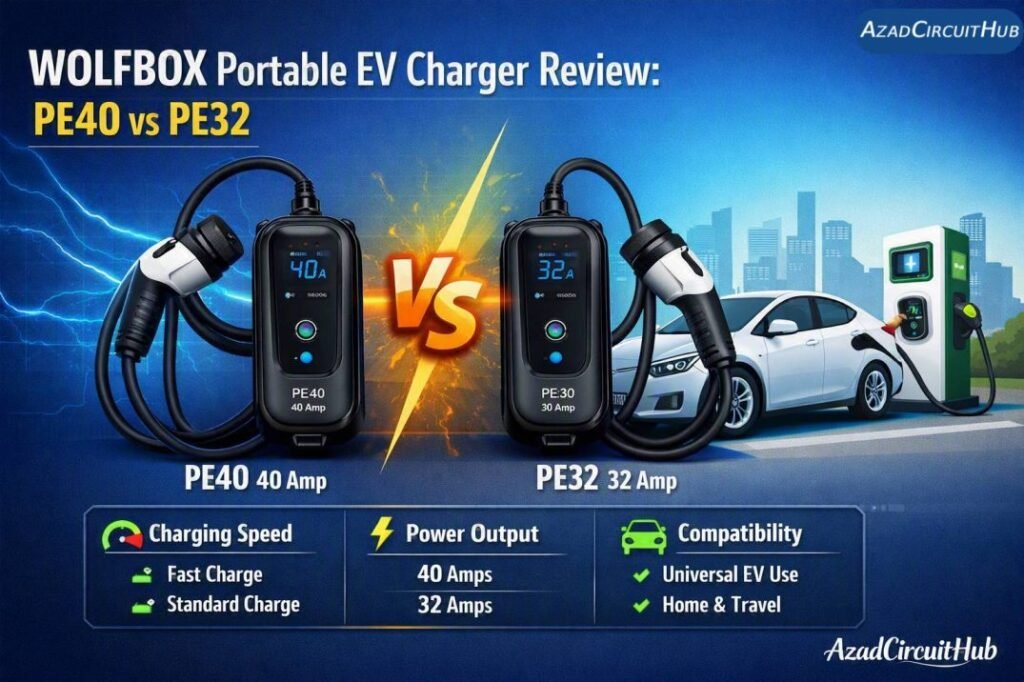
Table of Contents
Table of Contents
What Is the WOLFBOX Portable EV Charger?
The WOLFBOX Portable EV Charger is designed for EV owners who want Level 2 charging without committing to a permanently wall-mounted charging station. This makes the concept particularly useful for drivers who travel, rent properties, use more than one parking location, or want a backup charging solution.
The main difference between the two models is their current capacity. The wolfbox pe40 can deliver up to 40 amps when connected to a suitable electrical supply, while the wolfbox pe32 is rated for up to 32 amps.
At 240V, the theoretical input power can be calculated using:
Power = Voltage × Current
Therefore:
- 240V × 40A = 9,600W
- 240V × 32A = 7,680W
This does not mean every EV will actually receive those power levels. The vehicle's onboard AC charger may have a lower maximum charging rate.
WOLFBOX PE40 Review
The WOLFBOX PE40 is the higher-output option of the two. At a full 40A and 240V supply, it can provide approximately 9.6 kW of charging power.
That makes the PE40 interesting for EV owners who regularly need to recover a large amount of driving range overnight.
Key PE40 advantages
- Up to 40A charging capability
- Level 2 AC charging
- Portable design
- Useful for home and travel charging
- Higher potential output than a 32A charger
- Charging information available through the unit's display
- Suitable for EV owners with an appropriately sized electrical circuit
The electrical installation deserves particular attention. A continuous EV charging load is normally treated differently from an occasional appliance load. Under the NEC continuous-load approach, a 40A EV charging load generally requires a circuit sized at 125% of the continuous load.
That means a 40A charging load commonly calls for a 50A branch circuit, subject to the installation method, equipment instructions, local code, and receptacle requirements.
For that reason, I would not recommend simply plugging the PE40 into an existing receptacle because it physically fits. The circuit must be verified first.
Who should buy the PE40?
The PE40 makes more sense for drivers who have a suitable 240V circuit and want the highest charging output between these two models.
If your EV can accept more than 32A of AC charging and you frequently need faster overnight recovery, the additional capacity can be useful.
Check the WOLFBOX PE40 on Amazon
WOLFBOX PE32 Review
The wolfbox pe32 takes a slightly different approach. Its 32A maximum output provides up to approximately 7.7 kW at 240V.
That is still substantial Level 2 charging power for many household EV applications.
For example, an EV that remains parked overnight for eight hours could theoretically receive a significant amount of energy from a 32A supply. Actual energy delivered will be lower than the simple calculation because charging power can vary and the vehicle may reduce current as conditions change.
The lower maximum current can also make the PE32 attractive where the available electrical infrastructure does not support a 40A continuous charging load.
PE32 highlights
- Up to 32A charging
- Portable Level 2 design
- Lower maximum circuit demand than a 40A charger
- Useful for home and travel applications
- Suitable for overnight charging for many EV owners
- Easy option for drivers who do not need the PE40's higher output
One important point is that circuit suitability still needs to be checked. A 32A continuous EV load commonly corresponds to a 40A circuit under the NEC 125% continuous-load calculation, although the final installation must follow the applicable code and manufacturer's instructions.
See the WOLFBOX PE32 on Amazon
WOLFBOX PE40 vs PE32: Charging Speed
Charging speed is probably the biggest reason to compare these two models.
| Charging setup | Approx. power | Relative output |
|---|---|---|
| 240V × 32A | 7.68 kW | PE32 maximum |
| 240V × 40A | 9.60 kW | PE40 maximum |
| Difference | 1.92 kW | PE40 advantage |
The PE40 has a theoretical maximum output about 25% higher than the PE32 when both operate at their maximum rated current.
However, this advantage only matters when the vehicle can accept the additional current and the electrical circuit can safely provide it.
For example, if an EV's onboard charger is limited to 32A AC charging, choosing a 40A portable charger will not automatically make that vehicle charge at 40A.
This is one reason I recommend checking the vehicle's AC charging specification before buying.
WOLFBOX Portable Level 2 Charger: Which Model Fits Your Circuit?
From an electrical engineering perspective, circuit capacity should be considered before charging speed.
| Charger output | Approx. continuous load | Common circuit approach* |
|---|---|---|
| 24A | 24A | 30A circuit |
| 32A | 32A | 40A circuit |
| 40A | 40A | 50A circuit |
*Illustrative NEC continuous-load sizing approach. Actual requirements depend on equipment, wiring method, receptacle, installation conditions, local code and manufacturer instructions.
If your existing EV circuit is appropriately rated for 32A continuous charging, the PE32 may provide all the charging performance you need.
If you already have a suitable 50A circuit and your vehicle supports higher AC charging, the PE40 can make better use of that available capacity.
For readers comparing other charging configurations, my guide to the best level 2 ev charger covers additional factors such as hardwired versus plug-in installation, current ratings, cable length, and vehicle compatibility.
Portability and Everyday Use
The biggest attraction of a WOLFBOX Portable EV Charger is flexibility.
A permanently installed EVSE is excellent for a dedicated home charging location. A portable unit offers a different advantage: it can travel with the vehicle.
That can be useful for:
- Road trips
- Vacation properties
- Rental homes
- Backup charging
- Work locations with suitable outlets
- EV owners who move between parking locations
Before traveling, however, I recommend checking the electrical supply at the destination. A portable EV charger does not eliminate the need for a properly rated circuit.
Safety Features to Consider
EV charging places a continuous electrical load on the supply, so protection features and installation quality matter.
When comparing the PE40 and PE32, buyers should pay attention to features such as:
- Overcurrent protection
- Overvoltage and undervoltage protection
- Ground-fault protection
- Temperature monitoring
- Leakage detection
- Plug and cable temperature management
- Weather resistance appropriate to the installation
- Proper grounding
The exact protection behavior should always be confirmed against the current manufacturer's documentation for the model and version being purchased.
I also recommend avoiding extension cords or adapters unless they are specifically approved for EV charging and correctly rated. Improvised connections can create additional resistance and heat.
PE40 vs PE32: Which Is Better for Your EV?
There is no universal answer because the correct choice depends on the vehicle and electrical supply.
| If you have... | Consider |
|---|---|
| A suitable 50A circuit | WOLFBOX PE40 |
| A suitable 40A circuit | WOLFBOX PE32 |
| An EV limited to 32A AC charging | WOLFBOX PE32 may be sufficient |
| An EV capable of higher AC charging | WOLFBOX PE40 may offer more capacity |
| Frequent travel and backup charging needs | Either model, based on circuit availability |
| No suitable 240V circuit | Have the electrical installation evaluated first |
The important point is not simply choosing the model with the larger number. The charger, circuit and vehicle should be treated as one system.
If you want a broader comparison of WOLFBOX models, charging levels, and different use cases, see my WOLFBOX EV Charger Review for a wider look at the brand's charging lineup.
My Electrical Engineer Take
After years of working around electrical distribution equipment and troubleshooting real-world installations, I tend to judge EV chargers by how well they fit the complete electrical system rather than by advertised amperage alone.
The PE40 is attractive when a driver has the electrical capacity and vehicle capability to use 40A charging. Its higher potential output can reduce charging time compared with a 32A unit.
The PE32 is more conservative in terms of maximum current and can be a practical match for many residential Level 2 installations.
For most buyers, the decision should start with three questions:
- What is the vehicle's maximum AC charging rate?
- What circuit and receptacle are available?
- How much energy do I normally need to add overnight?
Answer those questions first, and the choice becomes much easier.
Frequently Asked Questions
Is the WOLFBOX Portable EV Charger compatible with all EVs?
Compatibility depends on the vehicle's charging connector and the charger's connector configuration. Most North American Level 2 portable chargers are intended for vehicles using the corresponding J1772-style AC connection, while adapter requirements vary for other EVs.
Is PE40 faster than PE32?
Yes, when operating at maximum output on a suitable 240V circuit. The PE40 can provide up to approximately 9.6 kW at 40A, compared with approximately 7.7 kW for the PE32 at 32A. The vehicle may limit the actual charging rate.
What size breaker does a 40A EV charger need?
A 40A continuous EV charging load commonly requires a 50A branch circuit under the NEC 125% continuous-load calculation. The exact installation must follow applicable electrical code, equipment instructions and local requirements.
Can I use a PE32 charger on a 50A circuit?
A properly configured 32A charger can generally operate on a circuit with adequate capacity, but the branch-circuit protection, receptacle, wiring and charger settings must all be suitable. A higher-rated circuit does not force the charger to draw 40A.
Is a portable Level 2 charger better than a wall-mounted charger?
They serve different needs. A portable charger provides flexibility for travel and backup charging, while a permanently installed EVSE can offer a cleaner and more convenient dedicated charging setup. The better choice depends on how and where the EV is normally charged.
Final Verdict: PE40 or PE32?
The WOLFBOX Portable EV Charger range gives EV owners two practical output levels. The PE40 is the higher-output choice for a suitable 50A-class circuit and an EV capable of using the additional current. The PE32 offers a lower maximum current while still providing strong Level 2 charging performance at 240V.
For buyers who regularly need faster charging and have the electrical infrastructure to support it, the PE40 deserves closer consideration. For drivers whose vehicle or electrical installation is better matched to 32A charging, the PE32 can provide a straightforward portable solution.
Before ordering either model, verify the EV's AC charging capability, outlet configuration, branch-circuit rating, plug type, and local electrical requirements.
For a wider look at charging options, installation types and other WOLFBOX models, continue with my WOLFBOX EV Charger Review.
Related Guides & Tools
- WE40 plug-in wall charger
- YLITES portable Level 1&2 charger review
- EVDANCE Level 1&2 charger review
- Level 1 vs Level 2 charging
- Lectron Level 2 EV Charger Review
Get new guides in your feed. Follow Electrical Insights on LinkedIn for new electrical standards guides, calculators and design tips from Azad Circuit Hub.
#WOLFBOX, #PortableEVCharger, #WOLFBOXPE40, #WOLFBOXPE32, #EVChargerReview, #Level2EVCharger, #PortableEVCharging, #EVCharging, #ElectricVehicle, #EVCharger