
YLITES Portable Level 1&2 EV Charger Review for J1772 EVs, NEMA 5-15/6-20
If you own a J1772 electric vehicle and want one charger that can work with both ordinary 120V outlets and faster 240V circuits, the YLITES Portable Level 1&2 EV Charger is worth a closer look. Its dual-voltage design, adjustable current settings, 25-foot cable, and travel-friendly construction make it more flexible than a basic Level 1 EV charger.
As an electrical engineer, I pay particular attention to charging current, circuit capacity, plug configuration, voltage drop, cable length, and protection features when reviewing EV charging equipment. Those details matter because an EV charger is a continuous electrical load, so convenience should never come at the expense of proper circuit selection.
The model reviewed here supports J1772 EVs and offers 120V/240V operation with adjustable charging from 8A to 16A. It uses NEMA 5-15 and NEMA 6-20 connections and includes a 1–12 hour timer.
YLITES Portable Level 1&2 EV Charger: Key Features
The following table summarizes the main specifications of the charger listed for this review.
| Feature | Specification |
|---|---|
| EV connector | SAE J1772 |
| Charging levels | Level 1 and Level 2 |
| Input voltage | 120V / 240V |
| Adjustable current | 8A–16A |
| Plug options | NEMA 5-15 / NEMA 6-20 |
| Cable length | 25 feet |
| Timer | 1–12 hours |
| Weather resistance | IP66 |
| Primary use | Home, garage and travel |
| Vehicle compatibility | J1772 EVs |
| Portable design | Yes |
| Release design | Smooth plug-in and release |
The biggest selling point is flexibility. You can use a standard 120V household receptacle for slower overnight charging or move to a suitable 240V circuit when you need more charging power.
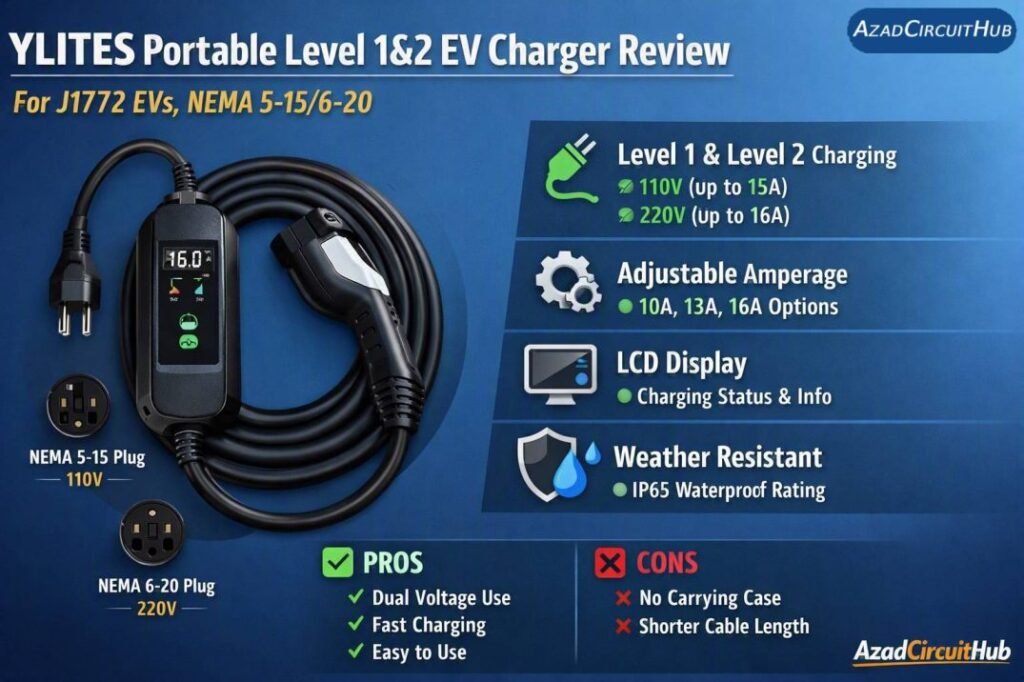
Table of Contents
Table of Contents
What Makes This Portable EV Charger Different?
Many entry-level EV chargers are designed around a single voltage and current configuration. That can be limiting for drivers who travel frequently or move between different properties.
This unit takes a more flexible approach. Its 120V/240V capability allows it to function as a Level 1 or Level 2 EV charging solution, depending on the available electrical supply and plug configuration.
At 120V, charging is relatively slow, but it can be useful when you do not have a dedicated 240V EV charging circuit. At 240V and 16A, the theoretical charging power is approximately 3.84 kW:
240V × 16A = 3,840W
Actual energy delivered to the vehicle can vary because charging efficiency, vehicle limits, battery temperature, and other factors affect real-world performance.
The adjustable 8A–16A current range is another practical feature. Lower current can be useful when a circuit has limited capacity, while 16A can provide faster charging when the electrical installation is properly rated.
Level 1 vs Level 2 Charging Performance
The difference between Level 1 and Level 2 charging is primarily related to voltage and available power.
| Charging setup | Approx. maximum power | Typical application |
|---|---|---|
| 120V at 8A | 0.96 kW | Low-demand overnight charging |
| 120V at 12A | 1.44 kW | Standard household charging |
| 120V at 16A | 1.92 kW | Faster Level 1 charging where permitted |
| 240V at 8A | 1.92 kW | Low-current Level 2 |
| 240V at 12A | 2.88 kW | Moderate home charging |
| 240V at 16A | 3.84 kW | Full-rated charging for this unit |
These are electrical input values rather than guaranteed battery charging rates.
If your priority is maximum charging speed, this portable unit should not be confused with high-power 32A, 40A, or 48A Level 2 EV chargers. Its 16A maximum makes it better suited to portable and moderate-duty charging.
For readers comparing charging equipment, our guide to the fastest level 2 charger can help explain how higher-current models compare with portable 16A options.
NEMA 5-15 and NEMA 6-20 Explained
The included NEMA configurations are important because the receptacle determines how the charger can be connected to the electrical supply.
A NEMA 5-15 outlet is the familiar 120V household receptacle commonly found in homes and garages. A NEMA 6-20 receptacle is intended for 240V applications and can support a higher-voltage charging setup.
| Plug | Nominal voltage | Common use |
|---|---|---|
| NEMA 5-15 | 120V | Standard household receptacle |
| NEMA 6-20 | 240V | Dedicated 240V circuit |
Do not install or adapt a receptacle simply to obtain faster charging. The branch circuit, overcurrent protection, wiring, grounding, receptacle rating, and installation method must all be suitable for the load.
Because EV charging is generally a continuous load, circuit loading should be evaluated according to the electrical code applicable to your location.
25-Foot Cable: A Useful Advantage
Cable length is easy to overlook until you park your vehicle several feet away from the electrical outlet.
The 25-foot charging cable gives the YLITES unit a practical reach for many garages, driveways, and travel situations. It can reduce the need to position the vehicle directly beside the receptacle.
However, a longer cable also requires sensible storage. Avoid leaving the cable in standing water, driving over it, or tightly bending it around sharp corners. A loose coil or suitable cable hanger is better for long-term use.
IP66 Protection for Home and Travel
The listed IP66 rating is useful for a portable EV charging device because charging equipment may encounter dust, rain, or splashing water.
IP66 generally indicates protection against dust ingress and powerful water jets under specified test conditions. It does not mean the charger should be submerged or intentionally exposed to severe weather.
For outdoor charging, keep the control unit and electrical connections positioned according to the manufacturer's instructions. The receptacle itself should also be appropriate for the installation and environmental conditions.
Adjustable 8–16A Charging Current
The adjustable current feature is one of the more practical parts of this charger.
For example, you may choose a lower current when using a circuit shared with other equipment. If the circuit is dedicated and appropriately rated, a higher setting can provide more charging power.
| Current | 120V input | 240V input |
|---|---|---|
| 8A | 0.96 kW | 1.92 kW |
| 10A | 1.20 kW | 2.40 kW |
| 12A | 1.44 kW | 2.88 kW |
| 16A | 1.92 kW | 3.84 kW |
These calculations are useful for understanding the charger, but they should not be used as a substitute for checking the actual circuit rating.
1–12 Hour Timer
The built-in timer adds another layer of convenience for overnight charging.
A timer can be useful when you want charging to operate for a defined period rather than leaving the session running indefinitely. It may also help users coordinate charging with household routines or electricity-rate periods where time-of-use pricing is available.
The timer should be treated as a convenience feature, not as a replacement for the vehicle's charging controls or electrical protection.
Smooth Plug-In and Release
Frequent EV charging can become annoying when connectors are difficult to handle. The smooth plug-in and release design is intended to make daily connection and removal easier.
The SAE J1772 connector is widely used by many North American-market plug-in vehicles, including numerous older and current EV and plug-in hybrid models. However, buyers should always confirm the vehicle's charging inlet before ordering.
If your vehicle uses a different connector, such as CCS or NACS for AC charging, you should verify whether an approved adapter is appropriate rather than assuming compatibility.
Is It Good for Home Charging?
For homeowners who do not need high-amperage charging, this charger can be a practical choice.
Its strongest use case is a driver who wants one portable device that can operate from an existing 120V receptacle while also supporting a suitable 240V installation. The 25-foot cable is particularly helpful in garages where the parking position and outlet location are not close together.
However, if your daily mileage is high and you need to recover a large amount of battery capacity every night, a higher-current dedicated Level 2 charger may be a better fit.
If you are comparing several residential charging options, see our guide to the best ev charger level 2 for a broader look at higher-performance home charging equipment.
Is It Suitable for Travel?
Portability is one of the main reasons to consider this type of EV charger.
A portable J1772 charger can provide additional flexibility during road trips, vacations, or stays at properties where a dedicated EV charging station is not installed. The ability to use a standard 120V outlet can be particularly useful as a backup charging method.
Before traveling, however, inspect the destination outlet and confirm that it is properly grounded and suitable for sustained EV charging. Old, loose, damaged, or overheated receptacles should not be used.
Pros and Cons
| Pros | Cons |
|---|---|
| 120V and 240V operation | Maximum current is 16A |
| J1772 compatibility | Slower than high-current Level 2 chargers |
| 8–16A adjustment | Requires suitable receptacles |
| 25-foot cable | Long cable needs careful storage |
| 1–12 hour timer | Not intended to replace a high-power home charger |
| IP66-rated design | Vehicle compatibility must be checked |
| Portable for travel | Electrical installation still matters |
Who Should Buy the YLITES Portable EV Charger?
This charger makes the most sense for J1772 EV owners who value flexibility more than maximum charging speed.
It is particularly suitable for:
- Drivers who need both 120V and 240V charging options
- Apartment or rental-property residents with limited charging choices
- EV owners who travel between different locations
- Homeowners who already have a suitable NEMA 6-20 circuit
- Drivers looking for a backup EV charging cable
- Users who prefer adjustable charging current
It may be less suitable for households that regularly need 40A or higher Level 2 charging.
Where to Buy the YLITES Portable Level 1&2 EV Charger
If you have confirmed that your EV uses the J1772 connector and the NEMA configuration matches your electrical setup, Amazon is a convenient place to check the current price, availability, and customer reviews for this model.
Check the latest price and availability of the YLITES Portable Level 1&2 EV Charger on Amazon before ordering. This is especially useful because portable EV charger pricing and included accessories can change over time.
Before purchasing, confirm the exact plug option, vehicle connector, voltage requirements, and current setting you intend to use.
Final Verdict
The YLITES Portable Level 1&2 EV Charger is a flexible option for J1772 EV owners who want a portable charging solution rather than a permanently installed high-power EVSE.
Its combination of 120V/240V operation, adjustable 8–16A current, 25-foot cable, IP66-rated construction, and NEMA 5-15/6-20 compatibility gives it a useful balance between portability and charging performance.
From an electrical engineering perspective, its main advantage is not raw charging speed. It is the ability to adapt to different charging environments while giving the user control over current. For home backup charging, travel, and moderate daily driving, that flexibility can be more valuable than a larger fixed charger.
If you need the highest charging output for a home installation, compare it with dedicated high-amperage EVSE units before making a decision. For a broader comparison of residential options, our guide to the best level 2 ev charger covers other charging configurations and use cases.
Frequently Asked Questions
Is the YLITES Portable Level 1&2 EV Charger compatible with J1772 EVs?
Yes. The model reviewed here uses a J1772 vehicle connector and is designed for compatible J1772 electric vehicles and plug-in hybrids. Always verify your vehicle's charging inlet before purchase.
Can this EV charger work with a normal 120V outlet?
Yes. With the NEMA 5-15 configuration, it can operate from a compatible 120V household receptacle. Charging at 120V is considerably slower than 240V Level 2 charging.
How fast is a 16A Level 2 EV charger?
At 240V and 16A, the electrical input is approximately 3.84 kW. Actual charging speed depends on the vehicle, charging efficiency, battery conditions, and other factors.
Can I use the NEMA 6-20 plug on any 240V outlet?
No. A NEMA 6-20 plug should be connected to a compatible receptacle and properly rated branch circuit. Never use an improvised adapter or unsuitable outlet to increase charging speed.
Is this portable EV charger good for road trips?
It can be useful as a backup or travel charger for compatible J1772 vehicles, particularly where a suitable 120V or 240V outlet is available. Before plugging in, inspect the receptacle and confirm that the electrical supply is appropriate for sustained EV charging.
Related Guides & Tools
- eviqo level 2 ev charger review
- WOLFBOX 40amp Level 2 EV Charger Review
- NexCyber Level 2 EV Charger Review
- SEGUMA Level 1&2 Tesla Charger Review
- EV charger cable size calculator
- Lectron Level 2 EV Charger Review
Get new guides in your feed. Follow Electrical Insights on LinkedIn for new electrical standards guides, calculators and design tips from Azad Circuit Hub.
#YLITES, #EVCharger, #PortableEVCharger, #Level2EVCharger, #Level1EVCharger, #J1772, #NEMA515, #NEMA620, #ElectricVehicle, #EVCharging
