NEC Code for Solar Installation: Articles 690 and 705 Explained (2026)
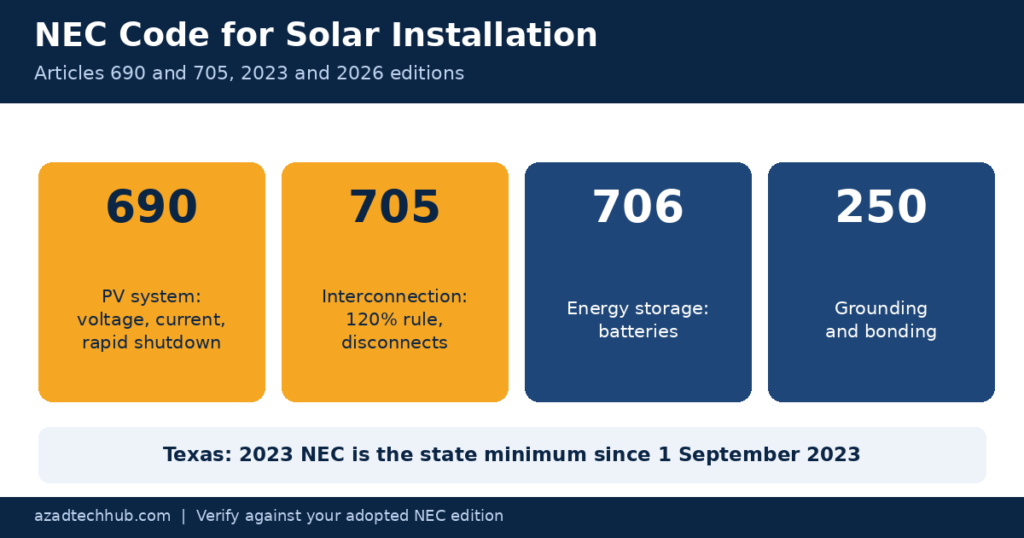
The NEC code for solar installation is spread across several articles, not one. Article 690 covers the PV system itself, Article 705 covers how it connects to the building and the grid, Article 706 covers batteries, and Article 250 covers grounding. This guide maps those articles, shows what changed in the 2023 and 2026 editions, explains the labels, rapid shutdown and the 120% rule, and covers Texas, where the 2023 NEC is the state minimum. A free one-page PDF cheat sheet is included.
Quick answer: Under the NEC code for solar installation, size PV circuits to 690.8, mark the maximum DC voltage (690.7(D) in 2023), provide rapid shutdown on buildings (690.12), and connect to a service panel under 705. On a busbar, the main breaker plus the solar breaker cannot exceed 120% of the busbar rating (705.12). Always confirm which edition your inspector enforces.
Which NEC Articles Cover Solar Panels and Photovoltaic Systems?
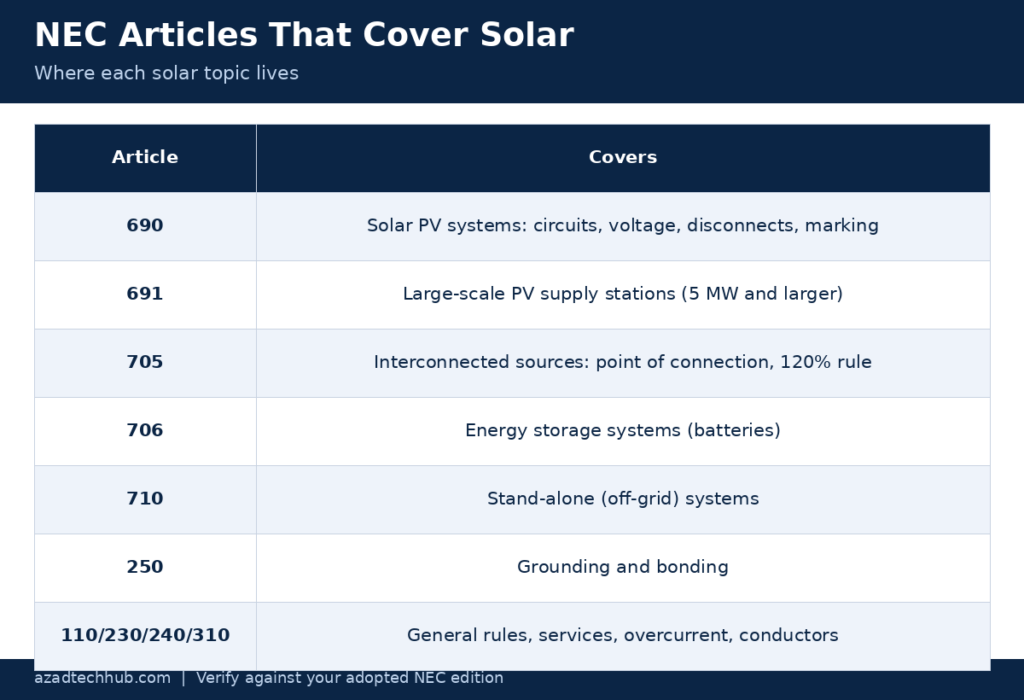
The National Electrical Code, which is NFPA 70, is a model code that states and cities adopt. Searches for NEC photovoltaic and NEC solar panels all lead to the same set of articles:
| Article | Covers |
|---|---|
| 690 | Solar PV systems: circuits, voltage, disconnects, rapid shutdown, grounding, marking |
| 691 | Large-scale PV electric supply stations (5 MW and larger) |
| 705 | Interconnected power sources: connection to the service, the 120% rule, disconnects |
| 706 | Energy storage systems (batteries) |
| 710 | Stand-alone (off-grid) systems |
| 250 | Grounding and bonding, including the PV grounding sections |
| 110, 230, 240, 310 | General requirements, services, overcurrent protection and conductors |
NEC 705 is the article that most often decides the permit, because it governs the point of connection. If you are sizing the system first, start with our solar energy hub and the solar panel size calculator.
NEC Code for Solar Installation by Edition: 2020, 2023 and 2026
There is no 2021 or 2022 NEC. The editions are 2017, 2020, 2023 and 2026, so searches for the NEC code for solar installation 2021 or 2022 usually mean the 2020 code. The 2023 NEC requirements for solar photovoltaic systems changed these things:
- PV definitions moved from Article 690 to Article 100.
- The maximum DC voltage label moved to 690.7(D).
- Rapid shutdown labels moved from 690.56(C) to 690.12(D), with simpler wording.
- Power source identification was centralized in 705.10.
- Carports, shade structures and solar trellises got an exception from rapid shutdown.
The 2026 NEC (NFPA 70-2026, effective 9 September 2025) is mostly clarifications for solar. It adds a rounding rule in 690.4(G), lets a licensed engineer use documented calculations for PV voltage and current on systems of any size, and sends PV disconnect requirements to 705.20. It also restores a supply-side conductor length limit in 705.11(C)(1). The 2026 edition renumbers parts of the code, and Article 220 became Article 120, so check section numbers carefully.
NEC Code for Solar Installation in Texas
Texas adopted the 2023 NEC as the statewide minimum standard, effective 1 September 2023, through the Texas Department of Licensing and Regulation. The NEC code for solar installation Texas applies to licensed electricians everywhere in the state, and cities can add local amendments and their own permit rules. Utilities also set interconnection requirements separately, so check the utility and your city before design. For bill and sizing context, see our Texas electricity bill calculator.
NEC 690.7: Maximum Voltage
Within the NEC code for solar installation, NEC code 690.7 sets the maximum PV system voltage. For a series string it is the sum of the rated open-circuit voltages of the modules, corrected for the lowest expected ambient temperature using the table in 690.7 or the module’s temperature coefficient. That voltage sets the rating of cables, disconnects and inverters. In 2023, 690.7(D) requires a label showing the highest maximum DC voltage. The 2026 edition allows that label value to be rounded up, according to the sources we checked.
Circuit current is sized in 690.8, where the short-circuit current is multiplied by 125% twice, giving 156%, before the conductor and overcurrent device are chosen. Size the wires with our DC cable size calculator.
Rapid Shutdown (690.12)
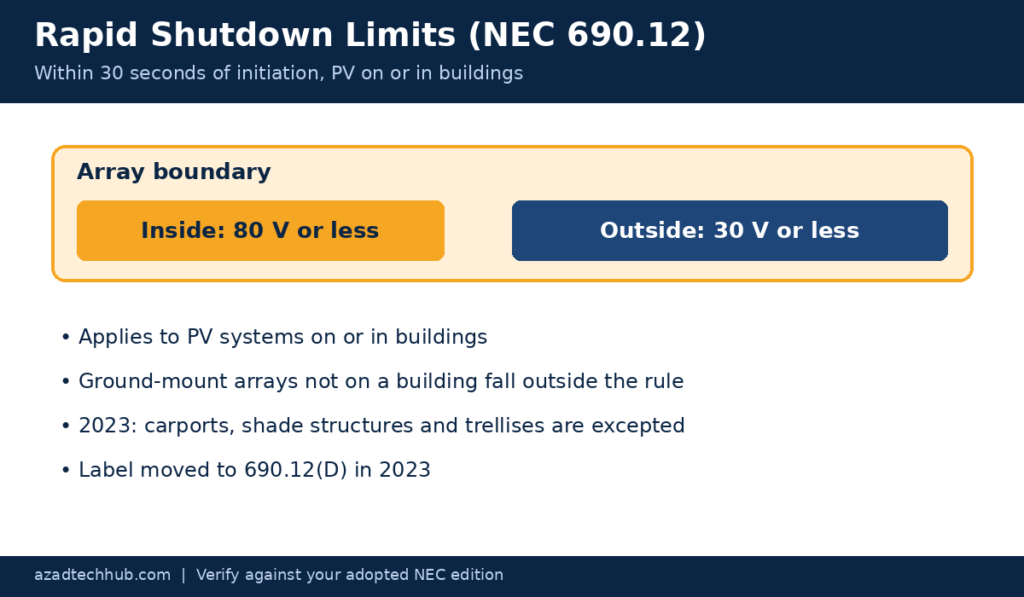
In the NEC code for solar installation, rapid shutdown applies to PV systems on or in buildings. Within 30 seconds of initiation, controlled conductors outside the array boundary must drop to 30 volts or less, and conductors inside the boundary to 80 volts or less. A ground-mount array that is not on a building falls outside the rule. Rapid shutdown is why module-level electronics and listed shutdown devices are used.
NEC Solar Labeling Requirements
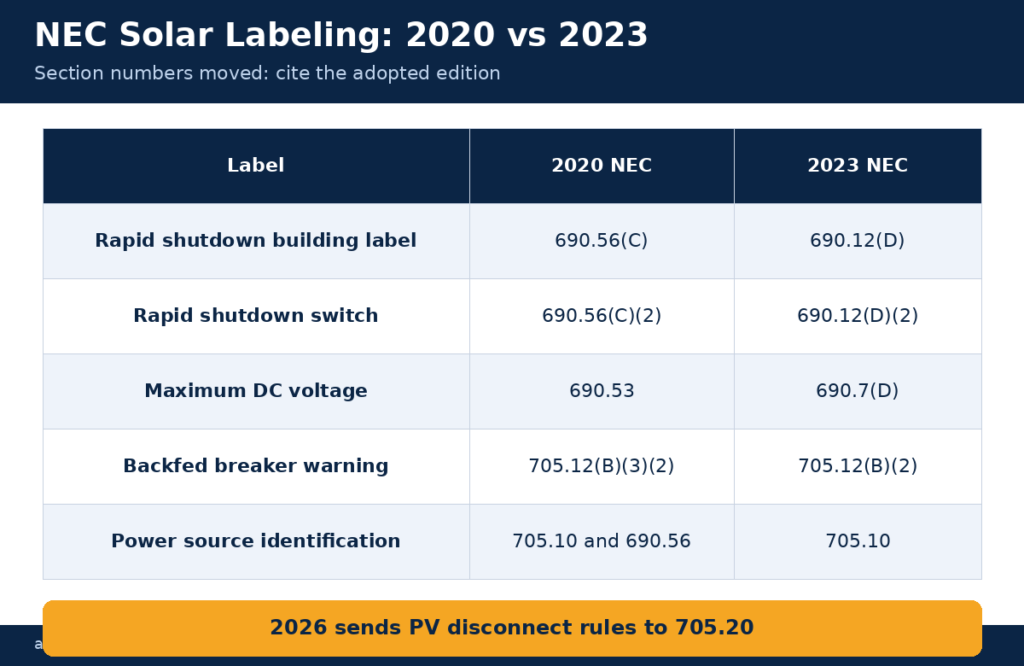
NEC solar labeling requirements trip up many plan sets. The 2023 changes are:
| Label | 2020 NEC | 2023 NEC |
|---|---|---|
| Rapid shutdown building label | 690.56(C) | 690.12(D) |
| Rapid shutdown switch | 690.56(C)(2) | 690.12(D)(2) |
| Maximum DC voltage | 690.53 | 690.7(D) |
| Backfed breaker warning | 705.12(B)(3)(2) | 705.12(B)(2) |
| Power source identification | 705.10 and 690.56 | 705.10 |
The 2023 rapid shutdown label no longer needs the old three-color format, but it still needs the roof diagram and the required wording. Confirm label text with your inspector.
NEC 705: The 120% Rule
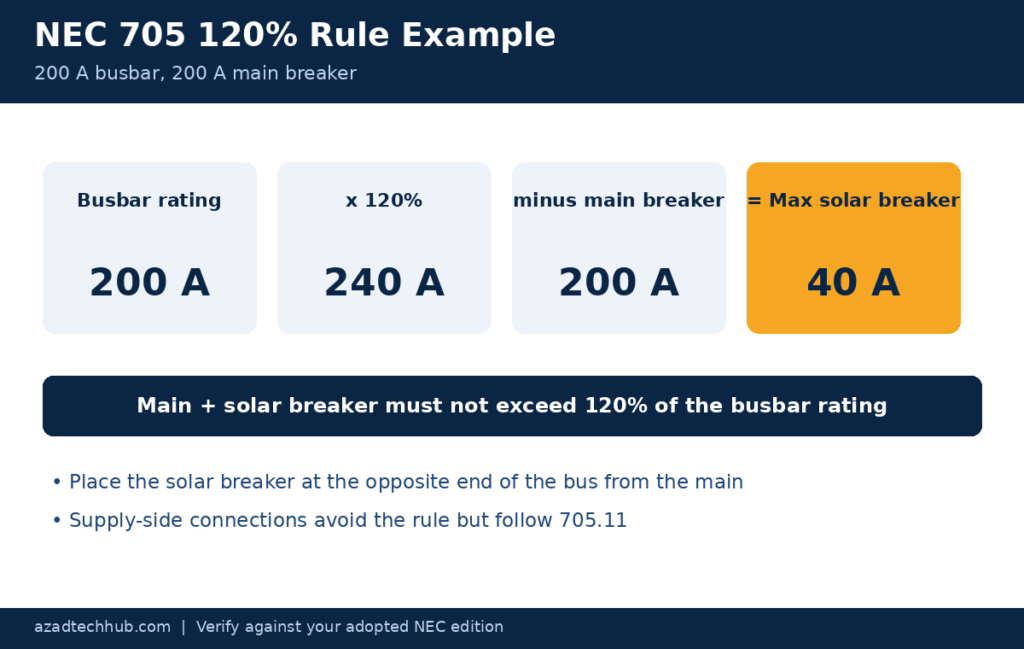
Under 705.12, a load-side connection to a busbar is allowed if the main breaker plus the solar breaker do not exceed 120% of the busbar rating. For a 200 amp busbar with a 200 amp main:
- Busbar limit: 200 × 1.2 = 240 A.
- Maximum solar breaker: 240 − 200 = 40 A.
The solar breaker also goes at the opposite end of the bus from the main. A supply-side connection avoids the rule, but it has its own requirements in 705.11.
Grounding and Bonding for PV
The NEC code for solar installation requires equipment grounding and a grounding electrode connection for PV systems, covered by 690.41 to 690.47 and Article 250. Read our guides on earth cable size for solar panels, the NEC article for grounding and bonding and grounding vs bonding.
NEC Solar Fence Requirements
The NEC has no general fence requirement for residential ground-mount arrays. Article 691 covers large-scale PV stations of 5 MW and above, and 691.4 limits access to authorized personnel, while 691.11 requires fence bonding and grounding details in the documentation. For systems over 1,000 volts, 250.194 covers fence grounding. Many insurers, fire marshals and utilities add their own fence or access rules, so see our guide on insurance for solar panels.
Wiring and Raceways
PV circuits inside buildings often run in metal raceways. Every conductor counts when checking fill, so use our conduit fill calculator and the NEC article for conduit fill. Size the inverter with the solar inverter sizing calculator.
Free PDF: NEC Code for Solar Installation Cheat Sheet
The NEC is copyrighted, so we do not host its text. Download our one-page summary of the NEC code for solar installation, including the article map, label changes and the 120% rule:
You can read the NEC free on NFPA’s free access page.
Tools for Solar Installation Work
Once the NEC code for solar installation is clear, the right tools speed up the job. As an Amazon Associate I earn from qualifying purchases, at no extra cost to you. See our affiliate disclosure.
- MC4 crimper and connectors: for PV wiring.
- Solar label kit: rapid shutdown and DC voltage labels.
- DC clamp meter and multimeter: see our best clamp meter for electricians.
- Thermal camera: find hot modules. See our FLIR ONE Pro review.
- Charge controller: see our Renogy Rover 40A review and charge controller guide.




Frequently Asked Questions
What is the NEC code for solar installation?
Article 690 for the PV system, Article 705 for interconnection, 706 for batteries and Article 250 for grounding.
What does NEC 705 cover?
Interconnected power sources, including the 120% rule and disconnects.
Does Texas use the 2023 NEC?
Yes, since 1 September 2023, with possible local amendments.
Conclusion
The NEC code for solar installation comes down to a few checks: voltage and current in 690, rapid shutdown and labels, the connection in 705, and grounding in 250. Confirm the edition, download the cheat sheet, and use our solar panel size calculator to start the design.
Sources: NFPA 70, National Electrical Code (Articles 690, 691, 705, 706 and 250; 110.31).
Get new guides in your feed. Follow Electrical Insights on LinkedIn for new electrical standards guides, calculators and design tips from Azad Circuit Hub.