Siemens VersiCharge EV Charger Review: Features, Specs, Installation & Buying Guide
If you are looking for a connected home EV charger with a higher current rating, the Siemens VersiCharge AC Series is worth examining. I have worked with electrical panels, protection systems, industrial controls, and automation equipment for years as an electrical engineer, and I pay close attention to circuit capacity, installation method, cable management, and real-world usability when reviewing EV charging equipment.
This Siemens VersiCharge EV Charger Review covers the two current versions relevant to home charging: the 40A plug-in model and the 48A hardwired model. Both are designed for 208/240V circuits and support indoor or outdoor installation.
Siemens VersiCharge EV Charger Specifications at a Glance
| Feature | VersiCharge 40A Plug-In | VersiCharge 48A Hardwired |
|---|---|---|
| Maximum charging current | 40A | 48A |
| Supply voltage | 208/240V AC | 208/240V AC |
| Maximum input power at 240V | 9.6 kW | 11.52 kW |
| Connection | NEMA 6-50 plug | Hardwired |
| Cable length | 20 ft | 20 ft |
| Installation | Indoor/outdoor | Indoor/outdoor |
| Connectivity | Smart connected | Smart connected |
| Enclosure | Silver/black | Silver/black |
| EV connector | SAE J1772 | SAE J1772 |
| Typical circuit size | 50A | 60A |
| Best suited for | Easier installation | Higher continuous charging |
Actual charging speed also depends on the vehicle's onboard AC charger, battery state, temperature, and electrical supply.
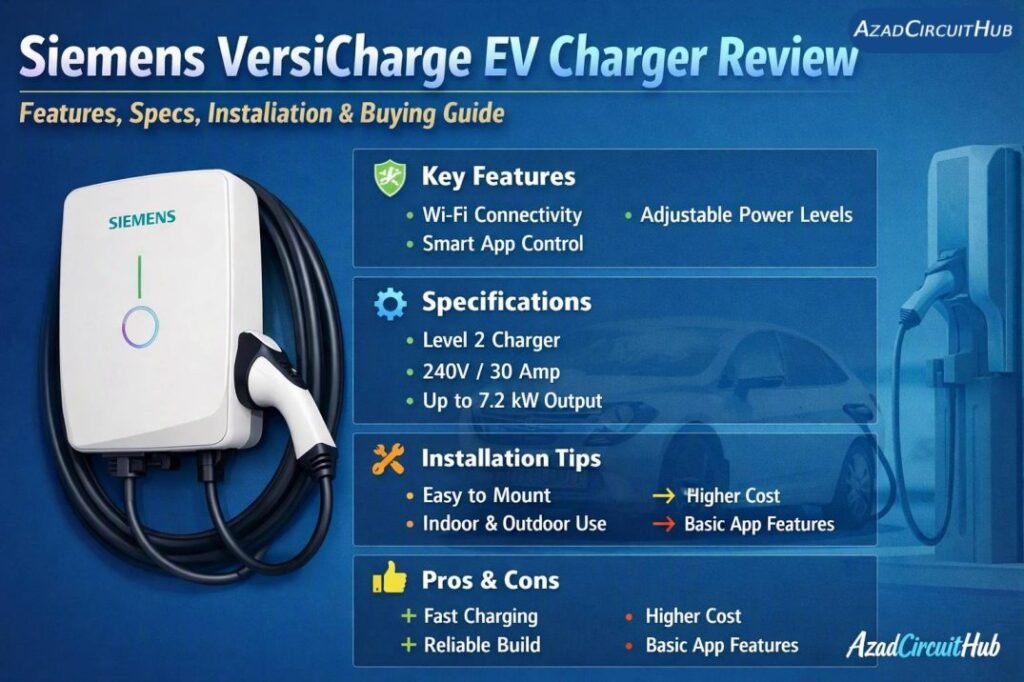
Table of Contents
Table of Contents
What Is the Siemens VersiCharge EV Charger?
The Siemens VersiCharge AC Series is a Level 2 EV charging system designed for residential and other compatible AC charging applications. Instead of relying on a standard 120V outlet, it uses a 208/240V supply to provide substantially more charging power.
The two versions make the product interesting for different installation situations.
The 40A Siemens VersiCharge uses a NEMA 6-50 plug. This can simplify installation when a suitable 6-50 receptacle and properly sized circuit are already available.
The 48A Siemens VersiCharge is hardwired. It eliminates the plug connection and can support a higher continuous charging output when installed on an appropriately sized circuit.
For many homeowners, the choice is therefore less about which unit looks better and more about the electrical service, branch circuit, installation cost, and vehicle charging capability.
Recommended Option: VersiCharge 48A Hardwired
Siemens VersiCharge 40A vs 48A
The biggest difference is the electrical connection and maximum current.
At 240V, a 40A charger can theoretically deliver:
240V × 40A = 9,600W or 9.6 kW
The 48A model can deliver:
240V × 48A = 11,520W or 11.52 kW
However, EV charging is generally treated as a continuous load. Under the commonly applied 125% sizing rule, a 40A continuous load requires a 50A circuit, while a 48A continuous load requires a 60A circuit.
| Charger output | Approx. power at 240V | Typical minimum circuit rating* |
|---|---|---|
| 32A | 7.68 kW | 40A |
| 40A | 9.60 kW | 50A |
| 48A | 11.52 kW | 60A |
*Final conductor, breaker, disconnect, and installation requirements should be determined according to the applicable electrical code and the equipment manufacturer's instructions.
If your vehicle can only accept 32A or 40A AC charging, moving from the 40A to the 48A charger may not produce a corresponding increase in charging speed.
Smart Charging and Connected Features
The smart-connected functionality is one of the main reasons to consider the VersiCharge instead of a basic Level 2 EVSE.
Depending on the specific model and software configuration, connected charging can provide greater control over charging sessions and allow users to manage charging through compatible digital features.
This can be useful when you want to schedule charging around household electricity usage or monitor the charging process without physically standing beside the EVSE.
Smart features are particularly useful for homeowners who want their EV charger to become part of a more connected energy-management setup.
However, connectivity should not be the only buying factor. A reliable electrical installation, adequate service capacity, correct overcurrent protection, and appropriate cable routing remain more important than app-based features.
20-Foot Charging Cable: Why It Matters
Both listed VersiCharge configurations come with a 20-foot charging cable.
That length is useful for many residential garages because the EV charging station does not always sit directly beside the vehicle's charging port.
A longer cable can also make parking more flexible. For example, one vehicle may have its charging port near the rear quarter panel while another has it toward the front.
There is a trade-off, though. Do not leave the cable lying across a vehicle path where it can become a trip hazard. Proper cable management is important, especially for an outdoor installation.
Siemens VersiCharge EV Charger Installation
Installation should be treated as a dedicated electrical project rather than simply mounting a charger on the wall.
For the 40A model, the installation typically involves a suitable 240V branch circuit terminating in the required NEMA 6-50 receptacle. The receptacle should be properly rated and installed using conductors appropriate for the circuit and local code requirements.
The 48A version is hardwired and therefore requires the branch circuit to be routed directly to the EVSE.
A typical installation sequence includes:
- Confirm the vehicle's maximum AC charging rate.
- Check the home's electrical service capacity.
- Select the appropriate branch-circuit rating.
- Determine conductor size based on code, installation conditions, and manufacturer requirements.
- Install the required overcurrent protection.
- Mount the EV charger securely.
- Route and terminate the circuit correctly.
- Verify grounding and required protection.
- Test the installation before normal use.
For outdoor installations, weather exposure, mounting height, cable routing, and the suitability of the installation location also need attention.
As an electrical engineer, I would not choose the 48A version simply because it has a higher number on the specification sheet. The panel and service need to support the additional continuous load.
Which Siemens VersiCharge Model Should You Buy?
The 40A plug-in model is attractive when you want simpler connection and flexibility for future servicing. A NEMA 6-50 connection can also be convenient in some garage installations.
The 48A hardwired model makes more sense when maximum AC charging power is important and the electrical system can support a 60A branch circuit.
| Your situation | More suitable option |
|---|---|
| Existing suitable NEMA 6-50 setup | 40A plug-in |
| Want up to 40A charging | 40A model |
| Vehicle supports higher AC input | 48A model |
| Prefer hardwired installation | 48A model |
| Want up to 11.52 kW at 240V | 48A model |
| Need easier plug-based servicing | 40A model |
Before buying, check the exact product listing, included accessories, connector configuration, electrical requirements, and current Amazon availability.
Check the Siemens VersiCharge 40A on Amazon if you want the plug-in NEMA 6-50 version for a suitable 240V installation.
Check the Siemens VersiCharge 48A on Amazon if you need the higher-output hardwired configuration.
How Fast Can a Siemens VersiCharge Charge an EV?
Charging time depends heavily on battery capacity and the vehicle's onboard AC charger.
For example, a vehicle that can accept 11.5 kW from an AC EVSE can take advantage of much of the 48A charger's available output. A vehicle limited to a lower AC input will charge at its own maximum rate.
A simplified calculation is:
Charging time ≈ battery energy required ÷ charging power
Real charging takes longer because charging efficiency is not 100%, and the vehicle may reduce current as the battery approaches full charge.
For homeowners comparing equipment, it is therefore better to look at the EV's maximum AC charging rate before paying more for a higher-current EVSE.
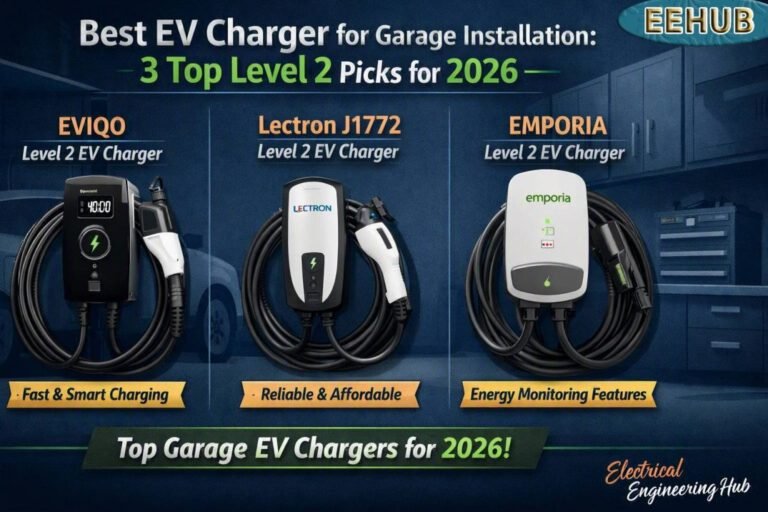
If you are comparing the VersiCharge with other home charging options, our guide to the best level 2 ev charger can help you compare charging power, installation type, cable length, and smart features.
Electrical Requirements to Consider
A Level 2 EV charger can place a substantial continuous load on a residential electrical system.
For a 40A charging output, a typical installation uses a 50A circuit under the 125% continuous-load calculation. For 48A output, a 60A circuit is commonly required.
But breaker size alone does not determine whether the installation is acceptable.
You should also consider:
- Main service rating
- Existing household demand
- Panel capacity
- Conductor ampacity
- Conduit fill
- Ambient temperature
- Voltage drop
- Termination ratings
- Grounding
- Required GFCI protection
- Local electrical code
- Manufacturer installation instructions
A load calculation may be appropriate when the home already has large loads such as electric heating, air conditioning, electric water heating, a pool, or other high-power equipment.
For more charger comparisons, see our guide to the best ev charger level 2 options and compare hardwired and plug-in installations before selecting a model.
Pros and Cons of the Siemens VersiCharge
Pros
- Available in 40A and 48A configurations
- 208/240V Level 2 charging
- Smart connected functionality
- 20-foot charging cable
- Indoor/outdoor installation capability
- Plug-in option available
- Higher-output hardwired option
- Siemens electrical equipment experience behind the product line
Cons
- The 48A model requires hardwired installation
- Higher-current charging may require electrical service upgrades
- Your EV may not be able to use the full 48A output
- Installation requirements can increase project cost
- Smart features may be unnecessary for users wanting a simple EVSE
Is the Siemens VersiCharge Worth Considering?
The Siemens VersiCharge offers a practical combination of Level 2 charging, connected functionality, a long cable, and two installation configurations.
The 40A NEMA 6-50 version is geared toward users who value a plug-in setup, while the 48A hardwired version is designed for installations where higher continuous charging power is useful.
The key point from an electrical engineering perspective is to match the charger to the vehicle and the home's electrical system. A larger EVSE does not automatically mean faster charging if the vehicle cannot accept the additional power.
If maximum charging speed is your main concern, compare your vehicle's AC input rating with other high-output models in our guide to the fastest level 2 charger options.
Frequently Asked Questions
Is the Siemens VersiCharge a Level 2 charger?
Yes. The Siemens VersiCharge AC Series is a Level 2 AC EV charging system designed for 208/240V applications. The 40A and 48A versions can provide substantially more charging power than a standard 120V Level 1 charger.
How many amps does the Siemens VersiCharge use?
The two configurations covered here are rated for 40A and 48A maximum charging output. The 40A model is commonly paired with a 50A branch circuit, while the 48A hardwired model generally requires a 60A circuit when applying the 125% continuous-load rule.
Is the Siemens VersiCharge 40A plug-in or hardwired?
The specified 40A model uses a NEMA 6-50 plug and includes a 20-foot charging cable. This provides a plug-in installation option where the electrical installation and local code permit it.
Does the Siemens VersiCharge 48A require hardwiring?
Yes. The specified 48A Siemens VersiCharge AC Series model is designed for hardwired connection. Because it can operate at up to 48A, the branch circuit and electrical service must be sized appropriately.
Can every EV charge at 48A?
No. The maximum charging current is determined by the vehicle's onboard AC charger as well as the EVSE and electrical supply. If an EV is limited to 32A or 40A AC charging, it will not charge at 48A simply because the VersiCharge has that capacity.
For readers who want to compare established products rather than focus on one model, our famous level 2 ev charger guide provides another starting point for evaluating popular Level 2 charging equipment.
Final Thoughts
This Siemens VersiCharge EV Charger Review shows why the two configurations should be evaluated according to the installation rather than just their maximum amperage. The 40A plug-in version offers a convenient NEMA 6-50 connection, while the 48A hardwired model provides higher available charging power for compatible vehicles.
For either model, proper circuit sizing, panel capacity, grounding, protection, and installation according to the manufacturer's instructions and applicable electrical code should come before installation.
Related Guides & Tools
- Emporia EV Charger Review
- Emporia Pro Level 2 EV Charger Review
- EVIQO vs ChargePoint Home Flex vs Emporia
- Emporia Level 2 EV Charger vs ChargePoint Home Flex
- EV Charger Cable Size Calculator
Get new guides in your feed. Follow Electrical Insights on LinkedIn for new electrical standards guides, calculators and design tips from Azad Circuit Hub.
#SiemensVersiCharge, #EVChargerReview, #Level2EVCharger, #EVCharging, #HomeEVCharger, #ElectricVehicle, #EVChargerInstallation, #EVChargingStation, #SiemensEVCharger, #EVChargerBuyingGuide