
Foot Separation Requirements For Undergrounds By KVA
When designing underground electrical systems, one of the most important considerations is Foot Separation Requirements For Undergrounds. Proper spacing between underground cables, ducts, and utility lines directly affects safety, heat dissipation, maintenance access, and compliance with electrical standards.
The required foot separation often depends on the KVA rating of the system because larger transformers and higher current loads generate more heat. If cables are installed too close together, this can lead to overheating, insulation damage, and reduced cable life.
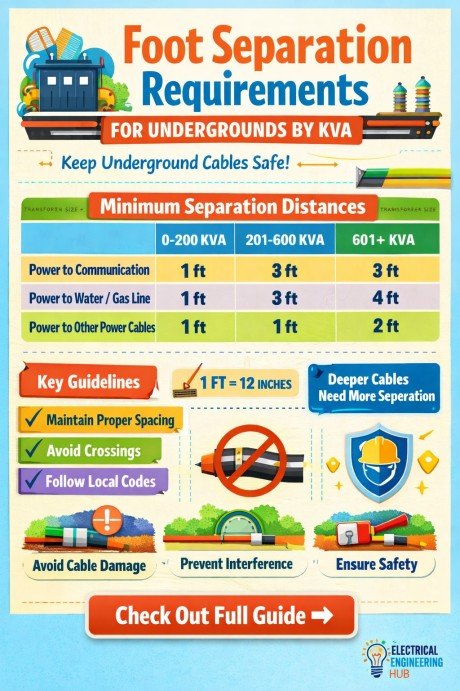
Table of Contents
Table of Contents
Understanding Foot Separation Requirements For Undergrounds helps engineers, contractors, and technicians plan better installations and avoid costly mistakes. Whether you are working on low-voltage service lines or medium-voltage feeders, correct spacing is essential for long-term performance.
Find all about Standard Depth of Underground Cables
Why Foot Separation Matters in Underground Installations
Underground cable systems operate in enclosed spaces where heat cannot dissipate as easily as overhead systems. Proper separation creates enough space for cooling and future maintenance.
Key reasons for maintaining proper underground spacing include:
- Better heat dissipation
- Reduced electromagnetic interference
- Easier fault detection
- Safer excavation during maintenance
- Compliance with NEC and IEC standards
- Reduced risk of cable insulation failure
For high KVA installations, the importance of Foot Separation Requirements For Undergrounds increases significantly.
Standard Foot Separation Requirements Based on KVA
The table below shows common industry practices for underground cable separation based on transformer size and system load.
| Transformer Capacity (KVA) | Recommended Cable Separation | Typical Application |
|---|---|---|
| Up to 75 KVA | 1 ft | Small residential |
| 75–300 KVA | 2 ft | Large residential/commercial |
| 300–750 KVA | 3 ft | Commercial buildings |
| 750–1500 KVA | 4 ft | Industrial facilities |
| 1500–2500 KVA | 5 ft | Heavy industrial |
| Above 2500 KVA | 6 ft or more | Utility substations |
These values may vary depending on soil resistivity, cable insulation type, and local utility standards.
Use this tool if you are trying to calculate cable size for underground cables. Try here Underground Cable Size Calculator – Find Correct Wire Size for Long Distance Runs
Factors Affecting Foot Separation Requirements For Undergrounds
Several factors influence spacing requirements beyond KVA rating.
1. Heat Dissipation
Higher KVA systems carry larger currents. More current means more heat generation. If cables are too close, mutual heating can reduce ampacity.
Thermal backfill and soil conditions also affect this.
2. Voltage Level
Higher voltage cables require greater clearance. This reduces electrical stress and minimizes fault risks.
For example:
| Voltage Level | Minimum Separation |
|---|---|
| 400V | 1–2 ft |
| 11kV | 2–3 ft |
| 33kV | 3–5 ft |
| 66kV and above | 5 ft+ |
Designing electrical system? Use this clearance and creepage calculator for accurate distances
3. Number of Circuits
Multiple circuits in one trench need extra spacing to prevent heat buildup.
This is where proper Cable Trench Design becomes important for optimizing trench width and depth.
4. Soil Thermal Resistivity
Dry soil traps heat. Wet soil dissipates heat better. Engineers calculate derating factors based on soil conditions.
5. Future Expansion
Leaving extra separation allows additional cable installation later without major excavation.
Recommended Underground Separation for Different Utilities
Underground installations often involve other utilities. Proper clearance prevents interference and accidental damage.
| Utility Type | Minimum Separation |
|---|---|
| Electric to Water | 1 ft |
| Electric to Gas | 3 ft |
| Electric to Telecom | 1 ft |
| Electric to Sewer | 2 ft |
| Electric to Fiber Optic | 1 ft |
Always verify local authority requirements.
Know more about Cable Gland Size Chart Hawke: Best NEC-Compliant Sizing & Industrial Application Guide
Key Takeaways
Before planning underground cable systems, remember these important points:
- Higher KVA means greater separation requirements.
- Heat dissipation is the main reason for spacing rules.
- Voltage level also impacts underground clearance.
- Soil condition can affect cable ampacity.
- Proper trench planning improves system life.
- Future maintenance becomes easier with good spacing.
Correct Foot Separation Requirements For Undergrounds improve safety and reliability.
Trench Width Calculation Example
Suppose you have three 11kV cables connected to a 1000 KVA transformer.
Given:
- Cable diameter = 4 inches
- Required separation = 4 ft
- Side clearance = 1 ft each side
Calculation:
Total trench width:
4 + 48 + 4 + 48 + 4 + 12 + 12 = 132 inches
132 inches ÷ 12 = 11 feet
This shows how large KVA systems demand wider trenches.
Proper Laying Cable techniques also help maintain these clearances during installation.
Experience fast and accurate results using our online tool Conduit Fill Calculator for Multiple Wire Sizes
Common Installation Mistakes
Many underground cable failures happen because of spacing errors.
Avoid these mistakes:
- Placing cables too close
- Ignoring soil temperature rise
- Not considering load growth
- Mixing power and communication cables without clearance
- Using incorrect trench dimensions
- Overlooking utility crossing requirements
Following Foot Separation Requirements For Undergrounds prevents these issues.
For Accurate and Easy Cable Capacity, use our online tool Cable Trench Fill Calculator
Best Practices for Underground Cable Separation
To improve performance and safety, follow these best practices:
Use Cable Spacers
Spacers maintain uniform distance during installation.
Install Thermal Backfill
Special backfill improves heat transfer.
Follow Utility Drawings
Always verify approved layouts before excavation.
Inspect Before Backfilling
Ensure separation is maintained before covering.
Label Utility Paths
This helps future maintenance teams identify cable routes.
Know more about Why Power Cables Insulation Rated for High Voltage
Compliance Standards for Underground Separation
Different standards guide underground installations.
Important standards include:
- NEC Article 300.5
- IEC 60364
- IEEE 835
- Utility company specifications
- Local municipal regulations
These standards may specify different Foot Separation Requirements For Undergrounds depending on voltage and environmental conditions.
How KVA Impacts Cable Trench Planning
KVA directly affects cable sizing, trench width, and thermal design.
For example:
| KVA Rating | Current Demand | Separation Impact |
|---|---|---|
| Low KVA | Low current | Minimal spacing |
| Medium KVA | Moderate current | Standard spacing |
| High KVA | High current | Increased spacing |
Larger KVA systems often require duct banks, thermal analysis, and dedicated trenches.
Find more Electrical Engineering Tools for easy electrical calculations and estimations.
This makes underground design more complex.
Conclusion
Foot Separation Requirements For Undergrounds play a major role in electrical safety and system efficiency. As KVA ratings increase, so does the need for greater spacing between cables and utilities. Proper separation improves heat dissipation, reduces failures, and makes maintenance easier.
Every underground project should consider transformer capacity, voltage level, soil condition, and future expansion. Following industry standards and best practices ensures a safe and durable installation.
Whether you are designing a small residential service or a large industrial feeder, applying the right Foot Separation Requirements For Undergrounds will save time, money, and future headaches.
Try this tool out to save time and effort for easy conversions Amps to Wire Size Calculator – Choose the Right Cable for 10A, 20A, 40A Loads
FAQs
1. What is the minimum foot separation for underground power cables?
The minimum is usually 1 foot for small systems, but it increases with KVA and voltage.
2. Does KVA affect underground cable spacing?
Yes, higher KVA means higher current, more heat, and greater spacing requirements.
3. What happens if underground cables are too close?
Cables may overheat, causing insulation damage and reduced service life.
4. Can power cables and communication cables share the same trench?
Yes, but proper separation barriers and clearance must be maintained.
5. Which standard covers Foot Separation Requirements For Undergrounds?
NEC, IEC 60364, IEEE standards, and utility regulations provide guidance.
You might find this tool useful for tackling similar tasks Sub Panel Wire Size Calculator – Accurate Wire Gauge & Load Sizing Tool
Get new guides in your feed. Follow Electrical Insights on LinkedIn for new electrical standards guides, calculators and design tips from Azad Circuit Hub.
#FootSeparationRequirements,#UndergroundCableSpacing,#KVASeparationGuide,#ElectricalCableInstallation,#UndergroundPowerCables,#CableClearanceStandards,#ElectricalSafetyGuide,#TransformerCableSpacing,#PowerDistributionDesign,#UndergroundWiringRules
