EV Charger Load Calculation Tool: Breaker Size, Wire Gauge & Charging Time
Electric vehicles (EVs) are rapidly transforming the transportation landscape. As the adoption of EVs grows, understanding EV charger load calculation becomes increasingly important for residential, commercial, and industrial settings. Proper load calculations are essential to ensure the safe, efficient, and reliable operation of EV charging stations.
This article provides an in-depth guide to calculating the load for EV chargers, with detailed technical insights, real-world examples, and references to standards like NEC 625.42. Additionally, we’ll integrate relevant concepts like EV charging capacity, EV charging station types, and considerations for charging electric cars.
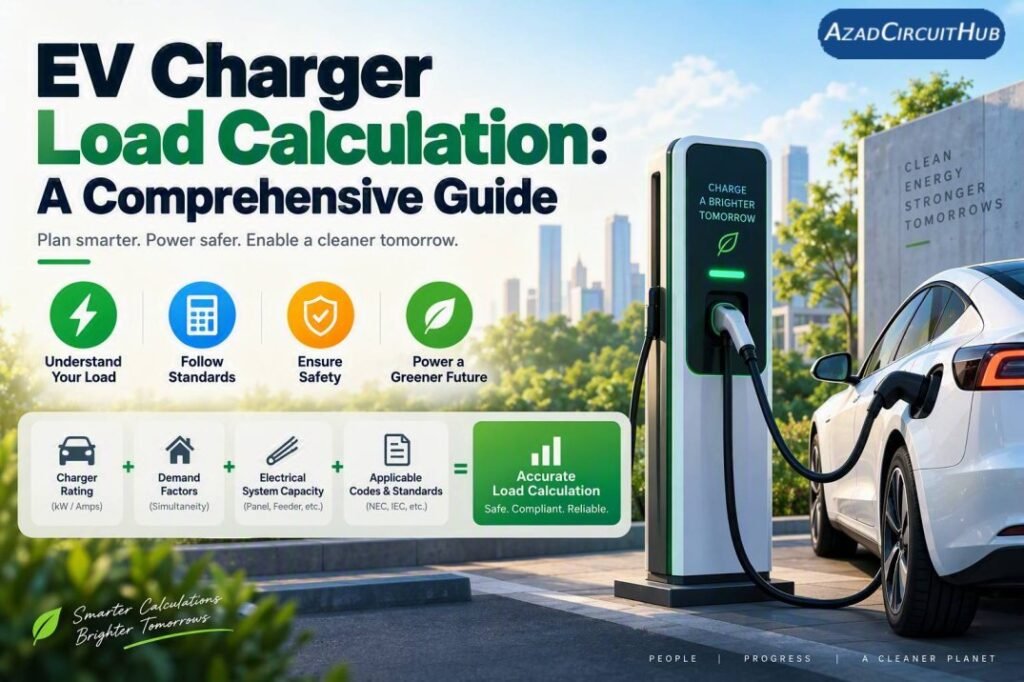
Table of Contents
Table of Contents
EV Charger Load Calculation
Electric vehicles (EVs) are rapidly transforming the transportation landscape. As the adoption of EVs grows, understanding EV charger load calculation becomes increasingly important for residential, commercial, and industrial settings. Proper load calculations are essential to ensure the safe, efficient, and reliable operation of EV charging stations.
This article provides an in-depth guide to calculating the load for EV chargers, with detailed technical insights, real-world examples, and references to standards like NEC 625.42. Additionally, we’ll integrate relevant concepts like EV charging capacity, EV charging station types, and considerations for charging electric cars.
EV Charger Load Calculator
EV Charger Load Calculator
Work out the breaker size, wire gauge, panel headroom, voltage drop, and charging time for a home or workplace EV charger installation. Enter your charger and panel details below, then press Calculate.
Charger Specifications
Panel and Existing Load
Circuit Run Optional
Charging Time Estimate Optional
How to Use
- Pick your charger from the Charger Type list, or leave it on Custom and enter the voltage and amperage yourself from the unit’s nameplate.
- Select your home or building’s main panel breaker size, and enter the amperage already used by other circuits if you know it. If you are not sure, leave the existing load at 0 for a best-case check, then confirm with an electrician before installing.
- If you know the distance from the panel to the planned charger location, enter it under Circuit Run to get a voltage drop check for that specific run.
- If you want a charging time estimate, fill in the battery capacity and the current and target charge levels. Add the vehicle’s efficiency in miles per kWh as well if you want an estimated range added.
- Press Calculate. The results panel will show the recommended breaker size, wire gauge, panel headroom, voltage drop status, and charging time and range, based on what you entered.
- Adjust any field and press Calculate again to compare different chargers, panel sizes, or circuit lengths side by side.
Technical Notes
EV charging is treated as a continuous load, which means the circuit and breaker feeding it need extra headroom above the charger’s rated draw, not just a size that matches it exactly. The calculator applies that margin automatically when it recommends a breaker size.
The wire gauge shown is matched to the recommended breaker size using standard copper conductor ampacity ratings, assuming typical 75 degree C rated terminations. It is a starting point for discussion with your electrician, not a substitute for a code check specific to your installation, conduit fill, and local amendments.
The panel headroom check applies a conservative safety margin to your main breaker rating before subtracting existing connected load, since panels are not meant to run at their full rated capacity continuously. A result that shows insufficient headroom does not automatically mean a panel upgrade is required. It usually means a proper load calculation, a load management or energy monitoring device, or a subpanel should be discussed with a licensed electrician.
The voltage drop check estimates how much the voltage sags over the length of the circuit run you entered. Long runs on an undersized wire can cause a charger to run hotter, charge slower, or trip intermittently even when the breaker size is otherwise correct. If the estimated drop is above the commonly used 3 percent guideline, the tool suggests moving to the next larger wire size for that run.
The charging time and range figures assume the charger delivers power at its rated voltage and amperage with a typical efficiency loss factored in. Actual results vary by vehicle, charger, cable, ambient temperature, and battery management behavior, especially near full charge.
This tool provides general planning estimates only. Electrical codes, utility rules, and safe practices vary by location and change over time. Always verify breaker sizing, wire sizing, panel capacity, and permit requirements with a licensed electrician and your local authority having jurisdiction before any installation.
What is EV Charger Load Calculation?
EV charger load calculation involves determining the electrical load required to safely charge electric vehicles. It accounts for factors like the number of chargers, their capacity, operating hours, and local electrical codes. Load calculation ensures your electrical system can handle the additional demand without overloading or causing safety risks.
When installing an EV charging station, whether for personal use or commercial purposes, understanding how much power is needed to charge electric cars is critical. This includes knowing where to charge electric cars, the types of EV charging stations, and how to balance multiple chargers on the same electrical circuit.
Calculate the Right EV Charger Cable Size
Choosing the correct cable is just as important as calculating the charger load. An undersized cable can overheat, while an oversized cable increases installation costs. The table below provides a quick reference, but factors such as installation method, cable length, ambient temperature, and local electrical codes should always be considered.
| EV Charger Rating | Typical Cable Size* |
|---|---|
| 16A | 2.5 mm² |
| 32A | 6 mm² |
| 40A | 8–10 mm² |
| 48A | 10 mm² |
For accurate results, use our EV Charger Cable Size Calculator to determine the recommended cable size based on your installation requirements. It helps minimize voltage drop and ensures a safe, code-compliant EV charging setup.
Key Factors in EV Charger Load Calculation
To perform an accurate EV charger load calculation, consider the following factors:
1. Type of EV Charger (Level 1, 2, or DC Fast Charger)
- Level 1 Charger: These operate on a standard 120V outlet and typically draw 12–16 amps. While slow, they are ideal for overnight charging of smaller EVs.
- Level 2 Charger: Operating on 240V, these chargers draw between 20–50 amps, providing faster charging for electric vehicle charge applications.
- DC Fast Chargers: These are high-powered chargers (typically 50 kW or higher) used in public EV charging stations. They require significant electrical capacity and are subject to detailed load calculations.
For homes or facilities with multiple EV chargers, EV Charger Load Management System solutions can help balance charging demand and prevent unnecessary electrical overload.
2. Number of EV Chargers
For multiple chargers, calculate the total load by summing the individual demands. For example, if you have two Level 2 chargers rated at 40 amps each, the total load will be 80 amps.
3. Diversity Factor
When multiple chargers operate simultaneously, you can apply a diversity factor to reduce the overall load. For instance, not all chargers may be in use at the same time in a commercial EV charging station.
4. Charging Duration and Patterns
The duration of charging impacts energy consumption. For example, a Level 2 charger drawing 32 amps for 6 hours will consume significantly more energy than one charging for 2 hours.
5. Local Electrical Codes
Adhere to codes like NEC 625.42, which governs the installation of EV chargers, ensuring safety and compliance.
6. Electrical System Capacity
Evaluate the existing electrical infrastructure to ensure it can handle the additional load. If not, upgrades may be necessary.
Steps for Calculating EV Charger Load
Identify Charger Specifications
Check the power rating (in kW) or current draw (in amps) of the charger. For example, a 7.2 kW Level 2 charger draws 30 amps on a 240V circuit.
Calculate Individual Load
Use the formula:

For a 240V, 30A charger:

Sum Up Multiple Chargers
Add the loads of all chargers. For instance, three Level 2 chargers rated at 7.2 kW each will have a combined load of:

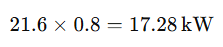
Apply Diversity Factor
If applicable, reduce the total load using a diversity factor. For example, with a diversity factor of 0.8:
Verify Against Electrical Panel Capacity
Ensure your panel can handle the calculated load. If not, consider installing a separate panel or upgrading the existing one.
After calculating your EV charging load, the next step is selecting the correct circuit protection. Use our EV Charger Breaker Size Calculator to determine the recommended breaker size based on your charger rating and NEC guidelines.
Worked Example: Using the EVIQO Level 2 EV Charger
To understand how charging time and energy consumption work in real life, consider this practical example using the EVIQO Level 2 EV Charger.
| Parameter | Value |
|---|---|
| EV Charger | EVIQO Level 2 EV Charger |
| Charging Power | 11.5 kW (48A, 240V) |
| Vehicle Battery Capacity | 75 kWh |
| Battery State of Charge | 20% to 80% |
| Energy Required | 45 kWh |
| Estimated Charging Time | Approximately 4 hours |
Calculation
Energy required:
75 kWh × (80% − 20%) = 45 kWh
Charging time:
45 kWh ÷ 11.5 kW = 3.91 hours
Allowing for normal charging losses (about 5–10%), the total charging time is approximately 4 hours.
Planning several charging points? Learn how an EV Charger Load Management System can coordinate charging loads and make better use of your available electrical capacity.
This example shows why a high-power Level 2 charger is ideal for overnight charging or quickly replenishing your EV battery before your next trip.
Tip: Actual charging time may vary depending on your vehicle’s onboard charger, battery temperature, and charging efficiency.
Looking for a Real-World Performance Review?
👉 Planning to install this charger? Read our detailed EVIQO Level 2 EV Charger Review to explore performance, installation tips, pros and cons, and real-world testing. If it fits your needs, you can also buy the EVIQO Level 2 EV Charger on Amazon to check the latest price and available discounts.
EV Charging Station Types
Understanding the EV charging station types is essential when planning installations:
Residential EV Chargers: Typically Level 1 or Level 2, used for home charging electric cars.
Commercial EV Chargers: Include Level 2 and DC fast chargers for public or workplace use.
Fleet Charging Stations: Designed for businesses with electric vehicle fleets, requiring precise load calculations for simultaneous charging.
NEC 625.42 and Load Calculation Compliance
The NEC (National Electrical Code) provides guidelines for EV charger installations, with NEC 625.42 emphasizing overcurrent protection. Key points include:
- Ensuring proper circuit sizing for chargers.
- Providing adequate protection against overloads.
- Adhering to voltage drop limits for longer cable runs (calculate voltage drop using tools like the Voltage Drop Calculator).
EV Charging Capacity and Future Expansion
When installing EV chargers, always consider future expansion. If you plan to add more chargers or upgrade to DC fast chargers, account for the increased load now.
Enhancing Efficiency in EV Charger Load Calculations
To optimize EV charger installations:
- Use energy management systems to monitor and control loads.
- Implement smart charging to distribute the load dynamically.
FAQs on EV Charger Load Calculation
How do you charge an electric car safely?
Always follow manufacturer guidelines, use dedicated circuits for chargers, and ensure compliance with local codes like NEC 625.42.
Where to charge an electric car?
EVs can be charged at home, at public charging stations, or workplace facilities equipped with EV charging station types suited to your needs.
Related Guide & Tools
- Electric Vehicle Charging Time Calculator
- How to Calculate Load for Multiple EV Chargers
- 48-Amp EV Charger Breaker Size
- 40A vs 50A vs 60A Circuit for EV Charger
Conclusion
Accurate EV charger load calculation is the foundation for safe and efficient EV charging infrastructure. By understanding charger specifications, adhering to codes like NEC 625.42, and planning for future capacity, you can ensure a seamless charging experience for both residential and commercial applications.
With the right calculations and planning, you’ll not only ensure compliance and safety but also contribute to a sustainable future powered by electric vehicles.
Follow Us on Social:
Subscribe our Newsletter on Electrical Insights for latest updates from Electrical Engineering Hub
#EVChargerLoad, #LoadCalculation, #EVChargingStation, #ElectricVehicleCharger, #EVChargerSetup, #SustainableEnergy, #EVChargerPlanning, #ElectricalLoad, #EVChargingSolutions, #SmartCharging, #ElectricVehicleInfrastructure, #GreenEnergy, #ChargingStationDesign, #EVLoadManagement, #ElectricalEngineering
EV Charger Load Calculation Tool: Breaker Size, Wire Gauge & Charging Time
EV Charger Load Calculation Tool to find breaker size, wire gauge, circuit load, and charging time for safe and efficient EV charger installation.
Price Currency: USD
Operating System: Web Browser
Application Category: UtilitiesApplication