NEC Code for Buried Electrical Wires: Depth Chart & Rules (2026)
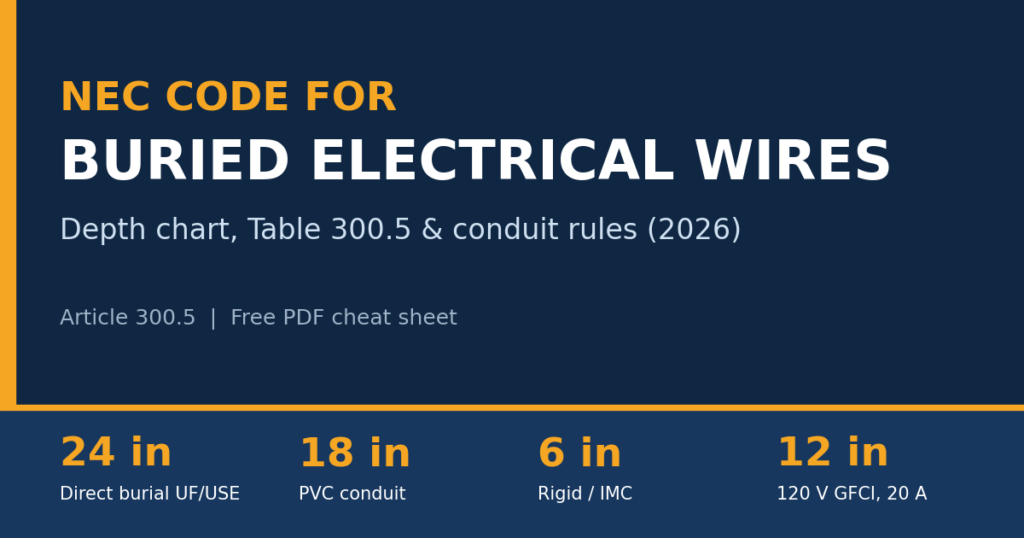
Table of Contents
Table of Contents
The NEC code for buried electrical wires lives in Article 300.5 and its Table 300.5. Together they decide how deep your trench must be, what protection the wiring needs, and whether you need conduit at all. Miss the minimum cover and an inspector can fail the trench before you backfill.
This guide gives you the full burial depth chart, the conduit rules, and straight answers to the questions people search most, from 12/2 Romex to California requirements. Keep our conduit fill calculator open in another tab while you plan the run.
Quick Answer: NEC Code for Buried Electrical Wires
For most outdoor runs, the NEC requires 24 inches of cover for direct-burial cable, 18 inches for PVC conduit, and 6 inches for rigid metal or IMC conduit. Residential 120-volt branch circuits of 20 amps or less with GFCI protection can be buried 12 inches deep. Under driveways and roads the numbers change. Local amendments can be stricter than the base code, so confirm with your inspector before you dig.
What Is Article 300.5 of the NEC Code?
Article 300.5 covers underground installations of 1,000 volts or less. It sets minimum cover in Table 300.5, requires wiring in a wet location to be rated for it, calls for protection where conductors rise out of the ground, and limits what backfill may touch the cable. Cover is measured from the top of the cable or raceway to the finished grade, a detail many DIY builders get wrong.
NFPA publishes the full text in NFPA 70, the National Electrical Code. For plain-language breakdowns of related rules, browse our electrical standards library, including NEC Article 210.8 A on GFCI protection and NEC Article 210.20 A on the 125% continuous load rule.
NEC Burial Depth Chart (Table 300.5)
This NEC burial depth chart shows the minimum cover in inches for the most common locations. Verify against the edition your jurisdiction has adopted.
![NEC burial depth chart placeholder: nec-burial-depth-chart.png]
| Location | Direct burial cable (UF, USE) | Rigid metal or IMC | PVC conduit | 120 V, 20 A or less, GFCI (residential) | 30 V or less landscape lighting |
|---|---|---|---|---|---|
| All other locations | 24 in | 6 in | 18 in | 12 in | 6 in |
| Residential driveways and parking areas | 18 in | 18 in | 18 in | 12 in | 18 in |
| Streets, roads, alleys, commercial parking lots | 24 in | 24 in | 24 in | 24 in | 24 in |
Reduced cover is allowed under concrete slabs and in solid rock, but the conditions are specific. Read the footnotes in Table 300.5 before you rely on a shallower trench.
Free download: grab the one-page NEC burial depth chart PDF for the truck or the job site.
Does a Buried Electrical Line Need to Be in Conduit?
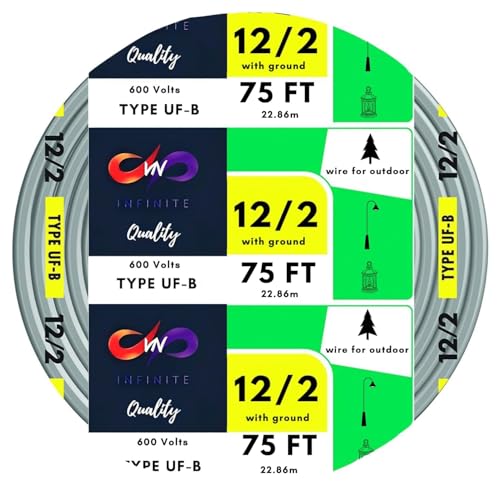
Not always. UF-B and USE-2 cables are listed for direct burial, so the code lets you run them without a raceway at the 24-inch depth. Conduit still earns its place. It protects against shovels, makes future wire replacement possible, and cuts the required depth for metal conduit to 6 inches.
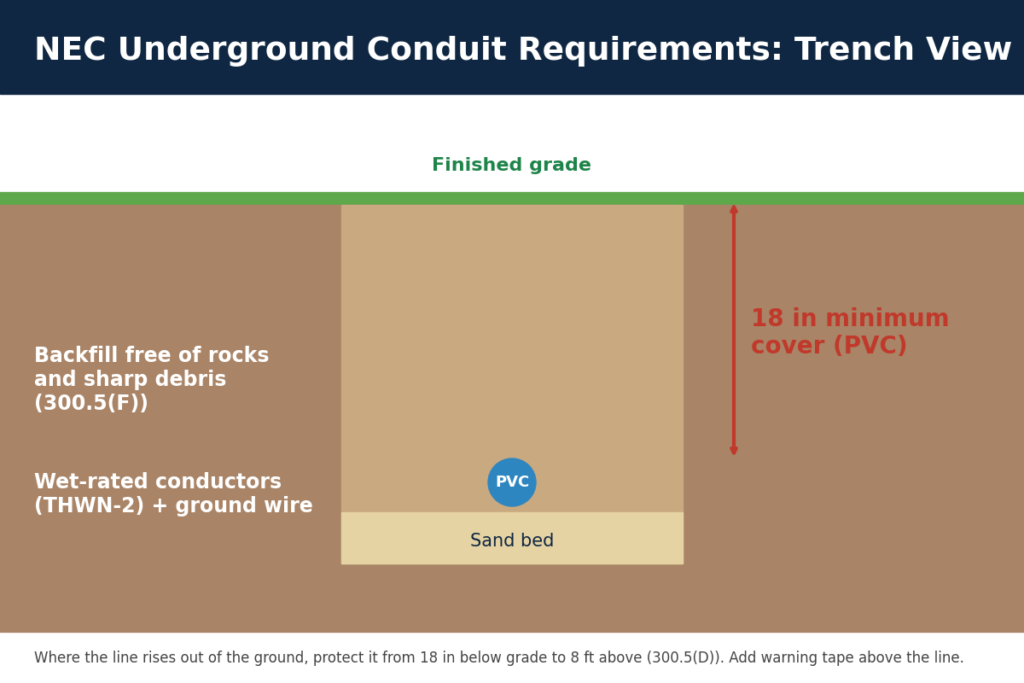
Where the line leaves the ground, protection is mandatory. Article 300.5(D) requires an enclosure or raceway from at least 18 inches below grade up to 8 feet above grade, or to the point of entry. Any wiring in conduit underground must be wet-rated, such as THWN-2, because the NEC treats buried raceways as wet locations.

Can 12/2 Romex Be Buried in Conduit?
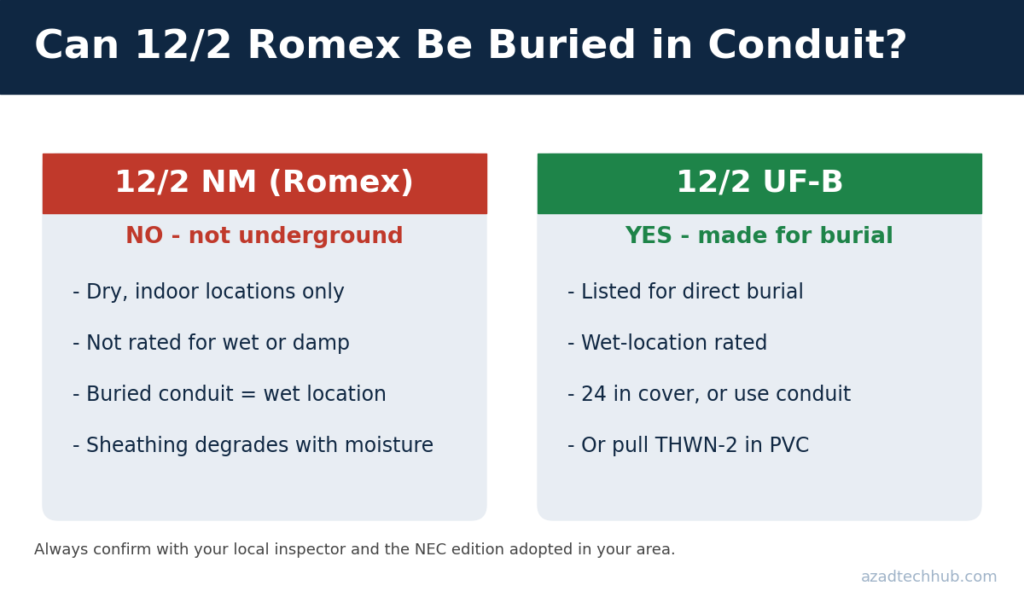
No. Type NM cable, the standard Romex, is not permitted in wet locations, and underground conduit counts as wet even when it looks dry. Condensation and groundwater destroy the sheathing and insulation over time. If you are asking can 12/2 Romex be buried in conduit, the safe answers are:
- Use 12/2 UF-B cable, which is made for direct burial and for wet locations.
- Pull individual THWN-2 conductors through PVC conduit and size them with our wire sizing guide and the AWG to mm² chart.
NEC Underground Conduit Requirements
The NEC underground conduit requirements go beyond depth. Follow these points on every trench:
- Wet-rated conductors only. Use THWN-2 or equivalent inside buried conduit.
- Backfill matters. Article 300.5(F) says backfill must not damage the raceway or cable, so keep large rocks and sharp debris away. A sand bed under and over the conduit is the easy fix.
- Bushings and sealing. Fit bushings at conduit ends and seal where the raceway enters a building so moisture cannot travel indoors.
- Expansion fittings. PVC grows and shrinks with temperature, so add expansion fittings where the run moves at a rigid connection.
- Include the ground. PVC is not a ground path, so pull an equipment grounding conductor with the circuit. Our grounding vs bonding guide explains why.
- Fill limits. Check conductor count against allowable fill with the conduit fill calculator.
NEC Code for Buried Electrical Wires 2020, 2022 and 2023
There is no 2022 edition of the NEC. The code updates every three years: 2020, 2023 and 2026. Anyone searching for the NEC code for buried electrical wires 2022 should read the edition their state has adopted, most likely 2020 or 2023.
For the common residential cases, the Table 300.5 cover depths stay consistent across these editions. The 2020 cycle widened GFCI protection for outdoor outlets, which matters for any buried circuit feeding a receptacle, so review our GFCI article 210.8 A guide. Working space around the panel at the other end also stays governed by NEC 110.26 A.
NEC Code for Buried Electrical Wires in California
California enforces the California Electrical Code, which is built on the NEC with state amendments. The 2025 CEC is based on the 2023 NEC and took effect on January 1, 2026. Cities and counties can add their own rules, so call your building department before trenching.
California homeowners are often trenching for EV chargers or detached garages. Start with the EV charger load calculation tool, then compare hardwired vs plug-in chargers and the Level 2 installation cost guide to budget the underground run.
Best Way to Bury Electrical Wire Underground
The best way to bury electrical wire underground is to follow a short, repeatable process:
- Call 811 a few days before digging so utilities mark their lines.
- Pick the wiring method. UF-B direct burial for short residential runs, or PVC conduit with THWN-2 for easier maintenance.
- Dig below the minimum cover from Table 300.5, then add a 2 to 3 inch sand bed.
- Install the conduit or cable, with bushings, glued joints and expansion fittings where needed.
- Test before backfill. Check continuity and insulation with a quality meter such as those in our best multimeter for electricians roundup, and confirm de-energized conductors with a non-contact voltage tester.
- Backfill in layers and lay warning tape about 12 inches above the line. Warning tape is a best practice, not a general NEC requirement for low-voltage circuits.
- Schedule the inspection before you cover the final layer.
Our Klein ET310 circuit breaker finder review shows how to trace the circuit back to the panel

- ACCURATE CIRCUIT BREAKER IDENTIFICATION: Quickly locate the correct breaker with precision using the transmitter and rec…
- CLEAR INDICATIONS: The Receiver provides visual and audible cues when the correct breaker is found, ensuring a hassle-fr…
- BUILT-IN GFCI TESTER: The Transmitter includes a GFCI outlet tester, enabling you to inspect wiring conditions and test …
Some links above may earn a commission at no extra cost to you. Read our affiliate disclosure.
NEC Code for Buried Electrical Wires PDF and Quick FAQs
Want the numbers offline? Download the NEC burial depth cheat sheet PDF. It is a small file that summarizes Table 300.5, the conduit rules and the Romex answer. A PDF summary cannot replace the code book, so buy or access the official NFPA 70 for compliance work.
What is the code for burying electrical wire?
Article 300.5 and Table 300.5 of the NEC set the minimum burial depth. The depth depends on the wiring method, the location and the circuit type.
How deep does electrical wire need to be buried in conduit?
PVC conduit needs 18 inches of cover. Rigid metal conduit or IMC needs 6 inches. Driveways and roads need more.
What are the NEC requirements for buried cable?
Use cable listed for direct burial, such as UF-B, bury it 24 inches deep, protect it where it emerges from the ground, and use backfill that will not damage it.
Final Thoughts on the NEC Code for Buried Electrical Wires
The NEC code for buried electrical wires is easy to follow once you know three things: the wiring method decides the depth, the location can raise it, and wet-rated wire is non-negotiable. Use UF-B or conduit with THWN-2, never Romex, and measure cover from the top of the cable to the finished grade. Next, size your conductors with the conduit fill calculator, and explore more guides in the electrical standards library.
This article is educational and does not replace the NEC, local amendments or a licensed electrician. Always confirm requirements with your authority having jurisdiction.
Get new guides in your feed. Follow Electrical Insights on LinkedIn for new electrical standards guides, calculators and design tips from Azad Circuit Hub.