
Phase to Phase Clearance as per Indian Standard vs. IEC 61439
Selecting the correct electrical clearance is essential for safety, insulation coordination, and compliance. Many engineers compare Indian Standards with IEC requirements before designing switchboards, motor control centers, and power distribution panels. This guide explains Phase to Phase Clearance as per Indian Standard vs. IEC 61439, highlights practical differences, and helps you understand when both standards lead to similar design values.
If you are looking for the complete clearance chart covering multiple voltage levels, see our detailed guide on Phase to Phase Clearance according to IEC 61439 with voltage-wise charts.
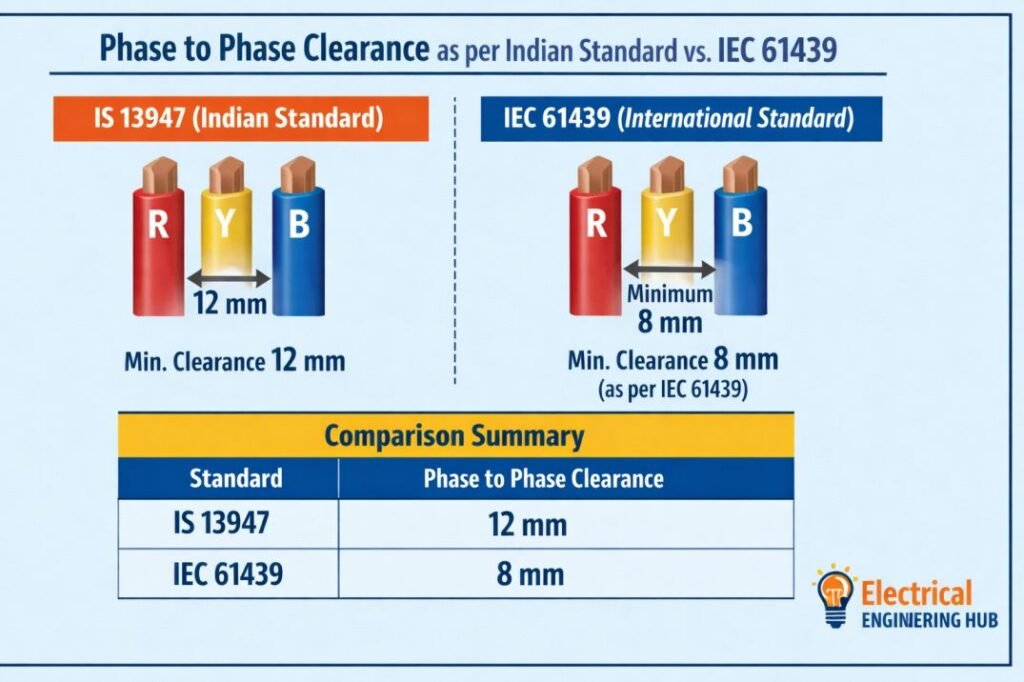
Table of Contents
Table of Contents
Quick Comparison Chart
| Parameter | Indian Standard (IS) | IEC 61439 |
|---|---|---|
| Primary Reference | IS/IEC 61439 Series | IEC 61439 Series |
| Application | India | International |
| Clearance Basis | Rated insulation voltage | Rated insulation voltage |
| Creepage Requirements | Pollution degree dependent | Pollution degree dependent |
| LV Panel Design | Same technical principles | Same technical principles |
| Safety Objective | Prevent flashover | Prevent flashover |
| Typical Industrial Use | Switchboards, MCCs, PCCs | Global LV Assemblies |
Quick Voltage Clearance Reference
| Rated Voltage | Typical Minimum Air Clearance* |
|---|---|
| 230/415 V | 14 mm |
| 690 V | 20 mm |
| 1000 V | 25 mm |
What Is Phase to Phase Clearance?
Phase to phase clearance is the shortest air distance maintained between two energized conductors of different phases. Adequate spacing prevents dielectric breakdown, flashover, and accidental arcing during normal operation or transient overvoltages.
The required clearance depends on several factors including:
- Rated insulation voltage
- Pollution degree
- Overvoltage category
- Installation altitude
- Environmental conditions
- Enclosure construction
Whether a panel is manufactured for the Indian market or international export, these engineering principles remain the same.
Phase to Phase Clearance as per Indian Standard vs. IEC 61439
Many engineers assume that Indian Standards specify completely different clearance values from IEC. In reality, modern Indian low-voltage assembly standards are largely harmonized with IEC requirements.
The Bureau of Indian Standards has adopted the IEC 61439 series as IS/IEC 61439. Therefore, most professionally designed electrical panels follow nearly identical insulation coordination requirements.
The comparison below provides a practical overview.
| Feature | Indian Standard | IEC 61439 |
|---|---|---|
| Standard Number | IS/IEC 61439 | IEC 61439 |
| Technical Basis | Harmonized with IEC | Original International Standard |
| Minimum Clearance Method | Insulation coordination | Insulation coordination |
| Verification | Design verification | Design verification |
| Dielectric Test | Mandatory | Mandatory |
| Safety Philosophy | Same | Same |
For modern low-voltage switchboards, there is generally no conflict between the two standards.
Why Indian Standards Match IEC 61439
India has increasingly aligned its electrical standards with internationally accepted IEC publications. This harmonization offers several advantages.
- Easier export of electrical equipment
- Uniform manufacturing practices
- Simplified product certification
- Improved electrical safety
- Better compatibility with multinational projects
As a result, most reputed panel manufacturers design their assemblies according to both IS/IEC 61439 and IEC 61439 simultaneously.
Clearance Requirements for Common Low-Voltage Panels
The following table summarizes common applications where phase clearance becomes critical.
| Panel Type | Clearance Importance |
|---|---|
| Power Control Center (PCC) | Very High |
| Motor Control Center (MCC) | Very High |
| Distribution Board | High |
| Capacitor Bank Panel | High |
| Synchronization Panel | High |
| VFD Panel | High |
| PLC Control Panel | Medium |
| Metering Panel | Medium |
Proper conductor spacing improves reliability while reducing maintenance issues caused by tracking or insulation failure.
Factors That Influence Clearance Values
Although the standards provide minimum requirements, designers often maintain additional spacing to improve safety and simplify assembly.
Rated Insulation Voltage
Higher insulation voltage requires greater air clearance between energized conductors.
Pollution Degree
Industrial environments with dust, moisture, chemicals, or conductive contamination demand stricter insulation coordination.
Altitude
Air becomes less dense at higher elevations, reducing dielectric strength. Additional clearance may be required for installations above 2000 meters.
Busbar Arrangement
Horizontal, vertical, or edge-mounted busbars can affect the achievable clearance inside compact enclosures.
Environmental Conditions
Outdoor panels exposed to humidity, salt spray, and dust may require additional design margins beyond the minimum standard.
Practical Design Comparison
| Design Aspect | Indian Projects | International Projects |
|---|---|---|
| Standard Followed | IS/IEC 61439 | IEC 61439 |
| Busbar Clearance | Same engineering approach | Same engineering approach |
| Dielectric Testing | Required | Required |
| Short Circuit Verification | Required | Required |
| Temperature Rise Verification | Required | Required |
In most cases, an electrical panel compliant with IEC 61439 will also satisfy equivalent Indian requirements when certified appropriately.
Common Misconceptions
Indian Standards Have Different Clearance Values
This is one of the most common misconceptions. Since IS/IEC 61439 adopts IEC requirements, clearance values are generally identical for comparable design conditions.
Bigger Clearance Is Always Better
While additional spacing may improve safety, unnecessarily large clearances increase enclosure size, copper length, manufacturing cost, and panel footprint.
Clearance and Creepage Are the Same
These terms describe different insulation distances.
| Parameter | Clearance | Creepage |
|---|---|---|
| Measurement | Through air | Along insulating surface |
| Purpose | Prevent flashover | Prevent surface tracking |
| Influenced By | Voltage | Voltage and pollution |
Both values must comply with the applicable standard.
Which Standard Should Engineers Follow?
The answer depends on the project location and client specifications.
| Project Type | Recommended Standard |
|---|---|
| Indian Industrial Plant | IS/IEC 61439 |
| Government Project | Client specification |
| Export Panel | IEC 61439 |
| Multinational Company | IEC 61439 or IS/IEC 61439 |
| EPC Project | Project specification |
Since the technical requirements are harmonized, many manufacturers simply design according to IEC 61439 while documenting compliance with the equivalent Indian standard.
For engineers needing detailed voltage-wise spacing, indoor and outdoor installation guidance, and practical design examples, refer to our complete IEC 61439 phase-to-phase clearance chart and design guide.
Best Practices for Panel Manufacturers
Following these practices improves compliance and long-term reliability.
- Maintain minimum required air clearance throughout the assembly.
- Verify clearances after busbar installation.
- Consider temperature expansion during design.
- Use insulated supports with adequate mechanical strength.
- Perform routine dielectric testing before dispatch.
- Review pollution degree for the installation environment.
- Increase clearance where altitude correction applies.
- Maintain proper documentation for design verification.
Frequently Asked Questions
Is there any major difference between Indian Standard and IEC 61439?
No. Modern Indian low-voltage assembly standards are harmonized with IEC 61439, so the technical clearance requirements are generally the same.
Which standard is used in India for electrical panel clearances?
Most manufacturers follow IS/IEC 61439, which adopts the technical requirements of IEC 61439 for low-voltage switchgear and controlgear assemblies.
Does IEC 61439 apply to all electrical panels?
IEC 61439 primarily applies to low-voltage switchgear and controlgear assemblies. Medium- and high-voltage equipment follows different IEC standards.
Can an IEC-compliant panel be used in India?
Yes. In many cases, an IEC-compliant panel can meet Indian requirements when it also satisfies applicable BIS and project-specific compliance requirements.
Why are clearance values important?
Correct phase-to-phase clearance reduces the risk of flashover, insulation failure, equipment damage, and electrical accidents while improving long-term operational reliability.
Related Guides & Tools
- Phase to Phase Clearance Calculator
- Phase to Ground Clearance
- Phase to Phase Clearance by Voltage Level (LV, MV, HV)
- Busbar Clearance as per IEC 61439
- Minimum Electrical Clearance as per IEC 61439
Conclusion
Understanding Phase to Phase Clearance as per Indian Standard vs. IEC 61439 is simpler than many engineers expect because the Indian standard is largely harmonized with IEC requirements. Both standards rely on the same insulation coordination principles, dielectric verification, and safety objectives for low-voltage assemblies.
Instead of searching for completely different clearance values, engineers should focus on rated insulation voltage, pollution degree, altitude, and project specifications. Applying these principles consistently results in safer, more reliable, and standards-compliant electrical panel designs.
Follow Us on Social:
Subscribe our Newsletter on Electrical Insights for latest updates from Electrical Engineering Hub
#PhaseToPhaseClearance, #IEC61439, #IndianStandard, #ElectricalEngineering, #Switchgear, #BusbarDesign, #ElectricalStandards, #PanelDesign, #PowerDistribution, #ElectricalSafety
