IEC 61439 Standard Explained: Scope, Structure & Requirements
The IEC 61439 Standard is the globally accepted standard for low-voltage switchgear and controlgear assemblies. It defines how electrical assemblies should be designed, verified, tested, and documented to ensure safety, reliability, and consistent performance.
Whether you are an electrical engineer, panel builder, consultant, contractor, or student, understanding the IEC 61439 Standard helps you design compliant electrical panels and avoid costly installation or inspection issues.
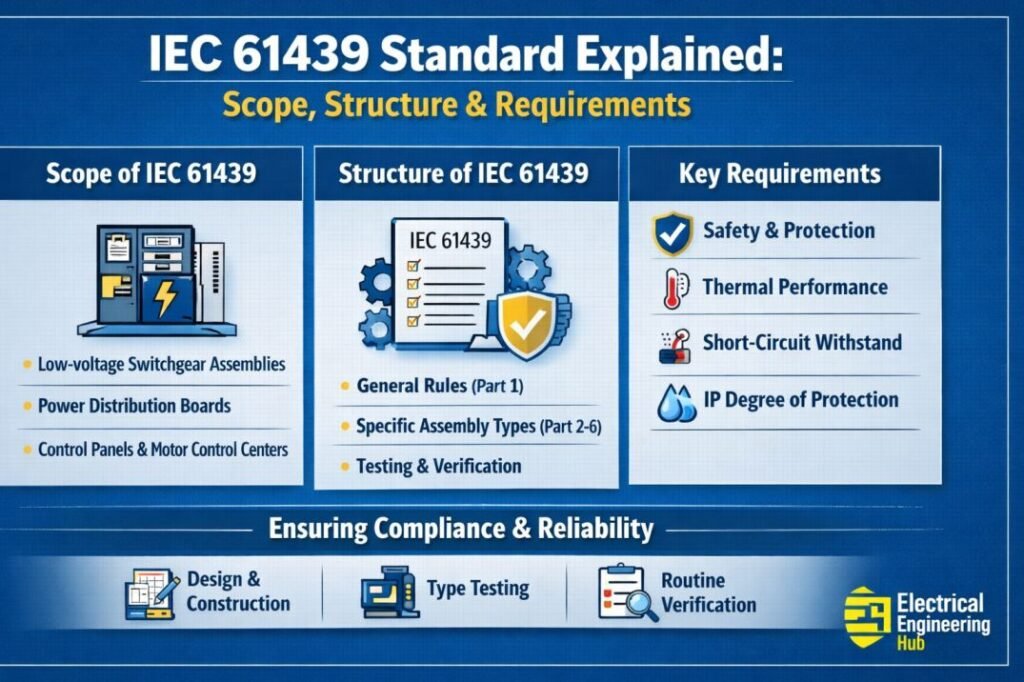
Table of Contents
Table of Contents
IEC 61439 Standard at a Glance
| Parameter | Details |
|---|---|
| Standard Name | IEC 61439 – Low-Voltage Switchgear and Controlgear Assemblies |
| Published By | International Electrotechnical Commission (IEC) |
| Voltage Range | Up to 1000 V AC and 1500 V DC |
| Replaced Standard | IEC 60439 Series |
| Main Purpose | Design, verification, testing, and safety requirements |
| Applicable To | Distribution boards, MCCs, PCCs, DBs, control panels |
| Verification Method | Design Verification and Routine Verification |
| Global Acceptance | Widely adopted across Europe, Asia, Middle East, Africa, and many international projects |
IEC 61439 Parts Overview
| Part | Description |
|---|---|
| IEC 61439-1 | General Rules |
| IEC 61439-2 | Power Switchgear and Controlgear Assemblies |
| IEC 61439-3 | Distribution Boards |
| IEC 61439-4 | Assemblies for Construction Sites |
| IEC 61439-5 | Assemblies for Public Power Distribution |
| IEC 61439-6 | Busbar Trunking Systems |
What is the IEC 61439 Standard?
The IEC 61439 Standard establishes uniform technical requirements for low-voltage electrical assemblies. It specifies how switchboards, motor control centers, power distribution panels, and control panels must be designed and verified before being placed into service.
The standard replaced the older IEC 60439 series to introduce a more structured verification process. Instead of relying mainly on type-tested assemblies, manufacturers now need documented evidence that every assembly meets the required performance criteria.
Today, iec 61439 is referenced in industrial plants, commercial buildings, renewable energy projects, hospitals, utilities, and infrastructure developments around the world.
Why Was IEC 61439 Introduced?
The previous standard had limitations when dealing with customized electrical panels. Modern electrical systems require greater flexibility while maintaining safety and reliability.
The 61439 standard was introduced to:
- Improve electrical safety
- Standardize assembly design
- Define responsibilities of manufacturers
- Ensure consistent product quality
- Support customized panel construction
- Reduce installation failures
- Improve operational reliability
This approach gives engineers confidence that assemblies perform safely under real operating conditions.
Scope of IEC 61439 Standard
The iec-61439 applies to low-voltage switchgear and controlgear assemblies operating up to:
| Parameter | Limit |
|---|---|
| AC Voltage | Up to 1000 V |
| DC Voltage | Up to 1500 V |
| Frequency | Up to 1000 Hz where applicable |
The standard covers assemblies used in:
- Main Distribution Boards (MDB)
- Sub Distribution Boards (SDB)
- Motor Control Centers (MCC)
- Power Control Centers (PCC)
- Automation Panels
- PLC Panels
- Generator Synchronization Panels
- Capacitor Banks
- Solar Power Distribution Panels
- Industrial Control Panels
Structure of IEC 61439
The IEC 61439 Standard consists of several individual parts, each focusing on a specific application.
IEC 61439-1 General Rules
This is the foundation document. It defines:
- Definitions
- Service conditions
- Construction requirements
- Design verification
- Routine verification
- Temperature limits
- Creepage and clearance requirements
Most other parts refer back to IEC 61439-1.
IEC 61439-2 Power Switchgear Assemblies
This part applies to power distribution assemblies commonly installed in industrial facilities and commercial buildings.
Typical applications include:
- Main LV switchboards
- Generator synchronization panels
- Power distribution centers
IEC 61439-3 Distribution Boards
This section focuses on distribution boards intended for operation by ordinary persons.
Examples include:
- Residential DBs
- Commercial floor distribution boards
- Small office panels
IEC 61439-4 Construction Site Assemblies
Temporary electrical installations at construction sites require additional protection against harsh environmental conditions.
This section defines those requirements.
IEC 61439-5 Public Distribution Networks
Applies to outdoor electrical distribution cabinets used by utility companies.
IEC 61439-6 Busbar Trunking Systems
Specifies requirements for busbar systems used for efficient power distribution in commercial and industrial buildings.
Design Verification Requirements
One of the biggest improvements introduced by the IEC 61439 Standard is mandatory design verification.
Instead of assuming identical performance, manufacturers must verify important design characteristics.
| Verification Item | Purpose |
|---|---|
| Strength of Materials | Mechanical durability |
| Degree of Protection (IP) | Protection against dust and water |
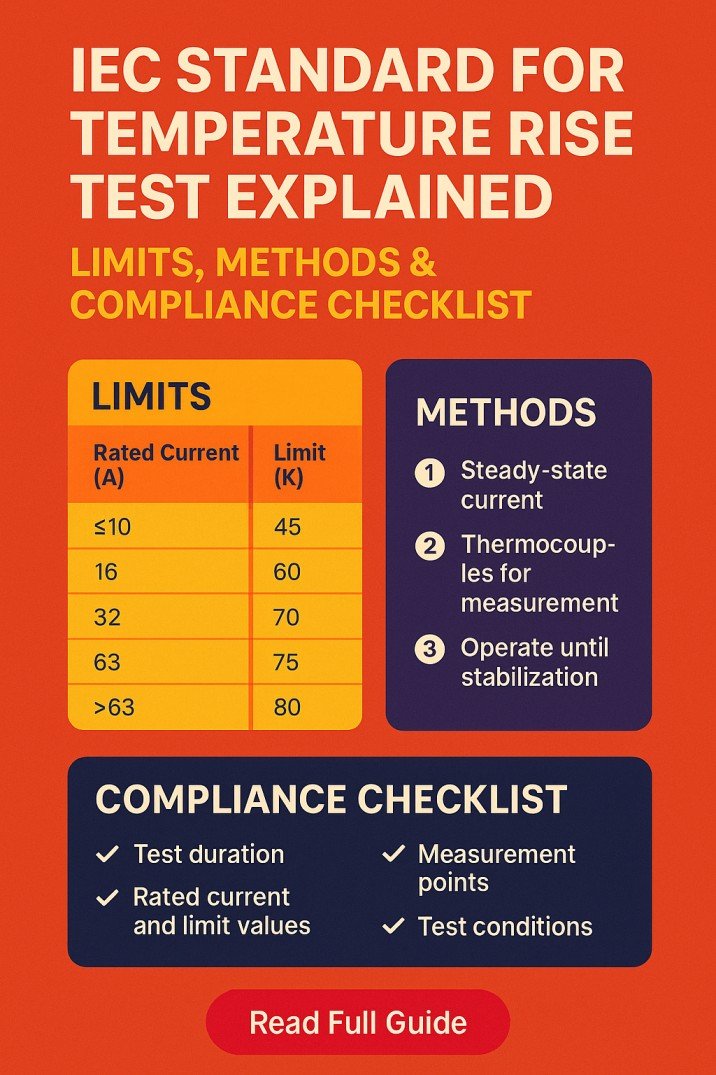
| Temperature Rise | Prevent overheating |
| Dielectric Properties | Electrical insulation |
| Short-Circuit Strength | Fault withstand capability |
| Protective Circuit Continuity | Earthing effectiveness |
| Clearance and Creepage | Safe insulation distances |
| Mechanical Operation | Functional reliability |
Proper spacing between energized conductors is essential during verification. For practical spacing values across different voltage levels, refer to our detailed guide on Phase to Phase Clearance as per IEC 61439, which includes easy-to-follow clearance charts and design recommendations.
Routine Verification
Every completed assembly must undergo routine verification before delivery.
Routine verification typically includes:
- Visual inspection
- Wiring inspection
- Functional testing
- Protective circuit continuity
- Dielectric test
- Mechanical operation check
These inspections ensure the manufactured panel matches the approved design.
Responsibilities Under IEC 61439
The standard clearly defines responsibilities.
| Party | Responsibility |
|---|---|
| Original Manufacturer | Creates verified reference design |
| Assembly Manufacturer | Builds compliant assemblies |
| End User | Provides operating conditions |
| Consultant | Specifies technical requirements |
| Installer | Ensures proper installation |
This division minimizes misunderstandings during project execution.
Important Technical Requirements
Several technical requirements must be satisfied to comply with the iec 61439 standard.
Temperature Rise
Electrical components generate heat during operation. The enclosure and internal layout must keep temperatures within acceptable limits.
Short-Circuit Withstand Strength
Assemblies must survive fault currents without creating hazardous conditions.
Protection Against Electric Shock
The design must include:
- Proper earthing
- Protective barriers
- Insulated live parts
- Correct enclosure construction
Mechanical Strength
Panels should withstand transportation, installation, and normal operating conditions without damage.
Internal Separation
Many industrial assemblies include internal barriers to improve safety and maintenance.
Common forms include:
| Separation Form | Description |
|---|---|
| Form 1 | No separation |
| Form 2 | Busbars separated from functional units |
| Form 3 | Functional units separated |
| Form 4 | Functional units and terminals separated |
Clearance and Creepage Distances
Clearance and creepage distances are among the most important safety requirements within the IEC 61439 Standard.
Incorrect spacing can lead to flashover, insulation failure, and equipment damage.
If you are selecting conductor spacing or designing busbar layouts, our comprehensive article on Phase to Phase Clearance as per IEC 61439 provides voltage-wise clearance values, practical examples, and engineering guidance that complements this standard.
IEC 61439 vs IEC 60439
| Feature | IEC 60439 | IEC 61439 |
|---|---|---|
| Verification Method | Type Testing | Design Verification |
| Manufacturer Responsibility | Limited | Clearly Defined |
| Customized Assemblies | Limited | Fully Supported |
| Documentation | Basic | Comprehensive |
| Safety Approach | Traditional | Performance-Based |
The newer standard provides greater flexibility while maintaining strict safety requirements.
Benefits of Using IEC 61439 Standard
Organizations adopting the IEC 61439 Standard gain several operational advantages.
- Higher electrical safety
- Improved equipment reliability
- Better thermal performance
- Easier project approvals
- Reduced maintenance costs
- Better documentation
- Greater international acceptance
- Increased confidence during inspections
These advantages explain why the standard is specified in many EPC, industrial, utility, and infrastructure projects.
Common Applications
The standard is widely used across multiple industries.
| Industry | Typical Assembly |
|---|---|
| Manufacturing | Motor Control Centers |
| Commercial Buildings | Main Distribution Boards |
| Hospitals | Essential Power Panels |
| Solar Plants | AC Distribution Panels |
| Oil & Gas | Hazard Area Power Panels |
| Water Treatment | PLC Control Panels |
| Data Centers | Critical Power Distribution |
| Utilities | Low Voltage Switchboards |
Best Practices for Compliance
Following good engineering practices makes compliance much easier.
- Select certified components.
- Maintain adequate ventilation.
- Follow torque specifications.
- Verify short-circuit ratings.
- Document every verification.
- Label assemblies clearly.
- Maintain proper phase spacing.
- Perform routine inspections before dispatch.
Frequently Asked Questions
Is IEC 61439 mandatory?
The standard itself is voluntary unless required by local regulations, project specifications, or customer contracts. However, it is widely specified for industrial and commercial electrical installations.
What replaced IEC 60439?
The IEC 61439 Standard replaced the IEC 60439 series with updated design verification requirements and clearer manufacturer responsibilities.
Does IEC 61439 apply to all electrical panels?
It applies to low-voltage switchgear and controlgear assemblies operating up to 1000 V AC or 1500 V DC. Specialized equipment may be covered by other IEC standards.
What is the difference between design verification and routine verification?
Design verification confirms that the assembly design meets the required performance criteria, while routine verification ensures every manufactured panel complies with the verified design before delivery.
Related Standards
- IEC 61508 Standard
- IEC 61000 Standards
- IEC 61326 Standard Series
- IEC 61000-4-3 Explained
- IEC 61537 Explained
Conclusion
The IEC 61439 Standard has become the benchmark for designing and manufacturing safe, reliable, and high-performance low-voltage switchgear assemblies. By defining clear design verification procedures, manufacturer responsibilities, and construction requirements, it improves electrical safety and supports consistent quality across projects worldwide.
Engineers, consultants, and panel builders who understand iec 61439 can confidently deliver compliant electrical assemblies that meet modern industrial and commercial expectations.
Get new guides in your feed. Follow Electrical Insights on LinkedIn for new electrical standards guides, calculators and design tips from Azad Circuit Hub.
PhaseToPhaseClearance, #IEC61439, #IndianStandard, #ElectricalEngineering, #Switchgear, #BusbarDesign, #ElectricalStandards, #PanelDesign, #PowerDistribution, #ElectricalSafety