Clearance Requirements for Hazardous Areas: IEC 60079-1 Guide
Equipment installed in hazardous locations must meet strict safety requirements to prevent ignition of explosive gases and vapors. Understanding the Clearance Requirements for Hazardous Areas helps engineers, panel builders, inspectors, and maintenance teams design compliant Ex equipment while minimizing operational risks.
The requirements in IEC 60079-1 primarily focus on flameproof enclosures (Ex d), where correctly designed flamepaths and electrical clearances prevent internal explosions from igniting the surrounding atmosphere. This guide explains the essential concepts, inspection methods, and design practices used in industrial installations.
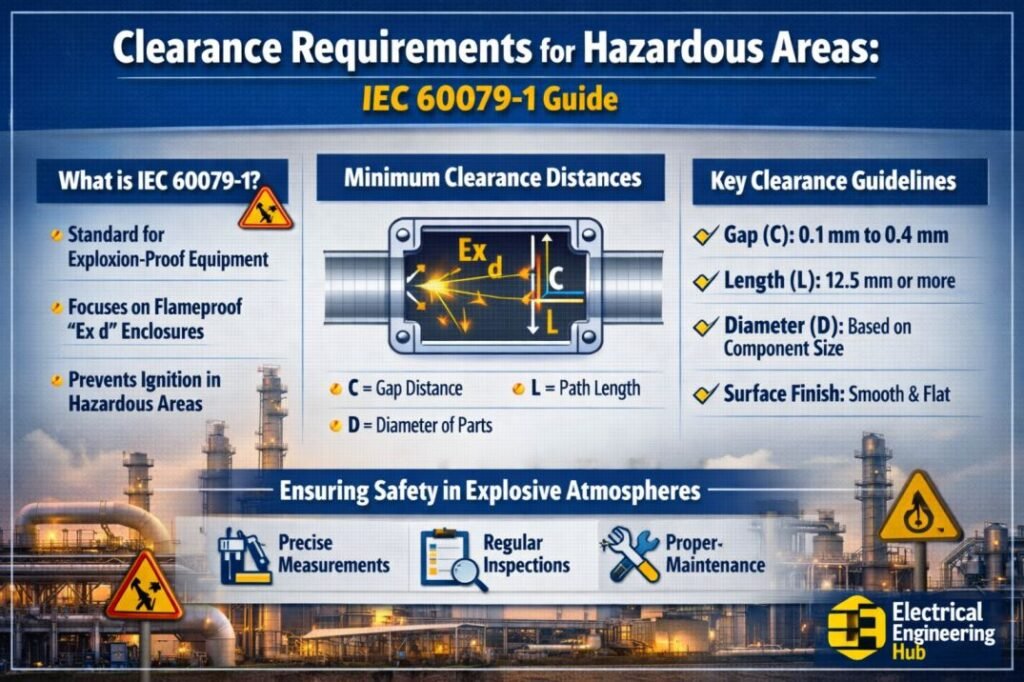
Table of Contents
Table of Contents
Clearance Requirements for Hazardous Areas at a Glance
| Parameter | Requirement |
|---|---|
| Applicable Standard | IEC 60079-1 |
| Equipment Type | Flameproof (Ex d) Equipment |
| Primary Purpose | Prevent ignition of explosive atmospheres |
| Main Inspection Item | Flamepaths, creepage, clearance, enclosure integrity |
| Typical Industries | Oil & Gas, Petrochemical, Mining, Chemical Plants |
| Verification Method | Visual inspection and precision measurement |
| Related Standards | IEC 60079-7, IEC 60079-14, IEC 60079-17 |
Quick Reference Chart
| Area | Key Requirement |
|---|---|
| Internal Electrical Clearance | Must comply with equipment design certification |
| Flamepath Clearance | Controlled according to IEC 60079-1 limits |
| Mechanical Damage | Not permitted |
| Surface Corrosion | Must not affect flamepath dimensions |
| Maintenance | Only approved repair methods |
If you also work with industrial switchgear, review Phase to Phase Clearance as per IEC 61439 to understand minimum electrical spacing requirements inside low-voltage assemblies.
What Are Clearance Requirements for Hazardous Areas?
Clearance Requirements for Hazardous Areas define the minimum safe distances and construction rules that prevent electrical equipment from becoming an ignition source in explosive atmospheres.
Unlike ordinary electrical installations, hazardous locations contain flammable gases, vapors, or combustible dust. Any electrical arc, spark, or excessive heat may ignite the surrounding atmosphere if equipment is not properly designed.
IEC 60079-1 focuses on flameproof enclosures, where an internal explosion is safely contained without transmitting flames to the external environment.
The standard controls several critical design elements including:
- Flamepath dimensions
- Mechanical clearances
- Joint tolerances
- Fastening arrangements
- Material strength
- Enclosure integrity
These requirements ensure that even under fault conditions, ignition remains confined inside the enclosure.
Understanding IEC 60079-1
IEC 60079-1 is an international standard covering flameproof enclosures identified as Ex d equipment.
Its objective is not to prevent internal explosions but to ensure that:
- The enclosure withstands the explosion pressure.
- Escaping gases cool sufficiently before leaving the enclosure.
- External explosive atmospheres are never ignited.
This makes accurate manufacturing tolerances extremely important.
Where Are These Requirements Applied?
Clearance Requirements for Hazardous Areas are commonly applied in:
| Industry | Typical Equipment |
|---|---|
| Oil Refineries | Junction Boxes |
| Petrochemical Plants | Motors |
| LNG Facilities | Control Panels |
| Offshore Platforms | Cable Glands |
| Chemical Industries | Lighting Fixtures |
| Fuel Storage Terminals | Instrument Enclosures |
| Pharmaceutical Plants | Process Sensors |
Each installation requires certified Ex equipment suitable for its hazardous zone classification.
Measurement of Clearances IEC 60079-1
The measurement of clearances iec 60079-1 is one of the most important inspection activities during manufacturing and maintenance.
Unlike ordinary electrical clearances, flameproof joints have extremely precise dimensional requirements.
Measurements typically include:
| Measurement | Inspection Tool |
|---|---|
| Flamepath Gap | Feeler Gauge |
| Flamepath Width | Vernier Caliper |
| Enclosure Diameter | Micrometer |
| Thread Engagement | Thread Gauge |
| Surface Flatness | Straight Edge |
| Damage Inspection | Visual Examination |
Inspection personnel verify that all measurements remain within the limits specified by the equipment certification.
Any unauthorized machining, corrosion, repainting, or filing of flamepaths can invalidate certification.
Types of Clearances in Ex Equipment
Several different clearances are evaluated during inspection.
Electrical Clearance
Electrical clearance is the shortest distance through air between energized conductive parts.
Its purpose is to prevent flashover during normal operation or transient overvoltages.
Creepage Distance
Creepage distance measures the shortest path along an insulating surface.
It becomes important where contamination, humidity, or conductive dust may reduce insulation performance.
Flamepath Clearance
Flamepath clearance is unique to Ex d equipment.
These machined joints allow combustion gases to cool before escaping outside the enclosure.
Excessive clearance increases the risk of flame transmission.
Too little clearance may prevent proper assembly or cause mechanical damage.
Ex Equipment Clearance Requirements
The ex equipment clearance requirements vary depending on equipment certification, enclosure type, gas group, and flamepath design.
Some typical inspection considerations include:
| Inspection Item | Acceptance Criteria |
|---|---|
| Flamepath Condition | Smooth and undamaged |
| Joint Width | Within certified limits |
| Corrosion | Minimal |
| Fasteners | Original approved type |
| Gaskets | Installed where applicable |
| Surface Finish | No deep scratches |
| Mechanical Damage | Not acceptable |
Only manufacturer-approved replacement parts should be used during maintenance.
Phase to Phase Clearance Requirements for Hazardous Areas
Correct phase-to-phase clearance is essential in hazardous areas to prevent electrical flashover and ignition of explosive atmospheres. While IEC 60079-1 specifies the construction requirements for flameproof (Ex d) equipment, the minimum electrical clearances between energized conductors are generally determined by equipment insulation standards such as IEC 60664-1.
Always use manufacturer-certified values for Ex equipment and never reduce the original spacing during installation or maintenance.
Phase-to-Phase Clearance Requirements Chart
| Rated Voltage (AC) | Minimum Phase-to-Phase Clearance | Common Application |
|---|---|---|
| Up to 250 V | 3 mm | Control panels, junction boxes |
| 251–690 V | 5.5–8 mm | Low-voltage motors, MCCs |
| 691 V–1 kV | 8–14 mm | Industrial switchgear |
| Above 1 kV | As specified by IEC equipment standards and manufacturer | Medium-voltage hazardous area equipment |
Note: Actual clearance depends on insulation coordination, pollution degree, overvoltage category, altitude, and equipment certification.
Installation Requirements
| Requirement | Recommendation |
|---|---|
| Follow IEC 60079-1 certification | Do not alter certified internal conductor spacing. |
| Maintain manufacturer clearances | Ensure wiring does not reduce phase-to-phase distance. |
| Avoid loose conductors | Secure conductors to prevent movement under fault conditions. |
| Verify insulation level | Use cables and terminals rated for the operating voltage. |
| Inspect after maintenance | Confirm all clearances remain intact before energizing equipment. |
Factors That Affect Clearance Compliance
Several conditions may reduce equipment safety over time.
Corrosion
Corrosion enlarges flamepath clearances and weakens enclosure strength.
Regular inspection helps identify deterioration before equipment becomes unsafe.
Mechanical Impact
Dropping or striking an enclosure may distort machined joints.
Even minor deformation can compromise explosion protection.
Unauthorized Repairs
Grinding, machining, welding, or drilling flameproof joints without certification approval is prohibited.
Repairs must follow IEC 60079-19 requirements.
Dirt and Paint
Paint accumulation inside flamepaths changes joint dimensions.
Cleaning should follow manufacturer instructions without altering machined surfaces.
Inspection Checklist
Maintenance engineers commonly verify the following items:
| Inspection Point | Status |
|---|---|
| Flamepath Clean | ✓ |
| Correct Fasteners | ✓ |
| No Corrosion | ✓ |
| Threads Undamaged | ✓ |
| Nameplate Visible | ✓ |
| Cable Glands Certified | ✓ |
| Enclosure Properly Closed | ✓ |
Routine inspection greatly reduces ignition risks.
Common Design Mistakes
Many hazardous area failures result from simple installation errors.
Common examples include:
- Mixing certified and non-certified components
- Incorrect cable glands
- Missing enclosure bolts
- Damaged flamepaths
- Wrong replacement fasteners
- Excessive corrosion
- Improper gasket installation
- Unauthorized modifications
Each issue can invalidate equipment certification.
Relationship Between IEC 60079-1 and IEC 61439
Although both standards discuss electrical safety, they serve different purposes.
| IEC 60079-1 | IEC 61439 |
|---|---|
| Hazardous Areas | Low-Voltage Assemblies |
| Explosion Protection | Electrical Safety |
| Flameproof Enclosures | Switchgear Construction |
| Ex Equipment | Distribution Panels |
| Flamepath Requirements | Phase Clearance Requirements |
Engineers designing industrial electrical systems often work with both standards. While hazardous locations require IEC 60079-1 compliance, electrical switchboards must also satisfy Phase to Phase Clearance as per IEC 61439 to maintain safe conductor spacing and insulation coordination.
Best Practices for Engineers
To maintain compliance:
- Purchase only certified Ex equipment.
- Follow manufacturer installation instructions.
- Never modify flameproof joints.
- Inspect flamepaths during every shutdown.
- Replace damaged fasteners with approved components.
- Record inspection measurements.
- Train maintenance personnel on hazardous area standards.
- Perform periodic certification audits.
These practices improve safety while extending equipment service life.
Related Guides
Frequently Asked Questions
Is electrical clearance the same as flamepath clearance?
No. Electrical clearance prevents flashover between conductors, while flamepath clearance controls hot gases escaping from flameproof enclosures.
Who performs the measurement of clearances iec 60079-1?
Qualified inspectors, certified repair facilities, manufacturers, and hazardous area specialists typically perform these measurements using calibrated instruments.
Can damaged flamepaths be repaired?
Only approved repair procedures following IEC 60079-19 and manufacturer recommendations should be used. Unauthorized machining may invalidate certification.
Do all hazardous area enclosures follow IEC 60079-1?
No. IEC 60079-1 specifically applies to flameproof (Ex d) equipment. Other protection methods such as Ex e, Ex i, and Ex p follow different parts of the IEC 60079 series.
Conclusion
Understanding the Clearance Requirements for Hazardous Areas is essential for maintaining safe operation in explosive environments. Proper inspection, accurate measurement, certified repairs, and compliance with IEC 60079-1 significantly reduce ignition risks and improve equipment reliability.
Engineers should verify flamepath dimensions, maintain enclosure integrity, and use only certified components throughout the equipment lifecycle. For facilities that also include low-voltage switchgear, reviewing Phase to Phase Clearance as per IEC 61439 provides additional guidance on electrical conductor spacing and complements hazardous area safety requirements.
Get new guides in your feed. Follow Electrical Insights on LinkedIn for new electrical standards guides, calculators and design tips from Azad Circuit Hub.
#ClearanceRequirementsForHazardousAreas, #IEC600791, #HazardousAreas, #ExplosionProof, #ElectricalSafety, #ExEquipment, #IndustrialSafety, #ElectricalEngineering, #ComplianceStandards, #ProcessIndustry