IEC 61537 Explained: Cable Management | Comprehensive Guide
Cable management systems play a critical role in electrical installations, industrial facilities, commercial buildings, and infrastructure projects. Proper cable support ensures safety, reliability, maintenance accessibility, and long-term system performance. Among the international standards governing cable support systems, the iec 61537 cable tray standard is one of the most important references for engineers, consultants, contractors, and manufacturers.
This standard provides requirements for cable tray systems and cable ladder systems used to support and route electrical cables. Understanding its scope, testing requirements, and compliance criteria helps professionals select suitable products and maintain high installation quality.
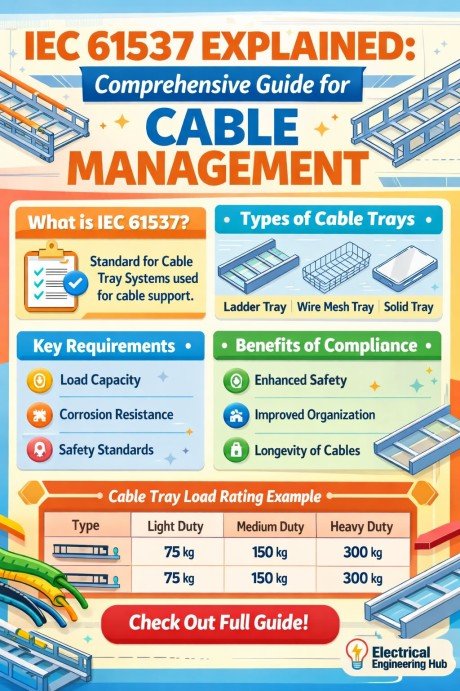
Table of Contents
What is IEC 61537?
IEC 61537 is an international standard published by the International Electrotechnical Commission (IEC). It specifies the requirements and tests for cable tray systems and cable ladder systems intended for cable management.
The standard covers mechanical strength, electrical continuity, corrosion resistance, fire performance considerations, and installation requirements. Manufacturers use these guidelines to design products that can safely support electrical and communication cables under various environmental conditions.
Use our online tool Armoured Cable Size Calculator
An iec 61537 cable tray installation ensures that the cable support system has been tested according to internationally recognized performance criteria. This gives confidence to project owners and engineers when selecting cable management products.
Why IEC 61537 is Important
Modern electrical installations contain large numbers of power, control, instrumentation, and communication cables. Poor cable support can lead to cable damage, maintenance difficulties, and safety hazards.
IEC 61537 helps standardize performance requirements across different manufacturers. It ensures that cable trays and ladders can withstand expected mechanical loads and environmental conditions.
Some key benefits include:
- Improved electrical safety
- Consistent product quality
- Better cable organization
- Easier maintenance and expansion
- Enhanced reliability of installations
- International acceptance in projects
Many industrial projects, data centers, commercial buildings, and renewable energy facilities specify compliance with this standard during procurement.
Use our online tool motor cable size calculator
Scope of IEC 61537
The standard applies to cable tray systems and cable ladder systems used for supporting insulated electrical cables and communication cables.
It covers:
- Straight sections
- Bends and tees
- Junction components
- Supports and brackets
- Accessories used in cable routing systems
The standard does not directly cover cable performance. Instead, it focuses on the structural support system that carries the cables throughout the installation.
Key Takeaways
- IEC 61537 is the primary international standard for cable tray and cable ladder systems.
- It establishes testing and performance requirements for cable support products.
- Compliance helps ensure safety, durability, and reliability.
- Mechanical load testing is one of the most critical aspects of the standard.
- Proper selection of cable management systems improves long-term operational efficiency.
Know more about Earth Cable Size for Lightning Protection
Types of Cable Tray Systems Covered
Several cable tray designs can comply with IEC 61537 requirements depending on project needs.
| Cable Tray Type | Common Application | Advantages |
|---|---|---|
| Perforated Cable Tray | Commercial and industrial buildings | Ventilation and easy cable routing |
| Ladder Cable Tray | Power plants and heavy industries | High load capacity |
| Solid Bottom Tray | Sensitive communication cables | Better protection |
| Wire Mesh Tray | Data centers and telecom facilities | Flexible installation |
| Channel Tray | Small cable runs | Cost-effective solution |
Each type offers unique benefits depending on cable quantity, environment, and maintenance requirements.
Mechanical Testing Requirements
One of the most important parts of the standard is mechanical load testing. Manufacturers must demonstrate that their products can support specified loads without excessive deformation or failure.
The testing process evaluates:
- Safe working load
- Span performance
- Deflection limits
- Structural integrity
- Load-bearing capability
Find all about High Voltage Cable Testing Standards
The iec 61537 cable tray testing procedures help engineers compare products from different manufacturers using standardized criteria.
When selecting a cable tray system, load calculations should include:
- Cable weight
- Future cable additions
- Environmental loads
- Safety margins
Material Requirements
Cable trays are manufactured from various materials based on project conditions.
| Material | Typical Use | Key Benefits |
|---|---|---|
| Galvanized Steel | Indoor installations | Economical and durable |
| Hot-Dip Galvanized Steel | Industrial environments | Enhanced corrosion resistance |
| Stainless Steel | Chemical plants and coastal areas | Excellent corrosion protection |
| Aluminum | Lightweight installations | Easy handling and installation |
| FRP/GRP | Corrosive environments | Non-conductive and lightweight |
Material selection should consider humidity, chemicals, temperature variations, and maintenance expectations.
Explore details on High Voltage Cable Testing Procedure
Corrosion Resistance Considerations
Corrosion is one of the major causes of premature cable tray failure. IEC 61537 includes provisions related to corrosion protection and durability.
Environmental factors affecting cable tray lifespan include:
- Coastal salt exposure
- Industrial pollutants
- High humidity
- Chemical processing environments
- Outdoor weather conditions
Protective coatings and material selection significantly influence the service life of cable management systems.
Electrical Continuity Requirements
Metallic cable trays often form part of the protective bonding system within electrical installations.
The standard includes requirements for electrical continuity between tray sections and accessories. Proper bonding ensures fault currents can safely flow through the intended path.
Find all about VLF Tan Delta Testing of MV Cables
During installation, contractors should verify:
- Secure connections
- Proper bonding jumpers
- Low-resistance joints
- Compliance with local electrical regulations
For complete electrical system verification, engineers should also understand the requirements of the insulation resistance test standard, which plays a vital role in ensuring cable integrity and system safety.
Installation Best Practices
Compliance with standards alone does not guarantee a successful installation. Proper installation practices remain essential.
Recommended practices include:
- Follow manufacturer span recommendations.
- Avoid overloading tray systems.
- Maintain adequate cable separation.
- Use appropriate supports and brackets.
- Inspect all joints and connections.
- Ensure proper grounding and bonding.
- Leave space for future expansion.
These measures improve both safety and maintenance accessibility.
Learn more about earthing cable size as per iec
Applications of IEC 61537-Compliant Systems
Cable tray systems compliant with IEC 61537 are widely used across many industries.
Common applications include:
- Power generation plants
- Solar energy projects
- Oil and gas facilities
- Manufacturing industries
- Data centers
- Commercial buildings
- Hospitals
- Airports
- Water treatment facilities
Because of their versatility, these systems have become a standard component in modern infrastructure projects worldwide.
How to Select the Right Cable Tray
Selecting the correct cable tray requires evaluating several project parameters.
Consider the following factors:
| Selection Factor | Importance |
|---|---|
| Cable Quantity | Determines tray size |
| Load Capacity | Ensures structural safety |
| Installation Environment | Influences material choice |
| Future Expansion | Allows additional cable routing |
| Maintenance Access | Simplifies troubleshooting |
| Regulatory Compliance | Meets project specifications |
A detailed engineering assessment helps optimize both performance and cost.
Discover everything about cable bending radius iec standard
Conclusion
IEC 61537 serves as the benchmark standard for cable tray and cable ladder systems used in electrical and communication infrastructure. By defining performance requirements, testing methods, and safety criteria, it ensures that cable support systems can reliably perform throughout their service life.
Understanding the requirements of an iec 61537 cable tray system helps engineers, contractors, and facility owners make informed decisions during design, procurement, and installation. Whether used in industrial plants, commercial buildings, renewable energy projects, or data centers, compliance with this standard contributes to safer, more organized, and more reliable cable management solutions.
Explore details on iec standard for underground cable laying
FAQs
What is IEC 61537?
IEC 61537 is an international standard that specifies requirements and test methods for cable tray systems and cable ladder systems used for supporting electrical and communication cables.
Is IEC 61537 mandatory?
The standard itself is not universally mandatory, but many projects, consultants, and regulatory bodies require compliance as part of technical specifications.
What is the difference between a cable tray and a cable ladder?
A cable tray generally has a continuous or perforated base, while a cable ladder uses side rails connected by rungs. Cable ladders are commonly used for heavier cable loads.
Which materials are commonly used in IEC 61537 cable trays?
Common materials include galvanized steel, hot-dip galvanized steel, stainless steel, aluminum, and fiberglass-reinforced plastic (FRP).
Why is load testing important for cable trays?
Load testing verifies that the tray system can safely support cable weight and operational loads without excessive deflection or structural failure. Explore all about IEEE Standard for Cable Insulation Resistance Test
Use our online tool HV Cable Bending Radius Calculator
Get new guides in your feed. Follow Electrical Insights on LinkedIn for new electrical standards guides, calculators and design tips from Azad Circuit Hub.
#IEC61537,#CableManagement,#CableTrayStandard,#ElectricalStandards,#IECStandards,#CableTraySystems,#ElectricalEngineering,#IndustrialElectrical,#WiringSystems,#EngineeringStandards