IEC 61000-4-3 Explained
Electromagnetic compatibility is one of the most important areas in modern electrical and electronic systems. Devices today operate in environments filled with radio frequency signals, wireless networks, industrial transmitters, and communication systems. This is where IEC 61000-4-3 becomes important.
IEC 61000-4-3 is an international EMC standard developed by the International Electrotechnical Commission. It defines the immunity requirements and test methods for electrical and electronic equipment exposed to radiated radio-frequency electromagnetic fields.
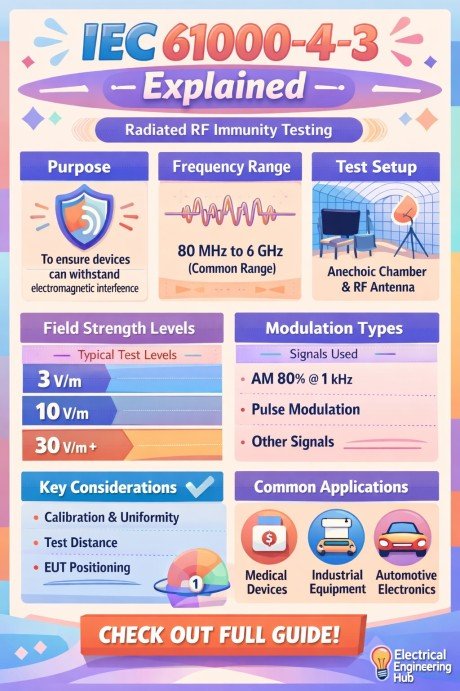
Table of Contents
Table of Contents
Manufacturers, engineers, and compliance professionals rely on IEC 61000-4-3 to ensure products can function correctly in electromagnetic environments without performance issues. Understanding this standard is essential for product design, certification, and compliance.
Explore in detail IEC 61936 Clearance Table
What is IEC 61000-4-3?
IEC 61000-4-3 is part of the broader IEC 61000 standards family, which covers electromagnetic compatibility testing and measurement techniques.
This specific standard focuses on radiated immunity testing. It checks how equipment reacts when exposed to RF electromagnetic fields. The purpose is to verify whether the device can continue normal operation under electromagnetic stress.
The standard is widely used for:
- Industrial automation systems
- Medical devices
- Consumer electronics
- Communication equipment
- Power system devices
- Control panels
If you want to understand the full EMC framework, exploring other IEC 61000 standards can help you build a stronger compliance foundation.
Why IEC 61000-4-3 Matters
Electronic devices often work near sources of electromagnetic radiation. These sources include:
| Source | Frequency Range |
|---|---|
| Mobile Phones | 800 MHz – 2.6 GHz |
| Wi-Fi Routers | 2.4 GHz – 5 GHz |
| Radio Transmitters | 80 MHz – 1 GHz |
| Industrial Equipment | Variable |
| Radar Systems | Up to 6 GHz |
Without proper immunity testing, products may:
- Malfunction
- Reset unexpectedly
- Produce false readings
- Lose communication
- Stop working completely
Know more about IEC Standard for Busbar Clearance
IEC 61000-4 3 helps manufacturers identify weaknesses before products reach the market.
Scope of IEC 61000-4 3
The standard applies to equipment that may be exposed to radiated electromagnetic fields from 80 MHz up to 6 GHz.
Its primary objective is to test immunity against:
- Amplitude-modulated RF fields
- Digital communication signals
- Continuous electromagnetic exposure
This standard does not focus on emissions. Instead, it measures the product’s ability to resist external RF disturbances.
Key Test Parameters in IEC 61000-4-3
Understanding the test setup is important for engineers.
Frequency Range
The standard covers:
| Edition | Frequency Range |
|---|---|
| Older Versions | 80 MHz – 1 GHz |
| Latest Versions | 80 MHz – 6 GHz |
This expansion reflects modern wireless technologies.
Find all about Phase to Phase Clearance in 132 kV
Field Strength
Typical test levels include:
| Level | Field Strength |
|---|---|
| Level 1 | 1 V/m |
| Level 2 | 3 V/m |
| Level 3 | 10 V/m |
| Level 4 | 30 V/m |
Higher field strengths simulate harsher electromagnetic environments.
Modulation
The standard commonly uses:
- 80% AM modulation
- 1 kHz sine wave
This simulates realistic RF interference.
Know more about Phase to Phase Clearance as per IEC 61439
Dwell Time
Each frequency point must be maintained for a specific duration to observe equipment behavior.
Typical dwell time:
- Minimum 3 seconds
How IEC 61000 4-3 Testing Works
Radiated immunity testing follows a controlled process.
Step 1: Test Setup Preparation
The equipment under test (EUT) is placed in an anechoic chamber. This chamber prevents signal reflections.
Main components include:
- RF signal generator
- Power amplifier
- Field sensor
- Antenna
- Monitoring equipment
Know more about iec 61508
Step 2: Calibration
Before testing, the electromagnetic field must be calibrated to ensure accuracy.
Calibration verifies:
- Uniform field distribution
- Correct field strength
- Frequency stability
Step 3: Exposure
The EUT is exposed to RF fields over the required frequency range.
Testing is done from multiple angles:
- Front
- Side
- Rear
This ensures full immunity coverage.
Read in detail about iec 61439 busbar calculation
Step 4: Monitoring Performance
During the test, engineers monitor the product for:
- Functional interruptions
- Display errors
- Data loss
- System resets
Any abnormal behavior is recorded.
Test Environment Requirements
IEC 61000 4-3 specifies strict test conditions.
| Requirement | Description |
|---|---|
| Chamber Type | Anechoic chamber |
| Temperature | Controlled |
| Humidity | Controlled |
| Antenna Distance | Usually 3 meters |
| Uniform Field Area | Defined by standard |
Maintaining proper conditions improves test reliability.
Discover everything about cable bending radius iec standard
Performance Criteria in IEC 61000-4-3
The standard uses performance criteria to classify results.
Criteria A
The equipment operates normally during and after testing.
Criteria B
Temporary degradation is allowed, but the equipment recovers automatically.
Criteria C
Temporary loss of function is acceptable if operator intervention restores operation.
These criteria help determine product compliance.
Key Takeaways
Here are the most important points about IEC 61000 4-3:
- It is a radiated RF immunity standard.
- It tests equipment from 80 MHz to 6 GHz.
- It ensures devices can survive electromagnetic interference.
- It is critical for EMC certification.
- It applies across many industries.
- Proper testing improves product reliability.
Understanding these basics can simplify product design and compliance planning.
Learn more about earthing cable size as per iec
Industries That Use IEC 61000-4-3
Many sectors depend on this standard.
Industrial Automation
Factories use PLCs, sensors, and motor drives that must resist RF noise.
Medical Equipment
Patient safety depends on stable device performance.
Renewable Energy Systems
Solar inverters and battery systems require EMC compliance.
Consumer Electronics
Phones, TVs, and smart devices must work without interference.
Automotive Electronics
Modern vehicles have many wireless systems.
Learn more in detail on NEMA 250 Enclosures
Common Challenges in IEC 61000-4-3 Testing
Manufacturers often face these issues:
- Product failure at certain frequencies
- Poor shielding design
- Cable routing problems
- Grounding issues
- PCB layout weaknesses
Early EMC design planning reduces these risks.
Tips for Passing IEC 61000 4-3 Compliance
To improve immunity performance:
- Use proper shielding
- Improve PCB grounding
- Add ferrite filters
- Use EMC gaskets
- Maintain cable separation
- Minimize loop areas
Good design practices save time and money.
Explore details on Electrical Compliance Testing
Frequently Asked Questions
What does IEC 61000-4-3 test?
It tests the immunity of electrical equipment against radiated RF electromagnetic fields.
What frequency range does IEC 61000-4-3 cover?
The latest editions cover 80 MHz to 6 GHz.
Is IEC 61000 4-3 mandatory?
It depends on product type and market requirements. Many certifications require it.
What is the purpose of radiated immunity testing?
It ensures equipment can operate correctly in environments with RF interference.
What is the difference between IEC 61000-4-3 and IEC 61000-4-6?
IEC 61000-4-3 covers radiated RF immunity, while IEC 61000-4-6 focuses on conducted RF immunity.
Final Thoughts
IEC 61000-4-3 is one of the most important EMC standards for modern electronic equipment. As wireless technology grows, the electromagnetic environment becomes more complex. This makes immunity testing more critical than ever.
By understanding IEC 61000-4-3, manufacturers can improve product quality, reduce failures, and meet compliance requirements faster. Whether you design industrial systems, medical devices, or consumer electronics, this standard plays a major role in ensuring reliable performance in the real world.
Get new guides in your feed. Follow Electrical Insights on LinkedIn for new electrical standards guides, calculators and design tips from Azad Circuit Hub.
IEC6100043, #EMCTesting, #RadiatedImmunity, #IECStandards, #ElectricalCompliance, #EMCCompliance, #IndustrialTesting, #ElectronicsTesting, #ImmunityTesting, #ComplianceEngineering