
Raspberry Pi Projects Boat Race: Build High-Speed IoT Racing Boats with Real-Time Control & Automation
Raspberry Pi Projects Boat Race is becoming one of the most exciting areas in modern DIY electronics, combining robotics, IoT systems, and remote-controlled watercraft engineering. This concept allows makers to design intelligent racing boats that can be controlled in real time, collect sensor data, and even perform semi-autonomous navigation on water. The blend of hardware hacking and software programming makes it a strong choice for hobbyists, students, and engineers who want hands-on experience with real-world automation systems.
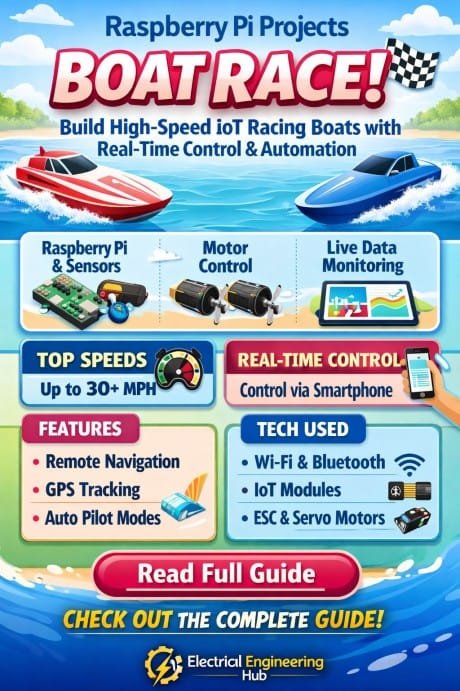
Table of Contents
In Raspberry Pi Projects Boat Race setups, a compact Raspberry Pi board acts as the central brain of the boat. It manages communication, processes sensor inputs, and controls motors through motor drivers. With wireless connectivity like Wi-Fi or RF modules, users can steer the boat remotely while receiving live telemetry data. This makes the experience not only competitive but also deeply educational.
The growing popularity of Raspberry Pi Projects Boat Race is also driven by STEM learning trends. Schools and makerspaces use these projects to teach embedded systems, control engineering, and IoT development in an engaging, practical way. Instead of theory alone, learners see how code translates into physical movement on water, which makes concepts easier to understand and apply.
Know more about How to Check Transistor With Multimeter
Understanding the Concept of IoT-Based Racing Boats
The core idea behind Raspberry Pi Projects Boat Race is to integrate IoT technology with high-speed watercraft design. Each boat is equipped with sensors, microcontrollers, and wireless communication modules that allow real-time interaction between the operator and the vessel. Unlike traditional remote-control boats, these systems can be upgraded with automation features such as obstacle detection, GPS tracking, and speed optimization.
A typical Raspberry Pi Projects Boat Race setup includes a control station (laptop or mobile device), a wireless communication link, and the boat itself equipped with propulsion and sensing components. The Raspberry Pi processes commands and ensures smooth motor control using PWM signals, which directly influence speed and steering accuracy.
In advanced builds, machine learning models can also be integrated to improve navigation decisions based on environmental data. This adds a competitive edge in racing scenarios where precision and adaptability matter.
Key Features of IoT Racing Boats
| Feature | Description |
|---|---|
| Real-time control | Instant steering and throttle response via wireless signals |
| Sensor integration | GPS, ultrasonic sensors, and gyroscopes for stability |
| Live telemetry | Speed, battery level, and position updates |
| Automation support | Semi-autonomous navigation and obstacle avoidance |
| Expandability | Easy integration of new modules and upgrades |
These features make Raspberry Pi Projects Boat Race an evolving platform rather than a fixed design.
Find all about Raspberry Pi Projects For Beginners
Hardware Architecture and Core Components
Building a reliable racing boat requires careful selection of hardware components. In Raspberry Pi Projects Boat Race systems, every component plays a critical role in performance, stability, and responsiveness.
The Raspberry Pi board acts as the main processing unit. It connects with motor drivers that control DC or brushless motors responsible for propulsion. Power management is equally important, as marine environments demand stable energy supply under varying loads.
Essential Components Breakdown
| Component | Purpose |
|---|---|
| Raspberry Pi 4/5 | Main processing and control unit |
| Motor Driver (L298N or ESC) | Controls motor speed and direction |
| Brushless DC Motor | Provides high-speed propulsion |
| Lithium Battery Pack | Powers the entire system |
| GPS Module | Enables location tracking |
| Wi-Fi Module | Ensures remote communication |
| Waterproof Hull | Protects electronics from water damage |
In Raspberry Pi Projects Boat Race builds, waterproofing is often underestimated. A well-sealed hull ensures long-term durability and prevents short circuits during high-speed racing conditions.
Real-Time Control and Communication System
One of the most important aspects of Raspberry Pi Projects Boat Race is real-time communication between the operator and the boat. Low latency is essential because even a small delay can affect steering accuracy during a race.
The Raspberry Pi typically runs a lightweight server that listens for incoming commands from a mobile app or web interface. These commands are then translated into motor instructions. Communication protocols such as WebSockets or MQTT are commonly used for fast and reliable data transfer.
Control System Flow
- User sends command from control interface
- Signal is transmitted via Wi-Fi or RF module
- Raspberry Pi receives and processes the command
- Motor driver adjusts speed and direction
- Sensor feedback is sent back to the control panel
Know more about Arduino UNO R3 Pinout
This closed-loop system ensures smooth operation and stability during competitive racing. In advanced Raspberry Pi Projects Boat Race designs, PID controllers are used to fine-tune motor responses and reduce oscillations in movement.
Software Development and Automation Logic
Programming is at the heart of Raspberry Pi Projects Boat Race. Python is the most commonly used language due to its simplicity and strong support for GPIO control, networking, and sensor integration.
The software stack typically includes modules for motor control, sensor data processing, and communication handling. Developers often structure their code in layers to ensure scalability and maintainability.
Sample Software Modules
| Module | Function |
|---|---|
| Motor Control Module | Handles PWM signals and speed regulation |
| Sensor Module | Reads GPS, distance, and motion data |
| Communication Module | Manages wireless data exchange |
| Automation Engine | Executes autonomous navigation rules |
Automation plays a major role in enhancing performance. For instance, if the boat detects an obstacle using ultrasonic sensors, the system can automatically adjust direction without manual input. This is where Raspberry Pi Projects Boat Race becomes more than just a remote-controlled hobby and moves toward intelligent robotics.
Know more about Raspberry Pi vs Arduino
Performance Optimization for Competitive Racing
Speed and stability are critical in any racing environment. In Raspberry Pi Projects Boat Race, performance tuning involves both hardware adjustments and software optimization.
Hull design plays a major role in reducing water resistance. A streamlined structure allows smoother movement and higher speed. On the software side, optimizing motor PWM frequency and reducing communication latency improves responsiveness.
Battery efficiency is another important factor. Using high-discharge lithium batteries ensures consistent power delivery during intense racing sessions. Cooling systems may also be added to prevent overheating of electronic components.
Optimization Checklist
- Use lightweight waterproof materials for hull construction
- Tune motor PWM signals for smoother acceleration
- Optimize code for minimal processing delay
- Ensure stable wireless connection range
- Balance weight distribution for better stability
When all these factors are aligned, Raspberry Pi Projects Boat Race setups can achieve impressive speed and control precision, making them suitable for competitive events.
Know more about Arduino Project Ideas For Final Year Student
Safety Measures and Testing Practices
Working with water-based electronics requires strict safety precautions. In Raspberry Pi Projects Boat Race systems, waterproofing is the first line of defense against damage. All electronic components should be enclosed in sealed compartments with proper insulation.
Before launching into full-speed racing, controlled testing in shallow water is recommended. This helps identify issues such as signal lag, motor imbalance, or steering inaccuracies. Regular inspection of wiring and battery health also ensures long-term reliability.
Emergency shutdown systems are often integrated into advanced builds. These allow users to instantly cut power if the boat behaves unexpectedly or loses control.
Conclusion
The evolution of Raspberry Pi Projects Boat Race demonstrates how accessible technology has become in the field of robotics and IoT. What once required industrial-level equipment can now be built using affordable components and open-source software.
From real-time control systems to autonomous navigation features, these racing boats offer a complete learning experience in embedded systems, programming, and mechanical design. As interest continues to grow, future versions will likely include more advanced AI-driven capabilities, making them even more intelligent and competitive on water.
Know more about Types of Field Effect Transistor
Follow Us on Social:
Subscribe our Newsletter on Electrical Insights for latest updates from Electrical Engineering Hub
#RaspberryPiProjectsBoatRace,#RaspberryPi,#BoatRace,#IoTProjects,#Robotics,#DIYElectronics,#STEM,#EngineeringProjects,#ArduinoProjects,#TechProjects
