
Raspberry Pi Arduino Projects: Ultimate Guide to High-Performance IoT, Robotics & DIY Electronics Builds
Raspberry Pi Arduino Projects are becoming a core part of modern DIY electronics because they combine computing power with precise hardware control. Makers, students, and engineers use this combination to build smart systems that range from home automation to advanced robotics. The flexibility of this setup makes it ideal for both beginners and experienced developers who want to experiment with Internet of Things (IoT) and embedded systems.
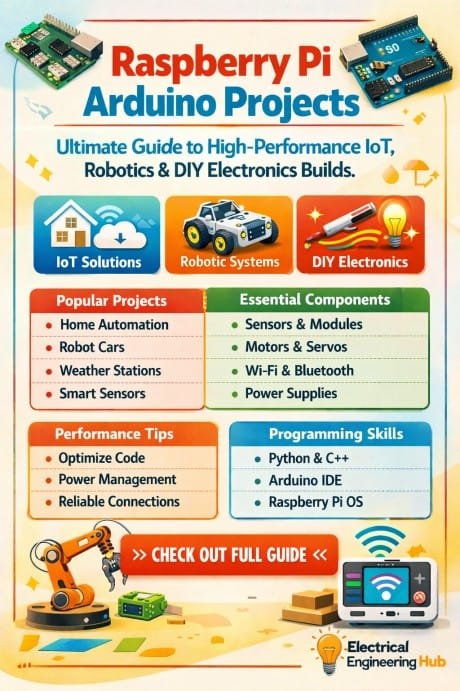
Table of Contents
At the heart of Raspberry Pi Arduino Projects is the idea of merging a microcomputer with a microcontroller. The Raspberry Pi handles processing, networking, and data management, while Arduino manages real-time sensor input and output control. This division of tasks creates highly efficient systems that can respond quickly while still handling complex computing tasks.
Find all about Raspberry Pi Projects For Beginners
Why Combine Raspberry Pi and Arduino for Modern Builds
The combination of Raspberry Pi and Arduino is popular because each platform fills the gaps of the other. Raspberry Pi alone is powerful but not ideal for real-time hardware control. Arduino excels at hardware interaction but lacks computing power and connectivity.
Raspberry Pi Arduino Projects benefit from this balance, allowing developers to build systems that are both intelligent and responsive. For example, a smart irrigation system can use Arduino to read soil moisture sensors instantly while Raspberry Pi analyzes weather data from the internet to make irrigation decisions.
This hybrid approach is widely used in smart agriculture, robotics, home automation, and industrial monitoring systems. It is also a cost-effective solution for prototyping complex embedded systems.
Core Components Used in Raspberry Pi Arduino Arduino Projects
Successful builds depend on selecting the right components. Below is a breakdown of commonly used hardware in Raspberry Pi Arduino Projects.
| Component | Purpose | Example Use |
|---|---|---|
| Raspberry Pi 4/5 | Main processing unit | AI processing, networking |
| Arduino Uno/Nano | Microcontroller for sensors | Motor control, sensor reading |
| Sensors (DHT11, ultrasonic) | Data collection | Temperature, distance measurement |
| Relay modules | Switching high-power devices | Home automation |
| Camera module | Image capture | Surveillance, robotics vision |
| Breadboard & wires | Prototyping | Circuit testing |
| Power supply | Stable energy source | 5V/12V systems |
Choosing the right combination ensures stability and scalability in Raspberry Pi Arduino Projects, especially when working with robotics or IoT-based systems.
Know more about Arduino UNO R3 Pinout
Popular Project Categories for Beginners and Experts
Raspberry Pi Arduino Projects cover a wide range of applications. Each category allows users to develop different technical skills while building practical solutions.
Smart home automation is one of the most popular categories. Users can control lights, fans, and appliances using mobile apps or voice commands. Arduino handles relay switching, while Raspberry Pi manages network communication.
Robotics is another major field. From simple line-following robots to advanced robotic arms, Raspberry Pi Arduino Projects allow real-time motor control and AI-based decision-making. Raspberry Pi can process camera input while Arduino controls servo motors for movement accuracy.
Environmental monitoring systems are also widely developed. These projects use sensors to track air quality, temperature, humidity, and pollution levels. Data is collected by Arduino and sent to Raspberry Pi for visualization and cloud storage.
Other common applications include security systems, smart farming, and wearable electronics. Each of these demonstrates the flexibility of Raspberry Pi Arduino Projects in real-world scenarios.
Step-by-Step Development Workflow for Efficient Builds
Developing reliable Raspberry Pi Arduino Projects requires a structured workflow. Skipping steps often leads to unstable systems or poor performance.
The first step is planning the system architecture. Decide what tasks will be handled by Raspberry Pi and what will be controlled by Arduino. This separation is crucial for performance optimization.
Next comes circuit design and prototyping. Use a breadboard to test sensor connections and ensure accurate readings. Arduino is typically programmed using the Arduino IDE, while Raspberry Pi uses Python or Node.js for higher-level logic.
Know more about Raspberry Pi vs Arduino
Communication between devices is usually handled through USB serial, I2C, or SPI protocols. Choosing the right communication method improves speed and reliability in Raspberry Pi Arduino Projects.
Once integration is complete, testing becomes essential. Each module should be tested individually before combining them into a full system. This reduces debugging time and improves system stability.
Comparison of Raspberry Pi and Arduino Roles in Projects
Understanding the difference between these platforms helps in designing efficient systems.
| Feature | Raspberry Pi | Arduino |
|---|---|---|
| Type | Single-board computer | Microcontroller |
| Operating System | Linux-based | No OS |
| Processing Power | High | Low to moderate |
| Real-time Control | Limited | Excellent |
| Connectivity | Built-in Wi-Fi, Bluetooth | Requires modules |
| Best Use | Data processing, AI, networking | Sensor control, motor handling |
In most Raspberry Pi Arduino Projects, Raspberry Pi acts as the brain while Arduino functions as the nervous system controlling physical components.
Common Mistakes to Avoid in Development
Many beginners face issues when building Raspberry Pi Arduino Projects due to avoidable mistakes. One common error is overloading the Raspberry Pi with real-time tasks, which should instead be handled by Arduino.
Another mistake is poor power management. Inconsistent power supply can cause random resets or sensor failures. Using regulated power sources ensures system stability.
Know more about Arduino Project Ideas For Final Year Student
Incorrect wiring is also a frequent problem. Always double-check pin configurations before powering the circuit. Even small mistakes can damage components or affect performance.
Lastly, ignoring communication delays between devices can lead to synchronization issues. Proper timing control is essential for smooth operation in complex Raspberry Pi Arduino Projects.
Future Trends in IoT and Robotics Development
The future of Raspberry Pi Arduino Projects is closely linked with artificial intelligence, edge computing, and automation. As IoT ecosystems expand, these hybrid systems are becoming more intelligent and autonomous.
Machine learning integration is now common, where Raspberry Pi processes sensor data to make predictive decisions. For example, predictive maintenance systems can detect equipment failure before it happens.
Another growing trend is cloud connectivity. Devices built using Raspberry Pi Arduino Projects can now send real-time data to cloud platforms for remote monitoring and analytics.
Robotics is also evolving rapidly. Autonomous drones, smart delivery robots, and AI-powered assistants are increasingly built using this combination of hardware platforms.
Final Thoughts on Building Efficient Systems
Raspberry Pi Arduino Projects continue to shape the future of DIY electronics and embedded systems. Their ability to combine computing power with precise hardware control makes them ideal for a wide range of applications.
From home automation to industrial robotics, these projects offer endless possibilities for innovation. With proper planning, component selection, and system design, anyone can build powerful and efficient electronic systems that solve real-world problems.
Know more about How to Check Transistor With Multimeter
As technology advances, the demand for smarter and more connected devices will continue to grow, making Raspberry Pi Arduino Projects an essential skill set for future developers and engineers.
Follow Us on Social:
Subscribe our Newsletter on Electrical Insights for latest updates from Electrical Engineering Hub
#RaspberryPiArduinoProjects,#RaspberryPi,#Arduino,#IoTProjects,#DIYElectronics,#Robotics,#EmbeddedSystems,#MakerCommunity,#TechProjects,#STEMLearning
