
Cable Trench vs Duct Bank: Ultimate Comparison for Better Design
Electrical cable routing is one of the most important aspects of power distribution system design. Engineers often face a common question when planning underground or surface cable installations: Cable Trench vs Duct Bank. Choosing the right system affects installation cost, maintenance accessibility, safety, cable lifespan, and future expansion capabilities.
Both cable trenches and duct banks are widely used in industrial facilities, substations, commercial buildings, renewable energy projects, and utility networks. However, each solution offers unique advantages and limitations depending on project requirements.
Understanding Cable Trench vs Duct Bank helps engineers make informed decisions that improve reliability and reduce long-term operational costs.
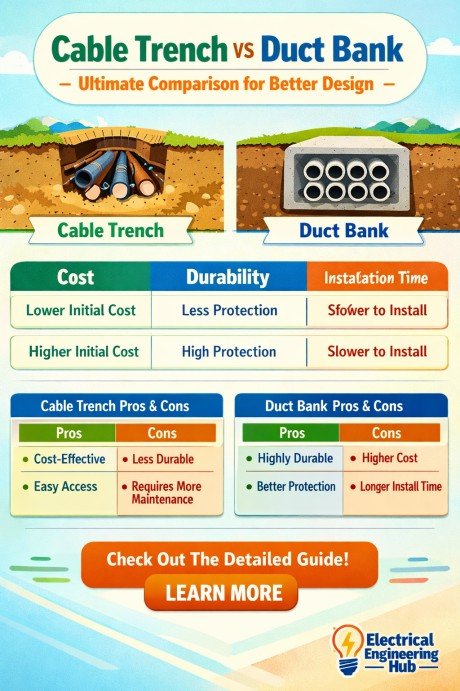
Table of Contents
Table of Contents
What Is a Cable Trench?
A cable trench is an open or covered channel constructed to accommodate power cables, control cables, communication cables, and instrumentation wiring. These trenches are usually made from reinforced concrete and may include cable supports, racks, and drainage systems.
Cable trenches are commonly found in:
- Electrical substations
- Industrial plants
- Power generation facilities
- Data centers
- Water treatment plants
The main advantage of a cable trench is easy cable access for inspection, maintenance, and future modifications.
Cable Trench Fill Calculator helps you quickly check cable capacity and optimize trench dimensions before finalizing your underground cable layout.
What Is a Duct Bank?
A duct bank is a group of conduits encased in concrete and installed underground to protect electrical cables. The conduits may be PVC, HDPE, fiberglass, or steel depending on project requirements.
Duct banks are typically used in:
- Urban power distribution systems
- Utility networks
- Commercial developments
- Airports
- University campuses
The enclosed conduit system provides superior mechanical protection and allows cables to be pulled or replaced without extensive excavation.
Why the Choice Matters
The decision between a cable trench and a duct bank affects several engineering factors:
- Initial construction cost
- Cable protection level
- Maintenance requirements
- Future expansion capability
- Thermal performance
- Installation duration
- Site safety
A proper evaluation ensures the selected system aligns with project objectives and budget constraints.
Cable Trench vs Duct Bank: Basic Comparison
The following table provides a quick overview of Cable Trench vs Duct Bank.
| Feature | Cable Trench | Duct Bank |
|---|---|---|
| Accessibility | Excellent | Limited |
| Cable Protection | Moderate | High |
| Installation Speed | Faster | Slower |
| Initial Cost | Lower | Higher |
| Maintenance | Easier | More Difficult |
| Future Expansion | Simple | Moderate |
| Mechanical Strength | Medium | Excellent |
| Space Requirement | Larger | Smaller |
| Cable Replacement | Very Easy | Requires Pulling |
| Typical Application | Substations and Industries | Utility Distribution |
Planning an underground cable installation? Use our Cable Trench Fill Calculator to estimate cable occupancy and ensure your trench design has adequate space.
Key Takeaways
- Cable trenches provide easy access for maintenance and cable additions.
- Duct banks offer superior protection against physical damage.
- Cable trenches generally have lower installation costs.
- Duct banks are preferred in urban and congested areas.
- Future cable expansion is usually easier in trench systems.
- Project environment and lifecycle cost should guide the final selection.
Installation Requirements
Installation procedures differ significantly when comparing Cable Trench vs Duct Bank.
Cable Trench Installation
Cable trench construction involves:
- Excavation of the trench path
- Placement of reinforced concrete walls
- Installation of cable racks and supports
- Drainage system construction
- Placement of removable covers
Since cables remain accessible, future modifications can be completed quickly.
Duct Bank Installation
Duct bank construction typically includes:
- Route excavation
- Placement of conduit spacers
- Installation of conduits
- Concrete encasement
- Backfilling and compaction
- Installation of manholes or pull boxes
The process requires greater precision to maintain conduit alignment.
Safety Considerations
Safety is a critical factor when evaluating Cable Trench vs Duct Bank.
Cable trenches may expose personnel to hazards if covers are removed during maintenance. Water accumulation can also become a concern without proper drainage systems.
Duct banks provide better protection from external damage, accidental excavation, and environmental exposure. The concrete encasement significantly reduces the risk of cable damage.
For projects involving high-voltage installations, engineers should also review the requirements outlined in High Voltage Cable Trench Depth Standards to ensure safe and compliant cable routing.
Thermal Performance Comparison
Cable ampacity depends heavily on heat dissipation.
Open cable trenches generally provide better ventilation, allowing heat generated by conductors to dissipate more effectively. This can improve cable current-carrying capacity.
Duct banks, especially those with concrete encasement, may trap heat around the conduits. Engineers often perform thermal studies to determine appropriate cable sizing and spacing.
The thermal characteristics should be carefully evaluated during the design phase to avoid derating issues.
Maintenance and Inspection
Maintenance accessibility is one of the biggest differences in Cable Trench vs Duct Bank.
Cable Trench
Advantages include:
- Visual cable inspection
- Easy fault identification
- Fast cable replacement
- Convenient cable additions
Maintenance personnel can access cables simply by removing trench covers.
Duct Bank
Maintenance challenges include:
- Limited direct access
- Fault location may require specialized testing
- Cable pulling equipment needed
- Additional labor during replacement
Although maintenance is more complex, cable protection is significantly better.
Cost Analysis
Cost comparisons depend on project size, location, and installation conditions.
| Cost Element | Cable Trench | Duct Bank |
|---|---|---|
| Civil Works | Moderate | High |
| Materials | Lower | Higher |
| Labor | Lower | Higher |
| Maintenance Cost | Lower | Moderate |
| Expansion Cost | Low | Moderate |
| Lifecycle Cost | Competitive | Competitive |
Cable trenches often have a lower initial investment, while duct banks may provide better long-term protection in harsh environments.
For a faster cable layout check, try the Cable Trench Fill Calculator to calculate trench capacity and avoid overcrowding in underground cable installations.
Best Applications for Cable Trenches
Cable trenches are generally preferred when:
- Frequent maintenance is expected
- Multiple cable systems share the route
- Future expansion is likely
- Industrial facilities require easy access
- Substation cable routing is involved
Their flexibility makes them highly suitable for facilities with changing operational requirements.
Best Applications for Duct Banks
Duct banks are often selected when:
- Maximum cable protection is required
- Underground utility corridors are needed
- Urban infrastructure projects are involved
- Road crossings are present
- Long-term reliability is prioritized
These systems are particularly effective in environments where excavation damage is a concern.
Which Option Is Better?
There is no universal winner in Cable Trench vs Duct Bank because each solution serves different design objectives.
If maintenance accessibility, flexibility, and lower installation costs are priorities, a cable trench is usually the better choice.
If physical protection, underground routing, and long-term durability are more important, a duct bank often becomes the preferred option.
The optimal selection depends on project location, environmental conditions, cable type, future expansion plans, and overall lifecycle costs.
Conclusion
The comparison of Cable Trench vs Duct Bank shows that both systems play essential roles in modern electrical infrastructure. Cable trenches offer excellent accessibility and simplified maintenance, while duct banks provide outstanding protection and durability.
Engineers should evaluate safety, thermal performance, maintenance requirements, installation costs, and future expansion needs before making a final decision. By understanding the strengths and limitations of each option, designers can develop reliable and cost-effective cable routing systems that support long-term operational success.
FAQs
1. What is the main difference between a cable trench and a duct bank?
A cable trench is an accessible channel that houses cables, while a duct bank uses conduits encased in concrete for underground cable protection.
2. Which is cheaper, a cable trench or a duct bank?
In most cases, cable trenches have lower installation costs than duct banks due to simpler construction requirements.
3. Which system provides better cable protection?
Duct banks generally provide better protection because cables are enclosed within conduits and surrounded by concrete.
4. Are cable trenches suitable for high-voltage cables?
Yes, cable trenches are commonly used for high-voltage installations when designed according to applicable standards and safety requirements.
5. Which option is better for future expansion?
Cable trenches are usually better for future expansion because additional cables can be installed more easily without major excavation work.
Get new guides in your feed. Follow Electrical Insights on LinkedIn for new electrical standards guides, calculators and design tips from Azad Circuit Hub.
#CableTrenchVsDuctBank,#CableTrenchDesign,#DuctBankSystems,#ElectricalEngineering,#PowerDistribution,#CableManagement,#UndergroundCables,#ElectricalInfrastructure,#UtilityEngineering,#CableInstallation
