Cable Trench Design Calculation | Important Guide
A proper Cable Trench Design Calculation is one of the most important steps in any electrical infrastructure project. Whether the installation is for an industrial plant, power station, commercial building, or utility network, the trench must be designed to accommodate cables safely while allowing future expansion and maintenance.
An incorrect design can lead to cable overheating, difficult maintenance, increased installation costs, and reduced system reliability. Engineers must consider cable quantity, trench dimensions, heat dissipation, segregation requirements, and safety standards before finalizing the design.
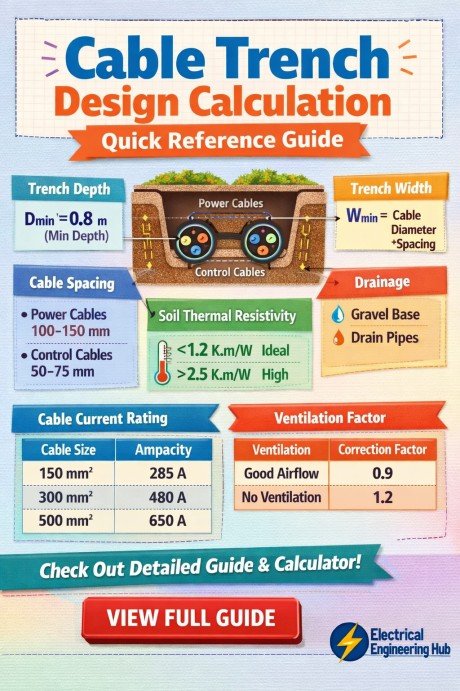
Table of Contents
Table of Contents
This guide explains the complete process of Cable Trench Design Calculation with practical examples, formulas, and design considerations to help engineers achieve accurate results.
Why Cable Trench Design Is Important
Cable trenches provide a protected route for power cables, control cables, communication cables, and instrumentation wiring. They ensure organized cable management while protecting conductors from mechanical damage.
A properly designed trench offers several advantages:
- Improved cable accessibility
- Better heat dissipation
- Easier maintenance and inspection
- Enhanced operational safety
- Space for future cable additions
- Compliance with electrical standards
Without proper planning, cable congestion can occur, resulting in excessive temperatures and reduced cable life.
Key Parameters Required for Design
Before starting a Cable Trench Design Calculation, collect all necessary project data.
| Parameter | Description |
|---|---|
| Number of Cables | Total installed cables |
| Cable Diameter | Outer diameter of each cable |
| Cable Type | Power, control, communication |
| Voltage Level | LV, MV, or HV |
| Installation Method | Single layer or multi-layer |
| Future Expansion | Additional spare capacity |
| Soil Conditions | Thermal resistivity and drainage |
| Safety Clearance | Required spacing between cables |
These inputs form the basis of the design process.
Determining Cable Quantity
The first step is identifying all cables that will pass through the trench.
Typical cable categories include:
- Power cables
- Control cables
- Instrumentation cables
- Fiber optic cables
- Earthing conductors
Engineers generally include at least 20% to 30% spare capacity for future expansion.
For example:
| Cable Type | Quantity |
|---|---|
| 240 mm² Power Cable | 12 |
| Control Cable | 15 |
| Instrument Cable | 10 |
| Fiber Optic Cable | 2 |
Total cables = 39
Future expansion allowance should also be included during planning.
Planning cable trench capacity? Use our Cable Trench Fill Calculator to quickly estimate cable occupancy and available space before finalizing your trench design.
Calculating Trench Width
The trench width depends on cable diameter and required spacing.
A common design approach is:
Trench Width = Total Cable Width + Total Spacing + Side Clearances
Example:
Assume:
- 10 cables
- Cable diameter = 50 mm
- Cable spacing = 75 mm
- Side clearance = 150 mm on each side
Calculation:
Total cable width = 10 × 50 = 500 mm
Total spacing = 9 × 75 = 675 mm
Side clearance = 300 mm
Required trench width:
500 + 675 + 300 = 1475 mm
Required trench width ≈ 1.5 m
This ensures adequate cable separation and accessibility.
Calculating Trench Depth
Depth selection depends on voltage level, cable arrangement, and protection requirements.
Typical recommendations are shown below.
| Cable Type | Typical Depth |
|---|---|
| LV Cables | 600 mm |
| MV Cables | 750 mm |
| HV Cables | 900 mm or more |
| Communication Cables | 450 mm |
For detailed requirements, refer to the guide on High Voltage Cable Trench Depth Standards, which explains recommended burial depths, safety clearances, and industry practices.
Key Takeaways
- Cable quantity is the starting point of every design.
- Adequate spacing improves heat dissipation.
- Spare capacity should be included for future expansion.
- Trench width and depth must comply with project standards.
- Thermal performance is critical for cable life.
- Proper segregation enhances safety and reliability.
Need to verify how many cables can fit safely in a trench? Check the Cable Trench Fill Calculator for a quick and practical cable capacity estimate.
Cable Spacing Requirements
Spacing between cables directly affects current-carrying capacity.
When cables are installed too close together, mutual heating occurs. This can reduce ampacity and accelerate insulation aging.
Typical spacing recommendations are:
| Installation Type | Minimum Spacing |
|---|---|
| LV Power Cables | 75 mm |
| MV Power Cables | 100 mm |
| HV Power Cables | 150 mm |
| Control Cables | 50 mm |
Actual values may vary according to project specifications and applicable standards.
Thermal Considerations in Cable Trench Design
Thermal performance plays a major role in Cable Trench Design Calculation.
Electrical cables generate heat during operation. If the trench cannot dissipate this heat effectively, cable temperatures rise above design limits.
Factors affecting heat dissipation include:
- Cable loading
- Ambient temperature
- Soil thermal resistivity
- Cable grouping
- Ventilation conditions
- Trench cover design
Engineers often perform ampacity calculations to ensure cable temperatures remain within allowable limits.
Segregation of Different Cable Types
Segregation prevents interference and improves operational safety.
Common segregation practices include:
| Cable Category | Recommended Separation |
|---|---|
| Power and Control | Separate compartments |
| Power and Instrumentation | Physical barrier |
| HV and LV Cables | Dedicated section |
| Fiber Optic and Power | Separate routing |
Proper segregation simplifies maintenance and reduces the risk of faults affecting multiple systems.
Cable Trench Load Capacity
The trench structure must support expected loads.
Potential loads include:
- Cable weight
- Personnel access
- Vehicle crossing
- Maintenance equipment
- Concrete cover slabs
Structural calculations should verify that walls, covers, and foundations can safely withstand operational loads.
For heavy industrial facilities, reinforced concrete trenches are commonly used.
Drainage Requirements
Water accumulation inside trenches can damage cable insulation and accessories.
A good trench design includes:
- Longitudinal slope
- Drainage pits
- Sump pumps if required
- Waterproof cable entry points
Typical trench slopes range from 0.5% to 1%.
Proper drainage significantly improves cable reliability and reduces maintenance costs.
Make cable trench planning easier with our Cable Trench Fill Calculator, designed to help you calculate cable fill and optimize available trench space.
Sample Cable Trench Design Calculation
Consider the following project:
| Parameter | Value |
|---|---|
| Number of Power Cables | 12 |
| Cable Diameter | 60 mm |
| Cable Spacing | 75 mm |
| Side Clearance | 150 mm |
| Future Spare Capacity | 25% |
Cable Trench Design Calculation
Step 1: Calculate Cable Width
12 × 60 = 720 mm
Step 2: Calculate Cable Spacing
11 × 75 = 825 mm
Step 3: Add Side Clearance
150 + 150 = 300 mm
Step 4: Total Width
720 + 825 + 300
= 1845 mm
Required trench width ≈ 1.85 m
Step 5: Select Depth
For medium-voltage cables:
Depth = 750 mm minimum
Step 6: Include Spare Capacity
25% spare space should be added for future cable installation.
Final trench width can be increased to approximately 2.3 m.
This example demonstrates a practical Cable Trench Design Calculation process used in many industrial projects.
Common Design Mistakes
Engineers should avoid the following issues:
- Ignoring future expansion requirements
- Insufficient cable spacing
- Poor drainage design
- Lack of cable segregation
- Undersized trench dimensions
- Ignoring thermal derating factors
- Inadequate maintenance access
Preventing these mistakes improves system reliability and reduces lifecycle costs.
Conclusion
A successful Cable Trench Design Calculation requires careful consideration of cable quantity, spacing, thermal performance, trench dimensions, drainage, and future expansion requirements. Proper design ensures safe operation, efficient heat dissipation, and long-term reliability of electrical systems.
By following industry best practices and performing accurate calculations, engineers can develop cable trench systems that support current operational needs while remaining flexible for future growth. A well-designed trench not only protects cables but also reduces maintenance costs and improves overall system performance.
Frequently Asked Questions
1. What is the purpose of Cable Trench Design Calculation?
It determines the correct trench width, depth, spacing, and capacity required for safe cable installation and future expansion.
2. How much spare capacity should be provided in a cable trench?
Most engineers provide 20% to 30% spare capacity to accommodate future cable additions.
3. Why is cable spacing important in trench design?
Proper spacing improves heat dissipation, reduces cable derating, and simplifies maintenance activities.
4. What factors affect cable trench depth?
Voltage level, cable type, soil conditions, protection requirements, and local standards influence trench depth selection.
5. How can water accumulation be prevented in cable trenches?
Providing adequate slope, drainage pits, sump systems, and waterproof entry points helps prevent water buildup inside trenches.
Get new guides in your feed. Follow Electrical Insights on LinkedIn for new electrical standards guides, calculators and design tips from Azad Circuit Hub.
#cabletrenchdesigncalculation,#cabletrenchdesign,#cabletrench,#cabledesign,#electricalengineering,#powerdistribution,#cableinstallation,#electricaldesign,#trenchengineering,#engineeringcalculations