
3 Phase Wire Size Calculator
Proper sizing of wires in industrial systems is not just a recommendation—it’s a necessity. In three-phase electrical setups, correct wire sizing ensures safety, system efficiency, and long-term reliability. Choosing the wrong 3 phase cable size can lead to overheating, voltage drops, or even catastrophic electrical failures. That’s why an accurate 3 phase wire size calculator is essential for engineers, electricians, and industrial plant operators.
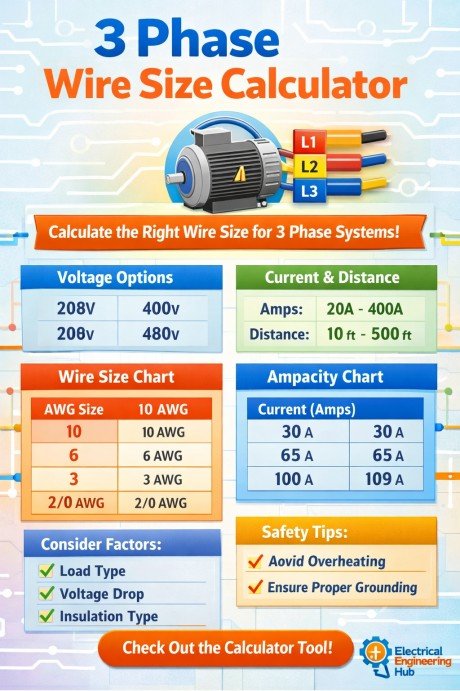
Table of Contents
Table of Contents
Unlike residential setups, industrial loads often operate on high currents and long cable runs. This makes it more complex to calculate the right wire gauge. Factors such as load current, cable length, system voltage, power factor, and allowable voltage drop must all be taken into account. A reliable 3 phase wiring calculator simplifies this process and ensures you choose a cable that meets both performance and regulatory requirements.
In this article, we’ll walk through everything you need to know about 3 phase wire sizing. From understanding the basics to using a 3 phase cable size calculator, you’ll gain practical insights to make well-informed decisions for industrial applications.
3 Phase Wire Size Calculator
3 Phase Wire Size Calculator
Estimate the correct conductor size for a balanced three-phase circuit based on load current, distance, voltage drop limits, and installation conditions.
Load Details
Cable & Installation
How to Use This Calculator
- Choose input mode. Enter the load current directly if you already know it, or switch to power mode and enter kW/HP, power factor, and efficiency.
- Select system voltage. Pick your line-to-line voltage from the list, or choose Custom to type any value.
- Enter cable length. Use the one-way distance from the source to the load, measured in meters.
- Set the allowed voltage drop. Three percent is a safe general target; use one percent for sensitive electronic or control loads.
- Pick installation conditions. Conductor material, installation method, insulation rating, ambient temperature, and circuit grouping all affect the final ampacity rating.
- Click Calculate. The tool checks every standard wire size against both your current-carrying requirement and your voltage drop limit, then recommends the smallest size that satisfies both.
- Review the comparison table. It shows which sizes pass or fail so you can see how much margin the recommended size has.
Technical Notes
Three-phase circuits are sized against two independent checks: the conductor’s current-carrying capacity (ampacity) and the permissible voltage drop over the run length. The larger of the two requirements always governs the final recommendation, which is why a long, lightly loaded feeder can require a bigger conductor than its current alone would suggest.
Ampacity ratings depend on the insulation temperature class, the ambient temperature around the cable, and how many other current-carrying conductors share the same conduit or tray. Higher ambient temperatures and more grouped circuits both reduce how much current a given conductor can safely carry, so the calculator applies correction factors before comparing against your load current.
Voltage drop becomes more significant as cable length increases and is also affected by conductor material, since aluminum has a notably higher resistance than copper for the same cross-section. This is why aluminum runs typically need to step up one or two sizes compared to an equivalent copper installation.
Direct burial and free-air installation conditions carry different heat dissipation characteristics than enclosed conduit, which is reflected in the ampacity comparison table. Always treat this tool as a planning aid; final conductor selection should be verified against the wiring regulation or standard applicable in your country (such as NEC, IEC 60364, or local utility code) and confirmed by a qualified electrical engineer before installation.
Key Takeaways
- The right 3 phase cable size ensures efficient power delivery and prevents electrical hazards.
- A 3 phase wiring calculator uses current, voltage, cable length, and allowable voltage drop for accurate sizing.
- Oversized cables are wasteful; undersized cables are dangerous. Proper sizing saves both energy and equipment.
Understanding 3 Phase Cable Size in Industrial Applications
A three-phase electrical system uses three alternating currents that are out of phase by 120 degrees. This type of system is commonly used in factories, large motors, pumps, HVAC systems, and other heavy-duty applications. The benefit of a three-phase system is that it provides constant power flow and supports higher loads compared to single-phase systems.
But this benefit also brings complexity. With higher current levels and longer cable distances, voltage drop becomes a significant concern. If the voltage drop exceeds allowable limits (usually 3% to 5%), it can damage sensitive equipment and cause motors to operate inefficiently. Hence, choosing the correct industrial wire size becomes mission-critical.
Using a 3 phase wire size calculator helps ensure your system performs at optimal voltage, even under load. The calculator uses formulas based on Ohm’s Law and includes factors like conductor resistance, reactance, and correction for temperature and material (copper or aluminum).
Use our online tool House Wiring Cable Size Calculator
How to Calculate 3 Phase Cable Size
Wire size depends on several parameters. Here’s a general step-by-step approach followed by the formula:
1. Determine the Load Current
Use the formula:
Current (I) = Power (P) / (√3 × Voltage (V) × Power Factor)
Where:
- Power (P) is in watts or kilowatts
- Voltage (V) is line-to-line voltage in volts
- Power Factor (pf) is typically 0.8 to 0.9 in industrial settings
2. Calculate Allowable Voltage Drop
Most industrial systems aim for a maximum of 3% voltage drop. Use:
Voltage Drop (Vd) = √3 × I × Length × (R + X)
Where:
- I = Current in amperes
- Length = One-way length in meters
- R = Resistance per unit length (Ω/km)
- X = Reactance per unit length (Ω/km)
Use our online tool for voltage drop calculations
3. Select Conductor Based on Material
Copper and aluminum conductors have different resistances. Copper is more conductive but costlier. Aluminum is cheaper but requires a larger size for the same current.
Sample Table for Reference (Copper Wires)
| Load Current (A) | Distance (m) | Recommended Cable Size (mm²) | Voltage Drop (%) |
|---|---|---|---|
| 40 | 50 | 10 mm² | 2.5% |
| 63 | 60 | 16 mm² | 2.9% |
| 100 | 75 | 25 mm² | 2.7% |
| 125 | 80 | 35 mm² | 2.8% |
| 160 | 100 | 50 mm² | 2.9% |
Note: Always consult the local wiring standards and derating factors for temperature, installation type, and grouping of cables.
Using a 3 Phase Wiring Calculator for Accurate Results
Manual calculations can be time-consuming and prone to error. An online 3 phase wiring calculator automates the process. You simply enter the load current, system voltage, cable run length, and acceptable voltage drop. The tool then returns the recommended 3 phase cable size based on these inputs.
Use our online tool 3 phase cable size calculator
Some advanced calculators even factor in ambient temperature, cable type (XLPE, PVC), installation method (buried, tray, conduit), and correction for altitude. This level of precision ensures you’re not just estimating, but engineering the right solution.
Using such a calculator is especially valuable when designing for:
- Industrial motors and pumps
- Conveyor systems
- Air compressors
- Welding machines
- HVAC systems in commercial buildings
Use our online tool Short Circuit Current Calculator for Motors
Industrial Wire Size and Its Effect on System Performance
Undersized wires result in higher resistance, leading to excessive voltage drop and energy loss. Equipment may draw more current to compensate, causing insulation breakdown or even fire. On the other hand, oversized wires increase project costs and may cause installation challenges due to size and flexibility.
This is where proper sizing using a 3 phase cable size calculator becomes your most reliable design tool. It balances electrical performance, cost, and safety in real-world applications.
Let’s look at the consequences of incorrect sizing:
- Undersized Cable:
- Motor stalling during startup
- Nuisance tripping of breakers
- Overheating and fire risk
- Oversized Cable:
- Unnecessary capital expense
- Larger conduits and trays needed
- Harder to terminate in control panels
Try our free online tool today ev charger cable size calculator
Factors That Influence Industrial Wire Size
Several real-world factors affect the final cable size you choose. These include:
- Voltage Level: Higher voltages (400V, 690V) reduce current and may allow smaller wires.
- Power Factor: Poor power factor increases current for the same load.
- Cable Length: Long cable runs need thicker wires to keep voltage drop within limits.
- Temperature: High ambient temperature reduces current-carrying capacity of the wire.
- Type of Load: Motors with high inrush currents may require oversizing.
- Installation Method: Bundled cables or buried conduits require derating.
A professional 3 phase wiring calculator will often provide optional inputs to adjust for these parameters. That’s why calculators designed for industrial use are far more detailed than basic home wiring tools.
Use our online tool Short Circuit Current Calculator
Example: Calculating 3 Phase Cable Size for a 15kW Motor
Let’s say we’re wiring a 15kW, 400V, 3-phase motor with a 0.85 power factor, over a 50-meter distance.
Step 1: Calculate Current
I = 15000 / (√3 × 400 × 0.85)
I = 15000 / (692.82) ≈ 21.65 A
Step 2: Use Calculator or Chart
From the earlier table or a calculator, a 6 mm² copper cable might result in around 2.7% voltage drop. Therefore, 6 mm² is an appropriate choice. If future expansion or inrush current is a concern, 10 mm² may be safer.
This approach ensures safety, long equipment life, and reduced energy loss.
Calculate instantly with our smart online tool cable size calculator australia
Importance of Regulatory Compliance and Safety
Each country has electrical standards that define the minimum requirements for cable sizing. These include IEC 60364 (International), NEC (USA), BS7671 (UK), and others.
By using a certified 3 phase wire size calculator, you align your design with these regulations. In industrial environments, compliance is not just best practice—it’s a legal requirement.
Ignoring standards can lead to non-compliance penalties, insurance rejection, and workplace hazards. Always document your sizing calculations and retain the data for inspections or future modifications.
Use our online tool Wire Size Calculator for Subpanels and Feeders – NEC Guidelines Included
Final Thoughts on Choosing the Right 3 Phase Cable Size
Selecting the right 3 phase cable size for industrial applications is more than a math problem. It’s about ensuring your operations remain safe, energy-efficient, and compliant.
The role of a well-designed 3 phase wiring calculator cannot be overstated. Whether you’re designing a new factory line or upgrading existing infrastructure, accurate wire sizing is the backbone of every electrical system.
With so many variables in play—load type, distance, environment, and regulations—it’s critical to use a tool tailored to industrial conditions. Avoid the guesswork. Let the science, backed by standards, guide your decision.
In Summary:
- Always consider voltage drop, load current, and cable length.
- Use an accurate 3 phase wiring calculator for reliable results.
- Consult local codes and derating tables before finalizing wire sizes.
- Prioritize safety, efficiency, and cost-effectiveness in your electrical designs.
Explore our professional online tool for quick calculations kw to cable size calculator
By following these guidelines, you ensure not only a successful installation but a robust electrical infrastructure built to perform for years to come.
Follow Us on Social:
Subscribe our Newsletter on Electrical Insights for latest updates from Electrical Engineering Hub
#3PhaseCableSize, #WireSizeCalculator, #IndustrialWiring, #ElectricalEngineering, #CableSizing, #3PhaseWiring, #AmpacityCalculator, #ElectricalLoad, #IndustrialAutomation, #PowerDistribution, #ElectricalDesign, #CableSizeChart, #VoltageDropCalculator, #ElectricWireSizing, #EngineeringTools
