NEC Code for Outlet Orientation: 7 Rules Explained (2026)
The NEC code for outlet orientation is shorter than most people expect: the National Electrical Code does not say whether the ground pin must point up or down. What it does regulate is where a receptacle may sit, whether it may face up, how close it can be to a tub, and which outlets must be tamper resistant. This guide covers seven rules, using the 2020 NEC as the baseline and flagging 2023 and 2026 changes.
Quick answer: There is no NEC rule for ground-up or ground-down mounting. Both are code compliant. The NEC does ban face-up receptacles in dwelling countertops, ban receptacles in the tub or shower zone (3 ft horizontally), require tamper-resistant receptacles in dwellings, and space wall outlets so no point is more than 6 ft from one.
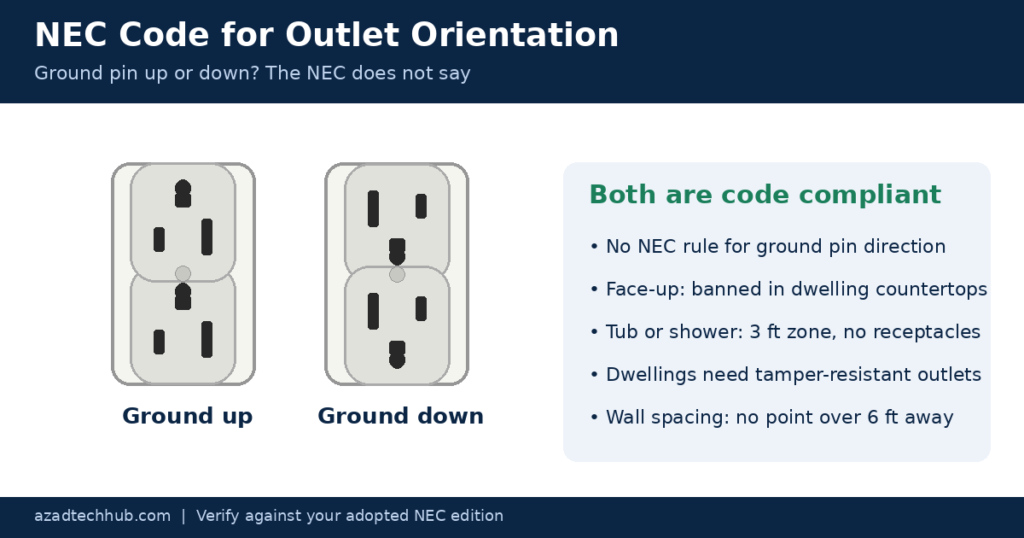
Table of Contents
Table of Contents
Is There an NEC Code for Outlet Orientation?
No. Whether you read the 2020 or 2023 edition, there is no section that says the ground terminal must be up, down or sideways. Proposals to require an orientation have been rejected in past code cycles, and installers, manufacturers and inspectors treat it as a matter of preference. That answers the common question, is there a code for electrical outlet orientation: not for the ground pin.
Because the NEC code for outlet orientation is silent, three other things decide which way an outlet goes: your project specification, the authority having jurisdiction (AHJ) and local custom. If an inspector cites the NEC for this, ask for the section number. The 2026 NEC reorganized Article 406, so section numbers differ from older editions.
Ground Up or Ground Down: Why Electricians Disagree
Ask why some electricians install outlets upside down and you will hear the same three arguments:
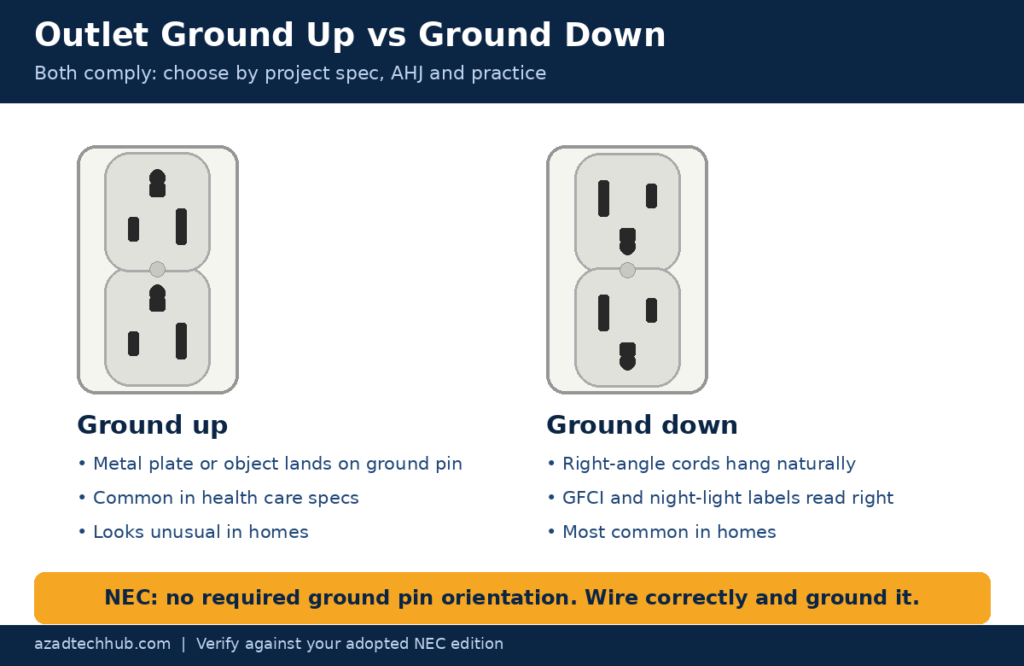
- Ground up: if a plug works partly loose and a metal object or cover plate slips down, it lands on the ground pin, not on the live blades. This habit is strongest in health care work.
- Ground down: most plugs with right-angle cords hang naturally, and GFCI devices with printed labels and many night lights are designed to read correctly this way.
- Custom: ground down is the most common in homes, so a ground-up outlet looks wrong to some people even though it is not.
Under the NEC code for outlet orientation, are upside down outlets up to code? Yes, provided the receptacle is wired correctly and grounded. The equipment grounding conductor works no matter which way the device faces. See our NEC article for grounding and bonding and our guide to grounding cable size as per NEC.
Can You Have an Outlet Facing Up?
Whole-receptacle orientation, meaning the face pointing up, is where the NEC code for outlet orientation does have teeth. Section 406.5 restricts face-up mounting:
- Countertops and work surfaces in dwellings: a face-up receptacle is not allowed unless it is part of a listed countertop assembly, such as a sealed pop-up unit.
- Floors: a face-up floor receptacle must be in a listed floor box assembly.
- Outdoors: receptacles in wet locations need weather-resistant (WR) devices and a cover that stays weatherproof, including with a plug in use.
Spills and crumbs collecting in a face-up receptacle are the reason.
NEC Code for Outlet Orientation 2020 vs 2023 vs 2026
If you work under the 2020 edition, the answer is the same: no ground-pin rule. The table shows what did change between editions for the outlet topics in this guide.
| Topic | 2020 NEC | 2023 and later |
|---|---|---|
| Ground-pin orientation | Not specified | Not specified (check 2026 text) |
| Tub and shower zone | 3 ft horizontal and 8 ft vertical zone | Wording clarified to include inside the tub and the space outside the stall |
| Tamper-resistant list | Shorter list of occupancies | Expanded list of locations |
Always read the edition your state or city has adopted. Many jurisdictions still enforce the 2020 NEC, so the 2020 rules above are not obsolete.
Are Tamper-Resistant Outlets Required by Code?
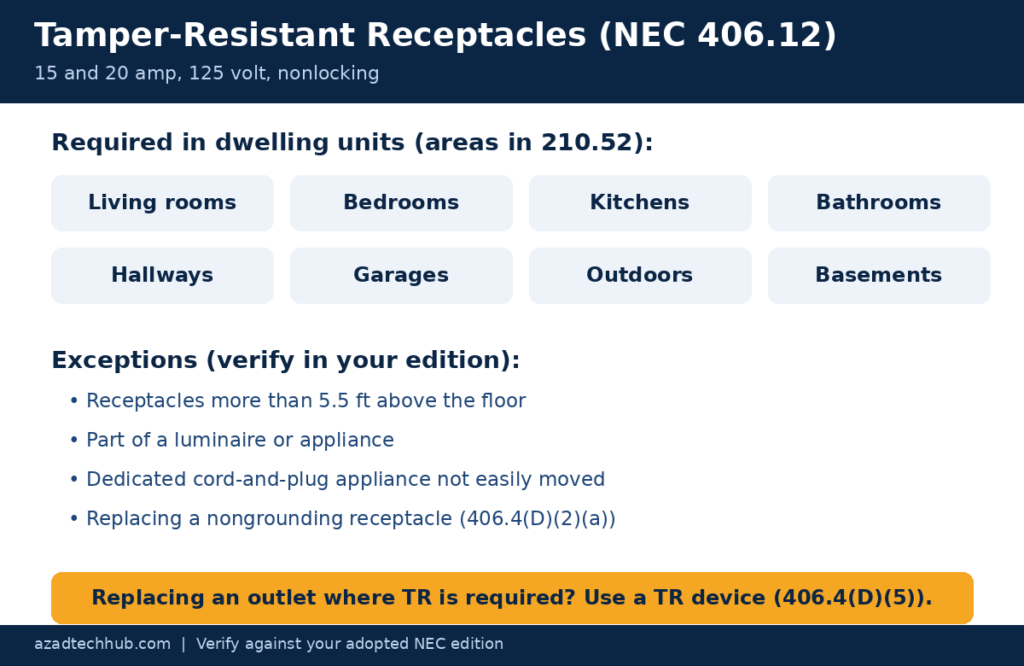
Yes, in many places, and it is separate from the NEC code for outlet orientation because it concerns the device you buy. Section 406.12 requires listed tamper-resistant (TR) receptacles, which have shutters that block objects from one slot. NEC tamper-resistant receptacles apply to 15 and 20 amp, 125 volt nonlocking receptacles. When you replace an old outlet in a location that needs TR, the replacement must also be TR under 406.4(D)(5).
What locations in a dwelling unit require tamper-resistant receptacles? All areas covered by 210.52, which means living rooms, bedrooms, kitchens, bathrooms, hallways, garages and outdoor outlets. Exceptions include receptacles more than 5.5 ft above the floor, receptacles that are part of a luminaire or appliance, and a dedicated receptacle for a cord-and-plug appliance that is not easily moved, such as a refrigerator. Outside dwellings the list covers guest rooms, schools and clinics, and 2023 expanded it.
2020 NEC Bathroom Requirements for Outlets
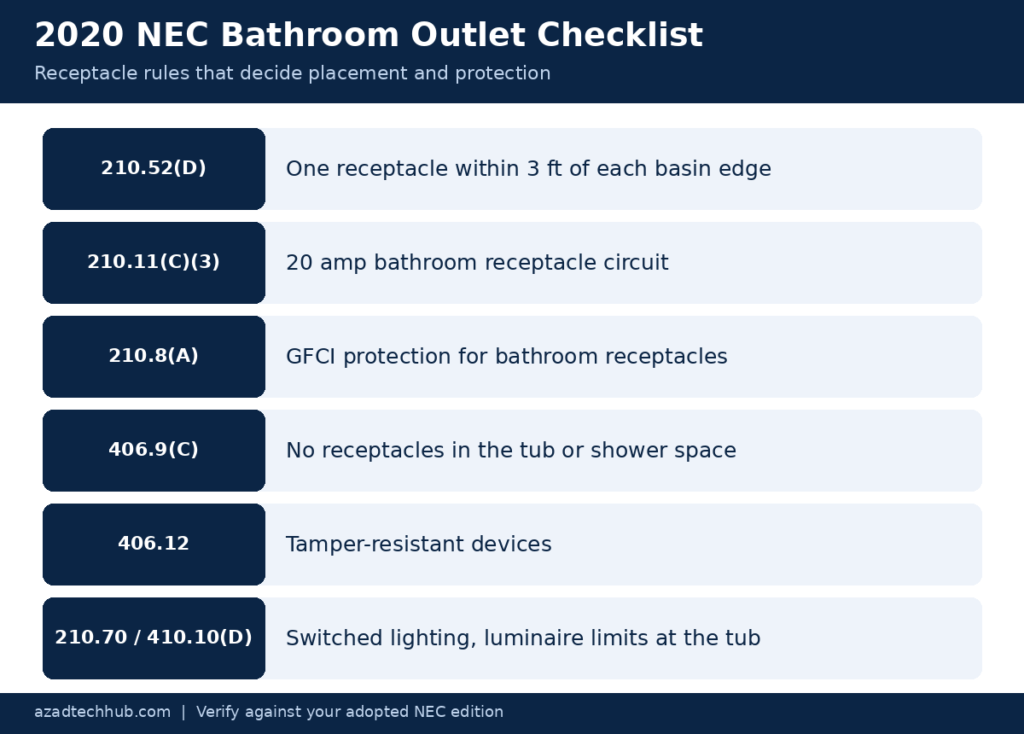
The NEC code for outlet orientation never mentions bathrooms, but the 2020 NEC bathroom requirements still decide where outlets go:
- One receptacle near each basin: at least one 125 volt, 15 or 20 amp receptacle within 3 ft of the outside edge of each basin, on the wall or on the side of the vanity (210.52(D)).
- A 20 amp circuit: a bathroom receptacle circuit must be rated 20 amps (210.11(C)(3)).
- GFCI protection: all bathroom receptacles need GFCI protection (210.8(A)). See our guide to NEC requirements for ground fault protection.
- No receptacles in the tub or shower space: see the next section (406.9(C)).
- Tamper-resistant devices: bathrooms are covered by 406.12.
- Lighting: a wall-switched lighting outlet (210.70) and luminaire limits above the tub (410.10(D)).
How Close Can an Outlet Be to a Bathtub or Shower?
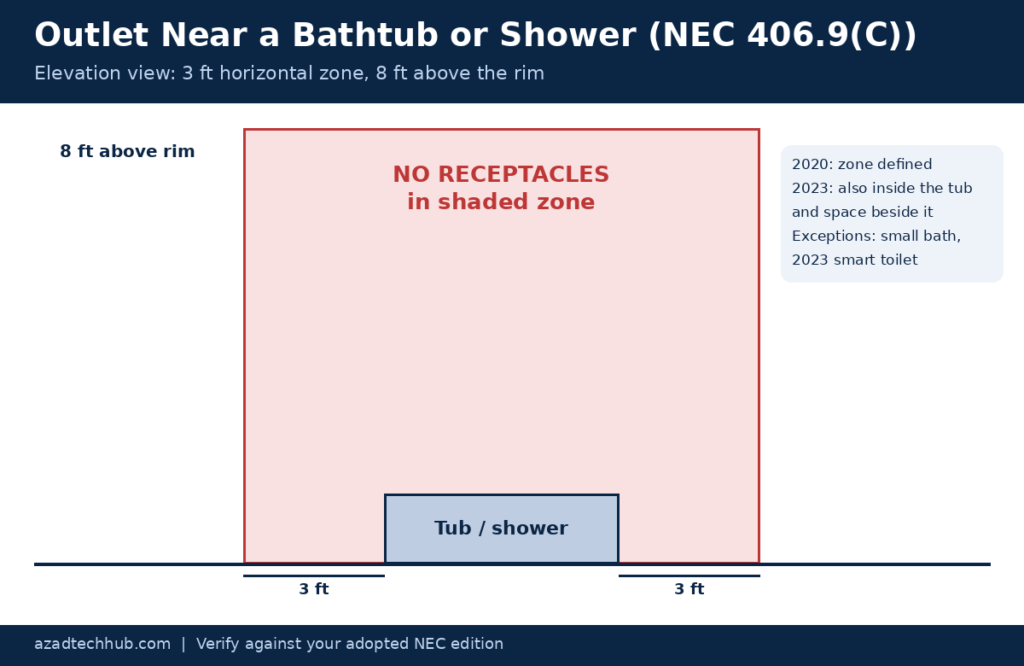
Electrical code for an outlet near a shower comes from 406.9(C): receptacles are not allowed in the tub or shower space. The rule creates a zone 3 ft horizontally from the outside edge of the tub or shower stall and 8 ft up from the rim or threshold. The 2023 edition clarified that the zone includes the inside of the tub and the space beside it below the 8 ft line.
In a bathroom, the NEC code for outlet orientation is really about location. So how close can an outlet be to a bathtub? The answer is no closer than 3 ft horizontally, measured from the outside edge. A small bathroom may use an exception that allows a receptacle on the wall farthest from the tub or shower. The 2023 NEC added an exception for a smart toilet. Local amendments vary, so check with your AHJ.
What Is the 2-6-12 Rule for Electrical Outlets?
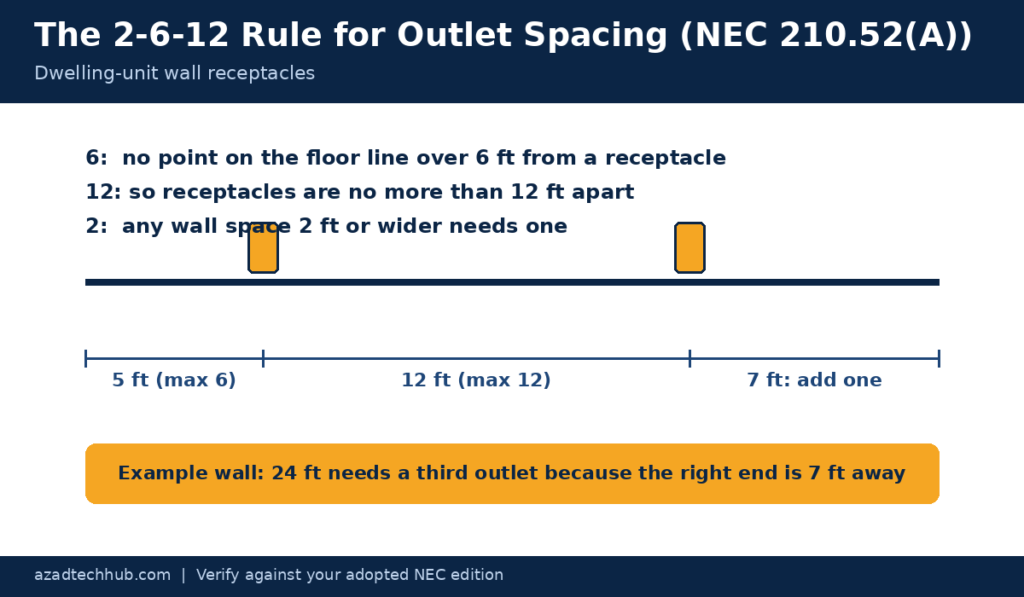
The 2-6-12 rule is shorthand for the dwelling-unit spacing in 210.52(A), also called the 6-12 rule:
- 2 ft: any wall space 2 ft or wider needs a receptacle within reach.
- 6 ft: no point along the floor line may be more than 6 ft from a receptacle.
- 12 ft: that works out to receptacles no more than 12 ft apart.
Receptacles within 5.5 ft of the floor count toward the spacing. Spacing is the other half of the NEC code for outlet orientation and placement, and it is why a long wall usually has an outlet every 10 to 12 ft. Our guide to home electrical wiring and the NEC covers the other room-by-room rules.
Wiring Outlets in Conduit
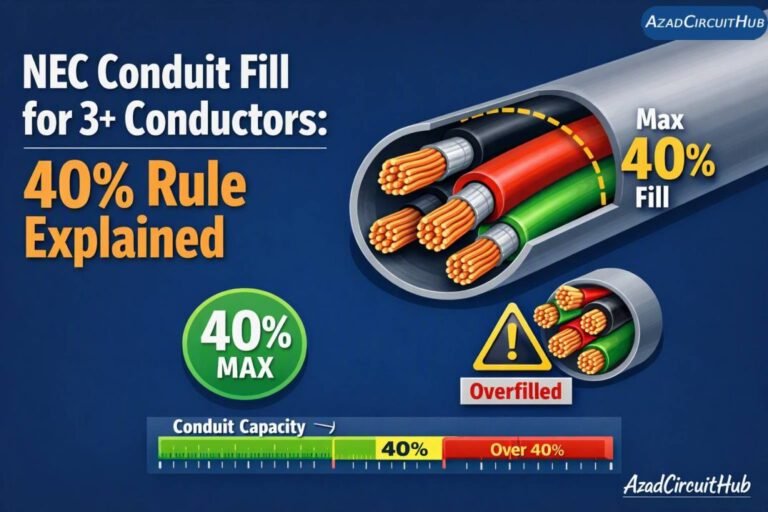
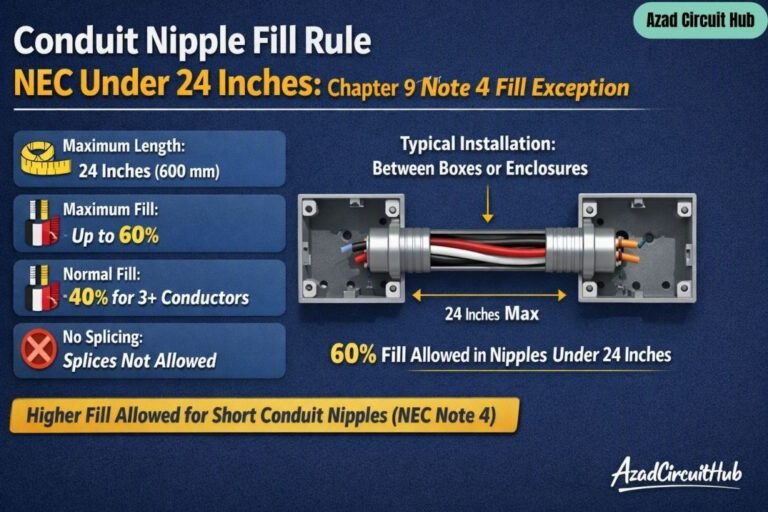
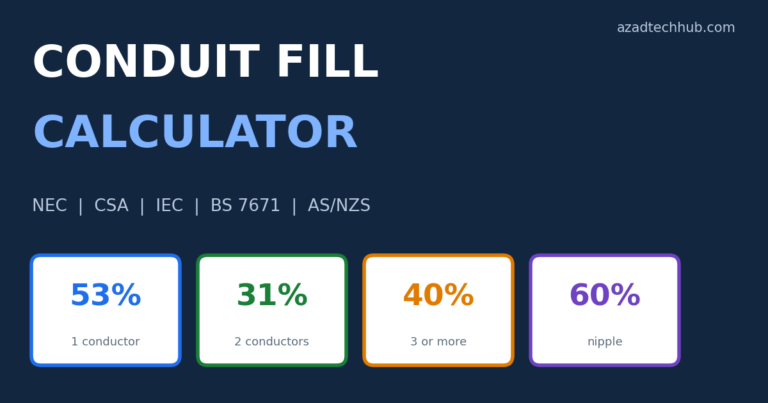
Even when the NEC code for outlet orientation is satisfied, outlets in garages and basements are often fed through conduit. Count every conductor, including the ground, and check fill with our conduit fill calculator. For the percentages and article numbers, read our guide to the NEC article for conduit fill. Long runs and many conductors may also need a pull box sized under NEC 314.28.
Tools for Installing and Checking Outlets
Once the NEC code for outlet orientation is settled, the right parts matter. As an Amazon Associate I earn from qualifying purchases, at no extra cost to you. See our affiliate disclosure.
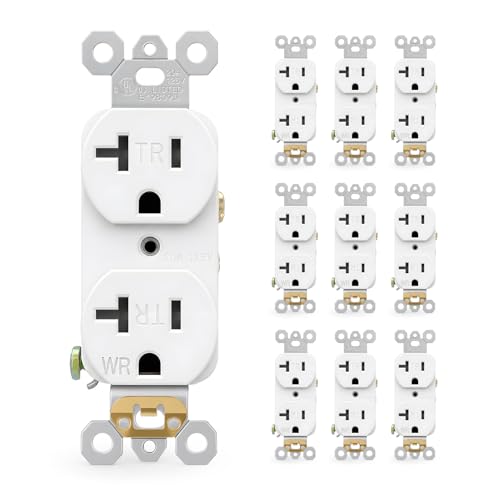
- Tamper-resistant outlets: buy TR, and WR for outdoor outlets, in 15 and 20 amp.
- GFCI receptacles for bathrooms: a self-test GFCI protects downstream outlets.
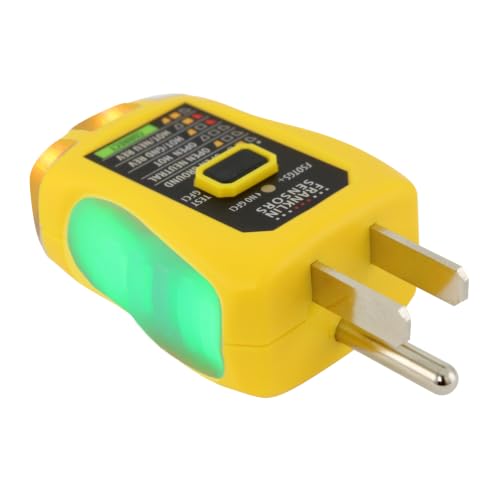
- Receptacle tester: confirms wiring and shows an open ground.
- Wire strippers: see our best wire strippers for electricians.
- Voltage tester: confirm the circuit is dead first. See our voltage tester reviews.



Frequently Asked Questions
What is the NEC code for outlet orientation?
There is no NEC rule for ground-pin direction. The NEC does regulate face-up receptacles (406.5), the tub zone (406.9(C)) and spacing (210.52).
How far from a shower should an outlet be?
At least 3 ft horizontally from the outside edge of the tub or shower stall, subject to exceptions and local rules.
Conclusion
The NEC code for outlet orientation boils down to one fact and six rules: the ground pin direction is your call, but face-up mounting, tub zones, tamper resistance, bathroom circuits, GFCI protection and 6-ft spacing are not. Check your adopted edition before you build, and use the conduit fill calculator when outlets are fed through conduit.
About This Guide
Written by Abdul Wassay, an electrical engineer who publishes standards-based calculators and guides on Azad Circuit Hub. This guide is educational, not a substitute for the NEC or a licensed electrician. Verify against the edition and local amendments your AHJ enforces. Spotted an error? Use our contact page.
Sources: NFPA 70, National Electrical Code (210.8, 210.11, 210.52, 406.4, 406.5, 406.9, 406.12, 410.10), viewable free on the NFPA 70 page.
Get new guides in your feed. Follow Electrical Insights on LinkedIn for new electrical standards guides, calculators and design tips from Azad Circuit Hub.