
Wallbox Pulsar Plus vs Emporia: Which Level 2 EV Charger Is Better?
If you are comparing home EV chargers, the wallbox pulsar plus vs emporia decision comes down to more than charging amperage. Both brands offer smart Level 2 charging, but they take different approaches to connectivity, energy monitoring, installation, and everyday usability.
I have worked as an electrical engineer across electrical panels, power systems, automation, and renewable-energy projects. When evaluating an EVSE, I look closely at continuous charging load, breaker requirements, cable length, connector type, installation flexibility, and how useful the smart features are after installation.
Wallbox Pulsar Plus vs Emporia at a Glance
| Feature | Wallbox Pulsar Plus | Emporia Level 2 |
|---|---|---|
| Charging current | Up to 48A | Up to 48A |
| Connector | J1772 | J1772 |
| Installation | Hardwired / model dependent | Plug-in or hardwired, model dependent |
| Smart connectivity | Wi-Fi / app | Wi-Fi / app |
| Indoor/outdoor use | Yes | Yes |
| Solar integration | Supported | Strong energy-monitoring focus |
| Cable | Long charging cable | Long charging cable |
| Best for | Compact smart charging | Energy monitoring and value |
For readers who want to compare more chargers before deciding, my guide to the best level 2 ev charger options covers different charging capacities and installation types.
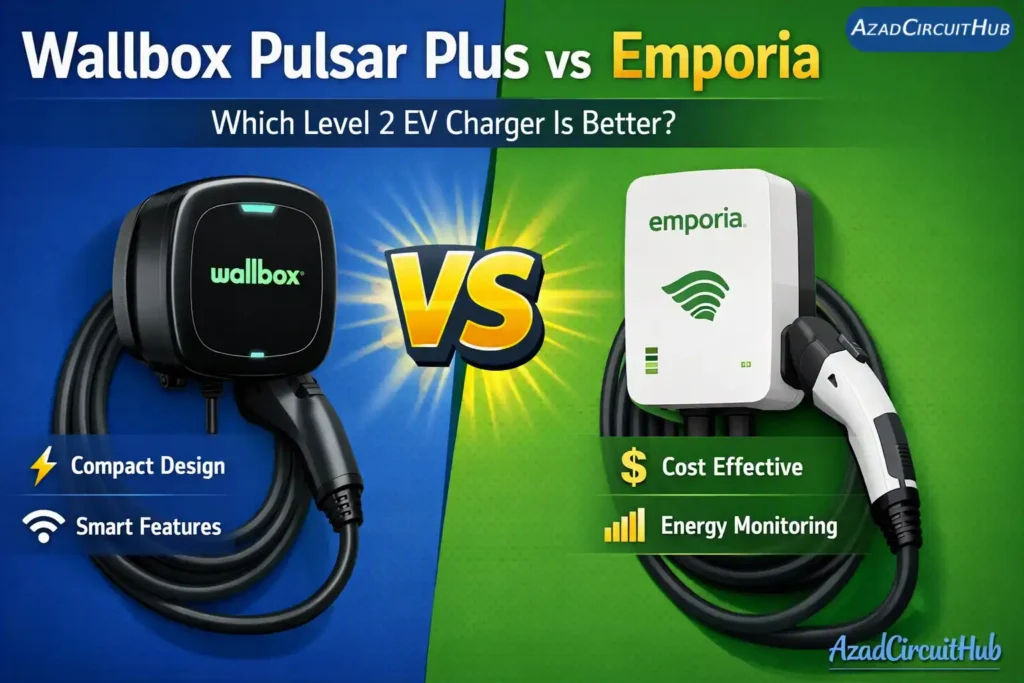
Table of Contents
Table of Contents
Charging Performance Compared
Both chargers target the 240V Level 2 home charging market. A 48A EV charger can provide approximately 11.5 kW at 240V when the vehicle and electrical installation support the full output.
However, the charger does not determine the vehicle's maximum charging rate. If your EV has a lower onboard AC charging limit, increasing the EVSE rating will not make it charge faster.
The Wallbox Pulsar Plus is especially appealing to drivers who want a compact smart charger with a clean installation. Emporia is attractive to homeowners who place greater emphasis on energy monitoring and integration with a broader home energy setup.
Wallbox Pulsar Plus Features
The Wallbox Pulsar Plus is a compact 48A Level 2 EV charger designed for home charging. The J1772 connector makes it compatible with a wide range of EVs and plug-in hybrids that use the standard North American AC charging connection.
The model listed for this review has a long cable, Wi-Fi app control, indoor/outdoor capability, and adjustable charging current. Depending on installation configuration, it can be set up to suit the home's available electrical capacity.
For a closer look at this model, see my Wallbox Pulsar Plus Level 2 EV Charger review covering installation, charging speed, features, and practical home use.
Emporia EV Charger Features
Emporia takes a strong energy-management approach. Its EV charger can be especially interesting for homeowners who want to monitor electricity consumption and coordinate EV charging with other household loads.
This can matter in homes with solar panels, battery storage, time-of-use electricity rates, or high overall electricity consumption.
The Emporia option also provides Level 2 charging suitable for overnight home charging. Its smart functionality can help users understand when and how much electricity the vehicle is consuming.
If energy monitoring is one of your main priorities, my emporia pro level 2 ev charger hardwired review provides a deeper look at the product and its installation considerations.
Which Charger Is Better for Solar Charging?
Solar compatibility is becoming increasingly important for EV owners. Both products can be used in homes with solar generation, but the overall experience depends on how the charger interacts with the home's energy-management system.
Emporia has a particularly strong appeal for users who want detailed energy monitoring. Wallbox also provides smart charging capabilities and can work well in a modern home energy setup.
The important distinction is that "solar compatible" does not automatically mean the charger will only use excess solar power. The inverter, energy meter, charger controls, and software configuration all influence actual solar charging behavior.
For a broader selection of solar-friendly home chargers, check the best level 2 ev charger options before purchasing.
Installation and Electrical Requirements
A 48A EV charger is a substantial continuous electrical load. The branch circuit must be designed according to applicable electrical requirements, including conductor sizing, overcurrent protection, and continuous-load considerations.
Before installation, check:
- Electrical service capacity
- Available breaker space
- Required circuit rating
- Conductor size
- Grounding requirements
- Charger mounting location
- Indoor or outdoor exposure
- Cable routing distance
- Local electrical code
As an electrical engineer, I would not select a 48A charger simply because it offers the highest charging speed. The home's electrical infrastructure needs to support the load safely.
Wallbox Pulsar Plus vs Emporia: Which Should You Buy?
The wallbox pulsar plus vs emporia choice depends on what matters most to you.
| Priority | Better Fit |
|---|---|
| Compact home charger | Wallbox Pulsar Plus |
| 48A charging | Both |
| Smart app control | Both |
| Detailed energy monitoring | Emporia |
| Solar-energy management | Emporia |
| Compact design | Wallbox |
| Broad EV compatibility | Both |
| Value-focused setup | Emporia |
Choose Wallbox if you want a compact, polished smart EV charging station with strong app-based controls. Choose Emporia if energy monitoring and broader household electricity management are higher priorities.
Frequently Asked Questions
Is Wallbox Pulsar Plus better than Emporia?
Neither is universally better. Wallbox is attractive for its compact design and smart charging features, while Emporia has a strong advantage for users focused on energy monitoring and home energy management.
Can Wallbox Pulsar Plus charge at 48 amps?
The 48A version can provide up to 48A when correctly installed and when the vehicle supports that charging rate. The electrical circuit must also be properly sized for the continuous load.
Is Emporia good for solar EV charging?
Emporia can be a strong choice for solar-equipped homes because of its emphasis on energy monitoring and smart energy management. Actual solar charging behavior depends on the complete home energy system.
Does Wallbox Pulsar Plus use J1772?
The Wallbox Pulsar Plus model covered here uses a J1772 connector, making it compatible with many EVs and plug-in hybrids sold in North America.
Which is better for home charging, Wallbox or Emporia?
For a compact smart charging station, Wallbox is an excellent option. For homeowners who want stronger energy-monitoring capabilities, Emporia may be the better fit.
Final Verdict
The wallbox pulsar plus vs emporia comparison is ultimately a choice between two capable smart Level 2 charging approaches. Wallbox stands out for its compact design, 48A capability, long cable, and smart app controls. Emporia is particularly compelling when energy monitoring and solar-aware home energy management are priorities.
For most homeowners, either can provide a major improvement over Level 1 charging. The final decision should be based on your EV's onboard charger, electrical service, installation location, charging schedule, and energy-management goals.
If you are still comparing alternatives, explore my best level 2 ev charger guide for additional home EVSE options.
Follow Us on Social:
Subscribe our Newsletter on Electrical Insights for latest updates from Azad Circuit Hub
#WallboxPulsarPlus, #EmporiaEVCharger, #WallboxVsEmporia, #EVChargerComparison, #Level2EVCharger, #EVChargerReview, #HomeEVCharging, #SmartEVCharger, #EVCharging, #ElectricVehicle
