Wallbox Pulsar Plus NACS Review: 48A Smart EV Charger Features & Buying Guide
The Wallbox Pulsar Plus has become a popular choice for homeowners who want a compact smart EV charger without giving up charging power. In this wallbox pulsar plus nacs review, I am focusing on the 48A NACS version because it combines a higher-power Level 2 charging output with the connector now used by many newer EVs.
I approach EV charger reviews from an electrical engineering perspective. My experience includes electrical panels, power systems, industrial controls, automation, and field troubleshooting, so I pay close attention to the part of an EV charger installation that is easy to overlook: circuit capacity, continuous loading, conductor sizing, voltage drop, protection, and compatibility with the vehicle.
For a home EV charger, the highest amperage is not automatically the best choice. The vehicle’s onboard AC charger and your home’s electrical service are just as important as the charger’s rating.
Wallbox Pulsar Plus NACS 48A: Quick Specifications
| Feature | Wallbox Pulsar Plus NACS 48A |
|---|---|
| Charger type | AC Level 2 |
| Maximum current | 48A |
| Maximum output | Up to 11.5 kW |
| Nominal voltage | 240V |
| Connector | NACS |
| Installation | Hardwired |
| Smart charging | Yes |
| Wi-Fi connectivity | Yes |
| Bluetooth | Yes |
| Typical application | Home EV charging |
| Best suited for | EVs supporting higher AC charging rates |
At 240V and 48A, the theoretical charging output is approximately 11.5 kW. Actual power delivered to the vehicle depends on the EV, supply voltage, charging limits, temperature, and other operating conditions.
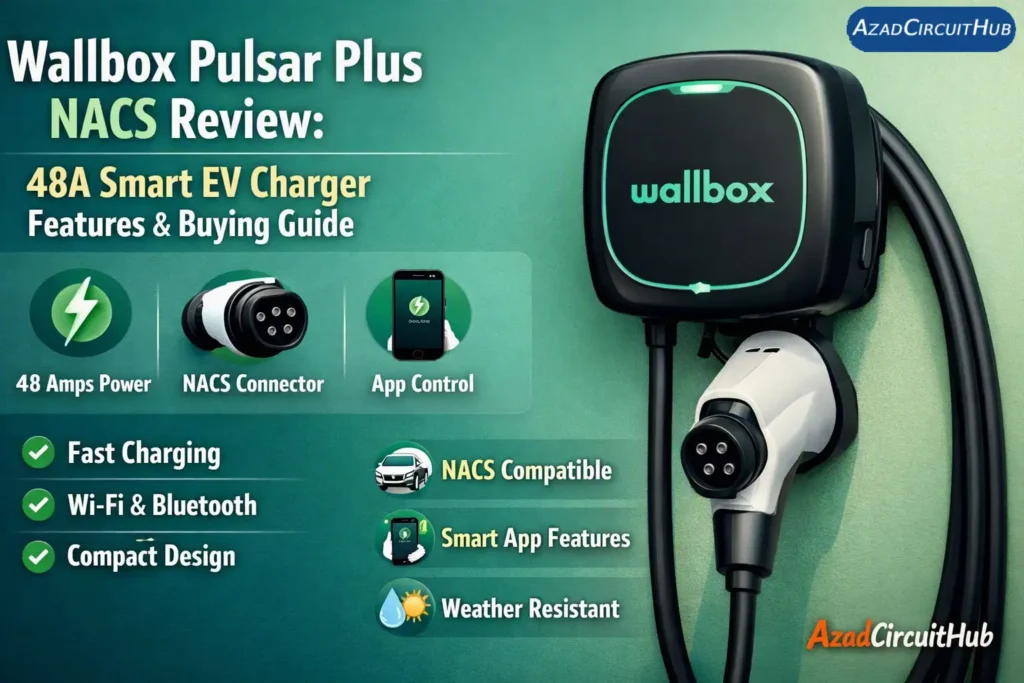
Table of Contents
Table of Contents
What Makes the Wallbox Pulsar Plus NACS Different?
The biggest attraction is the combination of a compact charger, 48A output, smart connectivity, and NACS connector.
NACS is particularly relevant to EV owners who want a direct connection to compatible vehicles rather than relying on an adapter. However, connector selection should always be based on the vehicle you own and the vehicles you expect to use in the future.
The Pulsar Plus is also much smaller than many traditional wall-mounted EV charging stations. That matters when the charger is installed in a garage where wall space is limited.
The smart functionality adds another advantage. Depending on the supported features and software configuration, homeowners can monitor charging, control sessions, and manage charging from the Wallbox ecosystem.
Wallbox Pulsar Plus NACS 48A Charging Performance
At its full 48A rating, the Pulsar Plus can provide approximately 11.5 kW at a nominal 240V supply.
That is enough to add a substantial amount of driving range during an overnight charging session. However, charging speed should be considered in relation to the vehicle.
For example, if an EV's onboard AC charger is limited below the station's maximum output, the vehicle will determine the actual charging rate. Installing a 48A EV charger does not force the vehicle to accept 48A.
| Charger Current | Approx. Power at 240V |
|---|---|
| 32A | 7.7 kW |
| 40A | 9.6 kW |
| 48A | 11.5 kW |
This makes the 48A Pulsar Plus particularly attractive for drivers who regularly cover long distances or want to recover more battery capacity during limited charging windows.
For readers comparing other residential charging stations, my best level 2 ev charger guide covers important differences in charging current, installation type, and smart features.
Hardwired Installation: What You Need to Know
The 48A Pulsar Plus is designed for a hardwired installation. This is an important distinction from plug-in EV chargers that use a NEMA 14-50 receptacle.
A 48A continuous EV load typically requires a branch circuit rated above the charger's operating current under applicable electrical requirements. In a common North American installation, this can mean a dedicated 60A circuit, although the exact requirement must be confirmed against the charger's installation instructions and the applicable local electrical code.
The installation should include:
- Correctly sized conductors
- Appropriate overcurrent protection
- A dedicated branch circuit
- Proper grounding
- Correct termination torque
- Adequate panel capacity
- Suitable outdoor protection where required
As an electrical engineer, I would never size the circuit simply by looking at the charger label. The complete installation needs to be evaluated, especially in homes with electric HVAC, water heating, dryers, ovens, or other large loads.
Smart Charging and Connectivity
One of the strongest reasons to consider the Pulsar Plus instead of a basic EVSE is its smart functionality.
The Wallbox ecosystem is designed to give users greater visibility and control over charging. Features can include remote monitoring, charging controls, scheduling, and energy-management functions depending on the model, software, and connected setup.
This can be useful for homeowners who want to schedule charging around their electricity rate structure or avoid unnecessary charging during expensive periods.
Smart charging also makes a Level 2 EV charger more useful as part of a modern home energy system.
Compact Design and Garage Installation
The Pulsar Plus has a compact design that makes it suitable for garages, driveways, and other residential charging locations where a large charging station would be inconvenient.
The smaller enclosure does not mean that the electrical installation can be treated casually. Heat, moisture, cable routing, mounting height, and protection from physical damage should still be considered.
Cable management also matters. A charger can have excellent electrical specifications, but a poorly positioned cable can make everyday charging frustrating.
Wallbox Pulsar Plus NACS vs J1772
The NACS version is best suited to vehicles with compatible NACS charging inlets. J1772 remains common among many EVs and plug-in hybrids, so the connector should be selected based on the vehicle.
| Factor | NACS | J1772 |
|---|---|---|
| Connector design | NACS | J1772 |
| AC Level 2 charging | Yes | Yes |
| Compact connector | Yes | Larger |
| Best choice | Compatible NACS EVs | Compatible J1772 EVs |
| Adapter consideration | Vehicle dependent | Vehicle dependent |
If your current EV has NACS, buying a native NACS charger can provide a clean and convenient setup. If you own a J1772 vehicle, choosing the correct connector or using a suitable approved adapter becomes more important.
Is 48A Better Than 40A for Home Charging?
Not always. A 48A charger can deliver more power, but the benefit depends on your vehicle and electrical system.
A 40A charger produces about 9.6 kW at 240V, while a 48A charger can reach about 11.5 kW. The difference is useful when you regularly need faster charging, but it may not matter for someone who plugs in every night and drives a modest distance.
The 48A option makes more sense when:
- Your EV supports higher AC charging power.
- You have a suitable electrical service.
- You drive significant daily mileage.
- You want shorter charging sessions.
- You are installing a permanent charger for long-term use.
Wallbox Pulsar Plus 48A Buying Considerations
Before purchasing, check these points:
- Confirm that your EV supports the NACS connector.
- Check the vehicle's maximum AC charging rate.
- Confirm that your electrical panel can support the circuit.
- Have the installation completed according to applicable electrical requirements.
- Check the charger's current configuration.
- Consider cable length and mounting position.
- Review smart charging requirements.
- Compare warranty and support coverage.
For a broader look at the product family, read my wallbox pulsar plus review before deciding between different Pulsar Plus configurations.
Wallbox Pulsar Plus 48A vs Other Level 2 Chargers
The Pulsar Plus competes with several established home EV charging stations. When comparing it with products from ChargePoint, Emporia, Enphase, Tesla, Autel, or other manufacturers, don't focus only on maximum amperage.
| Buying Factor | Why It Matters |
|---|---|
| Maximum current | Determines potential charging power |
| Connector | Must match your EV |
| Hardwired installation | Important for high-current models |
| Wi-Fi | Enables connected features |
| App support | Helps monitor and control charging |
| Cable length | Affects installation convenience |
| Warranty | Important for long-term ownership |
| Electrical certification | Important for safe installation |
The best charger is the one that fits your vehicle, electrical service, installation location, and charging routine.
Wallbox Pulsar Plus NACS 48A Review: Who Should Buy It?
The 48A NACS Pulsar Plus is particularly appealing to EV owners who want a permanent home charger with strong charging capability and smart functionality.
It is a better fit for a homeowner who can support a higher-current hardwired installation than someone looking for a simple portable charger.
If you have a compatible NACS vehicle and expect to keep it for several years, choosing a native NACS charger can also simplify your charging setup.
For a deeper look at the hardwired configuration, see my Wallbox Pulsar Plus 48A Hardwired Review.
Amazon Buying Recommendation
If the specifications match your EV and electrical installation, the Pulsar Plus 48A NACS is worth considering for a permanent home charging setup.
Check the Wallbox Pulsar Plus NACS 48A on Amazon: Wallbox Pulsar Plus NACS 48A EV Charger
Before purchasing, verify the exact NACS model, current rating, included cable, installation requirements, and seller details on the current Amazon listing.
For readers who are still deciding between models, my wallbox pulsar plus review provides a broader comparison of the Pulsar Plus range.
Frequently Asked Questions
Is the Wallbox Pulsar Plus NACS 48A a good home charger?
Yes, it can be a strong option for compatible EVs when the homeowner has sufficient electrical capacity for a higher-current hardwired installation. Its combination of 48A charging and smart functionality makes it suitable for regular home charging.
How many kW is a 48A EV charger?
At a nominal 240V supply, a 48A charger can deliver approximately 11.5 kW. Actual vehicle charging power can be lower depending on the EV's onboard charger and operating conditions.
Does the Wallbox Pulsar Plus 48A require hardwiring?
The 48A configuration covered in this review is intended for hardwired installation. This should be planned as a dedicated EV charging circuit by a qualified electrician.
Is NACS better than J1772?
Neither connector is universally better. NACS is the appropriate choice for compatible NACS vehicles, while J1772 remains useful for vehicles equipped with that inlet. Vehicle compatibility should determine your purchase.
Do I need a 60A breaker for a 48A EV charger?
A 48A continuous EV load commonly requires a 60A branch circuit under applicable electrical rules, but the exact installation must follow the charger's instructions and the electrical code governing your location. Have a qualified electrician verify the design.
Final Verdict
The Wallbox Pulsar Plus 48A NACS is a compelling choice for EV owners who want a compact, connected Level 2 charger with enough output for faster home charging. Its approximately 11.5 kW maximum output makes it considerably more capable than many 32A residential chargers.
The main question is not whether 48A sounds impressive. It is whether your vehicle and electrical system can use it effectively.
If you have a compatible NACS EV, adequate electrical capacity, and want a permanent smart charging station, the Pulsar Plus deserves a place on your shortlist. If your charging needs are modest, a lower-current charger may offer better value.
As I found repeatedly while working with electrical systems, correct sizing matters more than simply choosing the largest available rating. Match the EVSE to the vehicle, circuit, panel, and actual charging routine, and the result will be a much more practical home charging installation.
Get new guides in your feed. Follow Electrical Insights on LinkedIn for new electrical standards guides, calculators and design tips from Azad Circuit Hub.
#WallboxPulsarPlus, #WallboxNACS, #WallboxPulsarPlusNACS, #EVChargerReview, #48AEVCharger, #NACSEVCharger, #Level2EVCharger, #SmartEVCharger, #HomeEVCharging, #EVCharging