
Size of Earth Wire for Domestic Wiring in SWG: Best Guide
Choosing the correct earth wire is an important part of safe domestic electrical wiring. The earth conductor provides a low-resistance path for fault current and helps protective devices disconnect the supply when a fault occurs. However, older wiring systems often describe wire diameter using SWG, while modern electrical standards generally use mm² conductor area.
The Size of Earth Wire for Domestic Wiring in SWG depends on the circuit size, earthing system, conductor material, installation method, and applicable electrical standard. SWG can still be useful when identifying older wires, but the final selection should normally be checked against the required cross-sectional area in mm².
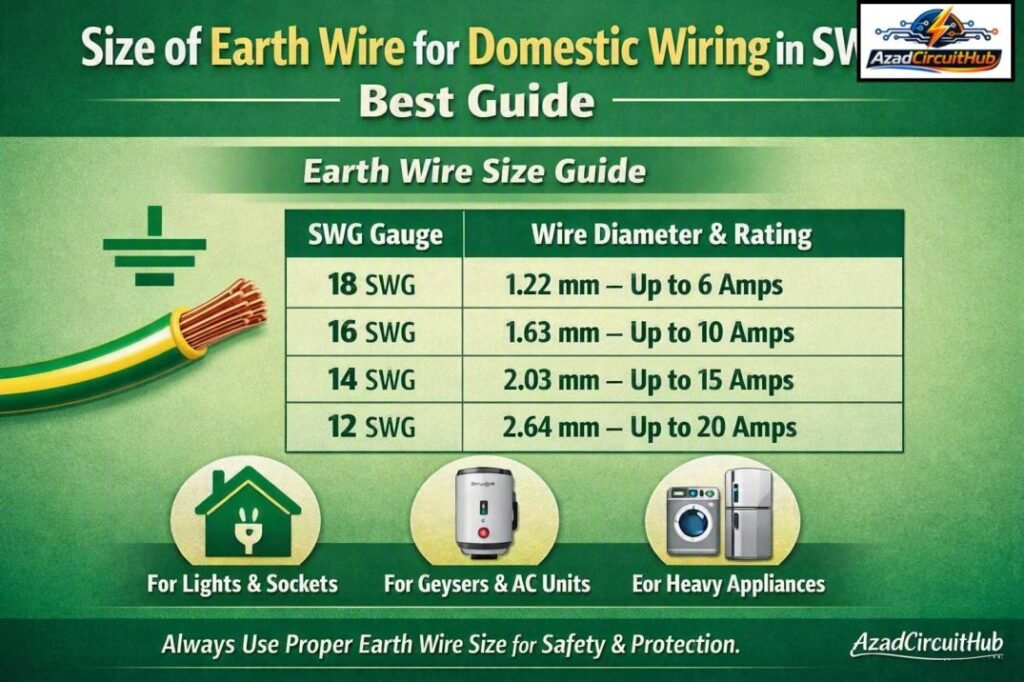
Table of Contents
Table of Contents
Quick Earth Wire Size Chart in SWG
The following table gives common SWG sizes and their approximate copper conductor areas. These values are useful for converting older wire specifications into modern metric sizes.
| SWG Size | Approx. Diameter | Approx. Copper Area | Approx. Metric Equivalent |
|---|---|---|---|
| 8 SWG | 4.06 mm | 12.97 mm² | 10–16 mm² |
| 10 SWG | 3.25 mm | 8.30 mm² | 6–10 mm² |
| 12 SWG | 2.64 mm | 5.47 mm² | 4–6 mm² |
| 14 SWG | 2.03 mm | 3.24 mm² | 2.5–4 mm² |
| 16 SWG | 1.63 mm | 2.08 mm² | 1.5–2.5 mm² |
| 18 SWG | 1.22 mm | 1.17 mm² | 1–1.5 mm² |
| 20 SWG | 0.91 mm | 0.66 mm² | 0.75–1 mm² |
SWG conversion values are approximate. Metric cable sizes are standardized nominal cross-sectional areas and should be used for final electrical design.
For many ordinary domestic circuits, the Size of Earth Wire for Domestic Wiring in SWG will often be discussed around the 14 SWG to 16 SWG range when converting older installations. However, this does not mean that one SWG size is suitable for every household circuit.
What Does SWG Mean in Electrical Wiring?
SWG stands for Standard Wire Gauge. It is an older system used to describe the diameter of wires. Unlike the modern mm² system, SWG identifies a wire primarily by its physical diameter.
A smaller SWG number means a thicker wire. For example, 12 SWG is thicker than 14 SWG, while 16 SWG is thinner than 14 SWG.
Modern electrical cable specifications normally state conductor size in square millimetres. This makes it easier to select conductors according to current-carrying capacity, fault current, voltage drop, and protective requirements.
SWG vs Metric Cable Size
| Measurement System | Example | What It Indicates |
|---|---|---|
| SWG | 14 SWG | Wire diameter/gauge |
| Metric | 2.5 mm² | Conductor cross-sectional area |
| AWG | 12 AWG | American wire gauge |
| kcmil | 250 kcmil | Large conductor area |
SWG and AWG are not interchangeable. A 12 AWG conductor, for example, should not simply be treated as 12 SWG.
What Size Earth Wire Is Used in Domestic Wiring?
There is no universal earth wire size for every domestic installation. The required protective conductor is selected according to the circuit arrangement and the electrical standard being followed.
For a modern installation, it is better to start with the required conductor area in mm² and then use an SWG conversion only if an older wire specification requires it.
The Size of Earth Wire for Domestic Wiring in SWG can therefore be understood as a conversion reference rather than a standalone design rule.
For example, a 2.5 mm² copper conductor has an area close to 14.5 SWG. A 4 mm² copper conductor is closer to 12.8 SWG. Because SWG sizes do not exactly match standard metric cable sizes, selecting the next suitable standardized cable size is generally preferable to relying on an exact gauge conversion.
Typical Domestic Earth Wire Sizes
The following table provides a practical starting point for common household circuits. It is not a substitute for the requirements of the local electrical code.
| Domestic Circuit | Common Phase Conductor Range | Typical Earth/PE Range* | Common Metric Sizes |
|---|---|---|---|
| Lighting circuit | 1.0–1.5 mm² | 1.0–1.5 mm² | 1.0 or 1.5 mm² |
| Socket circuit | 2.5 mm² | 1.5–2.5 mm² | 1.5 or 2.5 mm² |
| Small appliance circuit | 2.5–4 mm² | 2.5–4 mm² | 2.5 or 4 mm² |
| Water heater circuit | 4–6 mm² | Depends on design | 4–6 mm² |
| Cooker/large load | 6–10 mm²+ | Depends on design | 6–10 mm²+ |
| Main earthing conductor | Design dependent | Design dependent | Based on earthing system/code |
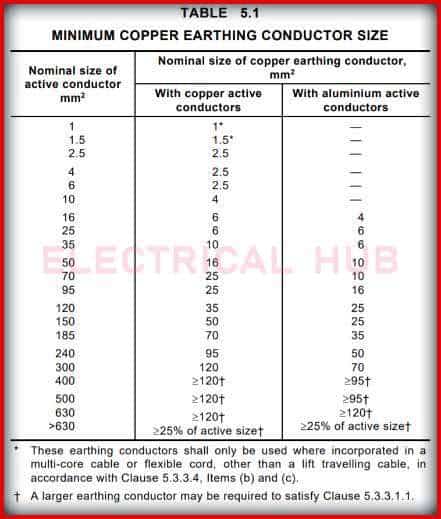
*The protective conductor must be sized according to the applicable standard, fault protection requirements, installation method, and protective device.
For a socket circuit, for example, using a 2.5 mm² protective conductor may be appropriate in some installations, while other arrangements can permit a smaller protective conductor when the relevant standard’s conditions are met.
If you are selecting a conductor for an existing installation, check the complete circuit rather than replacing the earth wire based only on its SWG number.
Typical Size of Earth Wire for Domestic Wiring
14 SWG (2.0 mm)
- Usage: This is often the minimum size recommended for general domestic applications, particularly for connecting earthing systems to socket outlets and light fittings.
- Application: Suitable for smaller circuits and appliances where the current load is relatively low.
12 SWG (2.5 mm)
- Usage: Commonly used for 15A circuits, providing a thicker conductor that can handle higher fault currents.
- Application: Ideal for three-pin 15A sockets and general-purpose circuits in homes.
10 SWG (3.2 mm)
- Usage: Used in installations requiring additional safety margins, especially in larger domestic systems.
- Application: Suitable for grounding larger appliances or systems that may experience higher fault currents.
8 SWG (3.8 mm)
- Usage: This size is typically used in more robust installations, such as those involving heavy machinery or high-capacity electrical systems.
- Application: Often required for earthing larger equipment or in cases where local regulations mandate a thicker conductor.
How to Select Earth Wire Size
The correct protective conductor size should be determined using the electrical installation standard applicable to the project.
Important factors include:
- Circuit conductor size – The phase and neutral conductor sizes influence protective conductor selection.
- Protective device rating – The MCB, fuse, or other protective device must disconnect the circuit safely during a fault.
- Fault current – The earth conductor must withstand the expected fault current for the required disconnection time.
- Earthing arrangement – TN, TT, and other earthing systems can have different requirements.
- Installation method – A conductor installed inside a cable, conduit, trunking, or exposed environment may be subject to different requirements.
- Mechanical protection – Smaller protective conductors may require suitable mechanical protection.
- Conductor material – Copper and aluminium have different electrical and thermal properties.
A useful design principle is that the protective conductor must be capable of carrying the prospective fault current long enough for the protective device to operate.
For larger or more critical installations, the adiabatic equation may be used:
S = √(I²t) / k
Where:
- S = required protective conductor cross-sectional area in mm²
- I = fault current in amperes
- t = disconnection time in seconds
- k = material and insulation-dependent factor
This approach provides a more technically sound method than simply choosing an SWG number.
Need help comparing conductor sizes? Use our earth cable size selection chart to compare common protective conductor sizes and their applications.
SWG Earth Wire Size Conversion Table
For readers working with older domestic wiring, the following conversion is particularly useful.
| SWG | Diameter | Approx. Area | General Use Reference |
|---|---|---|---|
| 10 SWG | 3.25 mm | 8.30 mm² | Larger earthing/bonding applications |
| 12 SWG | 2.64 mm | 5.47 mm² | Heavy domestic circuits or bonding |
| 14 SWG | 2.03 mm | 3.24 mm² | Common older domestic earth-wire range |
| 16 SWG | 1.63 mm | 2.08 mm² | Smaller domestic circuits |
| 18 SWG | 1.22 mm | 1.17 mm² | Light-duty applications where permitted |
| 20 SWG | 0.91 mm | 0.66 mm² | Generally too small for many modern protective applications |
These figures describe the approximate metallic conductor area. Insulation thickness does not change the conductor’s nominal cross-sectional area.
Is 14 SWG Good for Domestic Earthing?
14 SWG copper has an approximate conductor area of 3.24 mm². It is therefore physically larger than a 2.5 mm² conductor and smaller than a 4 mm² standard metric conductor.
This makes 14 SWG a useful reference when examining older installations. However, it should not automatically be selected for every domestic circuit.
The required earth conductor depends on the circuit and applicable regulations. If a modern specification calls for 4 mm² copper, replacing it with a smaller conductor merely because a particular SWG value appears similar would not be appropriate.
The Size of Earth Wire for Domestic Wiring in SWG should therefore always be checked against the actual metric cable requirement.
Earth Wire Size According to IEC and BS 7671 Principles
Modern IEC-based installations generally specify protective conductors in mm² rather than SWG. IEC 60364 includes rules for sizing protective conductors in relation to the phase conductor and installation conditions.
BS 7671 also uses metric conductor cross-sectional areas and provides methods for selecting protective conductors. Depending on the installation, the protective conductor can be selected using the tabulated method or calculated based on fault conditions.
NEC installations use AWG/kcmil rather than SWG and have their own requirements for equipment grounding conductors.
| Standard/System | Common Conductor Sizing Method |
|---|---|
| IEC 60364 | mm² |
| BS 7671 | mm² |
| NEC | AWG/kcmil |
| Older SWG installations | SWG |
| Many modern international cables | mm² |
Therefore, a search for the Size of Earth Wire for Domestic Wiring in SWG is particularly useful when dealing with older wiring, local trade terminology, or wire-gauge conversions. New installations should normally follow the applicable modern standard.
Earth Wire vs Neutral Wire
The earth wire and neutral wire perform different functions.
The neutral conductor normally carries current during normal operation. The protective earth conductor should not normally carry load current. Its main purpose is to provide a fault-current path and help protective equipment disconnect the faulty circuit.
| Feature | Neutral Wire | Earth Wire |
|---|---|---|
| Normal load current | Yes | Normally no |
| Main purpose | Return current | Fault protection |
| Connected to equipment body | No | Yes, where required |
| Protection function | Part of circuit operation | Electrical safety |
| Identification | Standard neutral color | Green/yellow in many IEC systems |
Never use the neutral conductor as a substitute for the protective earth conductor.
How Earth Wire Size Is Calculated
A simple selection process can be used for domestic wiring:
- Step 1: Identify the circuit load and protective device.
- Step 2: Determine the phase conductor size.
- Step 3: Identify the earthing system, such as TN or TT.
- Step 4: Apply the requirements of the applicable electrical standard.
- Step 5: Check fault current and disconnection time where calculation is required.
- Step 6: Select a standardized metric protective conductor size.
- Step 7: Convert to SWG only when comparing with an older wire specification.
Calculate your required protective conductor using our earthing cable size calculation before selecting an equivalent wire gauge.
Common Mistakes When Choosing Earth Wire
Several mistakes are common in domestic electrical work.
Choosing by wire thickness alone
A thick-looking wire is not automatically the correct protective conductor. Material, conductor area, insulation, installation method, and fault conditions all matter.
Treating SWG and AWG as the same
SWG and AWG use different gauge systems. Always confirm which measurement system is being used.
Using a very small earth conductor
An undersized protective conductor may not safely withstand fault current until the protective device operates.
Ignoring local regulations
Electrical codes differ between countries and installation types. A wire size suitable under one standard may not satisfy another.
Assuming every circuit needs the same earth size
Lighting, socket outlets, water heaters, cookers, air conditioners, and main earthing conductors can have different requirements.
Frequently Asked Questions
What is the standard size of earth wire for a house?
There is no single universal size. Modern domestic installations commonly use metric conductor sizes such as 1.5 mm², 2.5 mm², 4 mm², or larger depending on the circuit and applicable electrical standard.
Is 14 SWG suitable for domestic earthing?
14 SWG copper is approximately 3.24 mm² in conductor area. It can be a useful reference for older domestic wiring, but suitability must be confirmed against the circuit design and applicable electrical regulations.
What is 14 SWG in mm²?
14 SWG has an approximate diameter of 2.03 mm and a conductor area of about 3.24 mm². It does not correspond exactly to a standard metric cable size.
Is earth wire size the same as phase wire size?
Not always. Protective conductor sizing depends on the installation standard, phase conductor size, protective device, fault current, disconnection time, and installation conditions.
Can I use SWG for new electrical wiring?
SWG can be used as a reference, but modern electrical installations normally specify conductors in mm² or, under NEC practice, AWG/kcmil. For new work, follow the applicable electrical code and use standardized cable sizes.
Final Thoughts
Understanding the Size of Earth Wire for Domestic Wiring in SWG is useful when dealing with older houses and wiring systems that still use gauge measurements. However, SWG should mainly be treated as a conversion reference rather than the primary sizing method for modern electrical installations.
For new domestic wiring, determine the protective conductor size in mm² using the applicable electrical standard. Consider the circuit conductor, protective device, earthing arrangement, fault current, disconnection time, and installation method before making the final selection.
A properly sized earth conductor is a critical part of electrical safety. When in doubt, have the installation checked by a qualified electrician or electrical engineer rather than selecting the wire solely by its physical thickness.
For a broader comparison of conductor sizing methods, see our earthing conductor size guide, which explains how protective earth sizes are selected across common electrical standards.
Get new guides in your feed. Follow Electrical Insights on LinkedIn for new electrical standards guides, calculators and design tips from Azad Circuit Hub.
#EarthWireSize, #EarthWireSWG, #DomesticWiring, #EarthingCable, #ElectricalWiring, #EarthWireGauge, #ElectricalSafety, #SWGWireSize, #EarthingGuide, #HouseWiring
