
Conloc Earthing Arrangement: Essential Guide for Safe Installation
Electrical safety is one of the most important parts of any power system. A proper grounding system protects equipment, buildings, and human life from electrical faults. Among the many grounding methods used in electrical installations, the Conloc Earthing Arrangement is widely recognized for its efficiency, durability, and safety.
Understanding how this system works can help electricians, engineers, and property owners improve system reliability. Whether you are installing a residential power network or an industrial setup, choosing the right earthing arrangement matters.
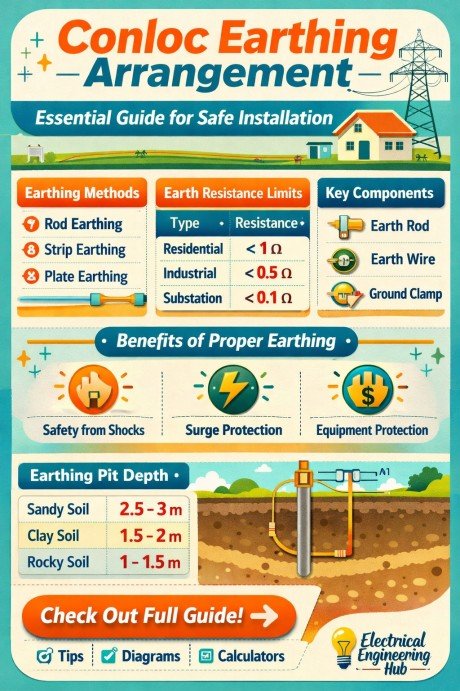
Table of Contents
Table of Contents
This guide explains the Conloc Earthing Arrangement, its working principle, installation method, benefits, and maintenance practices.
What is Conloc Earthing Arrangement?
Conloc Earthing Arrangement is a specialized earthing system designed to create a low-resistance path for fault current to safely flow into the ground. It is commonly used where stable grounding is required and soil resistivity conditions are challenging.
Find more about IEEE Standard for Neutral to Earth Voltage
This earthing arrangement uses a conductive compound and an electrode system to improve earth continuity and lower ground resistance. Compared to traditional rod earthing, it offers better long-term performance.
The main purpose of the Conloc Earthing Arrangement is to:
- Protect electrical equipment from fault currents
- Prevent electric shock hazards
- Stabilize system voltage
- Improve lightning protection
In modern installations, it is considered an effective grounding solution.
Why Earthing is Important in Electrical Systems
Without proper grounding, fault current can remain in the system and damage equipment. It can also create serious risks for workers and occupants.
Here is why earthing is necessary:
| Benefit | Description |
|---|---|
| Safety | Protects people from electric shock |
| Equipment Protection | Prevents damage from surges and faults |
| Voltage Stability | Maintains reference potential |
| Lightning Protection | Safely dissipates lightning energy |
| Fault Clearing | Helps protective devices trip quickly |
A properly installed Conloc Earthing Arrangement improves all these aspects.
Know more about Earth Cable Size for Lightning Protection
Main Components of Conloc Earthing Arrangement
To understand the Conloc Earthing Arrangement, you must know its key parts.
1. Earth Electrode
The electrode is usually made of copper or galvanized steel. It is buried underground to provide a direct conductive path.
2. Conloc Compound
This compound reduces soil resistivity and enhances conductivity around the electrode.
3. Earth Pit Chamber
The chamber protects the earthing point and allows easy inspection.
4. Earthing Conductor
This connects the electrode to the electrical system.
5. Inspection Cover
Used for testing and maintenance.
The combination of these components creates a strong and reliable grounding system.
Learn more about earthing cable size as per iec
How Conloc Earthing Arrangement Works
The Conloc Earthing Arrangement works by dissipating fault current into the earth through a low-resistance path.
When an electrical fault occurs:
- Fault current travels through the earthing conductor.
- It reaches the earth electrode.
- The Conloc compound improves contact with the soil.
- Current disperses safely into the ground.
This process helps protective devices like circuit breakers and relays operate faster.
For a deeper understanding of grounding principles, you can also explore our detailed guide on iec 60364 earthing to understand international standards and best practices.
Dive deeper into instrument earthing iec standard
Key Takeaways
Before installing any grounding system, remember these important points:
- Conloc Earthing Arrangement offers lower earth resistance than conventional methods.
- It improves safety for both people and equipment.
- Proper installation ensures long-term reliability.
- Regular testing is necessary for performance verification.
- It is suitable for industrial, commercial, and residential systems.
These takeaways can help in making better installation decisions.
Installation Process of Conloc Earthing Arrangement
A proper installation ensures maximum efficiency.
Step 1: Site Inspection
Check soil type and measure soil resistivity using an earth tester.
Step 2: Pit Excavation
Dig a pit according to the required dimensions.
| Installation Parameter | Typical Value |
|---|---|
| Pit Depth | 2 to 3 meters |
| Pit Width | 300 mm to 600 mm |
| Electrode Length | 1.5 to 3 meters |
Know more about IEC Standard for Earthing System
Step 3: Electrode Placement
Place the earth electrode vertically in the pit.
Step 4: Add Conloc Compound
Fill the surrounding area with Conloc material.
Step 5: Connect Earthing Strip
Use copper strip or GI strip to connect to the main system.
Step 6: Testing
Measure earth resistance after installation.
The target earth resistance usually depends on system type.
Recommended Earth Resistance Values
Different installations require different resistance values.
| Installation Type | Recommended Earth Resistance |
|---|---|
| Residential | Less than 5 ohms |
| Commercial | Less than 2 ohms |
| Industrial | Less than 1 ohm |
| Substations | Less than 0.5 ohm |
The Conloc Earthing Arrangement helps achieve these values more effectively.
Explore all about methods of earthing
Advantages of Conloc Earthing Arrangement
There are many reasons why professionals prefer this method.
Lower Ground Resistance
The conductive compound improves soil contact.
Longer Service Life
It reduces corrosion and increases durability.
Better Fault Current Dissipation
This improves protective device operation.
Low Maintenance
The system remains effective for years.
Suitable for Poor Soil Conditions
Works well in rocky and dry areas.
This makes the Conloc Earthing Arrangement ideal for demanding installations.
Know more about European Earthing System TN-S TN-C-S TT Explained: Key Differences, Safety, and Standards
Comparison with Traditional Earthing
Understanding the difference can help you select the right method.
| Feature | Conloc Earthing Arrangement | Traditional Rod Earthing |
|---|---|---|
| Resistance Stability | High | Medium |
| Maintenance | Low | Medium |
| Installation Cost | Higher | Lower |
| Durability | Excellent | Good |
| Performance in Dry Soil | Excellent | Weak |
While initial cost may be higher, long-term benefits often justify it.
Maintenance Tips for Conloc Earthing Arrangement
Maintenance is essential to keep grounding effective.
Follow these tips:
- Test earth resistance every six months
- Inspect conductor joints for corrosion
- Keep the inspection chamber clean
- Check moisture level around the earth pit
- Tighten all mechanical connections
For complete compliance and advanced grounding calculations, visit our comprehensive resource on iec 60364 earthing.
Regular checks improve system safety.
Know more about Earth Fault Relay Testing Procedure
Common Problems in Earthing Systems
Even with good installation, some issues may appear.
High Earth Resistance
Usually caused by dry soil or poor contact.
Corrosion
Metal parts may degrade over time.
Loose Connections
Can interrupt fault current flow.
Physical Damage
Excavation work may damage the conductor.
The Conloc Earthing Arrangement reduces many of these risks.
Know more about How Does Earth Fault Relay Protect Electrical Circuits? Complete Guide to Ground Fault Protection
Applications of Conloc Earthing Arrangement
This earthing method is used in many sectors.
Common applications include:
- Residential buildings
- Industrial plants
- Telecom towers
- Solar power systems
- Transformer yards
- Data centers
- Hospitals
Its reliability makes it suitable for critical electrical systems.
Get instant results with our online tool earth cable size calculator
Conclusion
A reliable grounding system is the backbone of electrical safety. The Conloc Earthing Arrangement provides a practical and durable solution for low-resistance grounding. It improves equipment protection, enhances human safety, and supports system stability.
With proper installation and regular maintenance, it can perform efficiently for many years. It is especially useful in areas where traditional grounding methods struggle to achieve desired resistance values.
If you want a modern and dependable grounding solution, the Conloc Earthing Arrangement is a strong option worth considering.
Frequently Asked Questions
What is Conloc Earthing Arrangement used for?
It is used to provide a safe low-resistance path for electrical fault current into the ground.
Is Conloc Earthing Arrangement better than rod earthing?
Yes, in many cases it offers lower resistance, better durability, and improved performance in dry soil.
How often should earthing resistance be tested?
It is recommended to test every six months or at least once a year.
Can Conloc Earthing Arrangement be used in solar systems?
Yes, it is widely used in solar installations for grounding panels and inverters.
What is the ideal resistance for industrial grounding?
Industrial systems usually require less than 1 ohm for effective grounding.
Get new guides in your feed. Follow Electrical Insights on LinkedIn for new electrical standards guides, calculators and design tips from Azad Circuit Hub.
#ConlocEarthingArrangement,#EarthingSystem,#ElectricalGrounding,#SubstationEarthing,#GroundingDesign,#ElectricalSafety,#PowerDistribution,#EarthingInstallation,#ConlocSystem,#IndustrialElectrical
