
Motor Calculation For Conveyor: Easy Power & Torque Guide
Designing an efficient material handling system starts with accurate engineering, and Motor Calculation For Conveyor plays a central role in ensuring smooth operation, energy efficiency, and long service life. Whether it is a small belt conveyor in a workshop or a heavy-duty industrial transport line, proper sizing of the motor prevents overheating, slipping, and unnecessary power loss.
In practical applications, Motor Calculation For Conveyor helps engineers determine the required torque, motor power, and gearbox ratio based on load, belt speed, and friction factors. Without this calculation, systems often suffer from poor performance, high maintenance, and increased electricity consumption.
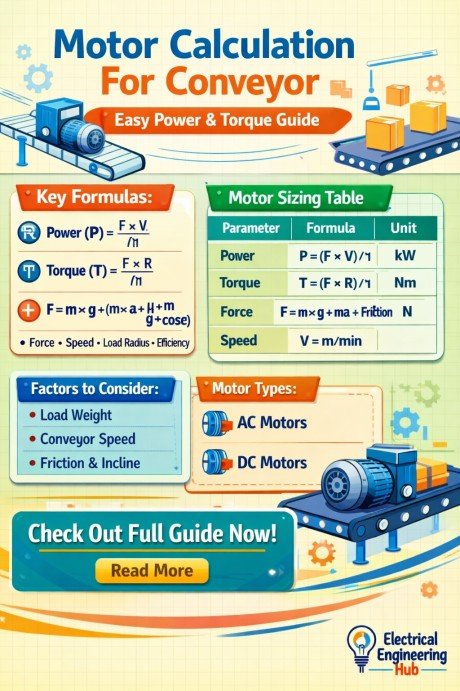
Table of Contents
Table of Contents
Understanding the Basics of Conveyor Motor Sizing
Before performing Motor Calculation For Conveyor, it is important to understand the basic parameters that influence motor selection. These include load weight, belt speed, pulley diameter, incline angle, and friction coefficient.
A conveyor motor is not selected only on horsepower. Instead, it is matched with torque requirements and duty cycle. For example, a short conveyor with light goods requires significantly less torque compared to a long inclined system carrying bulk material.
Key parameters involved:
- Total load (kg or tons)
- Belt speed (m/s)
- Conveyor length (m)
- Incline angle (if any)
- Friction factor of rollers and belt
- Gearbox efficiency
Understanding these basics makes Motor Calculation For Conveyor more accurate and reliable in real-world conditions.
Know more about Motor Starter Size Chart
Torque Requirements in Conveyor Systems
Torque is the most critical factor in Motor Calculation For Conveyor. It determines the rotational force needed to move the belt under load.
The general torque formula used in conveyor design is:
Torque (Nm) = Force (N) × Radius (m)
Where force includes:
- Load resistance
- Belt friction
- Acceleration force (if starting under load)
Find more Electrical Engineering Tools for easy electrical calculations and estimations.
A simplified comparison is shown below:
| Conveyor Type | Load Condition | Torque Requirement |
|---|---|---|
| Flat belt conveyor | Light packages | Low |
| Inclined conveyor | Medium load | Medium |
| Heavy industrial conveyor | Bulk material | High |
| Long-distance conveyor | Continuous load | Very High |
To make this process easier, engineers often use tools like the Motor Torque Calculator Online to quickly estimate torque values without manual calculations.
Accurate torque estimation ensures Motor Calculation For Conveyor remains efficient and avoids underpowered or oversized motor selection.
Power Selection and Energy Efficiency
Once torque is determined, the next step in Motor Calculation For Conveyor is converting it into motor power. The relationship between power, torque, and speed is given by:
Power (kW) = (Torque × Speed) / 9550
Where speed is in RPM.
Selecting the right power rating is essential because:
- Undersized motors overheat
- Oversized motors waste energy
- Incorrect sizing increases maintenance cost
Use our online tool Armoured Cable Size Calculator
In industrial setups, energy efficiency is a major concern. A properly calculated motor reduces electricity consumption significantly over time.
For quick cable and load estimation during system design, engineers often rely on the motor cable size calculator to ensure proper electrical compatibility with the selected motor.
Conveyor Load Analysis and Motor Sizing
Load analysis is a major step in Motor Calculation For Conveyor. It involves calculating the total resistance the motor must overcome.
A typical load breakdown includes:
- Material load on belt
- Belt weight
- Roller resistance
- Incline force (if applicable)
Here is a simplified motor sizing table:
| Conveyor Length | Load Type | Suggested Motor Power |
|---|---|---|
| Up to 10 m | Light load | 0.25 – 0.75 kW |
| 10–30 m | Medium load | 0.75 – 2.2 kW |
| 30–60 m | Heavy load | 2.2 – 5.5 kW |
| Above 60 m | Industrial bulk | 5.5 kW and above |
Proper Motor Calculation For Conveyor ensures that these values are not just theoretical but practically applicable in industrial environments.
Know more about Electric Motor Core Loss Test
To ensure system safety during operation, engineers also use the Motor Protection Calculator for setting protective parameters like overload, short circuit, and thermal limits.
Friction, Efficiency, and Safety Factors
Friction losses are often underestimated in Motor Calculation For Conveyor, but they directly impact motor performance. Friction occurs in rollers, bearings, and belt contact surfaces.
Efficiency factors include:
- Gearbox efficiency (typically 85%–95%)
- Belt efficiency losses
- Mechanical alignment losses
A safety factor of 1.2 to 1.5 is generally applied to ensure smooth startup under load. This prevents motor stalling and reduces stress on mechanical components.
Proper Motor Calculation For Conveyor also ensures that emergency conditions like sudden load changes or belt jams do not damage the system.
For safe operation settings, engineers often use the Motor Overload Setting Calculator to configure relay protection and prevent motor burnout.
Know more about Electric Motor Polarization Index Test
Practical Motor Calculation Example
Let’s consider a simple example of Motor Calculation For Conveyor:
Given:
- Load = 500 kg
- Belt speed = 1.2 m/s
- Conveyor length = 20 m
- Friction factor = moderate
Step-by-step approach:
- Calculate total force (load + friction)
- Convert force into torque using pulley radius
- Calculate power using RPM and torque
- Apply safety factor of 1.3
Result:
- Required torque: Medium range
- Motor power: Approximately 1.5 kW to 2.2 kW
This example shows how Motor Calculation For Conveyor is applied in real engineering scenarios rather than theoretical assumptions.
Know more about Types of Electric Motor Testing
Tools for Faster Conveyor Motor Design
Modern engineering relies heavily on digital tools to simplify complex calculations. These tools reduce human error and improve design accuracy.
Useful tools include:
- Motor Torque Calculator Online for quick torque estimation
- motor cable size calculator for electrical compatibility
- Motor Protection Calculator for safety coordination
- Motor Overload Setting Calculator for relay configuration
Using these tools alongside manual verification improves reliability in Motor Calculation For Conveyor and speeds up project execution significantly.
Key Takeaways
- Motor sizing depends on torque, load, and conveyor speed
- Friction and incline greatly affect power requirements
- Safety factors are essential for reliable operation
- Electrical and mechanical design must be balanced
- Online tools simplify Motor Calculation For Conveyor and reduce errors
- Proper calculation improves efficiency and reduces energy cost
Frequently Asked Questions
1. What is the most important factor in conveyor motor selection?
Torque is the most important factor because it determines the motor’s ability to move the load effectively.
2. How do I calculate motor power for a co nveyor?
Motor power is calculated using torque and speed with the formula Power = (Torque × RPM) / 9550. Know more about Electric Motor Visual Inspection Checklist
3. Why is friction important in conveyor systems?
Friction increases resistance, which directly affects torque and power requirements in Motor Calculation For Conveyor.
4. Can I use a higher power motor than required?
Yes, but it may reduce efficiency and increase energy cost if significantly oversized.
5. What happens if the motor is undersized?
An undersized motor may overheat, stall under load, and reduce the lifespan of the conveyor system.
Conclusion
Accurate Motor Calculation For Conveyor is essential for designing efficient, reliable, and cost-effective material handling systems. It ensures that torque, power, and load conditions are properly balanced for smooth operation.
In industrial applications, Motor Calculation For Conveyor not only improves performance but also reduces downtime and energy waste, making it a critical step in modern conveyor system design. Know more about How does the star delta starter reduce starting current?
Get new guides in your feed. Follow Electrical Insights on LinkedIn for new electrical standards guides, calculators and design tips from Azad Circuit Hub.
MotorCalculationForConveyor,#ConveyorMotor,#MotorSizing,#IndustrialConveyor,#PowerCalculation,#TorqueCalculation,#ElectricalEngineering,#MechanicalDesign,#AutomationSystems,#MotorSelectionGuide
