
IEC 60270 Insulation Resistance: Comprehensive Guide
Electrical insulation is one of the most critical elements in any power system. When insulation begins to deteriorate, equipment performance declines, reliability decreases, and the risk of failure increases significantly. Understanding IEC 60270 Insulation Resistance helps engineers, technicians, and maintenance teams evaluate insulation health and identify potential problems before they become costly failures.
Modern electrical networks depend on transformers, motors, generators, switchgear, cables, and other high-voltage equipment. These assets operate under continuous electrical, thermal, and environmental stress. Regular insulation assessment is therefore necessary to ensure safe operation and extend equipment life.
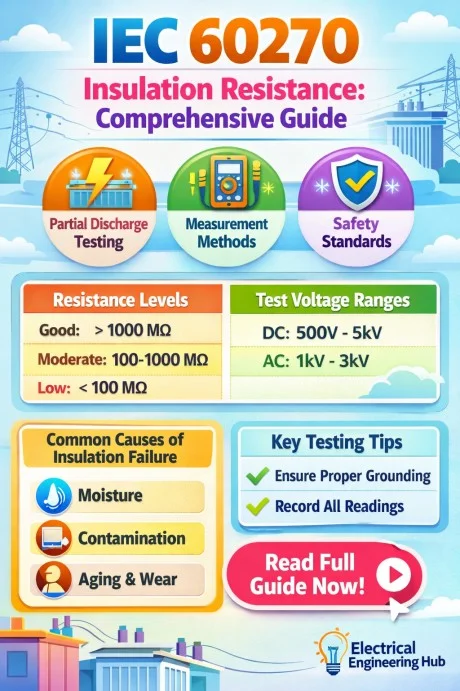
Table of Contents
IEC 60270 is widely recognized for partial discharge measurement in high-voltage equipment. While insulation resistance testing and partial discharge testing serve different purposes, they are often used together as part of a complete insulation condition monitoring program. Combining these methods provides a more accurate understanding of insulation integrity.
A well-planned testing strategy allows maintenance teams to detect contamination, moisture ingress, aging insulation, and manufacturing defects before they lead to unexpected outages. This proactive approach improves system reliability and reduces maintenance costs over time.
Key Takeaways
- IEC 60270 supports insulation condition assessment through partial discharge evaluation.
- Insulation resistance testing helps identify moisture, contamination, and insulation degradation.
- Combining resistance measurements with partial discharge analysis provides better diagnostic results.
- Regular testing improves equipment reliability and reduces unexpected failures.
- Proper interpretation of test data is essential for effective maintenance planning.
Understanding IEC 60270 Insulation Resistance Testing
The IEC 60270 standard primarily defines methods for measuring partial discharge in electrical equipment. Partial discharge occurs when localized electrical discharges develop within insulation systems without completely bridging the insulation gap.
Although insulation resistance measurement is not the primary focus of IEC 60270, insulation resistance testing is frequently performed alongside partial discharge testing. Together, these tests help maintenance engineers evaluate insulation quality from different perspectives.
Insulation resistance testing measures the resistance offered by insulation materials against leakage current. High resistance values generally indicate healthy insulation, while lower values may suggest deterioration, contamination, or moisture presence.
The combination of insulation resistance measurements and partial discharge analysis creates a comprehensive insulation diagnostic framework for critical electrical assets.
Why Insulation Resistance Testing Matters
Insulation resistance testing is one of the most widely used preventive maintenance techniques in electrical systems. It provides valuable information regarding the condition of insulation materials and their ability to withstand operating voltages. Explore all about IEEE Standard for Cable Insulation Resistance Test
Some major benefits include:
- Early detection of insulation degradation
- Identification of moisture contamination
- Reduced risk of electrical failures
- Improved equipment reliability
- Better maintenance scheduling
- Extended equipment service life
Without regular testing, insulation defects may remain hidden until catastrophic equipment failure occurs.
Relationship Between Partial Discharge and Insulation Resistance
Many engineers use IEC 60270 Insulation Resistance assessments as part of a broader asset health evaluation strategy.
Insulation resistance testing measures the overall condition of insulation. Partial discharge testing, however, identifies localized weaknesses that may not significantly affect resistance values during early stages.
Find all about IEEE Standard for Insulation Resistance Test
The following table highlights the differences:
| Parameter | Insulation Resistance Test | Partial Discharge Test |
|---|---|---|
| Purpose | Evaluate overall insulation condition | Detect localized insulation defects |
| Measurement | Resistance value (MΩ or GΩ) | Discharge magnitude (pC) |
| Equipment | Megohmmeter | PD Measurement System |
| Testing Time | Short | Moderate |
| Moisture Detection | Excellent | Limited |
| Void Detection | Limited | Excellent |
| Preventive Maintenance Value | High | Very High |
Using both methods together provides a more complete picture of insulation health.
Equipment Commonly Tested
Insulation resistance measurements are performed on a wide range of electrical equipment.
Transformers
Power transformers contain complex insulation systems exposed to electrical and thermal stress. Regular testing helps identify insulation deterioration before serious faults develop.
Power Cables
Cable insulation can degrade due to moisture, aging, mechanical damage, or environmental conditions. Periodic testing ensures reliable power transmission.
Find all about Best Megger Insulation Testers 5000V
Motors and Generators
Rotating machines often operate in harsh environments. Insulation resistance testing helps identify winding insulation problems early.
Switchgear
Switchgear insulation must remain reliable to ensure safe operation and fault interruption capabilities.
Standard Testing Procedure
The testing process generally follows these steps:
- Isolate equipment from the power source.
- Discharge any stored electrical energy.
- Inspect the equipment visually.
- Connect the insulation resistance tester.
- Apply the specified DC test voltage.
- Record resistance readings.
- Compare results with historical data.
- Document findings for maintenance records.
Safety precautions must always be followed during testing to prevent personnel injury and equipment damage.
Typical Test Voltage Selection
Different equipment ratings require different test voltages.
| Equipment Rating | Recommended Test Voltage |
|---|---|
| Up to 250 V | 250 V DC |
| 250 V to 600 V | 500 V DC |
| 600 V to 5 kV | 1000 V DC |
| Above 5 kV | 2500 V to 5000 V DC |
Manufacturers may provide specific recommendations that should take precedence.
Factors Affecting Test Results
Several factors can influence insulation resistance measurements.
Temperature
Insulation resistance decreases as temperature increases. Test results should be corrected to a reference temperature when comparisons are made.
Find more about Best Megger Insulation Tester for Industrial Motors
Humidity
High humidity can lower measured resistance values due to surface leakage currents.
Contamination
Dust, oil, dirt, and chemical deposits can significantly impact test accuracy.
Equipment Age
Older insulation systems naturally experience degradation over time, resulting in lower resistance values.
Understanding these variables helps maintenance personnel make accurate assessments.
Know more about insulation resistance test standard
Interpreting Test Results
A single insulation resistance value should not be viewed in isolation. Trending data over time provides much more meaningful information.
Healthy Insulation
- Stable or increasing resistance values
- Minimal partial discharge activity
- No signs of moisture contamination
Warning Condition
- Gradual decline in resistance
- Elevated leakage current
- Increasing maintenance requirements
Explore all about How to Use Megger BM5200 Insulation Tester 5kV
Critical Condition
- Rapid reduction in resistance
- Significant partial discharge levels
- High probability of insulation failure
Maintenance decisions should be based on historical trends rather than a single measurement.
Know more about How to Use Megger Insulation Tester 1000V
Best Practices for Reliable Testing
To achieve accurate and repeatable results, consider the following recommendations:
- Follow manufacturer guidelines.
- Use calibrated testing instruments.
- Record ambient temperature and humidity.
- Maintain detailed test records.
- Perform testing at scheduled intervals.
- Compare current readings with historical values.
- Combine resistance testing with partial discharge monitoring.
For a deeper understanding of testing requirements and compliance procedures, refer to our comprehensive guide on insulation resistance test standard.
Future Trends in Insulation Diagnostics
The electrical industry is moving toward predictive maintenance and digital asset management. Modern monitoring systems integrate insulation resistance measurements, partial discharge analysis, thermal imaging, and online condition monitoring.
These technologies enable maintenance teams to detect developing insulation problems earlier than ever before. As utilities and industries adopt smart maintenance practices, integrated insulation diagnostics will continue to play a major role in reliability improvement.
Know more about How to Use Megger Insulation Tester MIT2500
Conclusion
IEC 60270 Insulation Resistance remains an important topic for professionals involved in electrical asset management. While IEC 60270 focuses on partial discharge measurement, insulation resistance testing complements it by providing valuable information about overall insulation condition. Together, these methods help identify defects, improve reliability, reduce downtime, and extend equipment life.
Regular testing, proper interpretation of results, and adherence to recognized standards allow organizations to maintain safe and efficient electrical systems. A comprehensive insulation assessment program ultimately supports better maintenance decisions and long-term operational success. Find more about Fluke 1507 Insulation Tester Megger Working
Frequently Asked Questions
What is IEC 60270 used for?
IEC 60270 is an international standard that defines procedures for measuring partial discharge in high-voltage electrical equipment to assess insulation condition.
Is insulation resistance testing covered by IEC 60270?
IEC 60270 primarily addresses partial discharge measurements. However, insulation resistance testing is often performed alongside it as part of a complete insulation evaluation program.
What equipment requires insulation resistance testing?
Transformers, motors, generators, switchgear, power cables, and other electrical assets commonly undergo insulation resistance testing.
How often should insulation resistance testing be performed?
Testing frequency depends on equipment criticality, operating conditions, and maintenance policies. Critical equipment may require annual or more frequent testing.
Why combine partial discharge testing with insulation resistance testing?
Insulation resistance testing identifies overall insulation degradation, while partial discharge testing detects localized defects. Together they provide a more comprehensive assessment of insulation health.
Follow Us on Social:
Subscribe our Newsletter on Electrical Insights for latest updates from Electrical Engineering Hub
#IEC60270,#InsulationResistance,#ElectricalTesting,#HighVoltageTesting,#PartialDischarge,#IECStandards,#ElectricalEngineering,#PowerSystems,#ConditionMonitoring,#ElectricalMaintenance
