Insulation Resistance Test Between Conductors: Quick Guide
Electrical systems rely on proper insulation to prevent leakage currents, short circuits, and equipment failures. An Insulation Resistance Test Between Conductors is one of the most important maintenance and commissioning tests performed on electrical installations. It helps verify the integrity of cable insulation and ensures that conductors are properly isolated from each other.
Whether you are testing a new installation or carrying out preventive maintenance, understanding the correct testing procedure can improve safety, reduce downtime, and extend the life of electrical equipment.
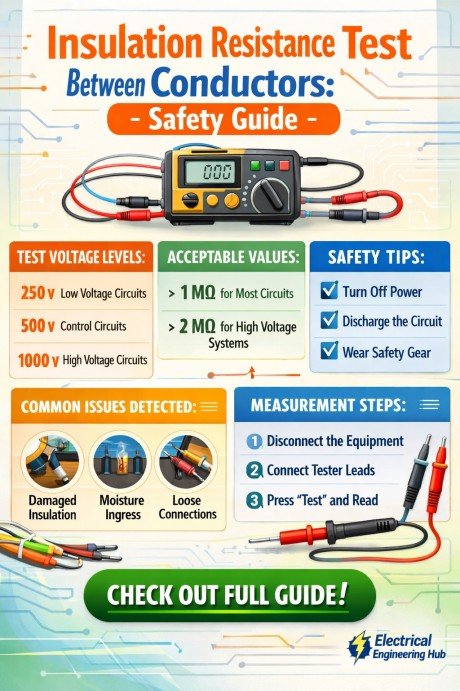
Table of Contents
Electrical insulation naturally degrades over time due to heat, moisture, contamination, vibration, and aging. As insulation weakens, the risk of electrical faults increases significantly. Conducting regular insulation resistance measurements helps identify hidden problems before they become serious failures.
The test is commonly performed on power cables, control cables, motors, transformers, switchgear, and distribution systems. The results provide valuable information about the condition of insulation and whether the equipment is suitable for safe operation.
A properly executed Insulation Resistance Test Between Conductors can reveal insulation breakdown, moisture ingress, damaged cable jackets, contamination, and other issues that may not be visible during routine inspections.
Key Takeaways
- Insulation resistance testing verifies insulation quality between conductors.
- The test helps detect insulation deterioration before failures occur.
- A megger or insulation resistance tester is typically used.
- Testing should be conducted according to applicable standards.
- Higher insulation resistance values generally indicate better insulation condition.
- Regular testing improves system reliability and electrical safety.
Explore details on Electrical Compliance Testing
What Is an Insulation Resistance Test Between Conductors?
An Insulation Resistance Test Between Conductors is a diagnostic test used to measure the resistance offered by insulation separating two or more conductors. The test determines whether current can leak through the insulation material under a specified DC voltage.
During the test, a high DC voltage is applied between conductors while the resulting leakage current is measured. The insulation resistance value is then calculated and displayed in megaohms (MΩ) or gigaohms (GΩ).
A high resistance reading indicates healthy insulation, while a low reading may indicate deterioration, contamination, moisture, or physical damage.
Why Is This Test Important?
Electrical faults caused by insulation failure can lead to:
- Equipment damage
- Production downtime
- Electrical fires
- Shock hazards
- Unexpected breaker tripping
- Reduced system efficiency
Know more about IEC Standard for MV Cable Testing
Regular insulation testing allows maintenance teams to identify insulation weaknesses before they result in costly failures.
The test is especially important for:
| Equipment Type | Purpose of Testing |
|---|---|
| Power Cables | Verify insulation condition |
| Motors | Detect winding insulation deterioration |
| Transformers | Assess insulation health |
| Switchgear | Prevent phase-to-phase faults |
| Control Cables | Ensure signal integrity |
| Distribution Panels | Improve operational safety |
Equipment Required for Testing
The primary instrument used is an insulation resistance tester, commonly called a megger.
Typical equipment includes:
- Insulation resistance tester
- Personal protective equipment (PPE)
- Lockout-tagout devices
- Test leads
- Voltage detector
- Safety warning signs
Know more about Transformer Oil Testing
Modern digital insulation testers can store readings and generate trend reports for maintenance analysis.
Standard Procedure for Insulation Resistance Test Between Conductors
Following a proper procedure is essential for obtaining accurate results.
Step 1: Isolate the Circuit
Disconnect the equipment from all power sources and ensure complete de-energization.
Step 2: Verify Absence of Voltage
Use a calibrated voltage tester to confirm that no voltage is present.
Step 3: Disconnect Sensitive Equipment
Remove electronic devices that may be damaged by the test voltage.
Step 4: Connect the Tester
Connect one lead to the first conductor and the second lead to the adjacent conductor.
Step 5: Apply Test Voltage
Select the appropriate DC test voltage according to the system voltage rating.
Step 6: Record the Reading
Allow the reading to stabilize and record the insulation resistance value.
Step 7: Discharge the Circuit
After testing, discharge stored energy from the conductors before handling them.
Find all about IEC Standard for Relay Testing
Recommended Test Voltages
The selected test voltage depends on the equipment’s operating voltage.
| Equipment Rating | Recommended Test Voltage |
|---|---|
| Up to 50 V | 100 V DC |
| 50 V to 100 V | 250 V DC |
| 100 V to 500 V | 500 V DC |
| 500 V to 1000 V | 1000 V DC |
| Above 1000 V | As per applicable standards |
Using the correct test voltage ensures meaningful and reliable results.
Understanding Test Results
Interpreting insulation resistance values correctly is just as important as performing the test itself.
| Insulation Resistance Value | Condition Assessment |
|---|---|
| Below 1 MΩ | Poor |
| 1 MΩ to 10 MΩ | Marginal |
| 10 MΩ to 100 MΩ | Good |
| Above 100 MΩ | Excellent |
These values serve as general guidelines. Actual acceptance criteria may vary depending on equipment type and industry standards.
Know more about Types of Circuit Breaker Testing
For a deeper understanding of acceptance limits and compliance requirements, refer to the detailed guide on insulation resistance test standard.
Factors Affecting Insulation Resistance
Several conditions can influence measured insulation resistance values.
Temperature
Higher temperatures generally reduce insulation resistance readings.
Moisture
Water contamination significantly lowers insulation resistance.
Dirt and Dust
Surface contamination creates leakage paths that affect test results.
Aging
Older insulation systems naturally degrade over time.
Mechanical Damage
Cuts, cracks, and abrasion can reduce insulation effectiveness.
Maintenance personnel should consider these factors when evaluating test results.
Know more about Earth Fault Relay Testing Procedure
Safety Precautions During Testing
Safety must always remain the top priority when performing insulation testing.
Follow these precautions:
- De-energize equipment before testing.
- Use lockout-tagout procedures.
- Wear appropriate PPE.
- Verify absence of voltage.
- Keep unauthorized personnel away.
- Follow manufacturer instructions.
- Discharge conductors after testing.
- Use calibrated instruments.
Ignoring these precautions can expose workers to dangerous electrical hazards.
Common Mistakes to Avoid
Many inaccurate test results occur because of improper testing practices.
Common mistakes include:
- Testing energized circuits
- Using incorrect test voltage
- Failing to disconnect electronic devices
- Not cleaning cable surfaces
- Ignoring temperature correction factors
- Recording readings too quickly
- Neglecting post-test discharge
Avoiding these mistakes improves test reliability and helps maintain electrical safety.
Know more about Best Transformer Testing Companies in Canada
Best Practices for Long-Term Monitoring
Instead of relying on a single reading, trend analysis provides a better picture of insulation health.
Recommended practices include:
- Conduct periodic testing
- Maintain historical records
- Compare readings over time
- Investigate sudden drops in resistance
- Follow maintenance schedules
- Use standardized testing procedures
Trend monitoring often identifies insulation deterioration long before a failure occurs.
Conclusion
An Insulation Resistance Test Between Conductors is a critical procedure for evaluating the condition of electrical insulation and ensuring system safety. By identifying insulation weaknesses early, organizations can prevent equipment failures, reduce maintenance costs, and improve operational reliability.
Know more about Electric Motor Stator Testing
Using proper testing procedures, selecting the correct test voltage, and interpreting results accurately are essential for obtaining meaningful data. Regular insulation resistance testing, combined with proper record keeping and trend analysis, forms a key part of any effective electrical maintenance program.
Frequently Asked Questions
1. What is the purpose of an Insulation Resistance Test Between Conductors?
The test measures insulation quality between conductors and helps detect leakage paths, insulation deterioration, and potential electrical faults.
2. Which instrument is used for insulation resistance testing?
A megger or insulation resistance tester is commonly used to perform the test and measure insulation resistance values.
3. What is a good insulation resistance value?
In most applications, values above 10 MΩ are considered good, while values above 100 MΩ indicate excellent insulation condition.
4. Can insulation resistance testing damage equipment?
When the correct test voltage is used and sensitive electronic components are disconnected, the test is generally safe and non-destructive.
5. How often should insulation resistance tests be performed?
Testing frequency depends on equipment type, operating environment, and maintenance requirements. Many facilities perform annual or scheduled preventive maintenance tests.
Know more about Best 5 Electric Motor Rotor Testing Machines
Follow Us on Social:
Subscribe our Newsletter on Electrical Insights for latest updates from Electrical Engineering Hub
#InsulationResistanceTest,#ElectricalTesting,#ConductorTesting,#InsulationResistance,#ElectricalSafety,#MeggerTest,#CableTesting,#ElectricalMaintenance,#PowerSystems,#IECStandards