
How Much Solar to Power a House in USA: Best Guide
Understanding How Much Solar to Power a House is one of the most important steps for homeowners in the United States who want to reduce electricity bills and move toward energy independence. The right system size depends on household consumption, roof space, sunlight hours, and the efficiency of solar panels. Many people assume it is a one-size-fits-all calculation, but in reality, it varies significantly from home to home.
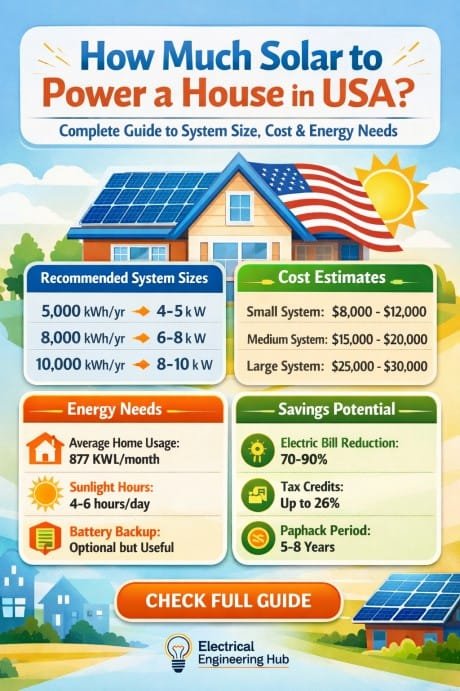
Table of Contents
Table of Contents
In this guide, we break down everything in simple terms, including system sizing, average costs, panel requirements, and real-world energy usage so you can make an informed decision.
Average Energy Usage in American Homes
Before deciding How Much Solar to Power a House is needed, you first need to understand your monthly electricity consumption. In the USA, an average household uses around 800 to 1,000 kWh per month, depending on location and appliances.
Homes in hotter states like Texas or Arizona often consume more due to air conditioning, while homes in milder climates use less.
Here is a quick overview:
| Home Size | Monthly Usage (kWh) | Annual Usage (kWh) | Estimated Solar System Size |
|---|---|---|---|
| Small home (1-2 people) | 400–600 | 5,000–7,000 | 3–5 kW |
| Medium home (3-4 people) | 700–1,000 | 8,500–12,000 | 5–8 kW |
| Large home (5+ people) | 1,200–1,800 | 14,000–20,000 | 8–12 kW |
This table gives a clear baseline, but actual sizing depends on sunlight availability and panel efficiency.
When evaluating How Much Solar to Power a House, installers also consider roof orientation, shading, and local weather conditions to fine-tune the system.
Key Factors That Affect Solar System Size
Several technical and environmental factors determine How Much Solar to Power a House effectively:
- Daily sunlight hours in your region
- Roof tilt and direction
- Energy efficiency of appliances
- Battery storage inclusion
- Seasonal energy variation
A south-facing roof in states like California will generally require fewer panels compared to a shaded roof in northern states.
The goal is to generate enough electricity annually to offset 100% of your grid consumption.
Solar System Sizing Calculation Method
To estimate How Much Solar to Power a House, professionals use a simple formula:
Daily energy use (kWh) ÷ Peak sunlight hours = Required system size (kW)
For example, if a home uses 30 kWh per day and receives 5 peak sunlight hours:
30 ÷ 5 = 6 kW system
This means you need a 6 kW solar system to fully power the home.
Most homeowners in the USA fall between 5 kW and 10 kW systems depending on lifestyle and electricity usage.
Not sure how many panels your home actually needs? Use our Calculate Solar Panel Estimate for House guide to estimate the ideal system size, panel count, and energy output based on your home’s electricity usage.
Cost of Solar Systems in the USA
Understanding How Much Solar to Power a House also involves knowing the investment required. Solar pricing has dropped significantly over the last decade, making it more accessible.
Here is a breakdown of average installation costs:
| System Size | Average Cost Before Tax Credit | After 30% Federal Tax Credit |
|---|---|---|
| 5 kW | $12,000 – $15,000 | $8,400 – $10,500 |
| 8 kW | $18,000 – $22,000 | $12,600 – $15,400 |
| 10 kW | $22,000 – $28,000 | $15,400 – $19,600 |
For accurate planning, homeowners often use tools like this solar installation cost estimator to get a clearer idea of total investment and savings potential.
Number of Solar Panels Required
Another practical way to understand How Much Solar to Power a House is by calculating the number of panels needed.
Most modern solar panels produce between 350W and 450W.
| System Size | Panel Wattage | Approx. Number of Panels |
|---|---|---|
| 5 kW | 400W | 12–14 panels |
| 8 kW | 400W | 20 panels |
| 10 kW | 400W | 25 panels |
This helps homeowners visualize roof space requirements before installation.
Every home has different energy needs, so avoid relying on rough estimates. Check our Calculate Solar Panel Estimate for House resource to get a more accurate solar panel estimate before planning your installation.
Energy Savings and Long-Term Benefits
When analyzing How Much Solar to Power a House, long-term savings are just as important as upfront costs. On average, homeowners save between $1,000 and $2,000 per year on electricity bills.
Additional benefits include:
- Protection from rising utility rates
- Increased property value
- Reduced carbon footprint
- Eligibility for net metering programs
Over 20–25 years, solar systems often pay for themselves multiple times over.
Installation Timeline and Process
The process of determining How Much Solar to Power a House usually includes:
- Site inspection and shading analysis
- System design and approval
- Permitting from local authorities
- Installation and wiring
- Utility connection and activation
The entire process can take 2 to 6 weeks depending on local regulations and installer workload.
Choosing the Right System Size
Selecting How Much Solar to Power a House correctly ensures maximum return on investment. Oversizing increases cost unnecessarily, while undersizing leads to continued grid dependence.
A professional installer will evaluate:
- Your last 12 months of electricity bills
- Roof capacity
- Future energy needs (EV charging, appliances)
- Battery backup requirements
Related Guides or Tools
FAQs
1. How many solar panels are needed for an average home in the USA?
Most homes require between 15 and 25 panels depending on energy consumption and system efficiency.
2. Can solar fully power a house year-round?
Yes, with proper system sizing and net metering, solar can fully offset annual electricity usage, even if seasonal production varies.
3. How long do solar panels last?
Most panels last 25 to 30 years with minimal efficiency loss over time.
4. Do solar panels work during cloudy weather?
Yes, but output is reduced. Systems are designed to account for average annual sunlight, not just peak conditions.
5. What happens if I produce more electricity than I use?
Excess energy is usually sent back to the grid, and many utilities offer credits through net metering programs. Find more about Anti Islanding Protection in Solar Inverter
Final Thoughts
Determining How Much Solar to Power a House is not just about numbers; it is about understanding lifestyle, location, and long-term energy goals. With proper system design, homeowners in the USA can significantly reduce electricity costs while contributing to a cleaner environment.
A well-sized solar system is an investment that delivers financial savings, energy stability, and environmental benefits for decades.
Get new guides in your feed. Follow Electrical Insights on LinkedIn for new electrical standards guides, calculators and design tips from Azad Circuit Hub.
#solarpowerusa,#solarpanelhome,#solarsystemhouse,#offgridsolar,#solarcostusa,#solarenergyhome,#homesolarsetup,#solarpowerguide,#renewableenergyusa,#solarcalculator
