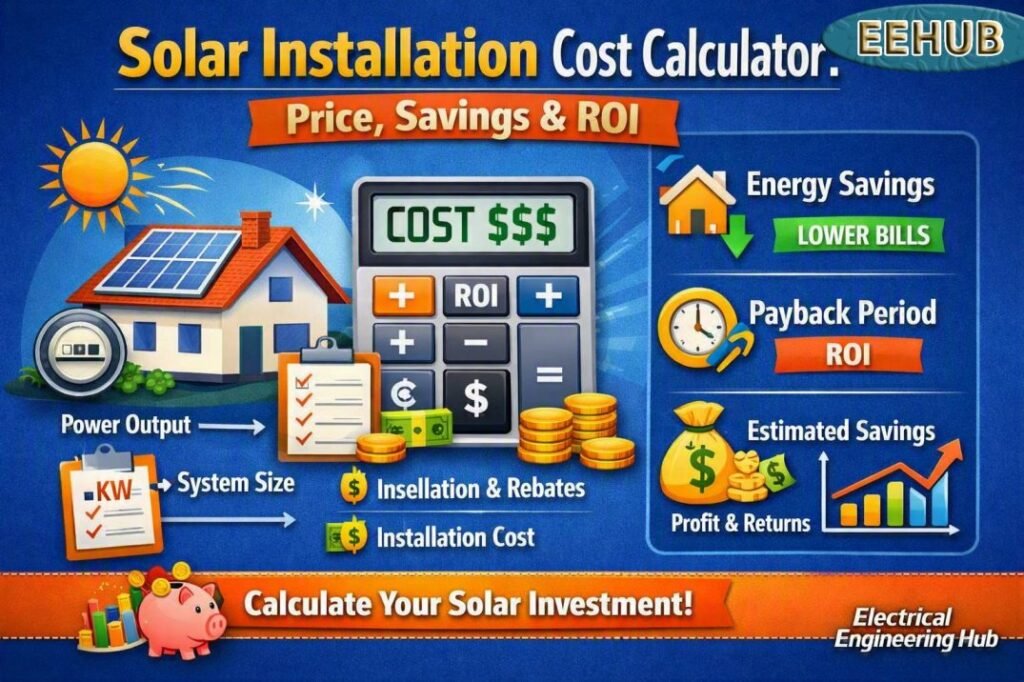
Solar Installation Cost Calculator: Price, Savings & ROI
Switching to solar energy is no longer just an eco-friendly choice. In 2026, it has become one of the smartest long-term investments for homeowners and businesses looking to reduce electricity bills and gain energy independence. Rising utility rates, improved solar technology, and federal incentives are driving more people toward rooftop solar systems than ever before.
A Solar Installation Cost Calculator helps property owners estimate the total price of a solar system, monthly savings, installation expenses, tax credits, and expected return on investment before making a purchase decision. Instead of relying on rough estimates, these calculators provide a realistic breakdown based on system size, electricity usage, location, and financing method.
Whether you are planning a residential solar setup, a commercial installation, or a hybrid solar solution with battery backup, understanding the real cost is essential before signing any contract.
Table of Contents
Table of Contents
Solar Installation Cost Calculator
Solar Installation Cost Calculator: Price, Savings and ROI
Estimate system size, upfront price, incentives, payback period and long-term return for a rooftop solar installation, based on your own electricity use and local pricing.
1Your Electricity Use
2System Price and Incentives
3System Performance Assumptions
4How Will You Pay
How to Use This Calculator
- Choose “Estimate From My Bill” if you don’t have a quote yet, or “I Have a Quote” if an installer already gave you a system size and price.
- Enter your monthly electric bill and rate, or your quoted system size and price, depending on the mode selected.
- Pick the sunlight availability that best matches your location, or switch to a custom value if you know your site’s actual sun hours.
- Adjust the cost per watt, tax credit, and any state or utility rebate to match your real quote or region.
- Select how you plan to pay. If you choose a solar loan, fill in the term and interest rate to see the effect on payback.
- Press “Calculate Cost and Savings” to view system size, pricing, payback period, and the full cash-flow chart.
How These Estimates Are Built
- System size is derived from your household’s electricity use and local sunlight availability when using the bill-based mode, so it reflects what your roof would realistically need to produce to offset your usage.
- Year-by-year production accounts for gradual panel output decline, while future savings account for the tendency of electricity prices to rise over time rather than stay flat.
- The payback period marks the point where cumulative savings catch up to what you spent after incentives, shown where the gold line crosses the red line on the chart.
- Loan scenarios compare what you pay in loan installments against what you save on your electric bill each month and year, rather than assuming the full price is paid on day one.
- Tax credit and rebate rules vary by country, state, and utility, and change over time, so treat the incentive fields as inputs you confirm locally rather than fixed constants.
How Much Do Solar Panels Cost in 2025?
The average solar panel installation cost in the United States during 2025 ranged between $15,000 and $35,000 before incentives. The final price depended on several factors, including energy consumption, panel efficiency, labor rates, and local permitting requirements.
Most installers calculate pricing based on cost per watt. In 2025, the average residential solar system cost was between $2.50 and $3.50 per watt before applying tax credits.
Average Solar System Cost by Size
| System Size | Average Cost Before Tax Credit | Estimated Cost After 30% Tax Credit |
|---|---|---|
| 3 kW | $7,500 – $10,500 | $5,250 – $7,350 |
| 5 kW | $12,500 – $17,500 | $8,750 – $12,250 |
| 7 kW | $17,500 – $24,500 | $12,250 – $17,150 |
| 10 kW | $25,000 – $35,000 | $17,500 – $24,500 |
A Solar Installation Cost Calculator typically uses your monthly electricity bill to recommend the ideal system size. For example, a household using 900 kWh per month may need a 6 kW to 8 kW system depending on sunlight exposure and panel efficiency.
Solar Cost Per Watt by State
Solar installation prices vary by state because labor costs, utility policies, and permitting fees differ across regions.
| State | Average Cost Per Watt | Typical 6 kW System Cost |
|---|---|---|
| California | $2.80 – $3.60 | $16,800 – $21,600 |
| Texas | $2.40 – $3.00 | $14,400 – $18,000 |
| Florida | $2.30 – $2.90 | $13,800 – $17,400 |
| Arizona | $2.20 – $2.80 | $13,200 – $16,800 |
| New York | $2.90 – $3.70 | $17,400 – $22,200 |
States with strong solar incentives and net metering policies often deliver faster returns on investment.
What Is Included in Installation Cost?
The total solar energy system price usually includes:
- Solar panels
- Inverters
- Mounting structures
- Wiring and electrical components
- Labor charges
- Inspection and permits
- Monitoring system
- Installation warranty
Battery storage systems increase costs significantly. Adding a lithium-ion solar battery may increase the total project cost by $8,000 to $18,000 depending on capacity.
What Factors Affect Installation Cost?
Several variables influence the final solar installation quote. A Solar Installation Cost Calculator analyzes these factors to generate a realistic estimate.
Roof Type and Roof Condition
The design and condition of your roof directly impact labor complexity and installation time.
| Roof Type | Installation Difficulty | Cost Impact |
|---|---|---|
| Asphalt Shingle | Easy | Low |
| Metal Roof | Moderate | Medium |
| Tile Roof | Difficult | High |
| Flat Roof | Moderate | Medium |
Older roofs may require repairs or replacement before solar panels can be installed safely.
System Size
Larger systems naturally cost more upfront, but they often provide better value per watt. A 10 kW solar system usually has a lower per-watt cost compared to a smaller 3 kW system.
Solar Panel Brand
Premium brands like SunPower, REC, and Panasonic generally cost more due to higher efficiency and longer warranties. Budget-friendly brands reduce upfront investment but may offer slightly lower performance over time.
Labor Market and Local Regulations
Installation costs are also influenced by:
- Local labor rates
- Building permit fees
- Utility interconnection charges
- Inspection requirements
- Regional demand for solar installers
Urban areas typically have higher installation costs than rural regions.
Battery Storage Integration
Adding battery backup increases energy independence and provides power during outages. However, battery systems significantly increase installation expenses.
Popular battery systems include:
- Tesla Powerwall
- Enphase IQ Battery
- LG Energy Solution
- FranklinWH
A Solar Installation Cost Calculator with battery estimation features can help homeowners compare solar-only and solar-plus-storage scenarios.
How the Federal 30% Tax Credit Works
The federal solar investment tax credit remains one of the biggest financial advantages for homeowners installing solar systems in 2026.
Under the Residential Clean Energy Credit, eligible homeowners can claim 30% of qualified solar installation costs as a federal tax credit.
What Expenses Qualify?
The tax credit applies to:
- Solar panels
- Inverters
- Wiring
- Labor costs
- Mounting equipment
- Battery storage systems
Example of Tax Credit Savings
| Total Solar Installation Cost | 30% Federal Tax Credit | Net Effective Cost |
|---|---|---|
| $20,000 | $6,000 | $14,000 |
| $28,000 | $8,400 | $19,600 |
| $35,000 | $10,500 | $24,500 |
Who Is Eligible?
To qualify:
- You must own the solar system
- The system must be installed at a U.S. residence
- The installation must be new
- You must owe federal income taxes
There are currently no income restrictions for claiming the federal solar tax credit.
How to Claim the Credit
Homeowners generally file IRS Form 5695 along with their federal tax return. It is recommended to keep invoices, contracts, and installation records for documentation purposes.
Solar Loan vs. Cash vs. Lease: Which Is Better?
Financing method plays a major role in total solar savings and ownership benefits.
Solar Financing Comparison
| Financing Option | Upfront Cost | Ownership | Monthly Savings | Tax Credit Eligibility |
|---|---|---|---|---|
| Cash Purchase | High | Yes | Highest | Yes |
| Solar Loan | Medium | Yes | Moderate to High | Yes |
| Solar Lease | Low | No | Lower | No |
| Power Purchase Agreement (PPA) | Low | No | Moderate | No |
Access our powerful online calculator now Conduit Fill Calculator (NEC Standard)
Cash Purchase
Paying upfront provides the highest long-term savings because there are no financing charges or lease payments. Homeowners also receive the full federal tax credit and may increase property value.
Solar Loan
Solar loans are popular because they reduce upfront costs while still allowing ownership. Monthly loan payments are often lower than electricity bills, creating immediate savings.
Solar Lease
Leasing allows homeowners to use solar energy with minimal upfront investment. However, the leasing company owns the system and receives the tax incentives.
Power Purchase Agreement
With a PPA, homeowners pay only for the electricity generated by the solar system. Pricing is usually lower than utility rates, but long-term savings may be limited compared to ownership.
A Solar Installation Cost Calculator can compare these financing options side by side to estimate long-term financial outcomes.
How Long Until Solar Pays for Itself?
The average solar payback period in the United States ranges between 6 and 12 years. After the system pays for itself, homeowners effectively generate free electricity for the remaining life of the system.
Average Payback Period by State
| State | Average Payback Period |
|---|---|
| California | 6 – 8 Years |
| Texas | 7 – 9 Years |
| Florida | 8 – 10 Years |
| Arizona | 6 – 9 Years |
| New York | 9 – 12 Years |
Real Example of Solar ROI
A homeowner in Texas installs a 7 kW solar system for $21,000.
- Federal tax credit: $6,300
- Net system cost: $14,700
- Average monthly electricity savings: $180
- Annual savings: $2,160
Estimated payback period:
$14,700 ÷ $2,160 = approximately 6.8 years
Since most solar panels last 25 to 30 years, the homeowner could save tens of thousands of dollars after the payback period ends.
Use our online tool 3 phase cable size calculator
Factors That Influence ROI
Several factors impact solar return on investment:
- Electricity rates
- Sunlight availability
- Utility net metering policies
- System efficiency
- Maintenance costs
- Financing method
Homes in sunny states with high utility rates usually achieve the fastest returns.
Questions to Ask Your Installer Before Signing
Choosing the right installer is just as important as choosing the right equipment. Before signing any agreement, ask detailed questions to avoid hidden costs and future problems.
Important Questions to Ask
- What is the total installed price before and after incentives?
- Which solar panel and inverter brands are included?
- What warranties are provided for equipment and labor?
- How much electricity will the system generate annually?
- Does the quote include permits and inspection fees?
- Are there additional maintenance or monitoring charges?
- How long will installation take?
- What financing options are available?
- Is battery storage recommended for my location?
- What happens if roof repairs are needed later?
Check out this tool that makes the process much easier and faster MM to AWG Wire Size Calculator According to IEC and NEC
Red Flags to Watch For
Be cautious if an installer:
- Avoids giving written estimates
- Uses aggressive sales tactics
- Promises unrealistic savings
- Does not explain warranty coverage
- Lacks proper licensing or insurance
A reliable installer should provide transparent pricing, realistic production estimates, and detailed project documentation.
Final Thoughts
Solar energy continues to become more affordable and financially rewarding in 2026. With electricity prices rising across many regions, homeowners are increasingly using a Solar Installation Cost Calculator to estimate system pricing, monthly savings, tax incentives, and long-term ROI before investing.
The right calculator can help you compare system sizes, financing options, and energy savings within minutes. Whether you choose a cash purchase, solar loan, or battery-backed system, understanding the numbers upfront helps you make a smarter financial decision.
By evaluating installation costs, tax credits, payback periods, and installer quality, you can confidently move toward a cleaner and more cost-effective energy future.
Get new guides in your feed. Follow Electrical Insights on LinkedIn for new electrical standards guides, calculators and design tips from Azad Circuit Hub.
#SolarPanelInstallationCostCalculator,#SolarCostCalculator,#SolarPanelCost,#SolarInstallation,#SolarEnergySavings,#SolarROI,#SolarSystemPrice,#RenewableEnergy,#SolarPowerSystem,#SolarCalculator
Solar Installation Cost Calculator: Price, Savings & ROI

Use the Solar Installation Cost Calculator to estimate your total solar system price, monthly electricity savings, payback period, and ROI. Compare installation costs and make informed decisions before investing in residential or commercial solar energy.
Price Currency: USD
Operating System: Web
Application Category: UtilitiesApplication