
Cable Trench Cable Derating: Reduce Heat Loss & Improve Efficiency
Cable trench cable derating is an important factor in electrical system design, especially in industrial, utility, and commercial projects. When power cables are installed inside trenches, their ability to dissipate heat changes compared to open-air installations. This directly affects current-carrying capacity.
Ignoring cable derating can lead to overheating, insulation damage, voltage drop, and reduced system life. Proper trench planning ensures safe operation, better efficiency, and compliance with IEC standards.
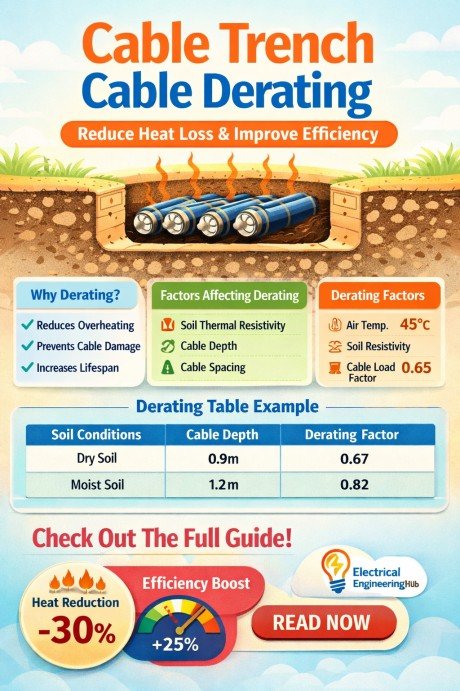
Table of Contents
Table of Contents
In this guide, we will explain cable trench cable derating, the factors that affect it, how to calculate it, and practical methods to improve cable performance.
What is Cable Trench Cable Derating?
Cable trench cable derating refers to reducing the current-carrying capacity of a cable due to installation conditions inside a trench. Since cables generate heat during operation, the surrounding environment must allow proper heat dissipation.
In cable trenches, heat can accumulate because of:
- Limited airflow
- Multiple cable grouping
- Soil thermal resistivity
- High ambient temperature
- Poor trench ventilation
This reduction factor is applied to ensure cables operate within safe temperature limits.
For example, if a cable is rated at 300A in free air and the derating factor is 0.85:
| Cable Rating | Derating Factor | Actual Capacity |
|---|---|---|
| 300A | 0.85 | 255A |
This means the cable should only carry 255A in trench conditions.
Before planning your cable trench layout, use our Cable Trench Fill Calculator to quickly determine the required trench capacity and avoid overcrowding.
Why Cable Trench Cable Derating Matters
Understanding cable trench cable derating is critical for electrical engineers because trench installations often carry multiple power feeders.
Without proper derating:
- Cable insulation can degrade faster
- Heat buildup may cause fire hazards
- System losses increase
- Voltage regulation becomes poor
- Maintenance costs rise
A well-planned trench system improves reliability and minimizes energy waste.
Factors Affecting Cable Trench Cable Derating
Several parameters influence trench derating calculations.
1. Number of Cables in the Trench
The more cables installed together, the greater the heat concentration.
| Number of Circuits | Typical Derating Factor |
|---|---|
| 1 | 1.00 |
| 2 | 0.90 |
| 3 | 0.85 |
| 4 | 0.80 |
Grouped cables reduce cooling efficiency significantly.
2. Trench Dimensions
Narrow trenches trap heat. Wider trenches allow better heat escape.
Important dimensions include:
- Width
- Depth
- Spacing between cables
Proper spacing is essential during Laying Cable to maintain thermal performance.
3. Soil Thermal Resistivity
Soil type has a major impact.
| Soil Type | Thermal Resistivity (K.m/W) |
|---|---|
| Wet Clay | 0.8 |
| Damp Soil | 1.2 |
| Dry Sand | 2.5 |
Higher thermal resistivity means poor heat transfer.
Want to verify your trench can safely accommodate the cables? Try our Cable Trench Fill Calculator for a quick and practical cable fill assessment.
4. Ambient Temperature
Higher trench temperatures reduce ampacity. Standards like IEC 60364 provide correction factors for elevated temperatures.
5. Cable Arrangement
Flat formation usually offers better heat dissipation than trefoil arrangement.
How to Calculate Cable Trench Cable Derating
The basic formula is simple:
Current Capacity = Base Cable Rating × Derating Factor
Example:
Suppose:
- Cable base rating = 400A
- Grouping factor = 0.85
- Temperature factor = 0.94
- Soil factor = 0.90
Calculation:
400 × 0.85 × 0.94 × 0.90 = 287.64A
So, the safe operating current becomes 288A.
This method ensures the cable remains within insulation temperature limits.
Key Takeaways
- Cable trench cable derating reduces cable ampacity due to heat accumulation.
- Grouping of cables has a major impact on derating.
- Soil thermal properties greatly affect heat transfer.
- Proper trench spacing improves cable efficiency.
- Derating calculations improve cable lifespan and safety.
- Following IEC and manufacturer tables is essential.
Common Cable Trench Installation Methods
Different trench configurations affect thermal performance.
Open Cable Trenches
These provide natural ventilation and lower heat retention.
Advantages:
- Better cooling
- Easy maintenance
- Faster fault detection
Covered Cable Trenches
Used for protection but may reduce airflow.
Advantages:
- Physical protection
- Better aesthetics
- Reduced accidental damage
Disadvantages:
- Higher temperature rise
- Increased derating requirements
Buried Cable Trenches
These rely heavily on soil thermal conductivity.
They need careful engineering analysis before installation.
How to Reduce Cable Derating in Trenches
Reducing cable trench cable derating can improve efficiency and save installation costs.
Increase Cable Spacing
Wider spacing lowers mutual heating.
Recommended spacing:
| Cable Size | Minimum Spacing |
|---|---|
| Up to 95mm² | 100mm |
| 120–240mm² | 150mm |
| Above 300mm² | 200mm |
Improve Ventilation
Ventilated covers or forced airflow can reduce trench temperature.
Use Thermal Backfill
Thermal sand or special backfill improves heat dissipation.
Select Higher Cable Size
Upsizing cables compensates for derating losses.
Reduce Circuit Grouping
Splitting circuits into separate trenches lowers heat concentration.
Standards for Cable Trench Cable Derating
Several standards guide cable derating.
| Standard | Purpose |
|---|---|
| IEC 60287 | Current rating calculation |
| IEC 60364 | Electrical installation requirements |
| IEEE 835 | Power cable ampacity calculations |
| BS 7671 | Wiring regulations |
These standards provide correction factors for temperature, grouping, and soil conditions.
Practical Example from Industry
Consider an industrial plant with six 11kV feeders installed in a covered trench.
Initial design:
- 300mm trench width
- 50mm cable spacing
- Dry soil
Problems observed:
- High trench temperature
- Frequent cable heating alarms
- Reduced load capacity
Solution:
- Increased trench width to 600mm
- Added thermal backfill
- Increased spacing to 150mm
Results:
| Parameter | Before | After |
|---|---|---|
| Cable Temperature | 78°C | 62°C |
| Load Capacity | 220A | 280A |
| System Losses | High | Reduced |
This shows how design optimization improves efficiency.
Proper cable spacing starts with accurate fill calculations. Use the Cable Trench Fill Calculator to check cable capacity and plan a more efficient trench layout.
Best Practices for Cable Trench Design
To minimize cable trench cable derating:
- Perform thermal analysis during design
- Use proper trench dimensions
- Maintain recommended cable spacing
- Choose low thermal resistivity backfill
- Avoid excessive cable grouping
- Follow manufacturer ampacity tables
- Inspect trench ventilation regularly
These practices improve cable reliability and reduce failures.
Conclusion
Cable trench cable derating is not just a design adjustment. It directly impacts system efficiency, safety, and long-term reliability. Proper trench dimensions, cable spacing, and thermal considerations help reduce heat buildup and improve current-carrying capacity.
Engineers must consider environmental conditions, grouping factors, and applicable standards before finalizing cable trench layouts. A properly designed trench system can reduce energy losses, extend cable life, and improve operational stability.
FAQs
1. What is cable trench cable derating?
It is the reduction of cable ampacity due to heat buildup inside cable trenches.
2. Why do cables in trenches need derating?
Because trenches restrict heat dissipation, causing temperature rise around cables.
3. Which standard is used for cable derating calculations?
IEC 60287 is widely used for ampacity and derating calculations.
4. How can I reduce cable derating in trenches?
Increase spacing, improve ventilation, use thermal backfill, and reduce cable grouping.
5. Does soil type affect cable derating?
Yes, soil thermal resistivity significantly impacts heat transfer and cable temperature.
Get new guides in your feed. Follow Electrical Insights on LinkedIn for new electrical standards guides, calculators and design tips from Azad Circuit Hub.
CableTrench,#CableDerating,#UndergroundCables,#PowerCableDesign,#ElectricalEngineering,#CableInstallation,#CableSizing,#VoltageDrop,#CableTrenchDesign,#IEC60364
