
Cable Tray Types: Ladder, Trough, Solid Bottom & Channel Explained
Choosing the right cable tray is important for safe cable support, ventilation, maintenance, and future expansion. The most common Cable Tray Types include ladder, ventilated trough, solid-bottom, and channel trays. Each design has a different balance of airflow, mechanical protection, cable access, and installation cost.
For electrical installations, the tray should be selected based on cable size, quantity, environment, support spacing, heat dissipation, and applicable standards such as NEC Article 392. The table below gives a quick comparison before we look at each design in detail.
Cable Tray Types
| Cable Tray Type | Typical Construction | Ventilation | Best Use |
|---|---|---|---|
| Ladder tray | Two side rails with rungs | Excellent | Power and large cables |
| Trough tray | Solid sides with ventilated bottom | Very good | Control and power cables |
| Solid-bottom tray | Continuous metal bottom | Low to moderate | Small/control cables |
| Channel tray | Narrow channel with side rails | Good | Small cable runs |
| Wire mesh/basket | Welded wire construction | Excellent | Data and low-voltage cables |
Actual tray prices vary by material, width, finish, load rating, and supplier. As a broad U.S. budgeting range, basic steel ladder tray can start around $10–$25 per linear foot, while heavier galvanized or stainless-steel systems can reach $30–$80+ per foot. Fittings, covers, supports, and installation add to the final project cost.
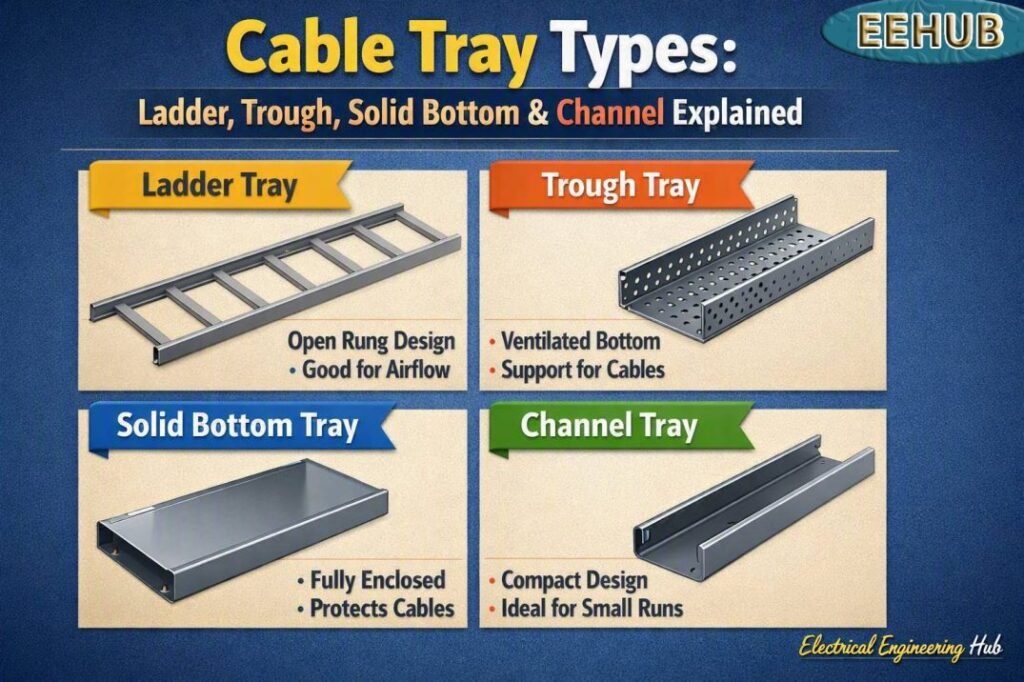
Quick Comparison of Cable Tray Types
The main Cable Tray Types differ most in how they support cables and allow heat to escape. Ladder trays provide the highest airflow, while solid-bottom trays offer better protection against falling debris and small objects.
| Feature | Ladder | Trough | Solid Bottom | Channel |
|---|---|---|---|---|
| Air circulation | Excellent | Very good | Limited | Good |
| Cable access | Excellent | Very good | Good | Good |
| Heat dissipation | Excellent | Very good | Moderate | Good |
| Mechanical protection | Moderate | Good | Excellent | Moderate |
| Large power cables | Excellent | Very good | Fair | Limited |
| Control cables | Good | Excellent | Excellent | Excellent |
| Easy cable additions | Excellent | Excellent | Good | Good |
1. Ladder Cable Tray
Ladder tray is one of the most widely used Cable Tray Types for industrial power distribution. It consists of two longitudinal side rails connected by regularly spaced rungs.
The open construction provides excellent natural ventilation. This helps prevent excessive cable heating, particularly when large power cables carry continuous loads.
Ladder trays are commonly installed in:
- Power plants
- Manufacturing facilities
- Solar power plants
- Commercial buildings
- Data and utility infrastructure
- Electrical substations
- Industrial process plants
A major advantage is easy cable installation. Cables can be placed directly onto the rungs, and electricians can secure them with approved cable ties, clamps, or other support methods.
Ladder tray is especially useful for heavy cables because the rungs provide strong support while keeping the cable accessible from above and below.
Advantages of Ladder Tray
- Excellent ventilation
- Easy cable inspection
- Simple cable installation
- Good support for heavy cables
- Easy future cable additions
- Excellent heat dissipation
Limitation
The open design provides less protection from dust, dripping liquids, and falling objects than a covered solid-bottom system.
2. Ventilated Trough Cable Tray
Ventilated trough is another important option among Cable Tray Types. It normally has a continuous bottom with ventilation openings and raised side rails.
Compared with ladder tray, a trough provides more continuous cable support. This can be useful for smaller cables that could otherwise sag between ladder rungs.
Ventilated trough is often selected for:
- Instrumentation cables
- Control cables
- Communication cables
- Small power cables
- Building services
- Industrial control systems
The ventilation openings allow heat to escape while giving the cable more support along its length.
Trough Tray Benefits
| Benefit | Why It Matters |
|---|---|
| Continuous support | Helps support smaller cables |
| Ventilation openings | Allows heat to escape |
| Good cable organization | Keeps cable groups orderly |
| Easy access | Cables remain accessible |
| Flexible installation | Suitable for many commercial and industrial runs |
For installations with many smaller cables, trough construction can offer a cleaner appearance than a ladder system.
3. Solid-Bottom Cable Tray
Solid-bottom tray provides a continuous base beneath the cables. Among Cable Tray Types, it offers one of the better levels of protection against debris, dripping contaminants, and accidental objects entering from below.
It is often used for control, instrumentation, communication, and sensitive cables where additional physical shielding is useful.
However, the closed bottom reduces airflow. Cable ampacity and heat buildup should therefore be evaluated carefully before selecting this design for heavily loaded power circuits.
A cover can provide additional protection, but it can also further restrict heat dissipation. Always follow the cable manufacturer’s ampacity requirements and the applicable electrical code.
Need a faster way to check tray capacity? Use our cable tray fill calculator to estimate required tray width from your cable sizes and quantities.
4. Channel Cable Tray
Channel tray is a narrow cable support system designed for relatively small cable runs. It is useful where a full-width ladder or trough tray would be unnecessarily large.
Channel tray works well for:
- Branch circuit wiring
- Control cables
- Instrumentation
- Small communication cables
- Short cable routes
- Equipment connections
Its compact profile can save space around electrical panels and equipment. It is also useful when only a few cables need mechanical support.
However, channel tray is generally not the first choice for large groups of high-capacity power cables because its smaller width and load capacity can limit expansion.
Cable Tray Fill Requirements
Cable tray sizing should never be based only on the number of cables. The cross-sectional area, cable arrangement, cable type, heat dissipation, and applicable NEC requirements must also be considered.
Under NEC Article 392, allowable cable fill depends on the cable arrangement and conductor size. For many common multiconductor cable installations, a 50% fill limit is used. Single-conductor cables and certain larger conductors have different requirements, so the exact rule must be checked against the applicable NEC section and installation conditions.
| General NEC Tray Fill Basis | Common Maximum Fill |
|---|---|
| Multiconductor cables | 50% |
| Single-conductor cables | 40% |
| Certain installations with larger cables | Specific calculation required |
| Mixed cable arrangements | Apply applicable NEC rules |
These percentages are not a substitute for the complete NEC calculation. Cable tray loading, spacing, ampacity adjustment, conductor arrangement, and support requirements can affect the final design.
Planning a new installation? Check the required tray capacity with our cable tray fill calculator before selecting the tray width.
How to Choose Between Cable Tray Types
The best selection depends on the installation rather than simply choosing the cheapest tray. Start by identifying the cable types and expected electrical load.
For large power cables, ladder tray is often the practical choice because of its ventilation and accessibility. For numerous smaller control cables, ventilated trough can provide better continuous support.
Solid-bottom tray is worth considering where additional protection is important. Channel tray works well for small cable groups and short runs where space is limited.
Consider these factors before purchasing:
- Cable quantity and outside diameter
- Total cable weight
- Required tray width and depth
- Cable ampacity and heat dissipation
- Indoor or outdoor installation
- Corrosion exposure
- Support span
- Future cable expansion
- Required covers
- Applicable NEC or IEC requirements
Cable Tray Materials and Typical Rates
Cable trays are available in several materials. Material selection has a major effect on price and service life.
| Material | Typical Use | Approximate Relative Cost |
|---|---|---|
| Pre-galvanized steel | Indoor installations | 1.0× |
| Hot-dip galvanized steel | Outdoor/industrial | 1.2–1.6× |
| Aluminum | Corrosive or lightweight applications | 1.5–2.2× |
| Stainless steel | Severe corrosive environments | 2–4× |
| FRP/GRP | Chemical and coastal environments | 1.8–3× |
These are budgeting ratios rather than fixed market prices. Local steel prices, tray dimensions, coating thickness, manufacturer, and freight can significantly change the actual rate.
Cable Tray Width and Load Planning
A tray should have enough space for the installed cables without forcing them into a crowded arrangement. Leaving room for future expansion can also reduce the need for another tray later.
For example, if the calculated cable area requires a 12-inch tray at the permitted fill ratio, selecting a 12-inch tray may technically work, but a 16-inch tray could provide better expansion capacity if the project is expected to grow.
Tray width should therefore be selected using both current cable requirements and the expected future load.
Before finalizing tray dimensions, use our cable tray fill calculator to estimate the tray size required for your cable list.
Cable Tray Support and Installation
Correct support is just as important as selecting the tray style. Support spacing depends on the tray manufacturer’s load rating, tray construction, cable weight, and applicable installation requirements.
Avoid using cable tray as a substitute for raceway where the wiring method is not permitted. Also, maintain proper separation between power, control, instrumentation, and communication cables where required.
For outdoor installations, consider drainage, corrosion protection, UV exposure, wind loading, and suitable covers. Bonding and grounding requirements should also be addressed as part of the complete electrical design.
Which Cable Tray Type Is Best?
There is no single best option for every project. Ladder tray is usually the strongest all-around choice for large power cables because it combines ventilation, accessibility, and good mechanical support.
Ventilated trough is a strong choice for smaller cables that benefit from continuous support. Solid-bottom tray is useful when cable protection is more important than maximum airflow. Channel tray is ideal for compact cable runs with relatively low cable quantities.
The correct Cable Tray Types selection should balance cable capacity, heat dissipation, mechanical strength, environmental conditions, installation space, and future expansion.
Frequently Asked Questions
What is the most common type of cable tray?
Ladder tray is one of the most common Cable Tray Types used for industrial and commercial power distribution. Its open structure provides excellent ventilation and makes cable installation and maintenance straightforward.
What is the difference between ladder and trough cable tray?
Ladder tray uses rungs between two side rails, while trough tray generally provides a continuous or ventilated bottom. Ladder tray offers better airflow, while trough provides more continuous support for smaller cables.
Is solid-bottom cable tray better than ladder tray?
Not necessarily. Solid-bottom tray provides more protection, but ladder tray normally provides better ventilation. The choice depends on the cable type, environment, heat dissipation requirements, and mechanical protection needed.
How much cable can be installed in a cable tray?
The permitted amount depends on cable type, conductor arrangement, cable dimensions, and NEC requirements. A common limit for multiconductor cables is 50% of the tray’s usable cross-sectional area, but other installations can have different limits.
How do I calculate cable tray size?
First determine the outside dimensions and quantity of all cables. Calculate their total cross-sectional area, apply the applicable cable tray fill requirement, and select a tray width and depth that meets the result while considering load, support spacing, and future expansion. A cable tray fill calculator can simplify the area and width calculation.
Get new guides in your feed. Follow Electrical Insights on LinkedIn for new electrical standards guides, calculators and design tips from Azad Circuit Hub.
#CableTrayTypes, #CableTray, #LadderTray, #TroughTray, #SolidBottomTray, #ChannelTray, #CableManagement, #ElectricalEngineering, #CableInstallation, #ElectricalDesign
