Thermal Overload Relay Setting Guide: How to Set It Correctly
Correct motor protection starts with proper thermal overload relay setting. If the relay is adjusted too low, it may trip during normal operation. If set too high, the motor may overheat before protection activates. This makes thermal overload relay setting one of the most important steps in motor control panel setup.
A thermal overload relay protects motors from overheating caused by overload current, phase imbalance, and prolonged starting conditions. It works with motor starters and contactors to disconnect power before damage happens.
Whether you are working on a small pump motor, industrial conveyor, or HVAC system, understanding the right thermal overload relay setting helps improve motor life, system reliability, and safety compliance.
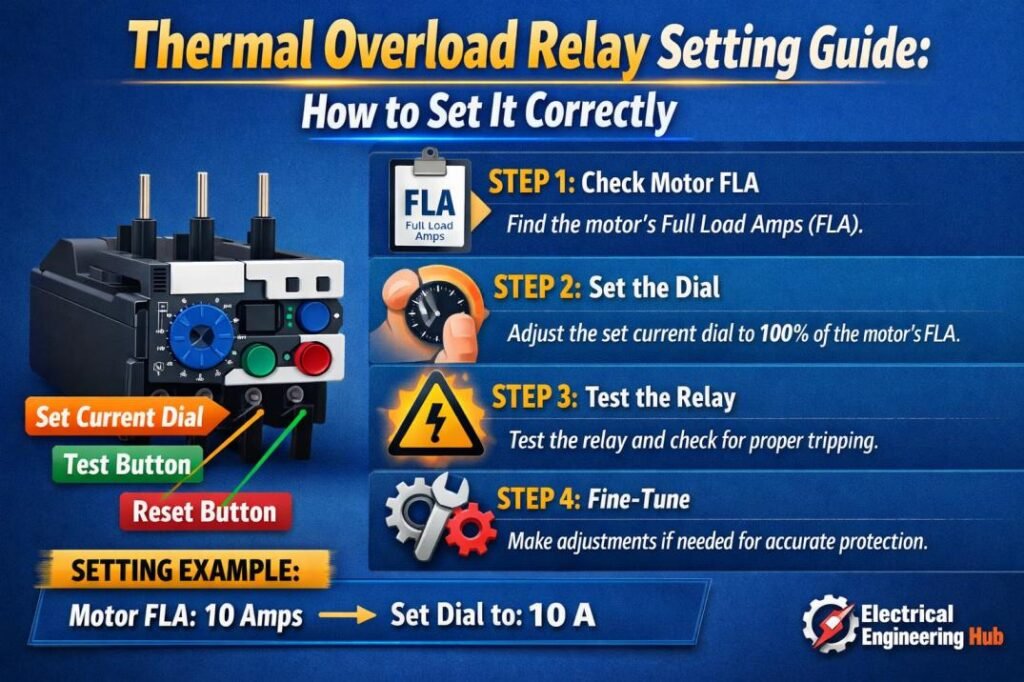
Table of Contents
Table of Contents
In this guide, you will learn how thermal overload relays work, how to adjust them correctly, and how to troubleshoot common trip issues.
What Is a Thermal Overload Relay?
A thermal overload relay is a motor protection device designed to protect electric motors against excessive current over time. It operates based on heat generated by current flow.
Unlike electronic overload relays, thermal overload relays use mechanical parts and bimetal strips to sense overload conditions. This makes them simple, cost-effective, and widely used in industrial motor starters.
The relay is installed in series with the motor circuit. When the motor draws more current than its rated full load current for a certain period, the relay trips and disconnects the contactor.
Main Functions of a Thermal Overload Relay
| Function | Purpose |
|---|---|
| Overload Protection | Protects motor windings from overheating |
| Phase Loss Protection | Detects single phasing in many models |
| Current Monitoring | Measures motor current continuously |
| Delayed Tripping | Allows temporary starting current |
Thermal overload relays are common in:
- Motor control centers (MCC)
- Pump systems
- Compressors
- Conveyor belts
- Air handling units
Their simple design makes thermal overload relay setting easy for technicians and electricians.
How Thermal Overload Relays Work
The working principle is based on heat expansion.
Inside the relay, each phase current passes through a heater element connected to a bimetallic strip. When motor current increases, the heat generated rises.
The bimetal strip bends because it is made of two metals with different expansion rates. If the heat reaches the trip point, the strip activates the trip mechanism.
Working Sequence
- Motor starts and draws normal current.
- Current passes through heater elements.
- Heat builds in the bimetal strip.
- Excess current increases heat.
- Strip bends and trips the contactor.
Thermal Relay Response Table
| Current Level | Relay Action |
|---|---|
| 100% FLA | Normal operation |
| 110% FLA | Slow heating |
| 125% FLA | Trip after delay |
| 600% FLA | Instant thermal rise |
This delayed response allows motors to handle inrush current during startup.
That is why thermal overload relay setting must match motor characteristics.
How to Set a Thermal Overload Relay
This is the most important part of thermal overload relay setting. A correct setting depends mainly on the motor full load amperes (FLA), service factor, and operating environment.
Step 1: Find the Motor Nameplate Current
Look at the motor nameplate and identify:
- Rated voltage
- Full load current (FLC)
- Service factor
- Power rating
Example:
| Parameter | Value |
|---|---|
| Motor Power | 15 kW |
| Voltage | 415V |
| FLA | 28A |
| Service Factor | 1.15 |
The FLA is the base for thermal overload relay setting.
Step 2: Locate the Relay Adjustment Dial
Most thermal overload relays have an adjustable dial marked in amps.
Example:
Relay range = 24A – 32A
If your motor FLA is 28A, this relay is suitable.
Always choose a relay range that includes the motor’s rated current.
Step 3: Apply the Correct Setting Formula
Use this standard rule:
For motors with service factor 1.15 or more:
Overload Setting = FLA × 125%
For motors with service factor less than 1.15:
Overload Setting = FLA × 115%
Example calculation:
Motor FLA = 28A
Service Factor = 1.15
Setting = 28 × 1.25 = 35A
If the relay maximum is below 35A, select the nearest suitable relay.
Quick Setting Table
| Motor FLA | 115% Setting | 125% Setting |
| 10A | 11.5A | 12.5A |
| 20A | 23A | 25A |
| 30A | 34.5A | 37.5A |
| 40A | 46A | 50A |
Step 4: Test the Motor
After thermal overload relay setting:
- Start the motor
- Measure running current
- Check startup duration
- Monitor temperature
If the motor trips under normal load, fine-tune slightly.
Best Practices
- Never set below motor FLA
- Avoid oversizing relay range
- Verify actual load current
- Check manufacturer data
Proper thermal overload relay setting improves protection and avoids nuisance trips.
Thermal Overload Relay Setting for 3-Phase Motors
For three-phase motors, thermal overload relay setting follows the same principle, but phase balance becomes critical.
Each phase must carry nearly equal current. A difference greater than 5% may indicate imbalance.
3-Phase Setting Checklist
| Check Item | Target |
|---|---|
| Motor FLA | Match nameplate |
| Phase Current Balance | Within 5% |
| Relay Range | Covers FLA |
| Voltage Balance | Stable |
For quick motor sizing and overload values, refer to the main hub guide’s overload relay setting table.
In 3-phase motors, single phasing can cause one phase current to rise sharply. A properly adjusted thermal relay can detect this condition.
This makes thermal overload relay setting more critical in industrial three-phase systems.
Adjusting for Ambient Temperature
Ambient temperature directly affects thermal relay performance.
Thermal relays respond to heat. If the surrounding panel temperature is already high, the relay may trip earlier.
This is common in:
- Outdoor panels
- Boiler rooms
- Hot climates
- Crowded control cabinets
Ambient Temperature Effect Table
| Temperature | Relay Behavior |
|---|---|
| 20°C | Normal |
| 30°C | Slightly faster trip |
| 40°C | Faster trip |
| 50°C+ | High nuisance trip risk |
Two Relay Types
Ambient-Compensated Relays
These adjust internally for surrounding temperature changes.
Best for variable environments.
Non-Compensated Relays
These are more affected by room temperature.
Manual thermal overload relay setting adjustments may be needed.
Adjustment Tip
If the panel temperature is above 40°C, monitor motor current carefully before increasing the setting.
Never increase blindly.
Common Thermal Overload Relay Trip Issues
Improper thermal overload relay setting can cause unwanted trips or no trip at all.
1. Nuisance Tripping
This happens when the relay trips too often.
Common causes:
- Setting too low
- High ambient temperature
- Long motor starting time
- Voltage imbalance
Solution:
Check actual running current and adjust properly.
2. Relay Fails to Trip
This is dangerous.
Causes:
- Setting too high
- Wrong relay size
- Mechanical fault
Solution:
Inspect and recalibrate.
3. Single Phasing
Loss of one phase increases current in remaining phases.
Symptoms:
| Symptom | Effect |
|---|---|
| Motor overheating | Insulation damage |
| Low torque | Reduced output |
| High vibration | Bearing stress |
Solution:
Check supply fuses and contactor terminals.
4. Frequent Reset Requirement
If the relay keeps resetting:
- Check motor load
- Inspect bearings
- Verify cable size
- Measure voltage drop
These checks often solve thermal overload relay setting issues.
Thermal Overload Relay vs. Electronic Overload Relay
Both protect motors, but their working method differs.
Comparison Table
| Feature | Thermal Relay | Electronic Relay |
| Sensing Method | Heat/Bimetal | Current Transformer |
| Accuracy | Moderate | High |
| Ambient Effect | Yes | Minimal |
| Cost | Lower | Higher |
| Settings | Manual Dial | Digital |
| Trip Class | Fixed | Adjustable |
Thermal relays are better for:
- Standard industrial motors
- Budget systems
- Simple motor starters
Electronic relays are better for:
- Critical loads
- Variable speed drives
- Precise protection systems
Thermal overload relay setting is simpler, but electronic relays offer more control.
Related Tools & Guides
- Overload Relay Setting Calculator
- Overload Relay for Motor
- Overload Setting for Motor
- Overload Relay Amp Lists
- Motor Protection Circuit Breaker vs Overload Relay
Frequently Asked Questions
How do you set a thermal overload relay?
Find the motor full load current from the nameplate and adjust the relay dial to match it. Apply 115% or 125% depending on service factor.
What happens if a thermal overload relay is set too low?
It may trip during normal operation, causing downtime and interrupting production.
Does ambient temperature affect thermal overload relay setting?
Yes. High ambient temperature can cause faster tripping, especially in non-compensated relays.
What is the difference between thermal and electronic overload relays?
Thermal relays use bimetal strips and heat, while electronic relays use sensors and digital logic for higher accuracy.
Final Thoughts
A correct thermal overload relay setting is essential for safe motor operation. It protects against overload, overheating, and phase failure while reducing maintenance costs.
Always start with the motor nameplate current. Select the right relay range, adjust based on service factor, and test under real operating conditions.
For three-phase motors, always verify current balance and ambient conditions. Small mistakes in thermal overload relay setting can lead to motor damage or unnecessary shutdowns.
When set correctly, thermal overload relays provide reliable and affordable motor protection for almost any industrial application.
Get new guides in your feed. Follow Electrical Insights on LinkedIn for new electrical standards guides, calculators and design tips from Azad Circuit Hub.
ThermalOverloadRelay, #OverloadRelaySetting, #MotorProtection, #ElectricalEngineering, #RelaySettings, #MotorSafety, #IndustrialAutomation, #ElectricalMaintenance, #ProtectionRelay, #ControlPanel