Tesla vs ChargePoint vs Emporia EV Charger: Which Level 2 Charger Is Right for You?
When choosing a home EV charger, the Tesla Wall Connector, ChargePoint Home Flex, and Emporia Pro Level 2 EV Charger are three products worth comparing. In this tesla vs chargepoint vs emporia comparison, I am looking at more than charging speed. Connector type, circuit requirements, smart features, energy monitoring, installation, and everyday usability all affect the right choice.
As an electrical engineer with more than 15 years of experience working with electrical panels, industrial controls, automation, and power systems, I always look at an EV charger as part of the home’s electrical system. A higher amp rating is useful only when the vehicle and electrical installation can support it.
Tesla vs ChargePoint vs Emporia at a Glance
| Feature | Tesla Wall Connector | ChargePoint Home Flex | Emporia Pro Level 2 |
|---|---|---|---|
| Maximum output | Up to 48A | Up to 50A | Up to 48A |
| Charging type | Level 2 | Level 2 | Level 2 |
| Typical voltage | 240V | 240V | 240V |
| Installation | Hardwired | Plug-in / hardwired depending on configuration | Hardwired |
| Connector | NACS | J1772 | J1772 |
| Smart charging | Yes | Yes | Yes |
| Energy monitoring | Limited compared with Emporia ecosystem | Charging data | Strong energy-monitoring focus |
| Best suited for | Tesla/NACS users | Multi-brand EV owners | Energy-conscious homeowners |
| Amazon availability | Check current listing | Check current listing | Check current listing |
The three chargers target slightly different buyers. Tesla emphasizes integration with its vehicles and charging ecosystem. ChargePoint offers broad EV compatibility and flexible charging features. Emporia stands out for homeowners who want detailed energy management.
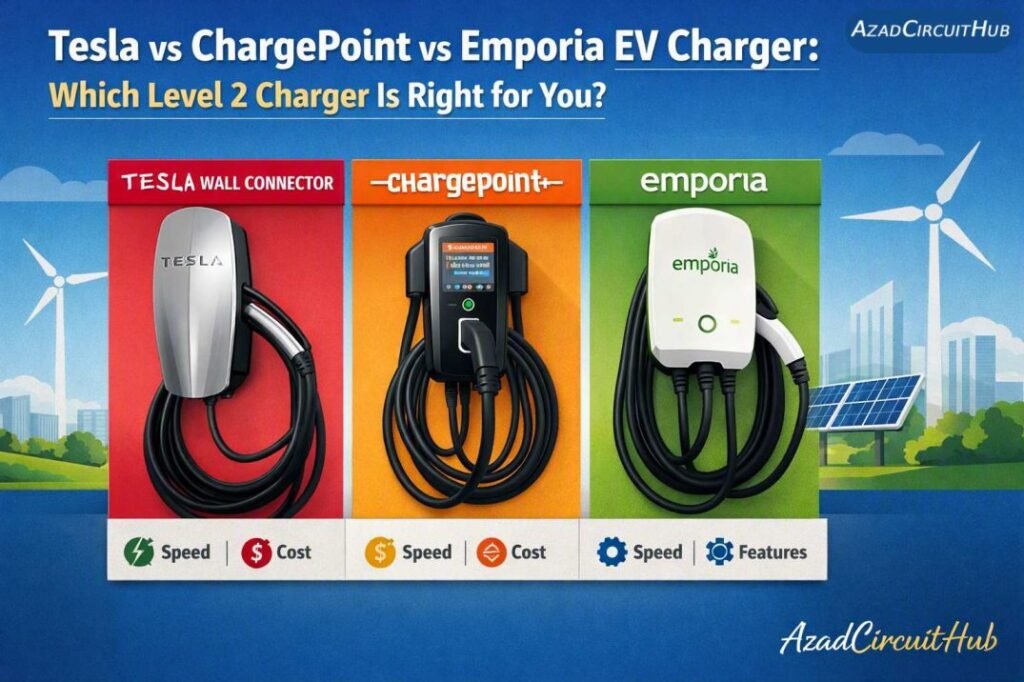
Table of Contents
Table of Contents
Tesla Wall Connector
The Tesla Wall Connector is a natural choice for Tesla owners and other compatible NACS vehicles. It is a hardwired Level 2 EV charger designed for permanent home installation.
One advantage is the clean installation. There is no NEMA 14-50 plug hanging from the wall, which can be useful in a dedicated garage charging location. Depending on the electrical configuration and vehicle, the Wall Connector can provide substantial AC charging power.
The Tesla ecosystem is another important factor. Owners who already use Tesla vehicles may prefer having charging equipment from the same manufacturer.
Amazon buying option: Check Tesla Wall Connector price on Amazon
If you want specifications, installation considerations, and charging details in one place, see my Tesla Wall Connector Review before buying.
ChargePoint Home Flex
ChargePoint Home Flex is designed for a wider range of EV owners. Its J1772 connector makes it compatible with many electric vehicles that use the common J1772 AC charging inlet.
One of the strongest features is charging flexibility. The charger can be configured for different current levels depending on the installation and electrical circuit. This can be useful when a home's electrical service cannot support a very high continuous EV charging load.
For homeowners who may change EV brands in the future, connector compatibility can be an important consideration.
Amazon buying option: Check ChargePoint Home Flex price on Amazon
For a deeper look at the charger, including electrical requirements and practical installation points, read my ChargePoint Home Flex Review.
Emporia Pro Level 2 EV Charger
Emporia takes a different approach by placing strong emphasis on energy monitoring and home energy management. This makes the Emporia Pro interesting for homeowners who already care about solar generation, household consumption, peak demand, or energy costs.
The charger is a Level 2 unit and is designed for permanent installation. Its smart features can make it particularly useful when the homeowner wants more visibility into how EV charging affects total household electricity use.
This is where the tesla vs chargepoint vs emporia comparison becomes more than a charging-speed discussion. If energy data and load management matter to you, Emporia deserves a closer look.
Amazon buying option: Check Emporia Pro Level 2 EV Charger price on Amazon
You can also read my detailed Emporia Pro Level 2 EV Charger Review for a closer look at its features and installation requirements.
Tesla vs ChargePoint vs Emporia: Charging Performance
Charging speed depends on three main limits: the charger, the branch circuit, and the vehicle's onboard AC charger.
For example, a charger capable of 48A does not automatically mean the EV will charge at 48A. If the vehicle has a lower AC charging limit, the vehicle becomes the limiting factor.
| Charging Level | Approx. 240V Power |
|---|---|
| 32A | 7.7 kW |
| 40A | 9.6 kW |
| 48A | 11.5 kW |
| 50A | 12.0 kW |
The actual energy added to the battery also varies because charging efficiency, battery temperature, battery state of charge, and vehicle charging strategy affect results.
Which Charger Is Better for Different EV Owners?
Instead of choosing purely by brand, consider your vehicle and electrical setup.
| Buyer Profile | Consider |
|---|---|
| Tesla/NACS-focused household | Tesla Wall Connector |
| Multiple EV brands | ChargePoint Home Flex |
| Energy monitoring priority | Emporia Pro |
| Existing J1772 EV | ChargePoint or Emporia |
| Tesla vehicle with NACS | Tesla Wall Connector |
| Solar and home-energy monitoring | Emporia |
| Future vehicle flexibility | ChargePoint |
These are product-fit differences rather than a universal ranking. The correct option depends on the equipment already installed at your home and the EV you drive.
Electrical Installation and Breaker Sizing
This is one area where I would not choose an EV charger based only on its maximum amp rating.
EV charging is generally treated as a continuous load. The branch circuit, overcurrent protection, conductor size, disconnect requirements where applicable, and panel capacity must be evaluated together.
For a 48A charging load, for example, the circuit needs to be designed for continuous operation at that level under applicable electrical requirements. The same principle applies when configuring a ChargePoint or another adjustable-current charger.
Before installation, check:
- Main service capacity
- Available panel space
- Branch-circuit rating
- Conductor size and type
- Breaker compatibility
- Charger installation instructions
- Local electrical code
- Indoor or outdoor installation conditions
- Vehicle charging limit
A qualified electrician should verify the installation rather than assuming an existing receptacle or breaker is suitable for continuous EV charging.
Smart Features and Energy Monitoring
The three products differ more clearly when smart features are considered.
Tesla focuses heavily on its vehicle and charging ecosystem. ChargePoint provides a mature EV charging platform with app-based controls and charging information. Emporia puts considerable emphasis on energy monitoring and integration with household energy management.
For someone who simply wants to plug in every night, these differences may not matter much. For a homeowner with solar panels, time-of-use electricity rates, or a strong interest in energy consumption, smart charging features become more valuable.
If you are still comparing alternatives, my guide to the best level 2 ev charger covers other residential chargers worth considering.
Tesla vs ChargePoint vs Emporia: What Should You Check Before Buying?
Before placing an order, I recommend checking these specifications:
- Connector type: Make sure the connector matches your EV or your planned adapter arrangement.
- Maximum charging current: Compare the charger with your vehicle's onboard AC charging capacity.
- Electrical service: Confirm that the home's panel and service can support the selected circuit.
- Installation type: Decide whether hardwired installation fits your garage or parking location.
- Smart features: Check whether you actually need scheduling, remote control, or energy monitoring.
- Future EV plans: A charger can remain installed for many years, so consider future vehicle compatibility.
Tesla vs ChargePoint vs Emporia: Final Buying Guide
The Tesla Wall Connector makes particular sense for Tesla and compatible NACS vehicle owners who want a permanent charger closely aligned with the Tesla ecosystem.
ChargePoint Home Flex is worth considering when broad EV compatibility and adjustable charging are important. Its J1772 connector also makes it suitable for many non-Tesla EVs.
Emporia Pro is especially interesting for homeowners who want charging combined with detailed household energy monitoring. It can be a strong fit for energy-conscious homes and solar users.
The key lesson from this tesla vs chargepoint vs emporia comparison is that maximum amperage should not be the only buying factor. Match the charger to your EV, electrical service, installation location, and energy-management needs.
Ready to compare prices? Shop Tesla Wall Connector on Amazon | Shop ChargePoint Home Flex on Amazon | Shop Emporia Pro Level 2 EV Charger on Amazon
Frequently Asked Questions
Is Tesla Wall Connector better than ChargePoint Home Flex?
They serve different use cases. Tesla Wall Connector is closely integrated with Tesla's charging ecosystem and uses NACS, while ChargePoint Home Flex is designed around broader EV compatibility with a J1772 connector. Your vehicle and connector requirements should guide the choice.
Is Emporia EV charger good for solar homes?
Emporia can be attractive for solar-equipped homes because its ecosystem places a strong focus on energy monitoring and household energy management. Solar owners should still verify the exact features supported by their installation and tariff.
Can ChargePoint Home Flex charge a Tesla?
ChargePoint Home Flex models using J1772 can charge compatible Tesla vehicles when the appropriate Tesla-approved J1772-to-NACS adapter is used. Confirm compatibility with your specific vehicle and charger configuration before installation.
What amperage should I use for a home EV charger?
The correct amperage depends on the vehicle's onboard charger and the home's electrical capacity. Common Level 2 settings include 32A, 40A, and 48A. Higher current is not useful if the vehicle cannot accept it.
Do I need a 50A or 60A breaker for a Level 2 EV charger?
The required breaker depends on the charger's configured maximum current and applicable continuous-load requirements. The charger manufacturer's installation instructions and local electrical code should be followed. Have the circuit evaluated by a qualified electrician.
Final Thoughts
The Tesla Wall Connector, ChargePoint Home Flex, and Emporia Pro Level 2 EV Charger each approach home charging with different priorities. Tesla emphasizes its NACS and vehicle ecosystem, ChargePoint focuses on broad EV charging compatibility and flexibility, while Emporia puts more attention on energy monitoring.
For buyers, the smartest starting point is the vehicle's charging capability and the home's electrical capacity. Once those are known, connector type, smart features, installation method, and energy-management needs can narrow the selection considerably.
Get new guides in your feed. Follow Electrical Insights on LinkedIn for new electrical standards guides, calculators and design tips from Azad Circuit Hub.
#TeslaVsChargePointVsEmporia, #EVChargerComparison, #TeslaEVCharger, #ChargePoint, #EmporiaEVCharger, #Level2EVCharger, #EVCharging, #HomeEVCharger, #ElectricVehicle, #EVChargerGuide