NEC Article for Elevators: Article 620 Rules (2026 Guide)
The NEC article for elevators is Article 620. It sets the wiring, branch circuit, disconnect and protection rules for elevators, dumbwaiters, escalators, moving walks, platform lifts and stairway chairlifts.
If you need the NEC article for elevators for a plan review, an inspection or an exam, this guide covers the rules that come up most: the separate branch circuit for each car, the machine room lighting switch location, the pit requirements and what changed in the 2026 code. You will also find free ways to read Article 620, quiz-style practice questions and links to the related NEC articles on this site.
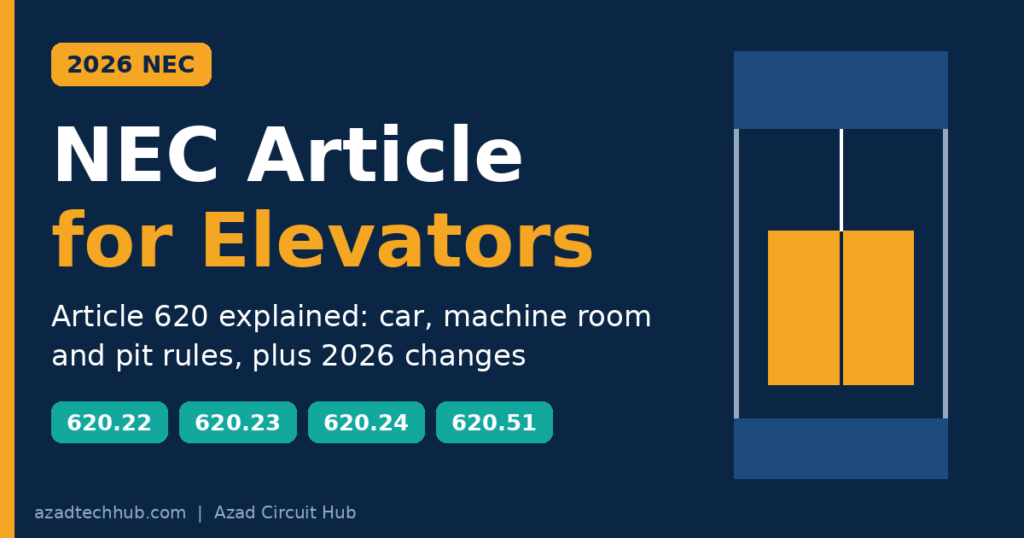
Table of Contents
Table of Contents
What Is the NEC Article for Elevators?
Article 620 sits in Chapter 6, Special Equipment, of the National Electrical Code (NFPA 70). The NEC article for elevators does not stand alone. Chapters 1 through 4 still apply, so working space follows 110.26, wiring methods draw on the NEC article for wiring methods and overcurrent protection draws on the NEC article for overcurrent protection.
Article 620 adds the elevator-specific rules for conductors, branch circuits, disconnecting means, grounding and emergency operation. It does not replace ASME A17.1, the safety code that covers the mechanical side. Since the 2023 edition, the defined terms used in Article 620 live in Article 100.
NEC Article for Elevators: Quick Reference Table
| Section | What it covers |
|---|---|
| 620.16 | Short-circuit current rating of the control panel, plus field marking of available fault current in the 2026 NEC |
| 620.22 | Separate branch circuit for each car’s lights, receptacles, auxiliary lighting and ventilation |
| 620.23 | Machine room, control room, machinery space and control space lighting and receptacles |
| 620.24 | Hoistway pit lighting and receptacles |
| 620.51 | Disconnecting means for each unit, plus surge protection in the 2026 NEC |
| 620.53 | Lockable disconnect for the car light and receptacle circuit |
| 620.62 | Selective coordination for multiple elevators on one feeder |
A Separate Branch Circuit Shall Supply Each Elevator Car
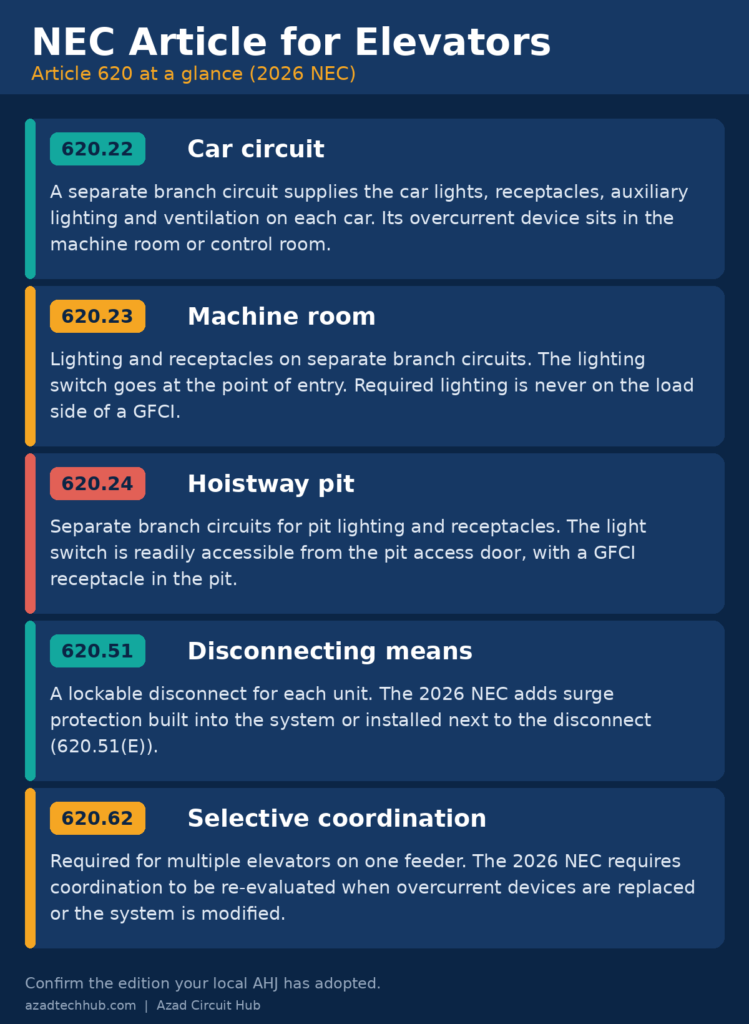
One of the most quoted lines in the NEC article for elevators says that a separate branch circuit shall supply the car lights, receptacle(s), auxiliary lighting power source and ventilation on each elevator car (620.22). Car air-conditioning and heating units get their own separate branch circuit.
The overcurrent device for the car circuit must sit in the machine room, control room, machinery space or control space, and required car lighting cannot be connected to the load side of a GFCI. Each car also needs its own lockable disconnect for that circuit in the machine room (620.53). If you are sizing the feeders and protection behind these circuits, the NEC article for branch circuits covers the Article 210 basics.
The Machine Room Lighting Switch Shall Be Located at the Point of Entry
Section 620.23 covers the machine room, control room, machinery space and control space. The lighting switch shall be located at the point of entry, so a technician can light the room before stepping in. Current editions require the lighting and the receptacles to be on separate branch circuits that supply no other loads.
Older editions allowed one separate circuit for both, so confirm the edition your authority having jurisdiction (AHJ) enforces. Provide at least one 125-volt, single-phase, 15- or 20-ampere duplex receptacle, and make it GFCI-protected. Required lighting stays off the load side of a GFCI so a ground fault cannot leave the room dark. For GFCI basics, see NEC Article 210.8 A.
NEC Elevator Pit Requirements (620.24)
The pit is where elevator inspections often fail. Section 620.24 requires separate branch circuits for the hoistway pit lighting and the pit receptacles, with no other loads. The pit light switch must be readily accessible from the pit access door, so the person entering never walks into the pit in the dark.
Provide at least one 125-volt, 15- or 20-ampere duplex receptacle in the pit with GFCI protection, and keep required pit lighting off the load side of a GFCI. Wiring in the hoistway is also limited to elevator-related equipment (620.37), so a pit circuit cannot double as a corridor or stairwell circuit.
2026 NEC Changes for Elevators
If you learned the NEC article for elevators from the 2020 or 2023 book, add these three updates. The 2026 edition of NFPA 70 is published, but each state and city adopts it on its own schedule.
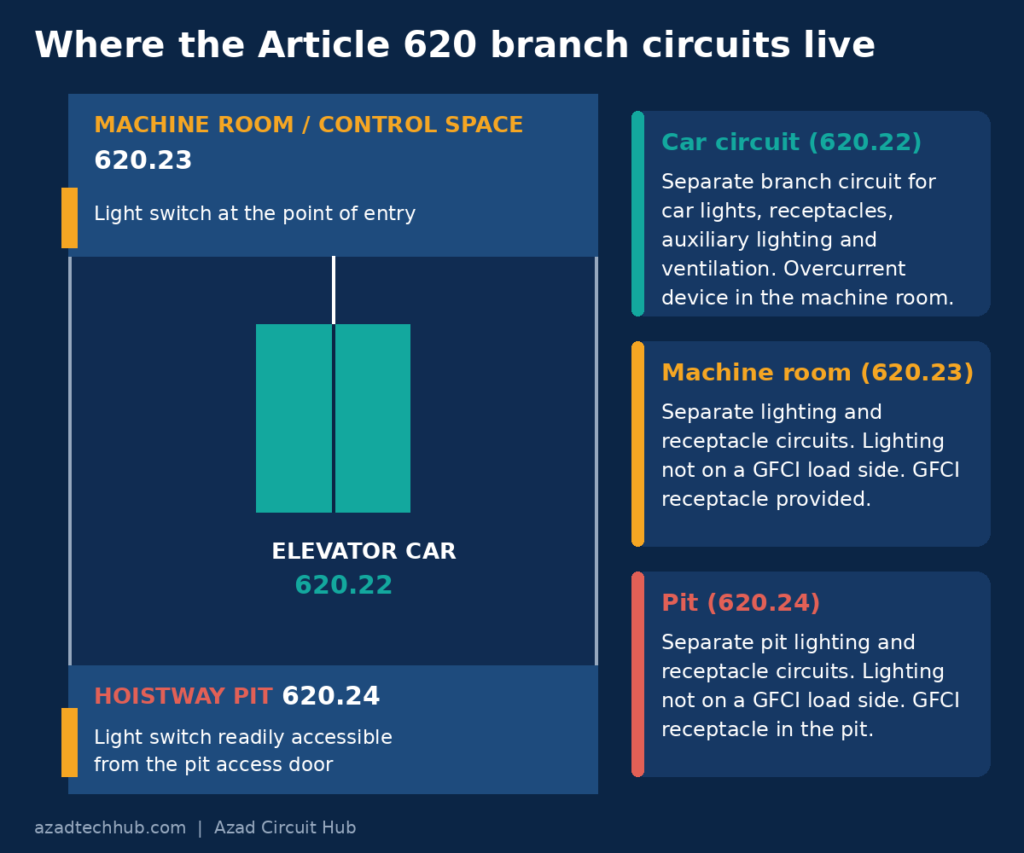
- 620.16(C): new field marking of the available fault current at the elevator control panel. This brings Article 620 in line with similar marking rules in 110.24 and 408.6.
- 620.51(E): a surge protective device (SPD) must be built into the elevator system or installed immediately adjacent to the disconnecting means. It now applies to all elevators, not only those on emergency systems.
- 620.62: selective coordination must be re-evaluated whenever overcurrent devices are replaced or the elevator system is modified, added to or reduced.
The same code cycle expanded surge protection to legally required standby systems (701.8) and added Article 742 for limited-energy systems.
Disconnects, Working Space and Backup Power
The NEC article for elevators requires a lockable disconnecting means for each unit (620.51), normally in the machine room or control space. Working clearance around controllers and disconnects follows 110.26, so keep the 36 inch depth in mind when planning the room (see clearance in front of panels).
Elevators fed from emergency or legally required standby power also need selective coordination, which is covered in the NEC article for generators. Drive-controlled machines follow the NEC code for variable frequency drives, and the machine itself is a motor under the NEC article for motors.
NEC Article for Elevators PDF, Free Access and Quizlet Study Tips
Searches for the NEC article for elevators PDF and free copies usually have one goal: reading Article 620 without buying the code book.
Searches for the NEC article for elevators 2021 usually mean the 2020 edition, because the NEC is published every three years (2017, 2020, 2023, 2026) and there is no 2021 edition. Sections 620.22, 620.23 and 620.24 keep the same numbers across these editions, but the wording moves, for example from one pit circuit to separate pit circuits.
For Quizlet-style practice, test yourself on these:
- A separate branch circuit shall supply what on each elevator car? Car lights, receptacle(s), auxiliary lighting power source and ventilation (620.22).
- Where is the machine room lighting switch located? At the point of entry (620.23).
- Where is the pit light switch located? Readily accessible from the pit access door (620.24).
- Can required machine room lighting be on the load side of a GFCI? No.
- What does 620.51(E) require in the 2026 NEC? A surge protective device built in or installed next to the disconnecting means.
Related NEC Articles: 100, 110, 200 and Overcurrent Protection
Elevator work touches several other articles, and these are the questions people ask most. For the full map, use the NEC articles list.
What does Article 100 of the NEC contain?
Article 100 holds the definitions. Since the 2023 edition, every defined term sits in Article 100 in alphabetical order, with article-specific terms tagged by article number.
What is Article 110 in the NEC?
Article 110 sets the general requirements for electrical installations, including working space in 110.26, termination rules in 110.14 and available fault current marking in 110.24. Read the full breakdown in NEC Article 110.26 A.
What does NEC Article 200 contain?
Article 200 covers the use and identification of grounded (neutral) conductors, including color coding and terminal marking. Grounding itself is in Article 250, explained in the NEC article for grounding and bonding.
Which article covers overcurrent protection: 230, 250, 220 or 240?
Article 240. Article 230 covers services, Article 250 covers grounding and bonding and Article 220 covers load calculations. See the NEC article for services and the NEC article for demand factors for those.
What is the 83% rule in the NEC?
It is the allowance in 310.12 that lets you size 120/240-volt, single-phase dwelling unit service and feeder conductors at 83 percent of the service rating, for services from 100 to 400 amperes. It applies to homes, not elevators, and you should confirm the wording in the edition your AHJ enforces. Commercial work follows the NEC code for commercial buildings.
Tools and Guides for Elevator Electrical Work
Pair the NEC article for elevators with these tools: the Overload Relay Setting Calculator, the guide to wire sizing for motors and the Conduit Fill Calculator. For machine room inspections, a thermal imaging camera and a good multimeter catch hot connections and verify circuits. Browse every electrical calculator and more NEC and IEC guides.
Frequently Asked Questions
What is the NEC article for elevators?
The NEC article for elevators is Article 620. It covers elevators, dumbwaiters, escalators, moving walks, platform lifts and stairway chairlifts.
Does every elevator car need its own branch circuit?
Yes. A separate branch circuit supplies the car lights, receptacles, auxiliary lighting and ventilation on each car (620.22).
Does the elevator pit need GFCI protection?
The pit receptacle needs GFCI protection. Required pit lighting stays off the load side of a GFCI (620.24).
Is Article 620 the same in the 2020 and 2023 NEC?
The section numbers match, but the wording changes in places. Check the edition your AHJ has adopted.
Conclusion
The NEC article for elevators comes down to a few habits: one separate circuit for each car, lights switched at the machine room door and the pit door, GFCI receptacles with non-GFCI lighting, and the 2026 additions for fault current marking, surge protection and selective coordination. Use the table and diagram above as a field checklist, then confirm every detail against the code edition your AHJ enforces and ASME A17.1 with a qualified elevator contractor.
Get new guides in your feed. Follow Electrical Insights on LinkedIn for new electrical standards guides, calculators and design tips from Azad Circuit Hub.