Latest Government Grants for Electric Car Charging Points in USA: Eligibility, Funding Programs & Application Guide 2026
The expansion of electric vehicles across the United States has created a strong demand for accessible and reliable charging infrastructure. Federal and state authorities are now actively supporting this transition through financial assistance and incentive programs. Among these initiatives, Government Grants for Electric Car Charging Points have become a key driver for building nationwide EV charging networks, especially along highways, commercial hubs, and residential areas.
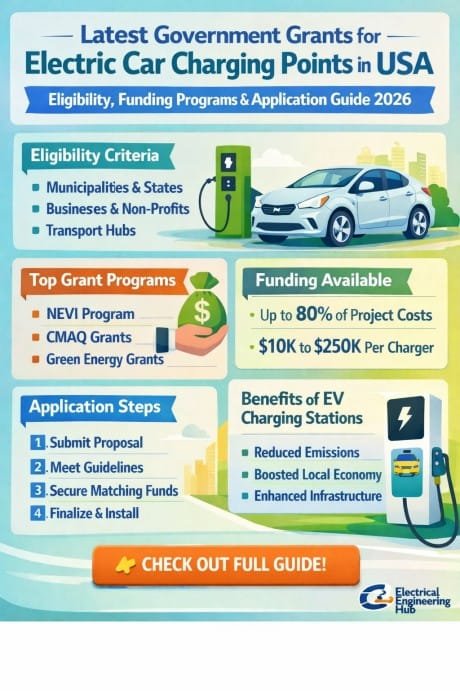
Table of Contents
In 2026, these funding opportunities are more structured and accessible than ever before, thanks to updated federal infrastructure policies and energy transition goals. Businesses, municipalities, and private investors are increasingly exploring Government Grants for Electric Car Charging Points to reduce installation costs and accelerate EV adoption. These grants are not only supporting climate goals but also improving transportation efficiency and energy security across the country.
Understanding Eligibility Criteria for EV Charging Incentives
Eligibility plays a critical role in accessing Government Grants for Electric Car Charging Points, as different programs target specific applicants. Generally, federal and state authorities categorize applicants into public sector, private sector, and nonprofit organizations.
Use our online tool EV Charger Load Calculation Tool
Public entities such as city councils and transportation departments are often prioritized under national EV expansion plans. Private businesses including shopping malls, fuel stations, and real estate developers can also qualify if they meet infrastructure and compliance standards.
Nonprofit organizations and educational institutions are increasingly being included to promote community-based charging solutions. Most Government Grants for Electric Car Charging Points require applicants to demonstrate project feasibility, grid compatibility, and long-term maintenance plans.
Common eligibility requirements include:
- Valid business registration or government authorization
- Site feasibility study for EV charger installation
- Compliance with electrical safety standards (NEC codes)
- Commitment to public accessibility (in many federal programs)
- Integration with renewable energy sources where possible
To further clarify eligibility, the table below outlines typical qualification factors across major programs.
| Applicant Type | Eligibility Level | Common Requirements | Priority Level |
|---|---|---|---|
| Local Government | High | Infrastructure planning, public access plan | Very High |
| Private Businesses | Medium to High | Commercial site readiness, utility approval | High |
| Nonprofits | Medium | Community impact documentation | Medium |
| Educational Institutes | Medium | Campus EV integration plan | Medium |
Many applicants underestimate documentation requirements, which often delays approval. Understanding eligibility for Government Grants for Electric Car Charging Points early in the planning stage significantly improves success rates.
Know more about Electric Vehicle Charging Station Cost
Major Funding Programs Supporting EV Infrastructure
The United States government has launched several large-scale initiatives to support EV charging expansion. These programs provide direct and indirect financial assistance, including rebates, cost-sharing models, and tax credits. The most notable among them is the National Electric Vehicle Infrastructure (NEVI) program, which allocates billions of dollars for interstate charging corridors.
Other state-level and utility-based initiatives complement federal efforts by offering localized support. Businesses seeking Government Grants for Electric Car Charging Points can often combine multiple funding sources to maximize financial coverage.
Key funding programs include:
- NEVI Formula Program under the Infrastructure Investment and Jobs Act
- Alternative Fuel Infrastructure Tax Credit (30C credit)
- State Energy Office EV infrastructure grants
- Utility company rebate programs for Level 2 and DC fast chargers
- Clean Cities Coalition funding initiatives
These programs are designed to reduce upfront installation costs, which can be significant depending on charger type and grid connection requirements. DC fast chargers typically require higher investment but also receive stronger financial support due to their importance in long-distance travel networks.
Know more about ChargePoint Charging Station Cost
The following table provides an overview of major funding programs:
| Program Name | Funding Type | Coverage Area | Support Level |
|---|---|---|---|
| NEVI Formula Program | Federal Grant | Highway corridors | High |
| 30C Tax Credit | Tax Incentive | Nationwide | Medium |
| State EV Grants | Direct Funding | State-specific | Medium to High |
| Utility Rebates | Cash Rebate | Local utilities | Medium |
| Clean Cities Program | Project Support | Selected regions | Medium |
Applicants pursuing Government Grants for Electric Car Charging Points should carefully evaluate program compatibility to avoid duplication and ensure compliance with federal funding rules.
Step-by-Step Application Guide for 2026
Applying for EV infrastructure funding requires careful planning, technical documentation, and regulatory approval. The process has become more streamlined in 2026, but competition remains high due to increasing demand.
A structured approach improves approval chances for Government Grants for Electric Car Charging Points and ensures smooth project execution.
Step 1: Conduct Site Assessment
Evaluate electrical capacity, parking layout, and accessibility. Utility providers often need to confirm grid readiness before approval.
Find all about EV Charging Station Code Requirements
Step 2: Choose Charger Type
Select between Level 2 chargers for commercial parking and DC fast chargers for highways or fleet operations. This decision impacts funding eligibility.
Step 3: Prepare Technical Documentation
Include engineering drawings, cost estimates, environmental impact assessment, and compliance certificates.
Step 4: Submit Grant Application
Applications are submitted through federal portals, state energy offices, or utility company platforms depending on the program.
Step 5: Review and Approval
Authorities review technical feasibility, environmental compliance, and community impact before awarding funds.
Step 6: Installation and Reporting
Once approved, installation must follow strict timelines. Regular progress reports are mandatory under most Government Grants for Electric Car Charging Points programs.
Cost Structure and Financial Breakdown
Understanding cost distribution is essential before applying for funding. Installation costs vary based on charger type, location, and electrical upgrades required. Federal and state incentives significantly reduce financial burden, making EV infrastructure more accessible.
| Cost Component | Estimated Range (USD) | Covered by Grants |
|---|---|---|
| Level 2 Charger Unit | $500 – $2,500 | Partial |
| DC Fast Charger Unit | $20,000 – $80,000 | Partial to High |
| Installation & Wiring | $2,000 – $50,000 | Partial |
| Grid Upgrade | $10,000 – $100,000 | Variable |
| Maintenance Setup | $1,000 – $5,000 | Limited |
Many Government Grants for Electric Car Charging Points now emphasize long-term sustainability, meaning projects with lower operating costs and renewable integration receive stronger consideration.
Use our free tool Electric Vehicle Charging Time Calculator
Benefits of Government Support for EV Charging Networks
The expansion of EV infrastructure offers multiple economic and environmental benefits. Government-backed funding programs help reduce barriers for private investors while ensuring nationwide accessibility.
One major advantage of Government Grants for Electric Car Charging Points is the acceleration of clean transportation adoption. This reduces greenhouse gas emissions and supports national climate targets. Additionally, businesses benefit from increased customer traffic, especially retail and hospitality sectors that install charging stations.
Other benefits include improved energy independence, job creation in clean energy sectors, and enhanced grid modernization. These advantages make EV infrastructure one of the fastest-growing investment areas in the country.
Common Challenges in Funding and Implementation
Despite strong support systems, applicants still face several challenges when applying for Government Grants for Electric Car Charging Points. One major issue is the complexity of regulatory compliance, especially across different states.
Utility coordination can also delay project timelines, particularly in areas requiring significant grid upgrades. Another challenge is the high competition for federal funding, which often results in selective approvals.
In some cases, businesses struggle with cost overruns due to unforeseen installation requirements. Proper planning and technical consultation are essential to minimize these risks.
Use our free tool Electric Car Charging Vs Petrol Calculator
Future Outlook of EV Charging Funding in the USA
The future of electric mobility in the United States looks promising, with continued expansion of funding programs and infrastructure investment. The federal government is expected to increase allocation under upcoming infrastructure bills, focusing on highway fast-charging networks and rural accessibility.
Private sector participation will also grow as incentives become more attractive and technology costs decrease. Government Grants for Electric Car Charging Points will likely evolve into more performance-based models, rewarding efficiency and sustainability outcomes.
As EV adoption accelerates, charging infrastructure will become a standard part of commercial and residential development planning. This shift will further integrate renewable energy systems, smart grid technology, and digital payment platforms into everyday charging solutions.
Use our online tool for free EV Charger Breaker and Wire Size Calculator
Conclusion
The transition to electric mobility is no longer a future concept but a rapidly expanding reality in the United States. Government Grants for Electric Car Charging Points are playing a central role in making this transition affordable, scalable, and efficient. With structured eligibility criteria, diverse funding programs, and simplified application processes, stakeholders now have more opportunities to participate in EV infrastructure development.
As 2026 progresses, these incentives will continue to shape the transportation landscape, encouraging broader adoption of clean energy vehicles and strengthening national charging networks.
Explore everything about Electric Vehicle Battery Replacement Cost
Follow Us on Social:
Subscribe our Newsletter on Electrical Insights for latest updates from Electrical Engineering Hub
#LatestGovernmentGrants,#ElectricCarCharging,#EVChargingUSA,#EVInfrastructure,#CleanEnergyGrants,#FederalEVIncentives,#ChargingStationFunding,#GreenEnergyUSA,#EVPolicy2026,#SustainableTransport
