How To Use A DSO Oscilloscope: Professional Step-by-Step Guide for Accurate Signal Analysis & Circuit Debugging
A digital storage oscilloscope is one of the most essential tools in electronics for analyzing waveforms, troubleshooting circuits, and verifying signal behavior. Understanding How To Use A DSO Oscilloscope is important for technicians, engineers, and students who want accurate measurements and reliable debugging results in both analog and digital systems. With proper handling, it becomes easier to observe voltage changes, frequency patterns, and signal distortion in real time.
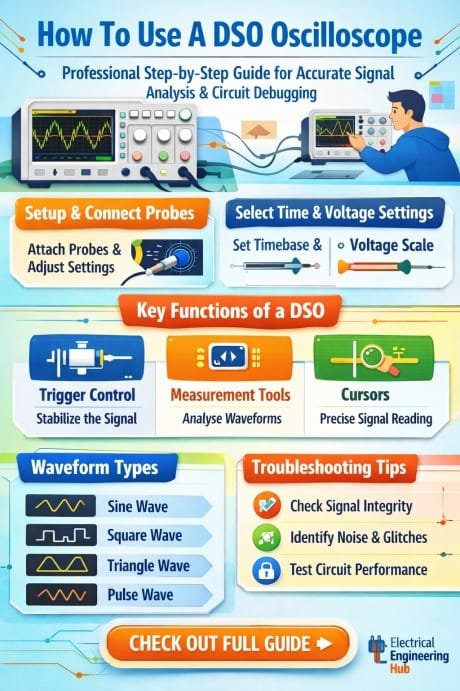
Table of Contents
Unlike older analog scopes, a DSO captures signals digitally and allows storage, analysis, and detailed measurement. This makes it highly useful in modern electronics labs, repair stations, and industrial testing environments. Learning How To Use A DSO Oscilloscope correctly ensures better accuracy and reduces the risk of misinterpretation during diagnostics.
Find the Best Oscilloscope For Automotive Use
Understanding the Basic Interface and Controls
Before starting measurements, it is important to understand the oscilloscope interface. A typical DSO includes a display screen, vertical controls, horizontal time base, trigger settings, and input channels. Each control plays a specific role in shaping how signals are viewed.
When practicing How To Use A DSO Oscilloscope, the first step is familiarizing yourself with voltage scale adjustment and time division settings. These parameters determine how large and how fast a waveform appears on screen.
Table 1: Basic Controls Overview
| Control Section | Function | Practical Use |
|---|---|---|
| Vertical Scale | Adjusts voltage per division | Measures signal amplitude |
| Horizontal Scale | Sets time base | Observes frequency behavior |
| Trigger System | Stabilizes waveform | Locks repetitive signals |
| Input Channels | Connect probes | Reads circuit signals |
Proper understanding of these controls builds the foundation for accurate signal interpretation.
Proper Probe Connection and Grounding Techniques
Correct probe handling is critical for safe and accurate readings. Poor grounding or incorrect connection can introduce noise or distort the waveform. Standard passive probes usually have a ground clip and a signal tip, which must be connected properly to the circuit under test.
While learning How To Use A DSO Oscilloscope, it is important to always connect the ground clip to a common ground point in the circuit. This ensures a stable reference voltage and reduces measurement errors.
Explore step wise guide on How To Read Oscilloscopes
Table 2: Common Probe Types and Usage
| Probe Type | Application | Advantage |
|---|---|---|
| Passive Probe | General-purpose testing | Simple and cost-effective |
| Active Probe | High-frequency signals | Higher accuracy and bandwidth |
| Current Probe | Current measurement | No circuit interruption |
Good probing techniques help in capturing clean signals, especially when working with switching circuits or microcontroller outputs.
Setting Time Base and Voltage Parameters
After connecting the probe, the next step in How To Use A DSO Oscilloscope is adjusting the vertical and horizontal settings. The voltage scale should match the expected signal amplitude, while the time base should correspond to the frequency of the waveform.
If the waveform appears too compressed, increase the time scale. If it looks too large or clipped, adjust the voltage scale. This balance ensures proper visualization of signal characteristics such as peak voltage, duty cycle, and waveform shape.
For digital circuits, it is often necessary to zoom into microsecond or nanosecond ranges to capture fast transitions accurately.
Know more about Best Low Cost Oscilloscopes to Buy
Using Trigger Settings for Stable Waveforms
Triggering is one of the most powerful features in a DSO. It allows the oscilloscope to lock onto a specific part of the waveform, producing a stable display. Without proper triggering, the waveform may appear to drift or roll across the screen.
In How To Use A DSO Oscilloscope, selecting the correct trigger mode is essential. Common options include edge trigger, pulse trigger, and video trigger. Edge trigger is the most widely used because it synchronizes the display based on rising or falling edges of a signal.
A properly set trigger level ensures consistent waveform observation, especially when analyzing repetitive signals like clock pulses or PWM outputs.
Measuring Signals and Interpreting Waveforms
Once the display is stable, the oscilloscope can be used to measure key signal properties. These include peak-to-peak voltage, RMS value, frequency, and rise time. Modern DSOs often provide automatic measurement functions, but manual interpretation is still valuable for deeper understanding.
During How To Use A DSO Oscilloscope, it is important to observe waveform shape carefully. A distorted sine wave may indicate filtering issues, while irregular square waves can suggest timing problems in digital circuits.
Find the Best 12 Budget Oscilloscope For Beginners
Accurate interpretation helps in diagnosing faulty components, communication errors, and power supply instability.
Troubleshooting Circuits with Advanced Features
Advanced DSOs come with features like FFT analysis, storage functions, and cursors for precise measurements. These tools are extremely useful when debugging complex circuits.
In How To Use A DSO Oscilloscope, FFT mode helps analyze frequency components of a signal, which is useful in identifying noise sources or harmonics. Storage functions allow comparison of past and present waveforms, making it easier to detect intermittent faults. Know more about cathode ray oscilloscope
Cursors can be used to manually measure time differences or voltage levels between two points, providing more control over analysis compared to automatic readings.
Practical troubleshooting becomes faster when these advanced features are used correctly, especially in power electronics and communication systems.
Best Practices for Accurate and Safe Operation
Proper usage habits improve both accuracy and equipment life. Always ensure that the oscilloscope is calibrated before use. Avoid exceeding maximum input voltage limits, as this can damage the device.
Explore Top 25 Questions Regarding Usage Of Oscilloscope
When practicing How To Use A DSO Oscilloscope, it is also important to minimize probe cable length to reduce noise interference. Keeping the workspace organized and using proper grounding techniques enhances measurement reliability.
Regular calibration checks and proper storage also ensure long-term accuracy and performance.
Conclusion
Mastering How To Use A DSO Oscilloscope is essential for anyone working with electronics, from beginners to professionals. With proper understanding of controls, probes, triggering, and measurement techniques, it becomes easier to analyze complex signals and diagnose circuit problems efficiently. Consistent practice improves accuracy and builds confidence in waveform interpretation, making the oscilloscope an indispensable tool in modern electronic troubleshooting.
Know more about How To Choose An Oscilloscope
Get new guides in your feed. Follow Electrical Insights on LinkedIn for new electrical standards guides, calculators and design tips from Azad Circuit Hub.
#HowToUseADSOscilloscope,#DSOOscilloscope,#OscilloscopeTutorial,#ElectronicsTesting,#SignalAnalysis,#WaveformMeasurement,#ElectronicDiagnostics,#ScopeProbes,#CircuitTroubleshooting,#EngineeringTools